
For Your Healthcare Provider
Have your patient scan this QR code with their smartphone camera to instantly access this educational guide on their device.

A guide for patients with abnormal iron tests
Access the Resources
Note: The video and audio linked above were generated with the assistance of AI. Clinical accuracy has been reviewed, but no AI-generated content can be guaranteed to be fully error-free.
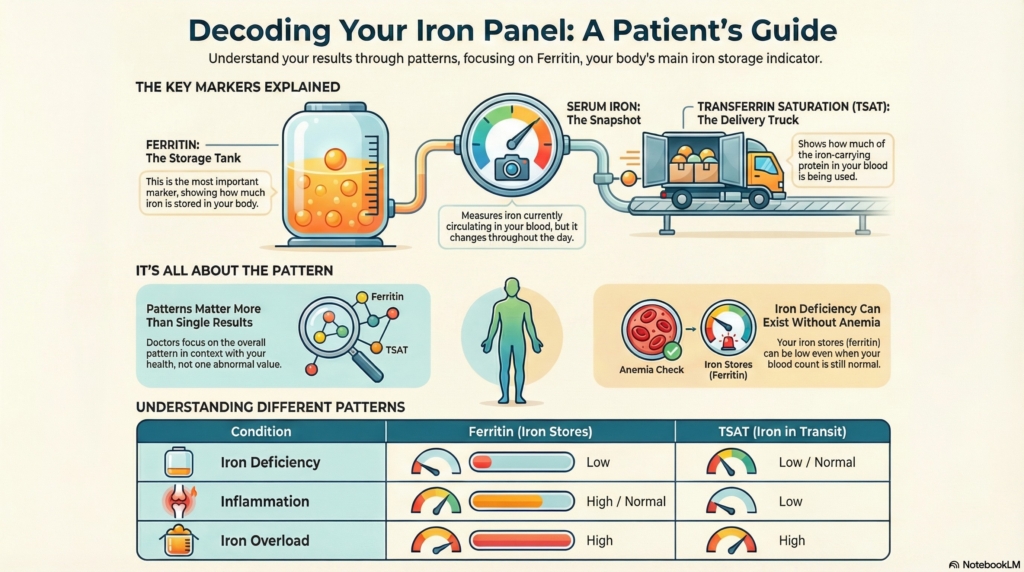
Opening overview
Iron tests are commonly ordered to evaluate iron levels in the body. Seeing multiple numbers—iron, ferritin, transferrin, or saturation—can be confusing, especially when some are marked “abnormal.”
Doctors do not interpret these tests one by one. Instead, they look for patterns, with special emphasis on ferritin, which reflects iron stores in the body.
First things first
Not all iron tests are equally important.
Although several values appear together on an iron panel, ferritin is the single most useful marker for determining whether iron deficiency is present. Other tests add context but are more variable and easier to misinterpret.
Iron tests are always interpreted alongside symptoms, hemoglobin level, and overall health.
What is ferritin?
Ferritin reflects iron stored in the body.
When ferritin is low, iron stores are low. When ferritin is normal or high, absolute iron deficiency is unlikely.
Key points about ferritin:
- very low ferritin strongly supports iron deficiency
- the lower the ferritin, the more likely true iron deficiency is present
- ferritin can rise with inflammation, infection, or recent iron treatment
- ferritin can also be elevated in iron overload conditions such as hereditary hemochromatosis
Because ferritin responds to both iron stores and inflammation, doctors interpret it in clinical context.
Ferritin reference ranges vary by laboratory and are often different for men and women, so your doctor interprets your result in your clinical context.
What is serum iron?
Serum iron reflects iron circulating in the blood at that moment.
It does not measure iron stores.
Serum iron:
- changes throughout the day
- rises and falls based on recent meals
- can appear normal even when iron stores are depleted
For this reason, serum iron alone is not reliable for diagnosing iron deficiency.
What are transferrin and transferrin saturation (TSAT)?
Transferrin is a protein that carries iron in the bloodstream.
Transferrin saturation (TSAT) reflects how much of that carrier is filled with iron.
Some labs report TIBC (total iron-binding capacity) instead of transferrin.
These tests reflect similar information about iron-carrying capacity.
TSAT can be helpful in some situations, but it fluctuates and must be interpreted carefully.
A low TSAT does not automatically mean iron deficiency, especially if ferritin is normal.
Doctors often use TSAT to:
- understand iron availability
- recognize patterns related to inflammation
- assess iron balance after treatment
- help evaluate iron overload conditions, such as hereditary hemochromatosis
When ferritin and TSAT point in different directions, doctors look at patterns over time and the overall clinical picture rather than any single value. For example, during infection or inflammation, ferritin may be normal or high while TSAT is low, because the body temporarily makes less iron available.
Why iron tests can look confusing
Iron studies are influenced by many factors, including:
- recent meals
- time of day
- inflammation or infection
- recent intravenous iron treatment
Because of this, it is common for one value to look “off” while others are reassuring.
Doctors focus on patterns, not isolated numbers.
Iron tests and hemochromatosis
Iron studies are also used to evaluate iron overload conditions, such as hereditary hemochromatosis.
In this setting, doctors focus on a different pattern than they do for iron deficiency.
Key differences:
- ferritin reflects iron burden over time
- transferrin saturation (TSAT) reflects how much iron is circulating and available
- persistently high TSAT is often an early clue to iron overload
In people with hemochromatosis:
- ferritin may be normal early on
- TSAT may be elevated even before ferritin rises
- iron deficiency and iron overload can occasionally coexist
Because of this, iron studies are always interpreted in clinical context, sometimes alongside genetic testing and family history.
If you are being monitored for hemochromatosis, your doctor will guide you on which numbers matter most and how often they should be checked.
Iron tests and inflammation
Iron studies can reflect inflammation, not just iron deficiency.
A common inflammatory pattern includes:
- higher ferritin
- low serum iron
- low transferrin saturation
This pattern does not necessarily mean iron overload or iron deficiency. It often reflects how the body handles iron during illness or chronic inflammation. In these situations, ferritin may be normal or high even when the body has low ‘usable’ iron, which is why your doctor may focus on symptoms, hemoglobin, and the overall pattern when deciding next steps.
Iron deficiency without anemia
Iron deficiency can exist even when hemoglobin is normal.
Some people develop low iron stores before anemia appears. In these cases:
- ferritin may be low
- hemoglobin may still be normal
This is why iron studies are sometimes checked even when blood counts look reassuring.
After iron treatment
Ferritin often rises significantly after intravenous iron.
This is expected. Levels gradually fall and stabilize over time as iron is distributed and used. A temporarily high ferritin after treatment does not mean iron overload.
When should I contact my doctor?
Contact your doctor if you have ongoing or worsening symptoms, including:
- ongoing symptoms of iron deficiency
- worsening fatigue, shortness of breath, or dizziness
- questions about iron treatment or follow-up testing
If your doctor has recommended monitoring, it is reasonable to wait for repeat testing before drawing conclusions.
What is the usual plan going forward?
For most people, iron tests are followed over time rather than acted on immediately.
This may include:
- repeat testing.
- treating an underlying cause.
- monitoring response to iron therapy.
Doctors rarely base decisions on a single iron value.
Key takeaways
- ferritin best reflects iron stores, not serum iron
- serum iron fluctuates and does not reliably reflect iron stores
- patterns over time matter more than a single lab result
- iron deficiency can exist without anemia
- temporary lab changes after iron treatment are expected
For clinicians: Read our detailed guide on how to communicate about iron tests to patients.