
For Your Healthcare Provider
Have your patient scan this QR code with their smartphone camera to instantly access this educational guide on their device.

A brief guide for patients reviewing white blood cell results
Access the Resources
Note: The video and audio linked above were generated with the assistance of AI. Clinical accuracy has been reviewed, but no AI-generated content can be guaranteed to be fully error-free.
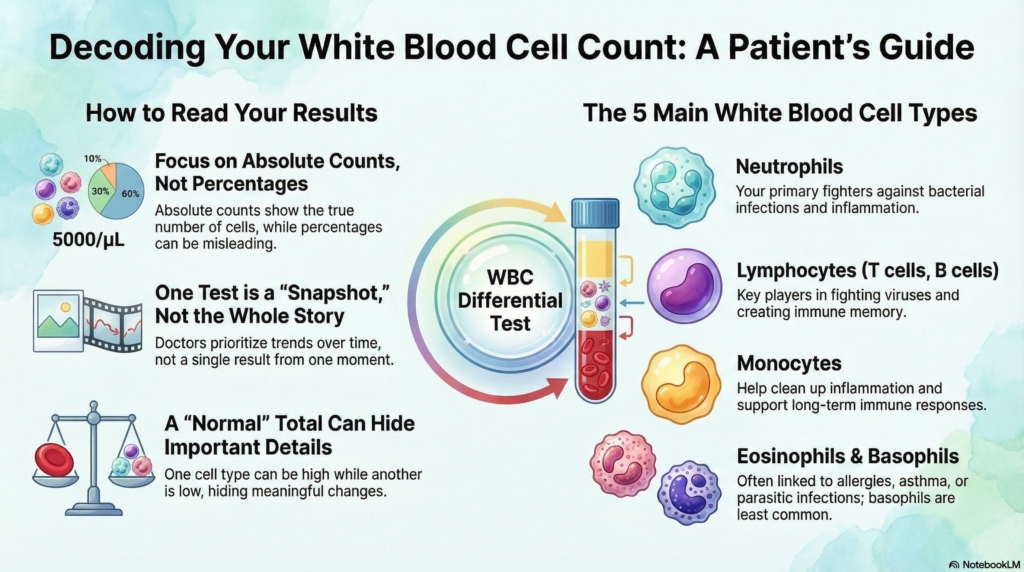
Opening overview
A white blood cell differential is a blood test that breaks down your total white blood cell count into different types of white blood cells.
Seeing a long list of cell names and percentages can be confusing, especially when some numbers are marked “abnormal.” Most changes are mild, temporary, and not dangerous. Doctors use the white blood cell differential to understand patterns in immune activity, not to make a diagnosis based on a single number.
What is the white blood cell differential?
The total white blood cell count tells how many white cells are present overall.
The differential shows which kinds of white blood cells make up that total. It usually includes five main types:
- neutrophils
- lymphocytes
- monocytes
- eosinophils
- basophils
Each type plays a different role in the immune system. Looking at them separately helps doctors understand what the body may be responding to.
Why the total white blood cell count isn’t the whole story
Doctors often think of the total white blood cell count (which is part of the CBC) as a summary number.
A helpful way to think about the differential is lifting the hood of a car.
The total white count is like a dashboard light — it signals attention.
The differential shows what’s actually happening underneath.
It’s possible to have:
- a normal total white count with an abnormal differential, or
- an abnormal total white count with reassuring underlying patterns
This is why doctors rarely interpret the total white count without also looking at the differential.
Percentages vs absolute counts: what matters most
The differential often reports both:
- percentages (for example, “60% neutrophils”), and
- absolute counts (the actual number of each cell type)
Absolute counts are far more important than percentages.
Percentages can be misleading because they depend on the total white count. A percentage may look low or high even when the absolute number is completely normal.
Doctors focus on absolute counts because they reflect how many cells are truly available to do their job.
The five main white blood cell types (at a glance)
Neutrophils
Help fight bacterial infections and respond to inflammation.
Low or high levels are common during illness, stress, or recovery.
Lymphocytes
Include T cells, B cells, and natural killer cells.
They are involved in viral responses, immune memory, and some chronic immune conditions.
Monocytes
Help clean up inflammation and support longer-term immune responses.
Mild increases are common during recovery from infection.
Eosinophils
Often associated with allergies, asthma, skin conditions, or parasitic infections.
Mild elevations are common and often benign.
Basophils
The least common white blood cell type.
Small changes are usually not clinically significant.
Doctors interpret these cells together, not in isolation.
Why a normal white blood cell count can still need explanation
Because the total white count is the sum of all five cell types, different changes can cancel each other out.
For example, one white cell type may be lower than usual while another is higher, resulting in a normal total white count despite meaningful changes underneath.
This is another reason the differential is important, even when the total white blood cell count looks normal.
When doctors pay closer attention
Doctors become more attentive when patterns suggest something more than a temporary change, such as when:
- absolute counts are very low or very high
- changes persist over time
- multiple blood counts are abnormal
- new or concerning symptoms are present
Most mild or temporary changes resolve on their own and do not require treatment.
Snapshot vs movie
A white blood cell differential is a snapshot of your immune system at one moment in time.
Doctors place far more weight on:
- trends over time
- symptoms
- the overall clinical context
This is why repeat testing is common and often reassuring.
How this page fits with the rest of your results
This page explains how doctors think about white blood cell differentials in general.
If a specific cell type is persistently abnormal, your doctor may point you to more focused information on topics such as neutropenia, lymphocytosis, eosinophilia, or other specific findings. Each of those topics builds on the same principles outlined here.
Key takeaways
- what the test shows: the white blood cell differential breaks down the total count into cell types
- what matters most: absolute counts are more important than percentages
- why totals can mislead: a normal white count can still hide important patterns
- overall reassurance: most changes are mild, temporary, and not dangerous
- how doctors think: trends over time matter more than a single result
For clinicians: Read our detailed guide on how to communicate about the WBC differential.