
For Your Healthcare Provider
Have your patient scan this QR code with their smartphone camera to instantly access this educational guide on their device.

A guide for individuals with sickle cell trait
Access the Resources
Note: The video and audio linked above were generated with the assistance of AI. Clinical accuracy has been reviewed, but no AI-generated content can be guaranteed to be fully error-free.
Sickle cell trait means you carry one copy of the sickle hemoglobin gene, but you do not have sickle cell disease.
Most people with sickle cell trait live healthy, normal lives and never develop complications.
Sickle cell trait mainly matters for family planning and in a few extreme conditions, where simple precautions (hydration, pacing, rest breaks, acclimatization) help keep you safe.
This guide applies to outpatient counseling and general health considerations for sickle cell trait.
This guide applies to outpatient counseling and general health considerations for sickle cell trait.
First things first
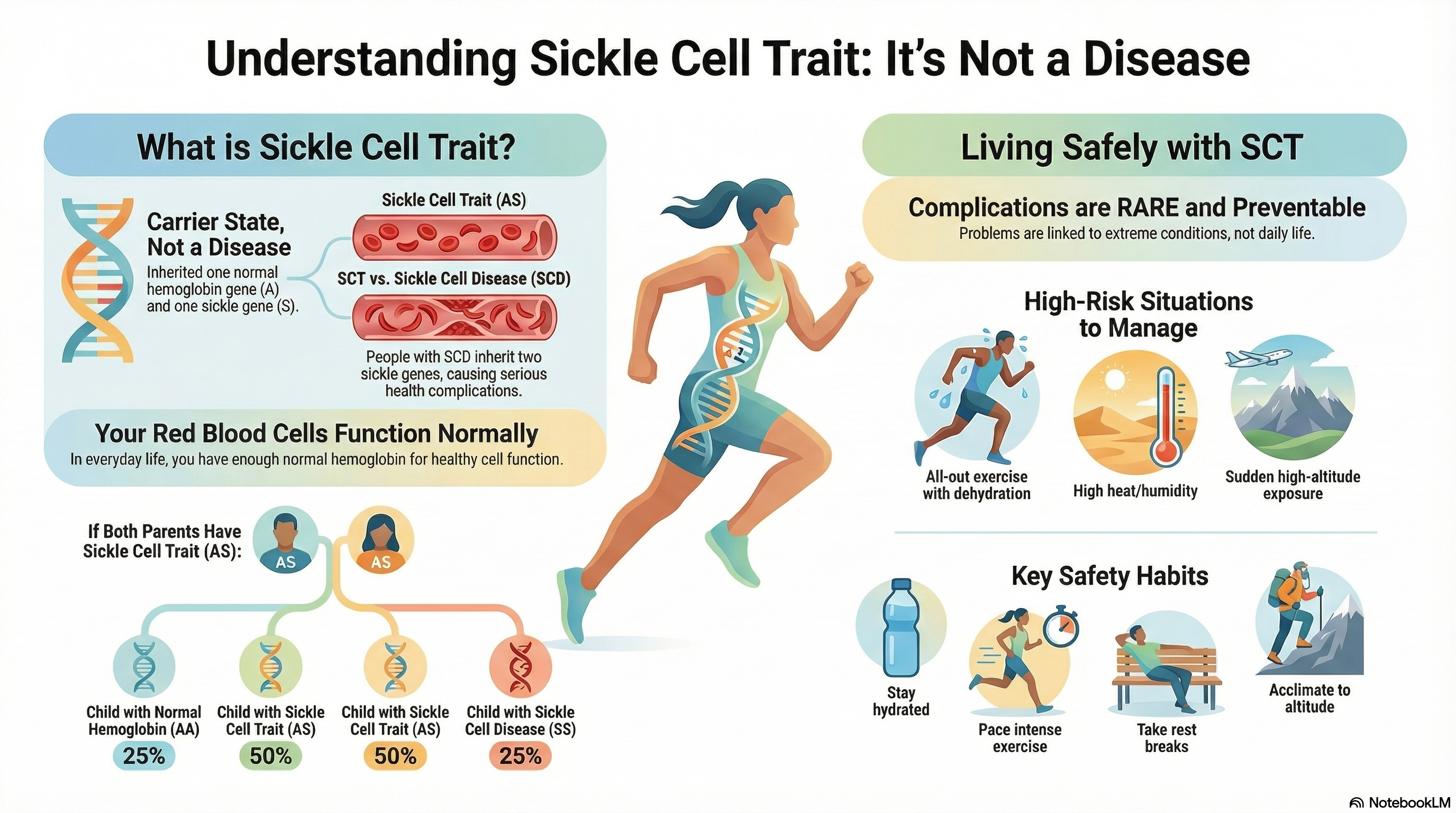
Sickle cell trait is not a disease. It means you inherited one normal hemoglobin gene (A) and one sickle gene (S). People with sickle cell disease usually inherit two genes that cause sickling (for example, SS, or combinations that behave like SS). Because you have only one sickle gene, your red blood cells usually behave normally and do not cause the complications seen in sickle cell disease.
Many people learn they have sickle cell trait from:
- newborn screening (standard in many countries)
- screening for school or college athletics
- military entrance testing
- pregnancy or fertility testing
- routine blood work
These programs test so that people with sickle cell trait can receive education and prevention advice, not to limit opportunities.
What is sickle cell trait?
Hemoglobin is the protein inside red blood cells that carries oxygen. You have two copies of the gene that provides instructions for hemoglobin, one from each parent. In sickle cell trait, one gene makes normal hemoglobin A and the other makes hemoglobin S.
Sickle cell trait is a carrier state, meaning you can pass the sickle gene to your children, but you do not have the disease yourself. Under usual conditions, you have enough hemoglobin A for red blood cells to stay round and flexible. The sickle gene becomes most important:
- when you are planning a family
- in extreme conditions, such as very intense exercise combined with dehydration, overheating, illness, or very high altitude
Why it happens (causes)
Sickle cell trait is inherited. You were born with one sickle hemoglobin gene and one normal gene. This pattern is more common in people whose families come from areas where malaria was or is common, because carrying one sickle gene provides some protection against severe malaria. Sickle cell trait can occur in people of many backgrounds.
If you have sickle cell trait, each of your children has, on average:
- a 50% chance of inheriting sickle cell trait
- a 25% chance of having normal hemoglobin
- a 25% chance of having sickle cell disease if the other parent also carries a sickle gene or certain related hemoglobin genes
Because of this, your clinician will usually recommend partner testing, and may suggest genetic counseling, when you are planning a pregnancy or are already pregnant.
Does it cause symptoms?
Most people with sickle cell trait have no day-to-day symptoms and feel completely well. Sickle cell trait does not cause the pain crises, chronic anemia, or organ damage associated with sickle cell disease.
Rare symptoms or complications may occur mainly in extreme conditions, especially when multiple stressors occur together (for example, intense exertion plus heat plus dehydration). Examples include:
- exertional problems (collapse, severe weakness, or muscle injury), usually during unusually intense, sustained exertion without adequate rest or hydration
- high-altitude problems, sometimes with left upper abdominal pain (see below)
- blood in the urine (hematuria), usually painless and intermittent
These events are uncommon, and risk is greatly reduced by smart precautions and stopping activity early if warning signs appear.
Is it dangerous?
For most people, sickle cell trait is not dangerous, and life expectancy is normal. The main health considerations are uncommon and usually situation-specific:
Exercise, heat, and dehydration
Very rare events have occurred during extremely intense exertion without adequate rest or hydration, particularly in hot conditions. Risk is much lower when people build up gradually, take rest breaks, stay well hydrated, avoid overheating, and stop promptly when symptoms begin.
High altitude
Most people with sickle cell trait travel safely to moderate altitudes, and many live and work at elevations around 5,000–8,000 feet without problems. The rare concern is rapid ascent to very high altitude (often above about 10,000 feet), especially when combined with immediate intense exertion before acclimatizing. In that setting, some people develop splenic infarction, which can cause left upper abdominal pain. This needs medical evaluation, and most people recover fully with appropriate care, including rest and often descent to a lower altitude.
Kidney and urinary issues
Some people with sickle cell trait experience painless blood in the urine (hematuria), sometimes triggered by dehydration or exercise. This should always be evaluated because there are many possible causes, even though sickle cell trait can be one explanation. Some people also have mild difficulty concentrating urine and may urinate more often, including at night. More serious kidney problems are uncommon.
How your doctor evaluates it
Evaluation for sickle cell trait may include:
- reviewing newborn screening results or prior lab work
- confirming the diagnosis with hemoglobin electrophoresis or similar tests
- asking about your personal and family history of hemoglobin disorders
- reviewing your history of exercise, heat exposure, altitude travel, and any episodes of fainting, collapse, or severe cramps during exertion
- asking about blood in the urine or frequent nighttime urination
- discussing pregnancy plans and partner testing
Your doctor may refer you to a hematologist or genetic counselor if there are questions about your results, family planning, or rare complications.
How is it treated
Sickle cell trait itself does not require treatment because it is not a disease. Care focuses on:
- education about situations where sickle cell trait matters
- prevention of rare complications (especially with intense exercise, heat, dehydration, or very high altitude)
- evaluation and management of issues such as blood in the urine or high-altitude pain, if they occur
If symptoms develop during intense exercise or at altitude, treatment may include rest, hydration, oxygen when needed, and checking for muscle injury or other causes.
Daily life and self-care
For day-to-day life, most people with sickle cell trait can live without restrictions.
Helpful habits include:
- staying well hydrated, especially during sports, hot weather, or illness
- building up intense exercise gradually, rather than jumping into all-out workouts
- taking regular rest breaks during hard training, and avoiding “push through at all costs” expectations
- stopping exercise right away if you develop unusual muscle pain, severe cramps, chest pain, feeling faint, or extreme weakness
- acclimating gradually to high altitude, and avoiding sudden intense exertion on the first days at very high elevations
- telling coaches, athletic trainers, or military medical staff that you have sickle cell trait so they can support safe training practices
People with sickle cell trait participate successfully in demanding sports, jobs, and military roles. Sickle cell trait is generally not a reason to avoid or be excluded from activities. The focus is on smart precautions.
If you are pregnant, tell your obstetric team you have sickle cell trait. There may be a slightly higher risk of urinary tract infections, and some studies suggest a slightly higher risk of pregnancy complications such as preeclampsia, but most pregnancies in people with sickle cell trait proceed normally with routine prenatal care. Your baby should be tested after birth through newborn screening.
When should I contact my doctor?
Contact your clinician if you experience:
- collapse, near-collapse, chest pain, or unusual shortness of breath during intense exercise
- severe muscle pain or cramps during exertion that does not improve with rest and hydration
- blood in your urine, even if painless or intermittent
- new or worsening trouble at high altitude, especially left upper abdominal pain, chest pain, or severe shortness of breath
- questions about pregnancy, partner testing, or the chance of having a child with sickle cell disease
Seek emergency care if you develop severe symptoms during extreme exertion, heat exposure, or high-altitude travel.
What is the usual plan going forward?
Your clinician will:
- confirm sickle cell trait with appropriate hemoglobin testing
- review your personal and family history, including exercise, heat, and altitude exposures
- discuss exercise and heat safety (hydration, pacing, rest breaks, early stopping with symptoms)
- review travel plans that might involve very high altitude and how to acclimate safely
- discuss family planning, including partner testing and genetic counseling when helpful
- provide guidance about when to seek care for blood in the urine or other symptoms
Most people do not need regular follow-up just for sickle cell trait. Follow-up is usually as needed for questions, new symptoms, or family-planning discussions.
If questions ever come up about disclosure, athletics, school, military service, or legal protections related to sickle cell trait, you may find it helpful to review our separate educational resource on advocacy and rights.
Learn more about sickle cell trait, advocacy, and your rights (U.S.-focused).
Making sense of it
Think of your hemoglobin genes as two instruction books for making the protein that carries oxygen.
With sickle cell trait, one book has the usual instructions and the other has the sickle version, but the normal book provides enough guidance for your red blood cells to work well in everyday life.
The second book matters mainly in extreme conditions or when you are planning for children.
Sickle cell trait means you carry one sickle gene but do not have sickle cell disease. Your red blood cells work normally most of the time, and you can live a full, active life. Sickle cell trait becomes important when you are doing very intense exercise, traveling to very high altitude, or planning a pregnancy, where simple precautions and partner testing can help keep you and your family safe.
Key takeaways
- not a disease: sickle cell trait is not sickle cell disease, most people stay healthy throughout life
- rare risks in extremes: uncommon problems can occur with all-out exertion, heat, dehydration, illness, or very high altitude
- hematuria matters: blood in the urine can happen and should always be evaluated
- family planning: partner testing helps clarify the chance of having a child with sickle cell disease
- simple precautions help: hydration, pacing, rest breaks, and acclimatization greatly reduce risk
- full participation: most people can safely take part in sports, travel, and demanding work with smart precautions
For clinicians: Read our detailed guide on how to communicate about SCT to patients.