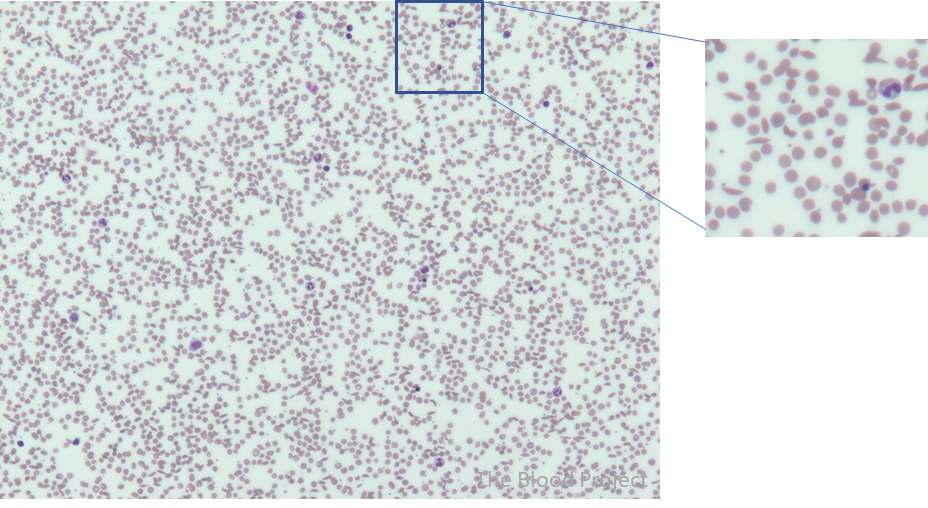
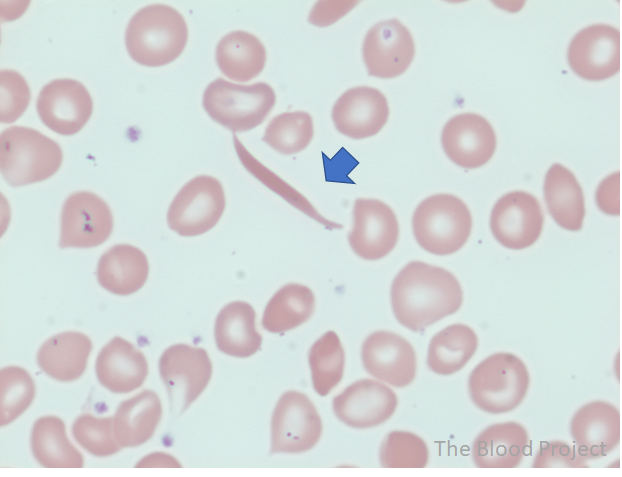
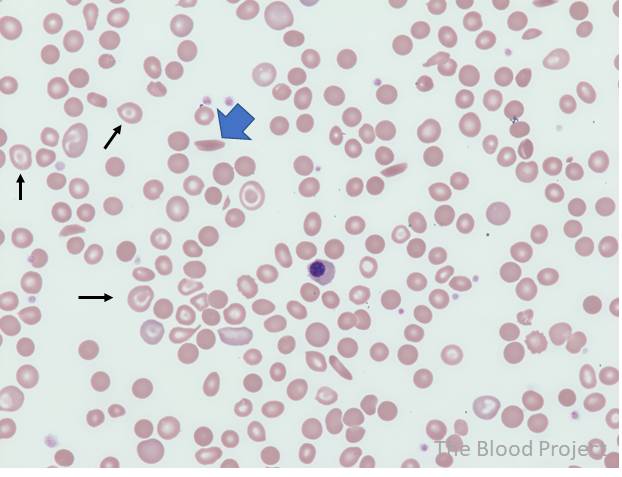
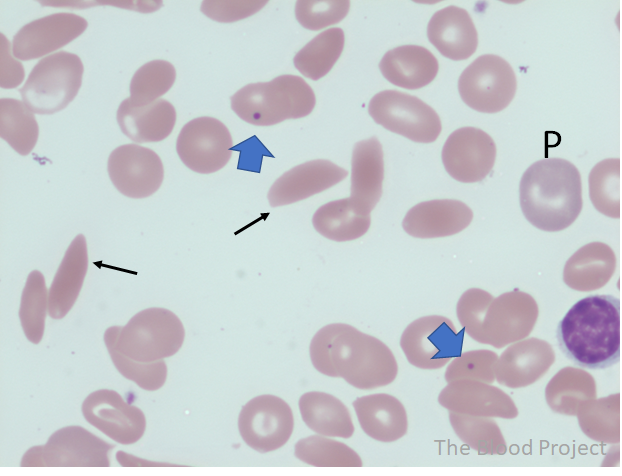
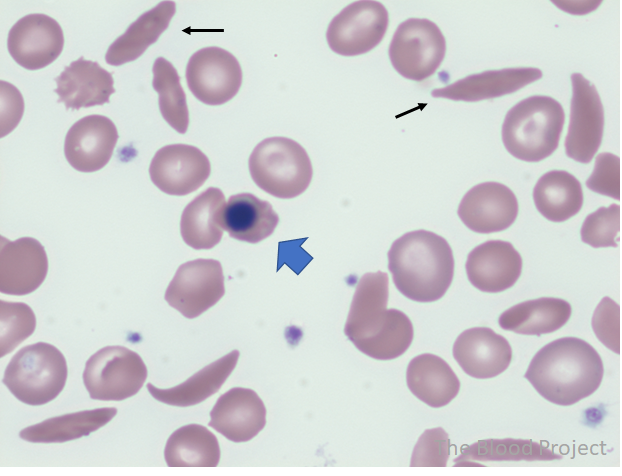
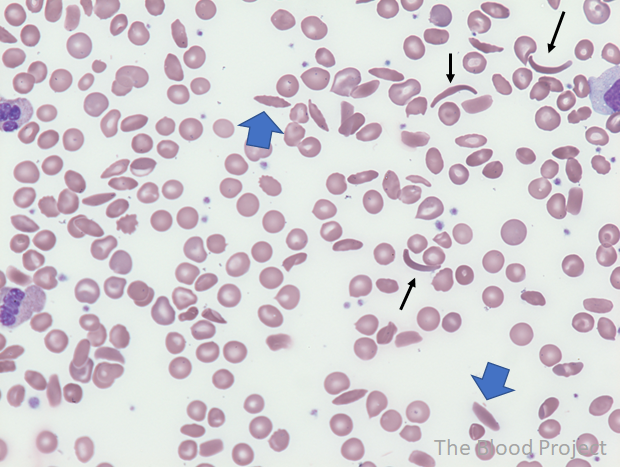
| Red blood cell, shape abnormality | Sickle cell and boat-shaped cell |
| Also known as | Drepanocyte |
| Definition | Sickle cells are elongated, sometimes crescent-shaped red cells with pointed ends. Boat-shaped cells have the appearance of a canoe viewed from above with sharpened ends. They lack central pallor, and stain deeply. Typically 10-15 um in length with width narrower than normal cells. |
| Conditions associated with the shape abnormality | Sickle cell disease, for example HbSS, HbSC |
| Mechanism of formation | Shape change caused by the polymerization/gelation of deoxygenated hemoglobin S |
| Other findings | Deoxy HbS may also result in crescent-shaped, filament-shaped, holly-leaf form, or envelope cells. These cells usually lack central pallor; polychromatophilic RBCs, target cells, Howell-Jolly bodies. |
| History | SCD was first described by James Herrick in 1910. Herrick noted the “sickle”-shaped red cells on the peripheral smear. |
| Source/author | William Aird |
| Reviewed and edited by | Parul Bhargava |
| References | Herrick JB. Peculiar elongated and sickle-shaped red blood corpuscles in a case of severe anemia. Arch Int Med 1910;6:517 |