
The contact system is the initial trigger of the intrinsic pathway of coagulation and plays a pivotal role in in vitro clotting assays (like the aPTT), inflammatory signaling, and host defense, though its role in in vivo hemostasis is limited.
What Is the Contact System?
The contact system involves a group of plasma proteins that become activated when blood contacts negatively charged surfaces (like glass, kaolin, or exposed subendothelial collagen). It plays a central role in initiating the intrinsic pathway of blood coagulation and activating proinflammatory responses. Key players include:
| Protein | Also Known As | Function |
|---|---|---|
| Factor XII | Hageman factor | Initiates the contact system cascade |
| Prekallikrein (PK) | Fletcher factor | Converts to kallikrein, amplifies XII activation |
| High-Molecular-Weight Kininogen (HMWK) | Fitzgerald factor | Cofactor for activation reactions |
| Factor XI | – | Activated by XIIa; links to thrombin generation |
About the Eponyms
- John Hageman (Hageman Factor = Factor XII)
- Who: John Hageman was a patient with prolonged clotting time (prolonged aPTT) but no bleeding symptoms.
- Discovery: In 1955, his blood was found to lack what became known as Factor XII, later named Hageman factor.
- Significance: Helped define the beginning of the intrinsic coagulation pathway, even though FXII deficiency doesn’t cause bleeding.
- Legacy: FXII is now known more for its role in thrombosis, inflammation, and contact activation than in hemostasis.
- Mr. Fletcher (Fletcher Factor = Prekallikrein)
- Who: The Fletcher family was described in the 1960s when members showed prolonged aPTT but again no bleeding tendency.
- Discovery: The family lacked what was eventually identified as prekallikrein, an important protein in the contact system.
- Significance: Helped define the role of kallikrein in amplifying FXII activation and releasing bradykinin.
- Mrs. Fitzgerald (Fitzgerald Factor = High-Molecular-Weight Kininogen, HMWK)
- Who: Mrs. Fitzgerald was a patient with a prolonged aPTT and no bleeding disorder.
- Discovery: She was found to lack HMWK, a cofactor essential for the activation of FXI and prekallikrein by FXIIa.
- Significance: Her case led to the identification of HMWK as a critical component of the contact system, and as the precursor to bradykinin.
For larger image, click here.
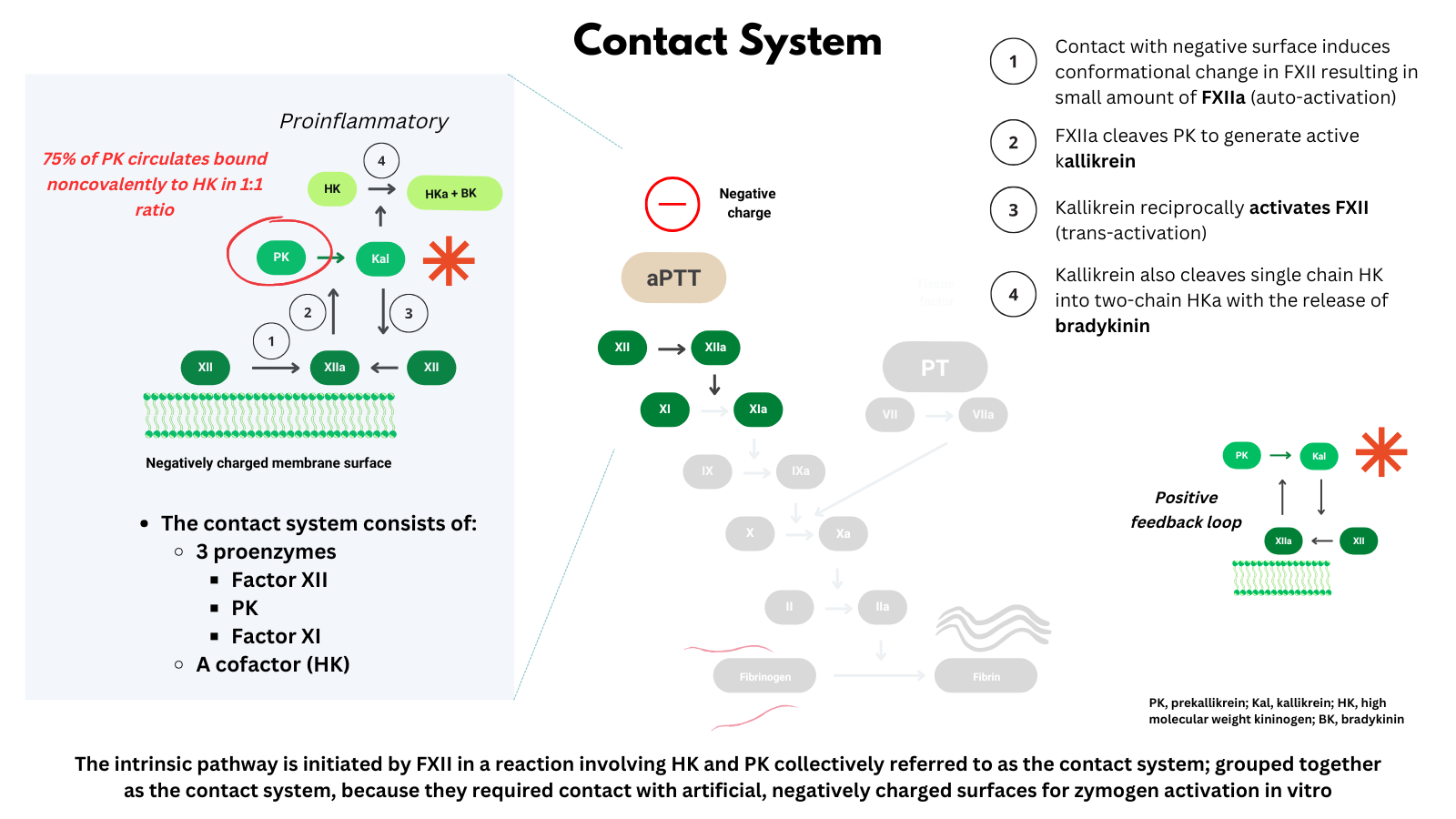
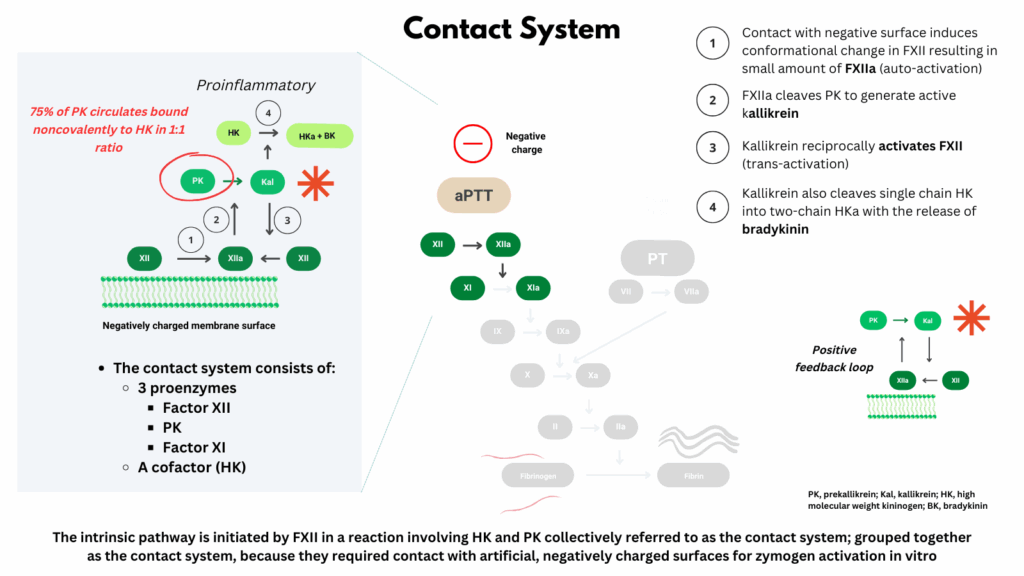
Contact system. Contact of Factor XII with a negatively charged surface induces a conformational change, resulting in the generation of a small amount of activated Factor XII (Factor XIIa) through a process known as auto-activation. Factor XIIa then cleaves prekallikrein to produce active kallikrein, which in turn amplifies the activation of additional Factor XII in a process called trans-activation. Concurrently, kallikrein cleaves high-molecular-weight kininogen (HMWK), releasing bradykinin, a potent vasodilator and pro-inflammatory mediator. This cascade forms a positive feedback loop in which Factor XIIa generates kallikrein, and kallikrein accelerates the formation of more Factor XIIa, linking the contact activation system to both coagulation and inflammation.
Step-by-Step Activation
- Contact Activation
- Initiated when blood contacts negatively charged surfaces, either artificial (such as glass or certain laboratory reagents) or natural (such as phospholipids, polyphosphate from platelets, or cell membranes)
- Upon activation, FXII is converted to FXIIa (FXII autoactivates to FXIIa).
- Coagulation Link
- FXIIa activates FXI → FXIa.
- FXIa activates FIX, leading into the intrinsic coagulation pathway and ultimately thrombin generation.
- Amplification
- FXIIa converts prekallikrein → kallikrein.
- Kallikrein further activates more FXII (positive feedback loop).
- HMWK acts as a scaffold and cofactor in these reactions.
- Bradykinin Release
- Kallikrein cleaves HMWK → bradykinin, a potent vasodilator and inflammatory mediator.
Role in Hemostasis
- In vitro (lab setting):
- Essential for aPTT prolongation.
- Explains why FXII deficiency causes prolonged aPTT despite no bleeding.
- In vivo (human physiology):
- Surprisingly not essential for normal hemostasis:
- Congenital deficiencies of FXII, prekallikrein, or HMWK do not cause bleeding.
- Mice lacking contact system proteins still form clots.
- The system is prothrombotic rather than hemostatic.
- Surprisingly not essential for normal hemostasis:
Role in Inflammation and Thrombosis
- The contact system links coagulation, inflammation, and innate immunity.
- Through bradykinin, it contributes to:
- Vasodilation
- Increased vascular permeability
- Pain and hypotension
- Implicated in:
- Sepsis
- Hereditary angioedema
- Thrombosis
Clinical Implications
| Condition | Contact Factor | Clinical Relevance |
|---|---|---|
| FXII deficiency | ↓ FXII | Prolonged aPTT, no bleeding |
| Prekallikrein deficiency | ↓ PK | Very prolonged aPTT, no bleeding |
| HMWK deficiency | ↓ HMWK | Rare, prolonged aPTT, no bleeding |
| Hereditary angioedema | Dysregulation of kallikrein–bradykinin | Episodic edema, treated by inhibiting kallikrein |
Summary
- The contact system initiates in vitro intrinsic pathway.
- Key proteins: FXII, PK, HMWK, FXI.
- Crucial for lab-based clotting tests, but dispensable for in vivo bleeding control.
- Important in inflammation, thrombosis, and diseases like hereditary angioedema.