
Replacing what is missing
Note: The video and audio linked above were generated with the assistance of AI. Clinical accuracy has been reviewed, but no AI-generated content can be guaranteed to be fully error-free.
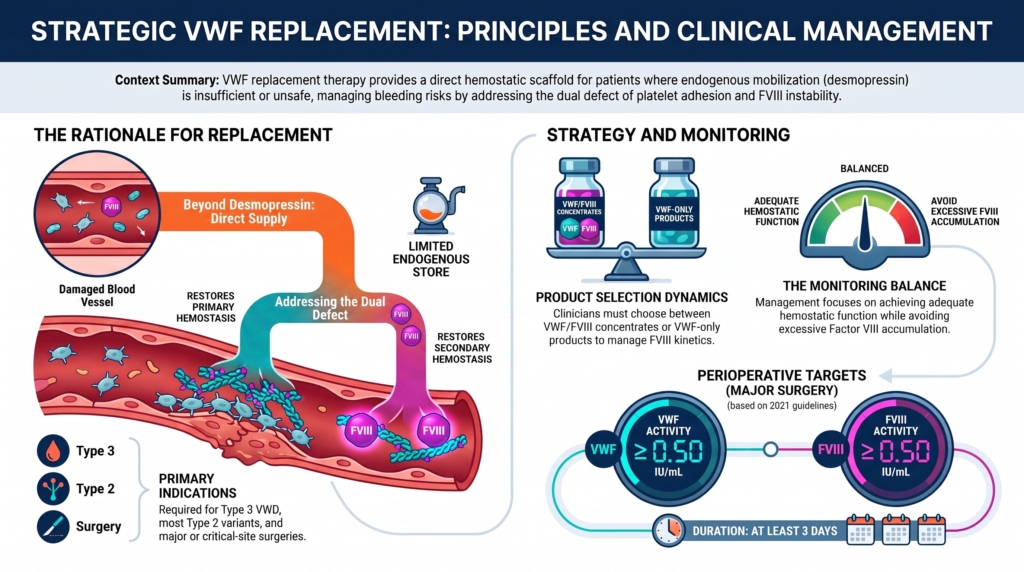
Why this spoke matters
Desmopressin borrows from the endothelium.
Replacement therapy does something different: it supplies von Willebrand factor from outside the patient.
That distinction matters. Desmopressin works only when there is stored, releasable, functional VWF. Replacement therapy is needed when that strategy is insufficient: when endogenous VWF is absent, dysfunctional, unsafe to mobilize, too short-lived after release, or inadequate for the hemostatic challenge.
VWF replacement is therefore not simply “stronger desmopressin.”
It is a different therapeutic strategy.
The clinician is no longer asking the patient’s endothelium to release reserve. The clinician is providing the missing hemostatic scaffold directly.
How to read this essay
Unlike desmopressin, which temporarily mobilizes endogenous VWF from endothelial stores, VWF replacement therapy supplies exogenous VWF when endogenous release is absent, insufficient, unsafe, or too short-lived.
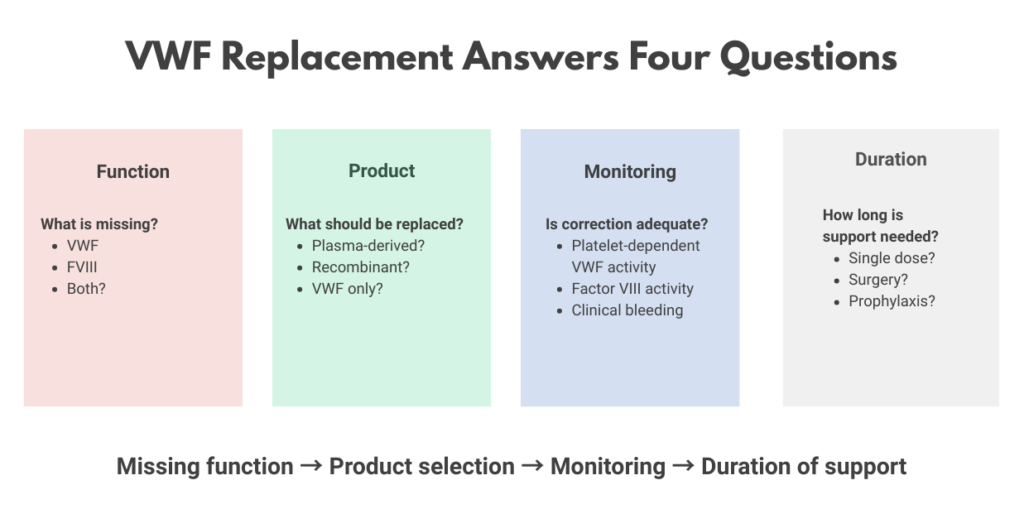
As you read, ask four questions:
- What hemostatic function needs to be replaced?
- Which VWF product best fits the clinical challenge?
- How long must hemostatic support be maintained?
- How will treatment be monitored to balance bleeding prevention with unnecessary overcorrection?
The goal is not simply to replace VWF. It is to restore the right hemostatic function, for the right duration, in the right patient.
What is being replaced
VWD has two linked hemostatic defects.
The first is primary hemostasis. VWF helps platelets adhere to injured vessel wall, especially under flow.
The second is secondary hemostasis. VWF stabilizes factor VIII in circulation. When VWF is absent or abnormal, FVIII may fall because it is no longer adequately protected.
Replacement therapy may therefore need to address both:
- the VWF defect
- the FVIII consequence
This is why VWD replacement is not identical to hemophilia A replacement. In hemophilia A, FVIII is the primary missing protein. In VWD, FVIII may be low because VWF is missing, abnormal, or unable to bind FVIII.
Replacing VWF can restore primary hemostasis and, over time, stabilize circulating endogenous FVIII. Some products also contain FVIII. Others contain VWF alone.
That difference matters.
When replacement is needed
Replacement therapy is most clearly needed when desmopressin is not a reasonable or sufficient strategy.
Common settings include:
- type 3 VWD
- many type 2 variants
- severe type 1 VWD
- type 1C or accelerated clearance with inadequate duration
- major surgery
- critical-site surgery
- severe bleeding
- recurrent gastrointestinal bleeding
- long-term prophylaxis in selected patients
- desmopressin contraindication
- desmopressin nonresponse
- desmopressin response that is too short for the challenge
Virus-inactivated plasma-derived VWF/FVIII concentrates, VWF-only products, and recombinant VWF are used when desmopressin is ineffective, unsafe, or inadequate, especially in severe type 1, type 2, type 3 disease, major surgery, severe bleeding, or when prolonged treatment is required.1
The reason for replacement should always be explicit. Replacement is not used simply because the number is low. It is used because a specific bleeding risk requires a level and duration of hemostatic support that endogenous release cannot reliably provide for the required duration.
Plasma-derived VWF/FVIII concentrates
For many years, replacement therapy has relied on plasma-derived concentrates containing VWF and variable amounts of FVIII.
These products can correct both the primary VWF defect and the associated FVIII deficiency. That dual correction is useful, especially when immediate FVIII support is needed.
But products differ. They vary in VWF content, FVIII content, VWF ratio, VWF activity, multimer composition, viral inactivation method, availability, labeling, and approved indications.
These differences are clinically relevant. Dosing by FVIII units may deliver different amounts of VWF depending on the product. Dosing by VWF activity may deliver different amounts of FVIII.
Replacement therapy is therefore not fully interchangeable across products.
The product is not just a brand.
It is a biologic preparation with its own VWF/FVIII composition.
VWF-only replacement
A newer therapeutic idea is to replace VWF without FVIII.
This may sound incomplete at first, but the logic is strong. If the patient can produce FVIII, then supplying VWF may stabilize endogenous FVIII after infusion. This approach aims to correct the primary defect while allowing the patient’s own FVIII to rise secondarily.
VWF-only replacement may be especially attractive when repeated dosing is expected and FVIII accumulation is a concern, provided baseline FVIII, urgency, and monitoring allow safe use. Initial FVIII coadministration may be needed when immediate FVIII correction is required.2
The trade-off is timing. If FVIII is very low at baseline and immediate hemostasis is required, VWF-only therapy may need initial FVIII co-administration. Once VWF is present and stabilizing endogenous FVIII, subsequent dosing may not require additional FVIII, depending on levels, product, and clinical context.
This is why monitoring matters. The clinician is managing two linked kinetics:
- VWF recovery and persistence
- FVIII rise and accumulation
Recombinant VWF
Recombinant VWF adds another layer to the treatment landscape.
It avoids human plasma exposure and contains VWF without FVIII. Because it has not circulated in plasma before infusion, recombinant VWF has a distinctive multimer composition and pharmacokinetic profile.
Recombinant VWF is approved in the United States for on-demand treatment and perioperative management in adult and pediatric patients with VWD and for routine prophylaxis in adults. Indications, age ranges, availability, and labeling vary by jurisdiction.3
The key point for clinicians is not that recombinant VWF is “better” in all situations. It is that product choice should follow the therapeutic question:
- Do we need immediate FVIII correction?
- Do we want to avoid FVIII accumulation?
- Is prolonged coverage required?
- Is human plasma exposure a concern?
- Is the product available?
- Can we monitor appropriately?
Replacement therapy becomes more strategic as product options increase.
VWF replacement products: clinically relevant differences
| Product | Source | Contains FVIII? | Principal US-labeled VWD uses | Main strategic consideration |
|---|---|---|---|---|
| Humate-P | Plasma-derived | Yes | Bleeding treatment and perioperative management | Higher VWF relative to FVIII; substantial clinical experience |
| Wilate | Plasma-derived | Yes | On-demand treatment, perioperative management, and routine prophylaxis | Approximately balanced VWF/FVIII content; prophylaxis indication |
| Vonvendi | Recombinant | No | On-demand and perioperative treatment in adults and children; adult prophylaxis | Separates VWF replacement from direct FVIII exposure |
| Alphanate | Plasma-derived | Yes | Selected surgical or invasive procedures when DDAVP is ineffective or contraindicated | Restricted VWD labeling; not indicated for type 3 major surgery |
Product indications, age ranges, potency assignments, availability, and regulatory labeling vary by jurisdiction and may change over time. Consult the current product label and local bleeding-disorder protocol before prescribing.
FVIII kinetics: the hidden issue
VWF replacement changes FVIII biology.
When VWF is infused, it can bind and protect endogenous FVIII. If the product also contains FVIII, the patient may receive both exogenous FVIII and VWF-mediated stabilization of endogenous FVIII.
With repeated dosing, FVIII can rise substantially, sometimes to supraphysiologic levels. That may be desirable early in treatment. It may become undesirable if levels become excessive during prolonged therapy.
This is especially relevant during major surgery, repeated postoperative dosing, older age, immobility, cardiovascular disease, cancer surgery, orthopedic surgery, or other thrombotic-risk settings.
Replacement therapy therefore requires attention not only to bleeding risk, but also to excessive correction.
The goal is adequate hemostasis.
Not maximal FVIII.
Monitoring is part of treatment
Replacement therapy should not be treated as “give concentrate and move on.”
Monitoring depends on the setting. For major surgery, the ASH/ISTH/NHF/WFH guideline suggests maintaining both VWF activity and FVIII activity at ≥0.50 IU/mL for at least 3 days, with duration individualized by procedure and bleeding risk.4
Monitoring may include:
- VWF activity
- FVIII activity
- clinical bleeding
- wound or procedural-site assessment
- timing of last dose
- anticipated duration of risk
- thrombotic risk
- adjunctive therapy use
Trough levels may be as important as peak levels when prolonged coverage is required.
The same tests used in diagnosis become tools for treatment assessment, though the clinical question is different.5
In diagnosis, the question is:
What disorder does this patient have?
In treatment, the question is:
Have we created enough hemostatic function for this challenge without unnecessary excess?
Replacement in type 3 VWD
Type 3 VWD is the clearest replacement state.
VWF is nearly absent. Desmopressin has little or no reserve to mobilize. FVIII is often substantially reduced because VWF is absent as its carrier.
Replacement therapy is therefore central. The clinician must replace VWF and often address FVIII deficiency, especially early in therapy or during acute bleeding and surgery.
Type 3 VWD also raises special long-term issues:
- recurrent bleeding
- joint or muscle bleeding in some patients
- need for prophylaxis in selected cases
- venous access burden
- alloantibody risk
- rare but serious anaphylactic reactions in patients with anti-VWF antibodies
The risk of anti-VWF alloantibodies appears largely restricted to type 3 VWD, especially in patients with large deletions or other severe null genotypes. Patients with such antibodies may have loss of response or anaphylactic reactions to VWF-containing concentrates and require specialized management.6
Type 3 VWD is therefore not simply “more severe type 1.”
It is a replacement-dependent state with its own complications.
Replacement in type 2 VWD
In type 2 VWD, the problem is qualitative. The patient may have VWF, but it does not function normally.
Desmopressin may be ineffective, insufficient, or unsafe depending on subtype. Replacement provides exogenous VWF with functional properties intended to compensate for the patient’s qualitative defect.
That is the therapeutic logic.
In type 2A, replacement may restore high-molecular-weight multimer function that the patient lacks. In type 2B, replacement avoids the desmopressin problem of releasing more abnormal endogenous VWF, but platelet count, bleeding severity, and procedural risk still need attention. In type 2M, replacement may provide VWF with better platelet- or collagen-dependent function. In type 2N, replacement supplies VWF capable of binding and stabilizing FVIII.
The key is that replacement therapy is not merely quantity correction.
It is quality correction.
It provides a protein intended to do what the patient’s VWF cannot.
Replacement in type 1 VWD
Many patients with type 1 VWD can use desmopressin.
But not all.
Replacement may be needed when:
- baseline levels are very low
- desmopressin response is inadequate
- response is too short-lived
- major surgery requires prolonged coverage
- desmopressin is contraindicated
- tachyphylaxis limits repeated dosing
- the bleeding challenge exceeds what DDAVP can safely support
In type 1 VWD, replacement is not a failure of desmopressin. It is recognition that the challenge requires more sustained or reliable hemostatic support than endothelial release can provide.
Replacement is often combined therapy
Replacement therapy rarely stands alone.
Mucosal bleeding often benefits from antifibrinolytic therapy. Dental procedures may require local measures. Heavy menstrual bleeding may require hormonal or gynecologic therapy. Iron deficiency must be identified and treated. Surgery requires procedural planning. Postpartum bleeding requires timing awareness and follow-up.
Replacement supplies VWF.
It does not treat every part of the bleeding terrain.
This matters especially in mucosal bleeding, where fibrinolysis and local anatomy may determine whether clot persists. VWF replacement helps build the clot. Adjunctive therapy may help protect it.
Antifibrinolytics are useful in many mucosal settings but should still be individualized, particularly where urinary tract clot obstruction or another site-specific concern is present.
The risk of treating the number
Replacement therapy can encourage numeric thinking:
VWF low → give VWF.
FVIII low → give FVIII.
Target not met → give more.
This is sometimes necessary, but it can become too simple.
The better question is:
What level is needed for this patient, this bleed, this procedure, this duration, and this risk profile?
For a short dental procedure, local measures and tranexamic acid may reduce the amount of replacement needed. For major surgery, sustained VWF and FVIII coverage may be essential. For recurrent gastrointestinal bleeding, long-term strategy may matter more than a single target. For an older patient with cardiovascular disease, excessive FVIII accumulation may be a concern.
The number matters.
But the number is not the treatment goal.
The treatment goal is controlled bleeding risk with acceptable treatment risk.
Thrombosis and excessive correction
Patients with VWD bleed. But replacement therapy can still create thrombotic concern in selected settings.
This is especially relevant when FVIII rises to high levels during repeated VWF/FVIII concentrate dosing, when endogenous FVIII rises after VWF replacement, or when other thrombotic risks are present.
The ASH/ISTH/NHF/WFH management guideline notes that individualized plans should account for the patient, procedure, bleeding history, and testing availability. Higher thrombotic-risk settings may require avoiding extended periods of very high VWF and FVIII levels, especially when antifibrinolytics are also used.7
This does not mean replacement is unsafe.
It means replacement is biologically active.
It shifts the patient toward a more procoagulant state. That shift should be monitored when the stakes are high.
Long-term prophylaxis
Most patients with VWD do not need continuous replacement, but selected patients do.
Long-term prophylaxis may be considered for patients with severe and frequent bleeding, with periodic reassessment. The evidence base is limited, and recurrent GI bleeding remains a difficult unmet-need phenotype.8
This is important because prophylaxis is not simply “more treatment.” It is a different care model. It asks whether episodic therapy is failing the patient.
That topic deserves its own essay. Here, the key point is that replacement therapy can be used not only for acute events, but also for prevention in selected patients.
Replacement and the future
The replacement landscape is evolving.
Historically, treatment moved from transfusion and cryoprecipitate to virus-inactivated plasma-derived concentrates, then to recombinant VWF and newer strategies.
Future directions include more personalized dosing, recombinant and engineered VWF approaches, anti-clearance strategies, and nonfactor therapies in selected difficult settings.9
But the conceptual foundation will remain the same.
Replacement works because VWD is, at least in part, a disorder of missing or dysfunctional VWF.
The challenge is not only to replace.
It is to replace wisely.
Clinical synthesis
VWF replacement therapy supplies exogenous VWF when endogenous release is absent, insufficient, unsafe, or too short-lived.
It is central in type 3 VWD, often required in type 2 VWD, and used in type 1 VWD when desmopressin is inadequate, contraindicated, or insufficient for the clinical challenge.
Replacement corrects the primary VWF defect and may also restore FVIII by direct FVIII infusion, stabilization of endogenous FVIII, or both.
Products differ in VWF content, FVIII content, multimer composition, pharmacokinetics, and availability. VWF-only and recombinant products add strategic options, especially when FVIII accumulation or plasma exposure matters.
Monitoring is not bureaucracy. It is how clinicians ensure that the patient receives enough hemostatic support without unnecessary excess.
The purpose of replacement therapy is not to normalize a number.
It is to provide the right hemostatic function for the right duration in the right patient.
Evidence anchor: why VWF replacement is not simply “give factor”
Summary derived from treatment guidelines, expert reviews, monitoring literature, severe VWD reviews, and contemporary product-focused reviews. The evidence consistently shows that VWF replacement requires attention to VWF function, FVIII kinetics, product composition, clinical challenge, monitoring, and treatment risk.
| Evidence stream | What it shows | Why it matters | Main limitation |
|---|---|---|---|
| Product heterogeneity | VWF replacement products differ in VWF content, FVIII content, VWF:FVIII ratio, multimer composition, pharmacokinetics, and plasma-derived versus recombinant source.10 | Replacement therapy is not fully interchangeable across products. Product choice should follow the clinical question. | Product availability, licensing, monitoring capacity, and institutional familiarity vary. |
| VWF-FVIII linkage | Replacing VWF may restore platelet-dependent VWF function and stabilize circulating endogenous FVIII; FVIII-containing products also supply exogenous FVIII.11 | VWD replacement is not single-variable therapy. Clinicians must manage both VWF recovery and FVIII rise. | FVIII kinetics differ by product, patient, baseline FVIII, dosing interval, and clinical setting. |
| Perioperative guidance | For major surgery, guidelines suggest maintaining both VWF activity and FVIII activity at ≥0.50 IU/mL for at least 3 days, with duration individualized.12 | Major surgery requires planned, monitored, sustained hemostatic coverage. | Evidence certainty is limited, and targets must be adapted to the procedure and patient. |
| Monitoring literature | VWF activity, FVIII activity, timing of dosing, clinical bleeding, and procedural-site assessment may all be needed during treatment.13 | Monitoring is part of therapy, especially when prolonged coverage or repeated dosing is required. | Assay availability, turnaround time, and local protocols differ. |
| Severe and type 3 VWD experience | Type 3 VWD is replacement-dependent and may be complicated by recurrent bleeding, venous access burden, prophylaxis needs, and rare anti-VWF alloantibodies with anaphylaxis risk.14 | Type 3 VWD is not simply “more severe type 1.” It has distinct replacement-related complications. | Alloantibodies are rare, and much evidence comes from small cohorts and expert experience. |
| Prophylaxis data and guidance | Long-term VWF prophylaxis may reduce bleeding in selected patients with severe and frequent bleeding, but the evidence base is limited and reassessment is required.15 | Replacement can shift care from episodic rescue to prevention in selected high-burden phenotypes. | Recurrent GI bleeding remains difficult, and optimal prophylaxis strategies are not fully defined. |
| Thrombotic-risk considerations | Repeated dosing, FVIII-containing products, endogenous FVIII stabilization, and perioperative risk factors can lead to excessive FVIII or VWF levels in selected settings.16 | Replacement must balance bleeding prevention against unnecessary hemostatic excess. | Thrombosis risk varies by patient, procedure, product, and adjunctive therapy. |
Interpretive note: These evidence streams point in the same direction: VWF replacement is not simply stronger desmopressin or generic factor administration. It is product-specific, kinetic, and context-dependent. The clinician must replace enough VWF function for the clinical challenge while monitoring FVIII response, treatment duration, bleeding control, and thrombotic risk.
Practical takeaway: The goal of VWF replacement is not to normalize every number. It is to provide the right hemostatic function for the right duration in the right patient.
Guideline perspective: replacing VWF requires targets, monitoring, and judgment
Based primarily on the ASH/ISTH/NHF/WFH 2021 management guideline, supported by monitoring reviews, severe VWD reviews, and contemporary replacement-therapy reviews.
Shared guidance themes
- VWF replacement is used when desmopressin is ineffective, unsafe, unavailable, or insufficient for the clinical challenge.17
- Replacement is central in type 3 VWD, often required in type 2 VWD, and used in type 1 VWD when desmopressin cannot safely or durably meet the challenge.18
- For major surgery, both VWF activity and FVIII activity should be maintained at hemostatic levels; the 2021 management guideline suggests ≥0.50 IU/mL for both for at least 3 days, with duration individualized.19
- Product choice should account for immediate FVIII need, risk of FVIII accumulation, expected duration of treatment, product availability, and monitoring capacity.20
- Monitoring may include VWF activity, FVIII activity, clinical bleeding, wound status, timing of doses, and thrombotic risk, especially during surgery or repeated dosing.21
- Higher thrombotic-risk settings may require avoiding extended periods of very high VWF and FVIII levels, especially when antifibrinolytics are also used.22
- Long-term prophylaxis may be considered for patients with severe and frequent bleeding, with periodic reassessment of bleeding burden, treatment benefit, and treatment burden.23
What guidelines do not eliminate
- the need to define the hemostatic challenge
- the need to select a product based on VWF and FVIII goals
- the need to monitor both under-correction and over-correction
- the need to integrate adjunctive therapy for mucosal bleeding
- the uncertainty in recurrent GI bleeding and long-term prophylaxis
- the special complications of severe type 3 VWD, including alloantibodies
- the need to adapt plans to product availability and local laboratory capacity
Practical takeaway: VWF replacement is structured, not automatic. Guidelines provide targets and principles, but the treatment plan must still answer four clinical questions: what function is missing, how much support is needed, how long it must last, and what risks treatment may create.
Reflect & Apply Case
A 46-year-old woman with type 2A VWD is scheduled for major abdominal surgery.
Her baseline testing shows:
- VWF antigen (VWF:Ag): 48 IU/dL
- Platelet-dependent VWF activity: 14 IU/dL
- Factor VIII activity (FVIII:C): 42 IU/dL
- Multimer analysis: loss of high-molecular-weight multimers
She previously had little rise in VWF activity after desmopressin.
Questions for reflection:
- Why is desmopressin unlikely to be sufficient?
- What is replacement therapy trying to replace: quantity, quality, or both?
- Why might FVIII activity rise during treatment even if the product contains little or no FVIII?
- What would you monitor after surgery?
- Why is FVIII accumulation relevant during repeated dosing?
- What adjunctive measures might still matter despite replacement?
- What would make the plan different if this were a dental extraction rather than major abdominal surgery?
This case illustrates the central principle:
VWF replacement therapy is not simply adding a missing protein.
It is restoring a functional hemostatic system for a defined clinical challenge.
Test your thinking
An interactive quiz for this topic is being developed and will be added soon.