
For Your Healthcare Provider
Have your patient scan this QR code with their smartphone camera to instantly access this educational guide on their device.

A guide for patients with anemia of inflammation
Access the Resources
Note: The video and audio linked above were generated with the assistance of AI. Clinical accuracy has been reviewed, but no AI-generated content can be guaranteed to be fully error-free.
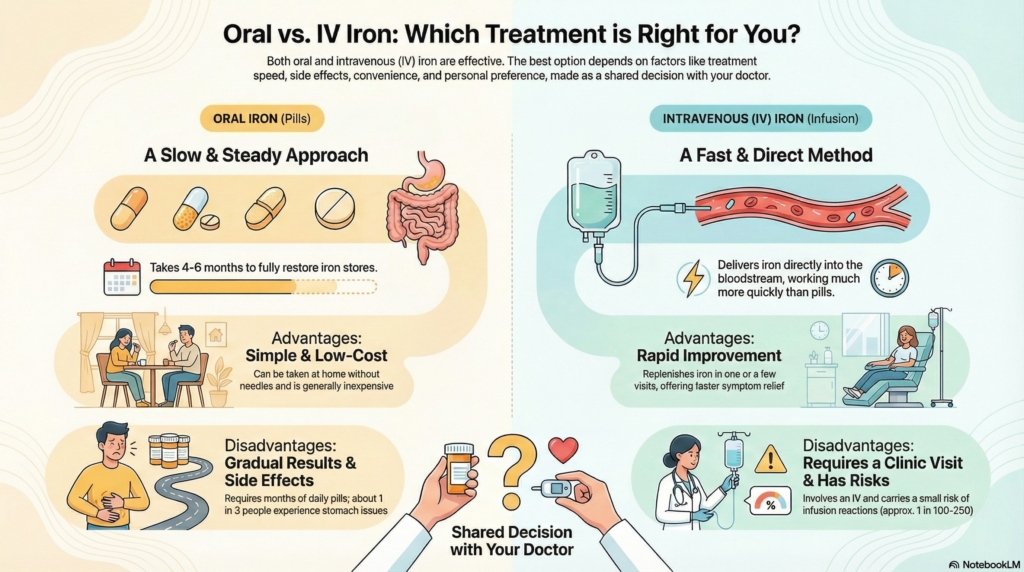
Oral iron and intravenous (IV) iron are both effective ways to treat iron deficiency.
The best option depends mainly on speed, side effects, logistics, and personal preference, not on whether one option is “stronger” or “better.”
This information is educational and cannot replace care from your own clinician.
First things first
Iron replacement is not one-size-fits-all.
For many years, IV iron was used mainly when people could not tolerate oral iron or could not absorb it. Today, that approach has changed. IV iron is now also used when people prefer a faster option or want to avoid months of daily pills, not only when oral iron has failed.
Both oral and IV iron can correct iron deficiency and improve symptoms. The decision is usually about timing, convenience, side effects, and what fits best into daily life, rather than right versus wrong.
Why iron replacement is needed
Iron deficiency affects more than just lab numbers.
Iron is required to make hemoglobin, the protein in red blood cells that carries oxygen. It is also important for muscle function, brain chemistry, and energy metabolism. When iron stores are low, people may feel tired, short of breath with activity, or generally “run down,” sometimes even before anemia develops.
Replacing iron restores iron stores, supports red blood cell production, and helps relieve symptoms. How quickly this happens depends on the method used.
Oral iron: how it works
Oral iron is absorbed through the gastrointestinal tract and gradually replenishes iron stores over time. It is commonly taken once daily or every other day, depending on the plan you and your clinician choose.
Because iron absorption from the gut is limited, oral iron works slowly. Even when symptoms begin to improve, it often takes 4–6 months of consistent use to fully restore iron stores.
Advantages of oral iron
- simple and familiar
- taken at home
- no needles or infusions
- usually inexpensive
Disadvantages of oral iron
- requires taking pills for several months
- some people dislike or forget daily medication
- around one in three people experience gastrointestinal side effects
- side effects may include constipation, nausea, stomach discomfort, or diarrhea
- improvement in symptoms and lab values is gradual
Intravenous (IV) iron: how it works
IV iron delivers iron directly into the bloodstream through a vein. This bypasses the gut and allows iron stores to be replenished much more quickly.
Depending on the preparation used, IV iron may be completed in one visit, while other formulations are given in a few smaller infusions over several weeks. Your care team can explain which option applies to you.
Advantages of IV iron
- often completed in one visit
- faster rise in ferritin and hemoglobin
- faster symptom improvement for many people
- avoids months of daily pills
- effective even when oral iron would eventually work
Disadvantages of IV iron
- requires time for an infusion visit
- involves starting an IV
- insurance approval may be required
- small risk of infusion reactions
Safety and side effects: putting risks in perspective
Both oral and IV iron are generally safe when used appropriately.
Oral iron most often causes gastrointestinal side effects, which can limit how consistently it is taken.
IV iron can cause infusion reactions in a small number of people, estimated at roughly 1 in 100 to 1 in 250 infusions. These reactions are usually not true allergies. Symptoms often improve by stopping or slowing the infusion, and iron can often be restarted after a short pause. Severe allergic reactions are rare.
IV iron is given in monitored settings so staff can respond quickly if symptoms occur.
How doctors help choose between oral and IV iron
Choosing between oral and IV iron is a shared decision.
Doctors consider how low iron levels are, how quickly improvement is needed, whether oral iron has caused side effects in the past, and how easy it will be to take medication consistently for months.
Other factors may include work schedules, transportation, insurance coverage, and comfort with IV treatments. In many situations, more than one option is reasonable, and patient preference matters.
Daily life and self-care during iron treatment
Regardless of the method used, iron replacement takes time.
Some people begin to feel better within weeks, while full restoration of iron stores may take several months. Feeling better does not always mean treatment is complete.
Staying consistent with the plan, keeping follow-up appointments, and checking iron levels after treatment help ensure recovery is complete and lasting.
When should I contact my doctor?
Contact your doctor if symptoms do not improve as expected, if side effects make treatment difficult to continue, or if symptoms return after treatment.
After IV iron, reach out if you develop new or concerning symptoms during or shortly after the infusion. Severe shortness of breath, chest pain, or feeling faint should prompt urgent medical evaluation.
Making sense of it
It can help to think of iron stores like a tank.
Oral iron fills the tank slowly, a little at a time. IV iron fills the tank much faster. Both approaches can restore iron to a healthy level.
If iron loss continues, such as from ongoing menstrual bleeding or other sources, the tank can slowly leak and become low again. Replacing iron refills the tank, but identifying and addressing the cause helps prevent recurrence.
Key takeaways
- both oral and IV iron work, and the choice is individualized
- oral iron is simple, but requires months of consistent use
- IV iron works faster, often in one or a few visits
- side effects differ, but serious reactions are uncommon
- finding the cause matters, no matter which option is chosen
For clinicians: Read our detailed guide on how to communicate about oral vs. intravenous iron therapy to patients.