
For Your Healthcare Provider
Have your patient scan this QR code with their smartphone camera to instantly access this educational guide on their device.

A guide for patients with an elevated white cell count
Access the Resources
Note: The video and audio linked above were generated with the assistance of AI. Clinical accuracy has been reviewed, but no AI-generated content can be guaranteed to be fully error-free.
A high white blood cell count, also called leukocytosis, is a common finding on routine blood tests. It often reflects your immune system responding to something simple or temporary, such as a recent infection, stress, exercise, pregnancy, or medications.
To understand what it means for you, your doctor looks at the white cell breakdown (called the differential), your symptoms, and whether the number changes over time. Most people with leukocytosis feel completely well, and the count improves once the underlying cause settles.
This guide applies to outpatient evaluation and does not apply to emergency or rapidly worsening illness.
First things first
Leukocytosis means the total white blood cell (WBC) count is higher than usual. For many people, this is discovered on a routine blood test when they feel completely well.
The total number alone does not explain why it is high. White blood cells include several types—neutrophils, lymphocytes, monocytes, eosinophils, and basophils—and each increases for different reasons.
The most common scenario is that you have had a recent infection, inflammation, stress, or other trigger, and your immune system is still responding. Your doctor will usually recheck your blood count in a few weeks to see whether the elevation settles on its own. A single high result is often temporary; the pattern over time matters more than one test.
What is leukocytosis?
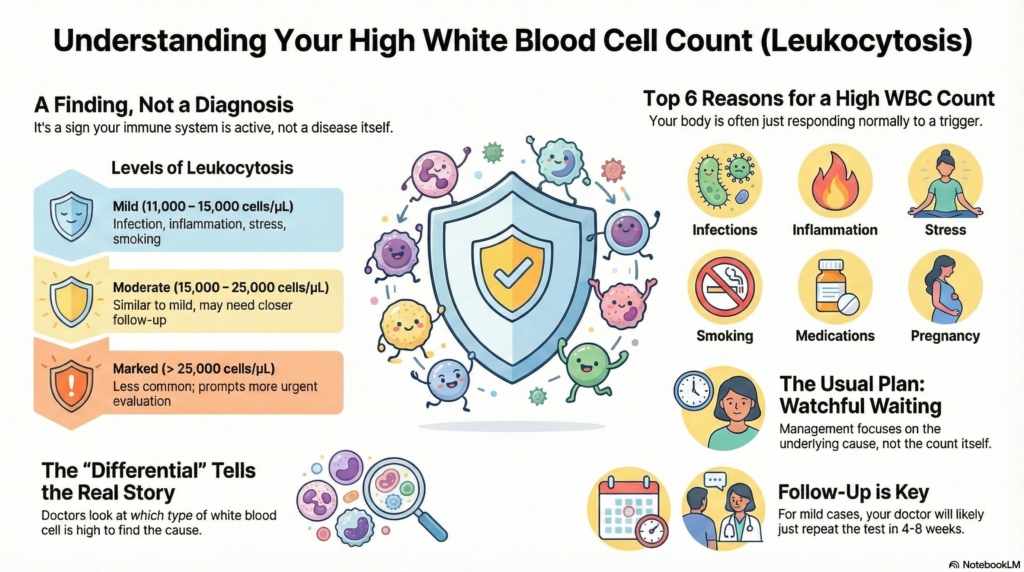
Leukocytosis means your total white blood cell count is above your lab’s reference range. Typical adult reference ranges are about 4–11 × 10⁹/L (4,000–11,000 cells/µL), though exact ranges vary slightly by lab and situation (including pregnancy).
Clinicians often think about leukocytosis in broad ranges:
- mild leukocytosis: about 11–15 × 10⁹/L, very common and often related to infection, inflammation, stress, or smoking
- moderate leukocytosis: about 15–25 × 10⁹/L, still often from common causes but may need closer follow-up
- marked leukocytosis: above ~25 × 10⁹/L, less common and usually prompts more urgent evaluation
Leukocytosis is not a diagnosis. It is a finding that tells us your immune system is more active than usual and prompts a closer look at which white cell types are elevated and how the count behaves over time.
Why it happens (causes)
White blood cells increase when your immune system is activated. Common reasons include:
- infections, especially bacterial or viral
- inflammation, including autoimmune conditions
- physical or emotional stress, such as illness, surgery, injury, intense exercise, or major life stress
- smoking, which can cause mild, persistent leukocytosis
- medications, especially steroids; other medicines such as lithium or growth factors (G-CSF) can also raise counts
- recovery from illness, when counts may temporarily increase as the body heals
- pregnancy, which often causes a mild, normal increase in white blood cells, especially later in pregnancy and around delivery
The total WBC count is made up of several subtypes, so the cause depends on which type is elevated:
- high neutrophils → often infection, inflammation, stress, steroids, or recent surgery
- high lymphocytes → often viral infections or recovery phases
- high monocytes → often recovery from illness, inflammation, or smoking
- high eosinophils → often allergies or parasitic infections
- high basophils → less common and usually mild
Very high counts (for example, above ~25–50 × 10⁹/L) can occur with severe infections, major inflammation or trauma, certain medications, or less commonly with blood disorders. When a very high count is due to infection or inflammation rather than a blood cancer, this may be called a leukemoid reaction.
Blood disorders such as leukemias or myeloproliferative conditions are uncommon causes of leukocytosis in people who feel well. They usually cause marked, persistent elevations over months and are often accompanied by other abnormal blood counts or symptoms such as fatigue, night sweats, weight loss, swollen lymph nodes, or an enlarged spleen.
Does it cause symptoms?
Leukocytosis itself usually does not cause symptoms. Any symptoms you notice are most often related to the underlying reason the white blood cell count is elevated, rather than to the count itself.
For example, symptoms may arise from:
- infection, such as fever, chills, or feeling unwell
- inflammation, such as joint pain, rash, or swelling
- stress on the body, such as recent surgery, injury, intense exercise, or emotional stress
Many people feel completely well when leukocytosis is discovered on routine blood testing.
Symptoms from leukostasis (thickened blood flow due to extremely high white counts) are very rare in the outpatient setting and occur almost exclusively with very high counts, usually in people with known blood cancers. These are not expected with mild or moderate leukocytosis.
Is it dangerous?
Most cases of leukocytosis are not dangerous. Mild elevations are especially common and often temporary. Concern increases when:
- the count is very high or rising quickly
- it remains elevated for several months
- it is associated with anemia, low platelets, or other abnormal blood counts
- the blood smear shows immature or abnormal cells
- you develop fevers, night sweats, weight loss, swollen lymph nodes, or repeated infections
Your doctor looks at both the numbers and the context—including how you feel and how other tests look—to decide whether further evaluation is needed.
How your doctor evaluates it
Evaluation typically includes:
- reviewing which white cell subtype is elevated (the differential)
- asking about recent infections, inflammation, stress, surgery, or injury
- reviewing medications, especially steroids, lithium, or G-CSF
- asking about smoking, which can raise white counts
- checking for symptoms such as fevers, night sweats, weight loss, swollen lymph nodes, or spleen enlargement
- repeating the CBC to look for trends over time
If leukocytosis is mild and you feel well, your doctor may repeat your CBC in 4–8 weeks. If it remains elevated but stable, another check in 2–3 months is common. Earlier testing or referral is considered if the count is very high, rising, or associated with symptoms or other abnormal blood counts.
How is it treated
There is no direct treatment for leukocytosis itself. Management focuses on the underlying cause, such as:
- treating an infection
- adjusting or stopping a medication that raises the count, if appropriate
- addressing inflammation or autoimmune disease
- supporting recovery after surgery, injury, or illness
If smoking is contributing, reducing or quitting smoking often lowers white counts over time and improves overall health. The white count usually improves as the trigger resolves.
Daily life and self-care
Most people do not need lifestyle restrictions just because of leukocytosis.
Helpful steps include:
- monitoring for new or changing symptoms
- attending follow-up appointments for repeat blood tests
- taking medications as prescribed for underlying conditions
- maintaining general health habits (rest, hydration, nutrition, activity)
- considering smoking cessation if you smoke
No special diet or activity changes are required solely because of leukocytosis.
When should I contact my doctor?
Contact your doctor sooner if you develop:
- fevers, chills, or night sweats
- unexplained weight loss
- swollen lymph nodes or a feeling of fullness under the left ribs
- worsening fatigue
- repeated or hard-to-clear infections
- new or worsening abnormalities on repeat blood tests
Seek care urgently if you feel suddenly or significantly worse.
What is the usual plan going forward?
For most people, the plan is repeat testing and observation. Your doctor will:
- confirm which white cell type is elevated
- look for common and reversible causes
- recheck your CBC in 4–8 weeks if the elevation is mild
- consider another check in 2–3 months if stable
- arrange earlier testing or referral if concerning patterns appear
Many mild elevations return to normal within weeks to months.
Making sense of it
Think of your total white blood cell count like the total score on a scoreboard.
To understand why the score is high, you need to know which team scored the points—neutrophils, lymphocytes, monocytes, eosinophils, or basophils.
Looking at the breakdown and how the score changes over time tells your doctor whether this is a brief reaction to something common or a pattern that needs more attention.
Leukocytosis means your immune system is more active than usual. In most cases, it is a sign that your body is responding appropriately to something—such as infection, stress, inflammation, pregnancy, or medications—rather than a sign that your immune system is failing. The specific white blood cell type that is elevated gives the best clue to the cause. Most mild elevations are temporary and harmless, especially when you feel well and the numbers improve on follow-up testing.
Key takeaways
- leukocytosis is a finding, not a diagnosis, meaning it signals increased immune activity rather than a specific disease
- the cause depends on which white blood cell type is elevated, because different cells rise for different reasons
- most elevations are mild and temporary, often related to infection, stress, pregnancy, medications, or smoking
- patterns over time matter more than a single number, which is why repeat testing is often reassuring
- the white blood cell count itself does not cause symptoms, and symptoms usually reflect the underlying condition
- follow-up is usually simple, involving repeat CBCs with further evaluation only if needed
For clinicians: Read our detailed guide on how to communicate about leukocytosis to patients.