
The evolution and future of VWD treatment
Note: The video and audio linked above were generated with the assistance of AI. Clinical accuracy has been reviewed, but no AI-generated content can be guaranteed to be fully error-free.
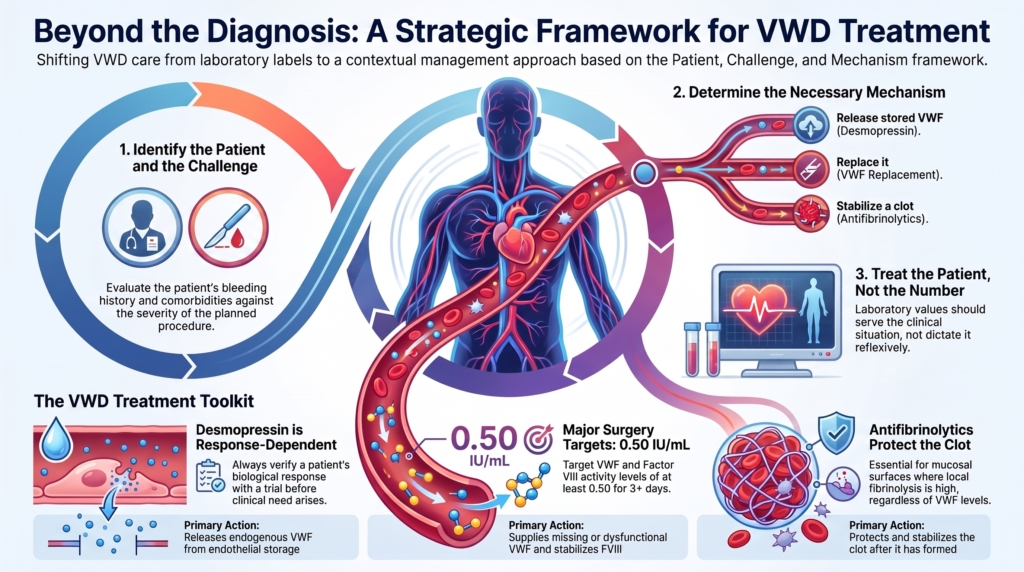
Why this spoke matters
Von Willebrand disease is often introduced through diagnosis: VWF antigen, VWF activity, factor VIII, multimers, type 1, type 2, type 3.
But treatment asks a different question.
Diagnosis asks: What is wrong with von Willebrand factor?
Treatment asks: What is most likely to fail in this patient, during this hemostatic challenge, at this moment?
That distinction matters. A patient with VWD may need no treatment for years. The same patient may need tranexamic acid for dental work, desmopressin for minor bleeding, VWF concentrate for major surgery, hormonal therapy for heavy menstrual bleeding, iron replacement for chronic blood loss, or long-term prophylaxis for recurrent bleeding.
The diagnosis may stay the same.
The treatment changes because the challenge changes.
That is the central principle of VWD therapy.1
How to read this essay
The diagnostic essays focused on:
- What is the bleeding disorder?
- What does the laboratory pattern mean?
- What mechanism explains the abnormality?
This essay begins where diagnosis ends.
Once the diagnosis is established, how do you choose the right treatment for the right patient at the right moment?
The answer is not to treat the diagnosis alone. It is to match therapy to the patient, the hemostatic challenge, and the mechanism most likely to fail.
VWD treatment is not hemophilia treatment
Hemophilia treatment is often organized around a missing coagulation factor: replace factor VIII, replace factor IX, prevent joint bleeding, maintain trough levels.
VWD is different.
Unlike hemophilia, VWD treatment cannot usually be reduced to maintaining a single factor level. VWF supports platelet adhesion, primary hemostasis under shear, and factor VIII stability. The relative importance of each function varies with the clinical setting, especially at mucosal surfaces, where fibrinolysis is prominent and local hemostatic stress is high.2
So treatment is not simply “replace what is low.” Sometimes the goal is to release endogenous VWF. Sometimes it is to replace VWF. Sometimes it is to protect the clot after it forms. Sometimes it is to reduce menstrual blood loss, prepare for surgery, or prevent recurrent bleeding in a patient whose disease has become clinically severe.
At the same time, VWD treatment is not free of targets. In major surgery and severe bleeding, target VWF and FVIII levels matter. The point is not that numbers are irrelevant; it is that the number must serve the clinical challenge.
The treatment plan must follow the biology.
But it must also follow the situation.
The treatment decision
A practical VWD treatment decision can be organized around three questions.
First: Who is the patient? This includes the VWD type, bleeding history, prior desmopressin response, baseline VWF and FVIII levels, age, pregnancy status, comorbidities, thrombotic risk, and safety concerns such as cardiovascular disease, seizure risk, type 2B VWD, type 3 VWD, or risk of hyponatremia.
Second: What is the challenge? Is this active bleeding or prevention? Is the bleeding mucosal, menstrual, gastrointestinal, postpartum, traumatic, joint-related, or surgical? Is the procedure minor or major? Is the site forgiving or dangerous? Is prolonged hemostatic coverage needed?
Third: What mechanism needs support? Is there enough endogenous VWF to release? Is replacement needed? Is factor VIII also low? Is fibrinolysis part of the problem? Is the issue recurrent bleeding despite apparently adequate episodic treatment?
These questions turn VWD treatment from a menu of drugs into a clinical reasoning process.
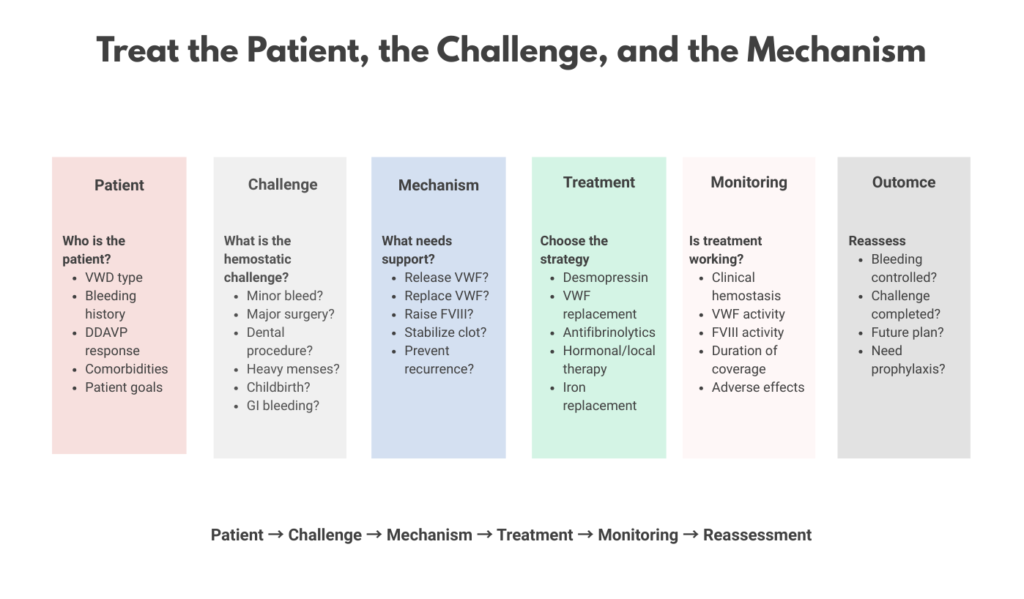
The core treatment tools
Most VWD treatment uses one or more of four tools: desmopressin, VWF replacement, antifibrinolytics, and local or supportive therapies.
Desmopressin
Desmopressin releases endogenous VWF from endothelial storage sites and usually raises both VWF and factor VIII levels. It is most useful in many patients with type 1 VWD.
Desmopressin is best viewed as a response-dependent option, not a label-based therapy. It should not be assumed effective when response is uncertain. It is generally ineffective in type 3 VWD because there is little or no VWF to release, and it is generally avoided in type 2B VWD because it may worsen thrombocytopenia through increased VWF-platelet binding. It may also be ineffective or only partially effective in many type 2 variants.3
Safety matters. Desmopressin can cause water retention and hyponatremia, and caution or avoidance is required in selected patients, including very young children, patients with seizure disorders, patients with active cardiovascular disease, and patients at increased risk of thrombosis.4
The key principle is simple:
Whenever possible, the desmopressin response should be known before it is needed.
The desmopressin trial
The desmopressin trial captures the logic of VWD therapy.
Desmopressin works if the patient can release enough functional VWF and factor VIII, quickly enough, and for long enough, to meet the clinical challenge. A patient may have an excellent early rise but a short-lived response because of accelerated VWF clearance. Another may have an inadequate rise. Another may respond biologically but still not be an appropriate candidate because of the procedure, age, comorbidities, pregnancy-related risks, or cardiovascular concerns.
The 2021 management guideline suggests a desmopressin trial when desmopressin is a valid option, particularly in type 1 VWD with baseline VWF below 0.30 IU/mL, and suggests against treating such patients with desmopressin in the absence of trial results.5
This is more than a technical recommendation.
It reflects a broader principle:
In VWD, treatment should be tested against biology whenever possible before it is tested against bleeding.
VWF replacement
VWF concentrates are used when desmopressin is ineffective, contraindicated, insufficient, or inappropriate for the clinical challenge. Replacement may be needed in type 3 VWD, many type 2 variants, severe type 1 VWD, major surgery, serious bleeding, prolonged hemostatic coverage, or recurrent bleeding requiring prophylaxis.
Products differ in whether they contain both VWF and factor VIII or VWF alone, and in whether they are plasma-derived or recombinant.6
This matters because VWF replacement does more than restore platelet adhesion. It also affects factor VIII. With repeated dosing of VWF/FVIII-containing concentrates, factor VIII may accumulate. With VWF-only products, endogenous factor VIII rises more gradually because infused VWF stabilizes the patient’s own factor VIII.
For surgery and other high-risk settings, replacement therapy should be treated as a monitored intervention, not simply as product administration. The product, dose, interval, duration, and laboratory monitoring plan should be matched to the patient, the procedure, and the expected duration of hemostatic stress. Perioperative monitoring of both VWF and FVIII helps guide dosing and avoid inadequate coverage on one side or excessive FVIII accumulation on the other.7
Antifibrinolytics
Tranexamic acid and aminocaproic acid do not correct VWF levels.
They protect the clot after it forms.
That makes them especially useful for mucosal bleeding, dental procedures, heavy menstrual bleeding, epistaxis, and postpartum bleeding. They are often used as adjuncts to desmopressin or VWF replacement. In selected minor mucosal procedures in mild type 1 VWD, tranexamic acid alone may be enough.8
This is an important teaching point: not every VWD treatment needs to raise VWF. Sometimes the best treatment is to stabilize the clot at the vulnerable surface.
Local, hormonal, and supportive therapies
VWD care also includes therapies that are not “VWF therapies” at all. Local hemostatic measures may be central for dental work, oral bleeding, or epistaxis. Hormonal therapy may be first-line for heavy menstrual bleeding in patients not seeking pregnancy. Iron deficiency should be actively sought and treated. Gynecologic causes of bleeding should not be missed just because VWD is present.
The 2021 management guideline emphasizes multidisciplinary care for heavy menstrual bleeding and regular assessment for iron deficiency and anemia.9
VWD may explain the bleeding tendency.
It does not exclude other causes of bleeding.
Treatment is contextual
The same laboratory diagnosis can lead to very different treatment decisions.
A patient with mild type 1 VWD and epistaxis may need local measures and tranexamic acid. A patient with type 3 VWD and the same symptom may need VWF concentrate.
A mild desmopressin responder undergoing dental extraction may need desmopressin plus tranexamic acid. Another patient may need VWF concentrate plus tranexamic acid. A very mild patient with baseline VWF activity above 0.30 IU/mL and a mild bleeding phenotype may need tranexamic acid alone for a minor mucosal procedure.
Major surgery is different. Here, “good enough” is not good enough. The goal is sustained hemostatic coverage. The ASH/ISTH/NHF/WFH guideline suggests targeting both VWF activity and factor VIII activity of at least 0.50 IU/mL for at least 3 days after major surgery, with duration individualized according to procedure and bleeding risk.10
Desmopressin alone is generally not appropriate for major surgery at critical sites, even in a responder, because the duration and reliability of coverage may be insufficient.
The goal is not maximal correction in every setting. It is adequate, monitored hemostatic coverage for the specific bleeding challenge.
Heavy menstrual bleeding, pregnancy, and postpartum risk
Heavy menstrual bleeding is not a minor manifestation. It is one of the most common and burdensome clinical problems in VWD.
Treatment may include tranexamic acid, hormonal therapy, a levonorgestrel-releasing intrauterine system, desmopressin in selected patients, VWF replacement in severe cases, and iron replacement. The treatment goal is not only to prevent acute hemorrhage. It is to reduce monthly blood loss, prevent iron deficiency, preserve quality of life, and align therapy with reproductive goals.
Pregnancy adds another layer of complexity. VWF and factor VIII often rise during pregnancy, especially in type 1 VWD, but postpartum levels may fall rapidly. Pregnancy can therefore create a false sense of security.
The apparent normalization of VWF during pregnancy does not eliminate postpartum risk.
Tranexamic acid is specifically suggested postpartum for women with type 1 VWD or low VWF, and may also apply to other types depending on circumstances.11
Antithrombotic therapy and competing risks
VWD does not protect patients from cardiovascular disease, atrial fibrillation, venous thromboembolism, or other conditions that may require antiplatelet or anticoagulant therapy.
This creates a different kind of treatment problem. The question is not simply, “Does this patient bleed?” It is also, “What happens if we undertreat thrombosis risk?”
The 2021 management guideline suggests that patients with VWD and cardiovascular disease who require antiplatelet or anticoagulant therapy should generally receive the necessary therapy rather than having it withheld solely because of VWD. The plan should be individualized, reassessed over time, and developed with the patient and relevant specialists. Patients with more severe bleeding phenotypes may require additional hemostatic support, including prophylaxis with VWF concentrate in selected cases.12
This reinforces the central theme: VWD treatment is not reflexive avoidance of bleeding risk. It is proportionate management of competing risks.
When episodic treatment is not enough
Some patients move beyond episodic therapy. This includes patients with severe and frequent bleeding, recurrent gastrointestinal bleeding, recurrent joint bleeding, or severe type 3 VWD.
For these patients, long-term VWF prophylaxis may reduce bleeding frequency and improve quality of life.13
The evidence base is limited, and guideline recommendations remain conditional. Recurrent gastrointestinal bleeding in particular remains difficult and often requires individualized care, repeated reassessment, and attention to associated lesions such as angiodysplasia.14
The key shift is from treating bleeding episodes to preventing them.
Clinical synthesis
VWD treatment begins with a simple but easily missed principle:
treat the patient, the challenge, and the mechanism.
The patient defines the bleeding phenotype, goals, preferences, comorbidities, reproductive context, prior treatment response, and tolerance for uncertainty.
The challenge defines the hemostatic demand: mucosal bleeding, heavy menstrual bleeding, surgery, childbirth, trauma, dental work, gastrointestinal bleeding, or recurrent spontaneous bleeding.
The mechanism defines the treatment logic: raise VWF, replace VWF, stabilize FVIII, protect the clot, reduce endometrial bleeding, treat the local site, or prevent recurrence.
No single therapy answers every VWD problem. Desmopressin borrows from endothelial stores. VWF replacement supplies what is missing or dysfunctional. Antifibrinolytics protect clots in fibrinolytic terrain. Hormonal and gynecologic therapies reduce menstrual bleeding burden. Local measures stabilize the surface where bleeding occurs. Prophylaxis changes the model when episodic treatment is no longer enough.
The correct question is therefore not simply:
What type of VWD does this patient have?
It is:
What is likely to fail in this patient, in this situation, and what treatment best prevents that failure?
Good VWD care is matched treatment, not maximal treatment.
The goal is not to normalize every laboratory value for every patient.
The goal is to produce enough hemostasis, for long enough, in the right place, with acceptable burden and risk.
That is the treatment strategy.
Evidence anchor: why VWD treatment cannot be reduced to a single pathway
Summary derived from treatment guidelines, expert reviews, perioperative reports, desmopressin studies, and prophylaxis data. The evidence consistently shows that VWD therapy depends on mechanism, clinical challenge, and treatment response. No single treatment strategy fits all patients or all situations.
| Evidence stream | What it shows | Why it matters | Main limitation |
|---|---|---|---|
| Desmopressin response studies | Desmopressin response varies by VWD type, baseline VWF level, clearance, and individual biology.15 | Desmopressin is a response-based therapy, not a label-based therapy. | Definitions of response vary, and trial results must still be interpreted in relation to the clinical challenge. |
| Guideline recommendations for procedures | Minor procedures, mucosal procedures, and major surgery require different levels and durations of hemostatic support.16 | The same patient may appropriately receive tranexamic acid alone, desmopressin, or VWF concentrate depending on the procedure. | Many recommendations are conditional and based on low-certainty evidence. |
| VWF replacement and perioperative monitoring | VWF concentrates differ in VWF content, FVIII content, multimer profile, and dosing implications. Monitoring both VWF and FVIII can be important during surgery or repeated dosing.17 | Replacement therapy is not simply “give factor.” Product choice, dose, interval, and monitoring must fit the clinical setting. | Product availability and monitoring capacity vary across centers. |
| Heavy menstrual bleeding literature and guidance | HMB treatment may require antifibrinolytics, hormonal therapy, LNG-IUS, VWF-directed therapy, iron replacement, and gynecologic evaluation.18 | Treating the bleeding disorder alone may miss the menstrual, reproductive, quality-of-life, and iron-deficiency dimensions of disease. | Comparative effectiveness data remain limited, and patient preferences strongly shape decisions. |
| Long-term prophylaxis studies | Long-term VWF prophylaxis may reduce bleeding in selected patients with severe and frequent bleeding, including severe VWD, recurrent joint bleeding, and difficult mucosal or GI bleeding.19 | Some patients need a shift from episodic rescue to prevention. | Evidence is limited, and recurrent GI bleeding remains difficult to manage. |
| Antithrombotic therapy guidance | Patients with VWD may still require antiplatelet or anticoagulant therapy when cardiovascular or thrombotic risk is high.20 | VWD care is not reflexive avoidance of bleeding risk. It requires balancing bleeding and thrombosis risks. | Data are sparse, and decisions often require individualized multidisciplinary planning. |
Interpretive note: Taken together, these evidence streams support a simple conclusion: VWD treatment is contextual rather than protocol driven. The correct therapy is not determined by the diagnostic label alone. It emerges from the intersection of VWD type, bleeding phenotype, desmopressin response, procedure or bleeding site, duration of hemostatic stress, safety concerns, and patient goals.
Practical takeaway: In VWD, the goal is not maximal correction in every setting. The goal is adequate hemostatic confidence for the patient and the moment.
Guideline perspective: procedural planning as individualized hemostatic coverage
- Desmopressin should be used as a response-dependent therapy, especially in type 1 VWD, and a trial is recommended when response is uncertain.21
- Desmopressin is generally ineffective in type 3 VWD and generally avoided in type 2B VWD because of the risk of worsening thrombocytopenia.22
- Minor mucosal procedures may be managed with tranexamic acid alone in selected patients with mild type 1 VWD, but other patients require desmopressin or VWF concentrate, often with antifibrinolytic support.23
- Major surgery requires planned hemostatic coverage, with attention to both VWF activity and FVIII activity. The ASH/ISTH/NHF/WFH guideline suggests targeting both VWF activity and FVIII activity of at least 0.50 IU/mL for at least 3 days after major surgery, with duration individualized to the procedure and patient.24
- Replacement therapy should be monitored when laboratory targets are clinically relevant. Perioperative management may require checking both VWF and FVIII to avoid inadequate coverage or excessive FVIII accumulation.25
- Heavy menstrual bleeding should be managed with attention to menstrual control, reproductive goals, gynecologic causes, iron deficiency, and patient preference, not simply VWF correction.26
- VWD should not automatically preclude indicated antiplatelet or anticoagulant therapy. Bleeding risk and thrombosis risk must be assessed together, often with multidisciplinary input.27
Practical takeaway: Guidelines do not replace judgment. They discipline it. In VWD, treatment is best understood as structured individualization: match the therapy to the patient, the challenge, and the mechanism most likely to fail.
Reflect & Apply Case
A 10-year-old boy with type 3 VWD is scheduled for his first major orthopedic procedure.
His baseline values are:
- VWF antigen: undetectable
- VWF activity: undetectable
- FVIII: 9 IU/dL
He has had recurrent epistaxis and easy bruising, but no prior major surgery. He does not respond to desmopressin. The orthopedic team expects significant tissue dissection and several days of postoperative rehabilitation.
Questions for reflection:
- Why is desmopressin not an effective strategy in this patient?
- What must replacement therapy provide early in the perioperative course?
- Why do both VWF activity and FVIII activity matter?
- How might rehabilitation extend the period of hemostatic risk?
- What should be monitored postoperatively?
- What thrombotic or line-related risks should be considered?
- What should the discharge and rescue plan include?
- How will this first major procedure inform future hemostatic planning?
This case illustrates the central lesson:
peri-procedural VWD care is not a formula.
It is planned hemostasis under stress.
Test your thinking
An interactive quiz for this topic is being developed and will be added soon.