
The label describes the disorder. It does not, by itself, predict the life.
Note: The video and audio linked above were generated with the assistance of AI. Clinical accuracy has been reviewed, but no AI-generated content can be guaranteed to be fully error-free.
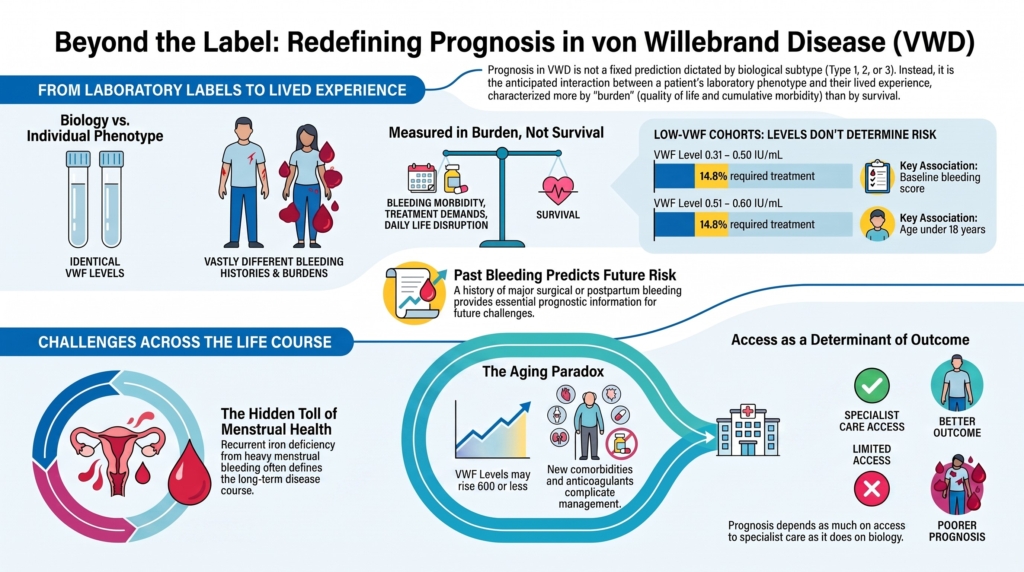
Why this spoke matters
Patients often ask a deceptively simple question after receiving a diagnosis of von Willebrand disease:
What does this mean for my future?
The answer cannot be read directly from the subtype label.
Type 1, type 2, and type 3 VWD describe important biological differences. Classification helps anticipate bleeding patterns, laboratory findings, treatment response, and certain complications. But prognosis depends on more than classification.
It also depends on:
- how much the patient has already bled
- which hemostatic challenges lie ahead
- whether treatment is available and effective
- whether iron deficiency, gastrointestinal bleeding, joint disease, or pregnancy-related bleeding develops
- whether medications or comorbidities alter the balance between bleeding and thrombosis
- how much the disorder disrupts daily life
Prognosis in VWD is the anticipated interaction between biology, exposure, treatment, and time.
It is therefore best understood as estimation rather than prediction. Clinicians can identify factors associated with greater or lesser risk, but they cannot forecast with certainty who will experience major surgical bleeding, postpartum hemorrhage, recurrent iron deficiency, or chronic complications.
Prognosis is measured in burden, not only survival
In many diseases, prognosis is framed primarily around mortality.
That is rarely the most useful starting point in VWD.
For most patients, prognosis is dominated by bleeding morbidity, treatment burden, and quality of life, particularly when the disorder is recognized and appropriately managed. Severe bleeding can be life-threatening, especially in type 3 disease, major trauma, surgery, childbirth, intracranial hemorrhage, or uncontrolled gastrointestinal bleeding. But for many patients, the more common consequences accumulate gradually.
The most relevant questions are often:
- Will bleeding remain infrequent or become disruptive?
- Will menstruation, childbirth, surgery, injury, or medication exposure reveal greater risk?
- Will recurrent blood loss cause iron deficiency?
- Will severe disease lead to joint damage or a need for prophylaxis?
- Will treatment remain practical and accessible?
- Will VWD affect school, work, physical activity, reproductive choices, or emotional well-being?
The prognosis of VWD is often measured in burden, not survival.
Classification shapes the expected range
Subtype matters.
Patients with type 3 VWD and selected severe type 1 or type 2 phenotypes generally face a greater risk of spontaneous, recurrent, or deep-tissue bleeding than patients with mild quantitative deficiency.
Type 3 disease may include:
- recurrent mucosal bleeding
- soft tissue or muscle bleeding
- gastrointestinal bleeding
- hemarthrosis
- chronic joint damage
- repeated exposure to VWF replacement
- consideration of long-term prophylaxis
Type 2 phenotypes may carry distinctive risks. Loss of high-molecular-weight multimers, impaired platelet-dependent VWF activity, thrombocytopenia, or markedly reduced FVIII can shape both bleeding pattern and treatment response.
Classification therefore materially shapes the expected bleeding spectrum.
It does not fully determine the individual burden or course.
Two patients with the same subtype may differ in:
- residual VWF and FVIII activity
- bleeding history
- treatment response
- exposure to surgery, childbirth, trauma, or anticoagulation
- access to specialist care and effective therapy
- comorbid disease
- burden on quality of life
Past bleeding helps estimate future risk
A patient who has already experienced major postoperative bleeding, postpartum hemorrhage, recurrent gastrointestinal bleeding, or frequent treatment-requiring mucosal bleeding has supplied important prognostic information.
The opposite history also matters.
Multiple previously tolerated hemostatic challenges may be reassuring, particularly when they occurred without prophylactic treatment. But they do not eliminate risk during a different, more intensive, or later-life challenge.
A routine dental extraction is not the same as major surgery.
One uncomplicated delivery does not guarantee another.
A patient who tolerated procedures before starting anticoagulation may face a different risk afterward.
Prognosis emerges from the relationship between laboratory phenotype and lived hemostatic experience.
In a cohort of patients with historical VWF levels between 0.31 and 0.60 IU/mL, subsequent treated bleeding was associated with an abnormal baseline bleeding score, referral because of bleeding, and age under 18 years. Risk did not differ significantly between the 0.31 to 0.50 and 0.51 to 0.60 IU/mL strata.1
The level matters. The history tells us what the level has meant.
Prognosis begins before adulthood
The life course of VWD begins long before cardiovascular disease, pregnancy, or surgery.
In childhood and adolescence, prognosis may be shaped by:
- recurrent epistaxis or oral bleeding
- bruising that limits participation in sport
- bleeding after dental procedures or injury
- delayed recognition of an inherited disorder
- school absence
- anxiety among children and caregivers
- menarche and the onset of heavy menstrual bleeding
- transition from pediatric to adult hematology care
A child with few spontaneous symptoms may still face important future challenges that have not yet occurred.
Conversely, early recognition can change the trajectory by allowing anticipatory planning, appropriate treatment, and education before the first major hemostatic challenge.
Prognosis is shaped not only by what happens, but also by what is prevented.
Mild disease can produce major burden
The term mild VWD may describe laboratory severity.
It does not necessarily describe the patient’s life.
A person with modestly reduced VWF may still experience:
- years of heavy menstrual bleeding
- recurrent iron deficiency
- delayed diagnosis
- repeated emergency visits
- unnecessary or avoidable invasive gynecologic procedures
- anxiety before surgery or childbirth
- disruption of school, work, exercise, or travel
- uncertainty about inheritance and family planning
Heavy menstrual bleeding is particularly important because it may be socially normalized, clinically underreported, or treated for years without recognition of the underlying bleeding disorder.
For some patients, the defining consequence of VWD is not a single dramatic hemorrhage.
It is cumulative loss.
Heavy menstrual bleeding and iron deficiency shape the life course
Heavy menstrual bleeding may begin at menarche and continue for decades.
Its consequences may include:
- iron deficiency with or without anemia
- fatigue
- reduced exercise tolerance
- impaired concentration
- missed school or work
- repeated hormonal treatment
- procedural or surgical intervention
- reduced quality of life
These effects arise from recurrent blood loss and iron deficiency rather than from VWD as an abstract diagnosis.
In low-VWF cohorts, heavy menstrual bleeding and postpartum hemorrhage have been prominent sources of morbidity, and some patients have undergone major gynecologic intervention despite only modest reductions in VWF.2
Iron deficiency is one of the clearest ways recurrent bleeding becomes chronic disease burden.
It may remain clinically important even after the patient has stopped perceiving the bleeding itself as abnormal.
Pregnancy improves hemostatic reserve but does not eliminate risk
Platelet-dependent VWF activity and factor VIII activity (FVIII:C) usually rise during pregnancy.
Third-trimester normalization may reduce concern about factor deficiency, but it does not eliminate postpartum hemorrhage. Bleeding may reflect the interaction of:
- the underlying hemostatic defect
- uterine atony
- retained placenta
- genital tract trauma
- operative delivery
- postpartum decline in VWF and FVIII
Patients may still face:
- primary or secondary postpartum hemorrhage
- uncertainty about neuraxial anesthesia
- need for coordinated delivery planning
- concern about inheritance and neonatal bleeding
- bleeding after hospital discharge as factor levels fall
A third-trimester visit with measurement of platelet-dependent VWF activity and factor VIII activity (FVIII:C) and a prospective delivery and postpartum plan can materially change the course.
A favorable laboratory trajectory does not guarantee an uncomplicated clinical outcome.
Gastrointestinal bleeding can change the course
For many patients, VWD is dominated by intermittent mucosal bleeding.
Recurrent gastrointestinal bleeding may create a different disease trajectory.
It can be:
- difficult to localize
- associated with angiodysplasia
- recurrent despite endoscopic treatment
- dependent on repeated iron replacement
- severe enough in some patients to require transfusion
- incompletely controlled by episodic hemostatic therapy
- an indication for prophylaxis or multidisciplinary care
GI bleeding is particularly associated with severe VWD and phenotypes lacking high-molecular-weight multimers.
It often becomes more complex when it coexists with renal disease, cardiovascular disease, gastrointestinal lesions, or antithrombotic therapy.
GI bleeding can convert an intermittent bleeding disorder into a chronic management problem.
Its course depends not only on VWF replacement, but also on lesion-directed treatment, iron repletion, medication review, and consideration of acquired modifiers.
Severe VWD may behave as a chronic bleeding disorder
Type 3 VWD and selected severe type 1 or type 2 phenotypes may produce a course qualitatively different from mild disease.
Possible long-term complications include:
- spontaneous or recurrent joint bleeding
- arthropathy
- muscle bleeding
- chronic pain
- impaired mobility
- repeated factor exposure
- venous access burden
- treatment fatigue
- need for prophylaxis
Joint bleeding in severe VWD has historically been underrecognized. In affected patients, recurrent hemarthrosis may produce joint damage and quality-of-life consequences analogous to those observed in hemophilia, although frequency and natural history are not identical.3
Long-term prophylaxis can reduce recurrent bleeding in selected patients and may reduce cumulative morbidity. Evidence that it prevents long-term arthropathy or otherwise modifies the natural history remains limited.
For severe disease, prognosis is shaped by two questions:
- How much bleeding can be prevented?
- At what burden of treatment?
Aging changes the problem VWD is part of
As the life-course discussion elsewhere in this module explores, VWF often rises with age. Whether that increase materially reduces bleeding risk remains incompletely understood and probably varies among patients.
At the same time, older adults may develop:
- atrial fibrillation
- coronary artery disease
- stroke risk
- renal dysfunction
- malignancy
- gastrointestinal angiodysplasia
- indications for antiplatelet or anticoagulant therapy
- need for invasive cardiovascular procedures
The problem becomes one of competing risks.
A higher current VWF level may improve laboratory hemostatic reserve, but it does not establish that the prior bleeding phenotype has resolved. Meanwhile, cardiovascular disease may create a strong indication for antithrombotic therapy.
When antiplatelet or anticoagulant treatment is indicated, VWD is not an automatic contraindication. Treatment requires individualized assessment, monitoring, and, in selected patients with a significant bleeding phenotype, hemostatic prophylaxis.
Aging does not merely modify VWD. It changes the problem VWD is part of.
Acquired modifiers may alter the expected course
A patient with inherited VWD may later develop conditions that superimpose additional VWF dysfunction, create a new source of bleeding, or complicate interpretation.
Potential contributors include:
- monoclonal gammopathy
- lymphoproliferative disease
- severe aortic stenosis
- mechanical circulatory support
- selected autoimmune disorders
- hypothyroidism
- medications that impair hemostasis
- structural gastrointestinal or gynecologic disease
New or unexpectedly severe bleeding later in life should not automatically be interpreted as progression of inherited VWD.
It may reflect:
- a new anatomical lesion
- antithrombotic or other medication exposure
- superimposed acquired VWF dysfunction
- another coagulation or platelet disorder
- interaction among several modest risk factors
Prognosis must be revised when the mechanism changes.
Access to care is part of prognosis
Biology is not the only determinant of outcome.
Access to:
- hematology expertise
- VWF replacement
- desmopressin testing
- antifibrinolytic therapy
- iron replacement
- multidisciplinary obstetric care
- home infusion
- emergency treatment
- appropriate laboratory testing
may influence the course as much as the nominal severity of disease.
A biologically manageable disorder may become burdensome when treatment is unavailable, unaffordable, delayed, or fragmented.
Conversely, early diagnosis and coordinated care may prevent bleeding that would otherwise be interpreted as inevitable.
Prognosis reflects both disease biology and the system in which the patient receives care.
Quality of life is part of prognosis
Bleeding frequency is not the same as disease burden.
A patient may bleed only occasionally yet live with:
- fear of procedures
- uncertainty about pregnancy
- activity restriction
- missed work or school
- fatigue from iron deficiency
- pain or impaired mobility
- treatment burden
- embarrassment about visible bleeding
- frustration when symptoms are minimized
Reviews of adults and children with VWD associate heavy menstrual bleeding, joint bleeding, pain, recurrent bleeding, and treatment demands with impaired health-related quality of life, although the available studies are heterogeneous.4
Quality of life is not an optional outcome. It is one of the principal ways prognosis is experienced.
Reassurance without minimization
Patients with VWD often need reassurance.
Many hemostatic challenges can be managed successfully when the diagnosis is recognized and a plan is in place. But reassurance becomes harmful when it is translated into dismissal.
Calling VWD “mild” may obscure:
- severe menstrual burden
- recurrent iron deficiency
- fear of childbirth
- cumulative procedural bleeding
- chronic GI bleeding
- treatment access problems
- psychosocial distress
The better message is:
VWD is usually manageable, but its burden is individual.
That statement reassures without pretending that all patients face the same course.
Clinical synthesis
Prognosis in VWD reflects the interaction of:
- subtype and residual hemostatic function
- accumulated bleeding phenotype
- future hemostatic challenges
- treatment response and access
- iron deficiency and organ-specific complications
- pregnancy and postpartum risk
- aging and competing comorbidity
- quality-of-life burden
The subtype establishes biological context.
The bleeding history reveals expression.
Treatment changes what happens next.
Time introduces new exposures, complications, and opportunities for prevention.
The prognosis is what happens when the biology meets a life.
Evidence anchor
| Evidence stream | What it shows | Why it matters | Main limitation |
|---|---|---|---|
| Longitudinal low-VWF cohort | Among 439 patients followed for a mean of approximately 6.3 years, 14.8% experienced bleeding requiring treatment. Subsequent treated bleeding was associated with an abnormal baseline bleeding score, referral because of bleeding, and age under 18 years; risk did not differ significantly between historical VWF levels of 0.31 to 0.50 and 0.51 to 0.60 IU/mL.5 | Prognosis should integrate presenting phenotype and exposure history rather than rely on small differences within a borderline laboratory range. | Retrospective tertiary-center cohort; procedural prophylaxis limits inference about untreated natural history. |
| Age-dependent type 1 VWD cohorts | VWF levels increased with age in many patients, and some entered the low-VWF or normal range while bleeding phenotype remained clinically important.6 | Current laboratory values should not be used as the sole measure of future burden. | Applies most directly to partial quantitative VWD; the effect of normalization on future bleeding risk remains uncertain. |
| Gynecologic morbidity | Women with low VWF may experience substantial heavy menstrual bleeding, iron deficiency, postpartum bleeding, and gynecologic intervention despite modest laboratory reductions.7 | Laboratory descriptions such as “mild” may underestimate cumulative life-course burden. | Retrospective cohort; referral and recall bias are possible. |
| Disease-burden literature | VWD is associated with impaired quality of life, healthcare use, heavy menstrual bleeding, joint bleeding, pain, and treatment burden.8 | Prognosis should include function and quality of life, not only major hemorrhage. | Heterogeneous populations, instruments, and outcome definitions; much of the evidence is observational. |
| Prophylaxis in severe and frequent bleeding | Long-term prophylaxis can reduce recurrent bleeding in selected patients with severe and frequent bleeding, including some with recurrent joint or gastrointestinal bleeding.9 | Treatment may reduce cumulative morbidity and alter the experienced course of severe disease. | Low-certainty evidence; optimal selection, dosing, duration, and long-term disease modification remain uncertain. |
| Contemporary comprehensive review | Long-term outcomes vary with subtype, bleeding phenotype, pregnancy, aging, cardiovascular disease, gastrointestinal bleeding, access to care, and treatment response.10 | Supports individualized prognostic counseling rather than deterministic prediction from subtype alone. | Broad synthesis; validated individualized prognostic models remain limited. |
Open Questions
Important uncertainties remain:
- Which mildly affected patients will bleed during future challenges?
- How much does age-related VWF normalization reduce future bleeding risk?
- Can prophylaxis prevent long-term joint damage or other cumulative complications?
- What is the optimal strategy for recurrent gastrointestinal bleeding?
- How should bleeding and thrombotic risks be balanced in older adults?
- How strongly do access, cost, and fragmentation of care influence long-term outcome?
- Which outcomes matter most to patients at different stages of life?
- How should prognosis be communicated without either alarmism or minimization?
These uncertainties do not make prognostic counseling impossible.
They make it probabilistic, individualized, and revisable.
Reflect & Apply Case
Consider two patients with type 1 VWD.
The first has platelet-dependent VWF activity of 24 IU/dL. She has undergone untreated dental extraction and appendectomy without abnormal bleeding. She has never been pregnant.
The second has platelet-dependent VWF activity of 44 IU/dL. She has experienced heavy menstrual bleeding since menarche, recurrent iron deficiency, postpartum hemorrhage, and repeated emergency visits for epistaxis.
Which patient has experienced the greater burden?
Clearly, the second.
Which patient has the worse future prognosis?
That question requires more information.
The first patient has lower VWF and has not yet faced every relevant hemostatic challenge. The second has demonstrated a greater bleeding propensity, but her future course will also depend on treatment, menopause, procedures, comorbidities, and access to care.
Prognosis requires both questions:
What biological defect is present?
and
What has that defect actually done in this person’s life?
The most honest counseling is neither falsely reassuring nor alarmist:
VWD is usually manageable. Its future impact depends on the phenotype already expressed, the challenges ahead, the treatments available, and the burdens the patient is already carrying.
Test your thinking
Quiz to follow