
The diagnosis endures. The patient does not stand still.
Note: The video and audio linked above were generated with the assistance of AI. Clinical accuracy has been reviewed, but no AI-generated content can be guaranteed to be fully error-free.
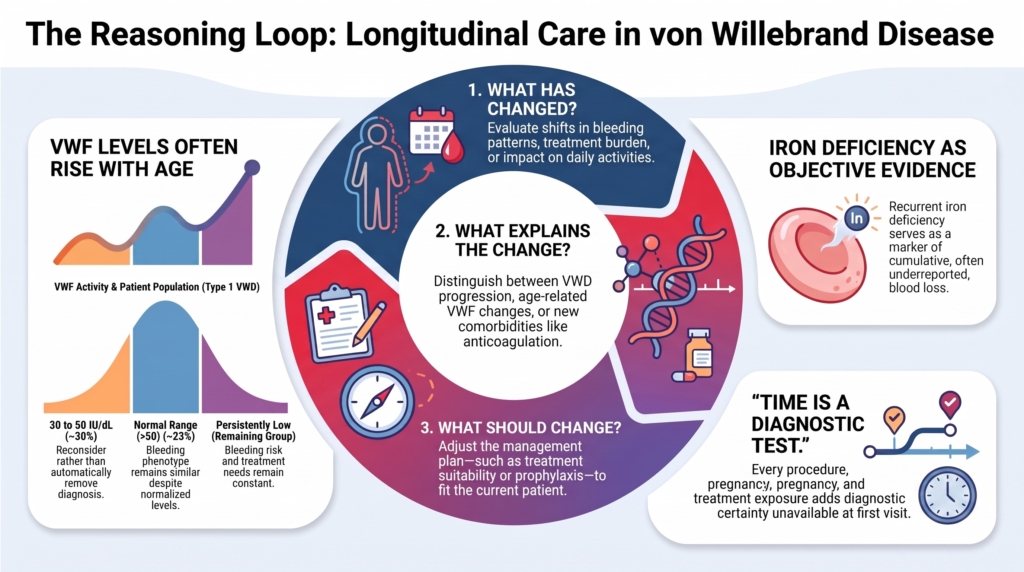
Why this spoke matters
For many patients, receiving a diagnosis of von Willebrand disease (VWD) feels like the end of a long search.
The bleeding has been explained.
The laboratory findings have been interpreted.
A subtype has been assigned.
Yet diagnosis is not the end of the story. It is the beginning of longitudinal care.
VWD is inherited, but its clinical expression is not fixed. Bleeding patterns may improve, worsen, or become newly apparent when life presents a hemostatic challenge. VWF levels change with age, pregnancy, inflammation, illness, and physiologic stress. New medications and medical conditions alter the balance between bleeding and thrombosis. Treatment priorities change as patients move from childhood to reproductive life, surgery, cardiovascular disease, and older age.
The clinical meaning of VWD must therefore be reassessed over time.
This principle applies most clearly when the original diagnosis was adequately established. Longitudinal reassessment may also reveal that an earlier diagnosis was uncertain, incomplete, or incorrectly classified.
The task is not simply to preserve or remove a label.
It is to ask what the accumulated evidence now means for the patient.
Time is a diagnostic test
The first consultation provides only a snapshot.
At diagnosis, the clinician knows the bleeding history available at that moment, the laboratory values obtained under particular conditions, and the treatments that might work.
Years later, much more is known:
- how the patient responded to desmopressin
- whether surgery, dental extraction, trauma, or childbirth produced unexpected bleeding
- whether heavy menstrual bleeding caused recurrent iron deficiency
- whether VWF levels changed with age
- whether treatment prevented bleeding or imposed an unacceptable burden
- whether the phenotype matched the diagnosis and subtype
- whether new comorbidities changed the balance between bleeding and thrombosis
Time itself becomes a diagnostic test.
Each procedure, pregnancy, treatment exposure, and period of observation adds information that was unavailable at the initial assessment.
Follow-up is therefore not passive surveillance. It is a process through which diagnostic and therapeutic certainty may increase, decrease, or change direction.
Three questions at every follow-up visit
Longitudinal care in VWD can be organized around three questions:
- What has changed?
- What explains the change?
- What should change?
Together, they form a continuing reasoning loop.
1. What has changed?
The starting point remains the patient’s bleeding experience.
The question is not simply whether bleeding has occurred. It is whether the pattern, burden, or consequences of bleeding have changed.
Relevant questions include:
- Have bleeding episodes become more frequent, prolonged, or difficult to control?
- Have new manifestations appeared, such as gastrointestinal bleeding or hemarthrosis?
- Have surgery, dental work, childbirth, injury, or anticoagulation revealed bleeding not previously apparent?
- Has heavy menstrual bleeding changed with hormonal therapy, pregnancy, or menopause?
- Has recurrent blood loss caused iron deficiency or anemia?
- Has bleeding interfered with school, work, exercise, travel, relationships, or daily activities?
- Has anxiety about bleeding become more limiting than bleeding itself?
- Has treatment become burdensome, impractical, or unacceptable to the patient?
The accumulated bleeding phenotype is often more informative for longitudinal risk assessment than an isolated VWF measurement.
A laboratory value describes one biological state.
A longitudinal history records what happened when hemostasis was actually tested.
Iron deficiency as accumulated evidence
Iron deficiency is not merely an associated laboratory abnormality. It may be an objective marker of cumulative blood loss, especially when bleeding has been normalized, minimized, or underreported.
Recurrent iron deficiency should prompt the clinician to ask:
- Is menstrual or gastrointestinal bleeding continuing?
- Has iron replacement been adequate?
- Has bleeding control been effective?
- Is another source of blood loss present?
- Has fatigue been attributed to VWD when iron deficiency is the more immediate cause?
The consequences of bleeding may be more disabling than any single bleeding episode.
2. What explains the change?
A change in the patient’s experience does not necessarily mean that inherited VWD itself has become more severe.
The explanation may involve the original disorder, a change in measured VWF, a new exposure, or an unrelated condition.
Potential contributors include:
- age-related changes in VWF
- pregnancy and the postpartum fall in VWF
- acute illness, inflammation, exercise, or physiologic stress that raises measured VWF and complicates interpretation
- antiplatelet or anticoagulant therapy
- renal, hepatic, cardiovascular, or hematologic disease
- structural gastrointestinal disease or angiodysplasia
- acquired von Willebrand syndrome
- an additional coagulation, platelet, or connective-tissue disorder
- changes in treatment adherence, access, or effectiveness
Biology and bleeding do not always move together.
VWF levels may rise with age and enter the normal range while a clinically important bleeding phenotype persists. Conversely, bleeding may worsen while VWF measurements remain stable because a new medication, lesion, comorbidity, or acquired disorder has altered the patient’s hemostatic balance.1
A new symptom should therefore not be attributed automatically to VWD simply because VWD is already present.
The established diagnosis is a starting point for reasoning, not an explanation for every future bleed.
Reconsidering is not the same as erasing
A patient diagnosed at age 20 with recurrent mucosal bleeding and VWF activity of 28 IU/dL may have a VWF activity of 72 IU/dL at age 65.
The laboratory value has changed. The lifetime bleeding history has not.
Nor has the information provided by previous procedures, childbirth, treatment responses, or recurrent iron deficiency.
The 2021 international diagnostic guideline suggests reconsidering rather than automatically removing a previously confirmed type 1 VWD diagnosis when VWF levels normalize with age. This recommendation assumes that the original diagnosis was sound and acknowledges that the evidence linking normalization to disappearance of bleeding risk remains uncertain.2
An age-related increase or normalization in VWF does not by itself establish that bleeding risk has resolved.
At the same time, reassessment should remain genuine. If the original diagnosis was based on limited testing, poorly characterized bleeding, or assays obtained during nonbaseline health, the clinician should be willing to revisit whether the diagnosis or subtype was correct.
Longitudinal care refines diagnosis rather than merely preserving or discarding it.
3. What should change?
The final question is practical.
Does the current management plan still fit the current patient?
Reassessment may include:
- continued suitability of desmopressin
- whether the magnitude and duration of desmopressin response remain adequate for the intended use
- need for VWF replacement therapy
- appropriate use of antifibrinolytic therapy
- whether recurrent severe bleeding justifies prophylaxis
- iron replacement and investigation of ongoing blood loss
- plans for surgery, dental procedures, pregnancy, delivery, and the postpartum period
- emergency instructions and access to specialist care
- medication review and counseling about bleeding risk
- patient preferences, treatment burden, and quality of life
A treatment that once worked is not automatically the treatment that should always be used.
Desmopressin may become less suitable as cardiovascular disease, hyponatremia risk, or other comorbidities emerge. Antifibrinolytics may become more useful when the dominant burden is mucosal bleeding. VWF concentrate may be needed for a major procedure even when episodic minor bleeding was previously controlled without it. Prophylaxis may be appropriate when recurrent bleeding demonstrates that on-demand treatment is failing, but its goals and continued need should be reassessed.
Laboratory reassessment should serve a clinical purpose
Repeat testing is most useful when it addresses a defined diagnostic or management question.
Examples include:
- reassessing an uncertain diagnosis or subtype
- obtaining values during baseline health after an initially elevated or borderline result
- measuring platelet-dependent VWF activity and factor VIII activity (FVIII:C) during pregnancy when results will guide delivery or neuraxial planning
- documenting the magnitude and duration of response to desmopressin
- monitoring response to VWF replacement
- evaluating possible acquired von Willebrand syndrome
- assessing a patient whose bleeding has become discordant with the established diagnosis
- planning a major procedure when current levels and treatment targets will affect management
The purpose of testing is not simply to determine whether the number has changed.
It is to decide whether the new number should alter interpretation or care.
Follow-up intensity should match clinical need
There is no universally established interval for long-term reassessment.
Patients with minimal bleeding and no active treatment may need primarily event-driven review before procedures, pregnancy, or major clinical changes.
More regular hematology follow-up may be appropriate for patients with:
- severe or frequent bleeding
- prophylactic therapy
- recurrent iron deficiency
- repeated procedures
- pregnancy planning
- gastrointestinal bleeding
- significant treatment burden
- evolving cardiovascular disease
- antiplatelet or anticoagulant therapy
- diagnostic uncertainty or suspected acquired modifiers
The aim is not to create a rigid schedule.
It is to ensure that clinically important change is recognized before it becomes a crisis.
Aging changes the balance, not simply the VWF level
Older adults may have rising VWF levels while simultaneously developing atrial fibrillation, coronary disease, malignancy, renal disease, gastrointestinal lesions, or an indication for invasive cardiovascular treatment.
Management increasingly requires balancing bleeding risk against thrombotic benefit.
Indicated antiplatelet or anticoagulant therapy should not automatically be withheld because of VWD. Instead, the decision should incorporate:
- the lifetime bleeding phenotype
- current VWF and FVIII levels
- prior major bleeding
- the strength of the cardiovascular indication
- the reversibility and monitoring of the proposed therapy
- opportunities to reduce modifiable bleeding risk
- whether prophylactic hemostatic support is appropriate in a patient with a severe phenotype
The goal is not zero bleeding risk. It is the best achievable balance between competing risks.
Patient education must also evolve
Education is not a one-time event delivered at diagnosis.
Topics that may require periodic review include:
- the meaning and limits of the diagnosis
- inheritance and family evaluation
- recognition of clinically important bleeding
- medication review and risk counseling
- iron deficiency
- emergency contact information
- medical identification
- communication with dentists, surgeons, obstetricians, and primary care clinicians
- the need to seek a hemostatic plan before invasive procedures
- when a change in bleeding should prompt reevaluation rather than routine treatment
Information that was irrelevant in childhood may become essential before pregnancy, surgery, or anticoagulation decades later.
Clinical synthesis
Long-term care in VWD is a repeated reasoning process:
- What has changed in the patient’s bleeding and disease burden?
- What best explains that change?
- What, if anything, should change in diagnosis, investigation, treatment, or planning?
The distinctive value of follow-up is that time supplies evidence unavailable at the first visit.
A procedure tests hemostasis.
A treatment tests mechanism and response.
A pregnancy tests planning across changing physiology.
A new comorbidity tests whether the previous management strategy still fits.
The first assessment establishes a working diagnosis. Longitudinal care tests and refines it.
Evidence anchor
| Evidence stream | What it shows | Why it matters | Main limitation |
|---|---|---|---|
| Age-dependent VWF trajectories | In combined type 1 VWD cohorts, VWF levels increased with age in many patients. Approximately 30% moved into the 30 to 50 IU/dL range and a further 23% entered the normal range, yet bleeding phenotype remained similar across persistently low, partially corrected, and normalized groups.3 | An age-related rise or normalization in VWF should not be assumed to erase the previous phenotype or settle current management by itself. | Observational cohort data; findings apply most directly to partial quantitative VWD. |
| Future bleeding in low VWF | In 439 patients followed for a mean of approximately 6 years, treated bleeding did not differ significantly between historical VWF levels of 0.31 to 0.50 and 0.51 to 0.60 IU/mL. Abnormal baseline bleeding score, referral for bleeding, and younger age were independently associated with future treated bleeding.4 | Longitudinal risk assessment should incorporate the presenting phenotype and exposure history, not just small differences within a borderline laboratory range. | Retrospective, tertiary-center cohort; most procedures received prophylaxis. |
| Diagnostic guidance after normalization | The 2021 international diagnosis guideline suggests reconsidering rather than automatically removing a previously confirmed type 1 VWD diagnosis when VWF normalizes with age.5 | Reassessment should integrate the accuracy of the original diagnosis, lifetime bleeding history, current laboratory values, and patient preferences. | Conditional recommendation based on very-low-certainty evidence. |
| Disease burden and quality of life | Bleeding burden in VWD is associated with impaired quality of life, including effects from heavy menstrual bleeding, joint bleeding, pain, treatment burden, and healthcare use.6 | Follow-up should assess consequences important to patients, not only bleed counts and laboratory values. | Heterogeneous studies, instruments, populations, and outcome definitions. |
| Contemporary management reviews | Current reviews emphasize individualized care that changes with subtype, bleeding phenotype, pregnancy, procedures, aging, cardiovascular disease, and treatment response.7 | Longitudinal care should adapt to the patient’s changing clinical context rather than follow a single lifelong template. | Primarily review and expert-practice evidence rather than prospective longitudinal trials. |
Guideline perspective: reassessment is targeted, not formulaic
Based primarily on the ASH/ISTH/NHF/WFH 2021 diagnosis and management guidelines, with laboratory interpretation informed by the 2024 British Society for Haematology guideline and broader contemporary reviews.
Shared guidance themes
The guidelines do not prescribe a universal follow-up schedule or a standardized longitudinal-care checklist. They do support several forms of context-specific reassessment:
- reconsidering rather than automatically removing a previously confirmed type 1 VWD diagnosis when VWF levels normalize with age
- reassessing desmopressin response and suitability when treatment decisions depend on it
- reviewing the need for and effectiveness of long-term prophylaxis
- platelet-dependent VWF activity and factor VIII activity (FVIII:C) when pregnancy, neuraxial anesthesia, delivery planning, or major surgery requires current targets
- monitoring response when VWF replacement is administered
- giving indicated antiplatelet or anticoagulant therapy with individualized reassessment of bleeding risk
- incorporating bleeding phenotype, procedural risk, comorbidity, treatment burden, and patient preferences into management decisions
The 2024 BSH guideline adds important laboratory context by emphasizing physiologic variability, appropriate assay selection, and targeted monitoring during pregnancy and after desmopressin or VWF replacement.8
What guidelines do not eliminate
- uncertainty about the optimal interval between follow-up visits
- uncertainty about how much age-related normalization changes future bleeding risk
- the need to determine whether a new bleed is caused by VWD, a comorbidity, a medication, or another hemostatic defect
- the challenge of balancing necessary antithrombotic therapy against bleeding risk
- the need to assess quality of life, treatment burden, and patient-defined goals
- the judgment required to decide when unchanged management remains appropriate and when it has become outdated
Practical takeaway: At follow-up, ask what has changed, what best explains it, and what should change in response. Repeat testing and treatment revision should serve a defined clinical purpose rather than occur automatically.
Reflect & Apply Case
A woman was diagnosed with type 1 VWD at age 19 after years of epistaxis, heavy menstrual bleeding, and iron deficiency. Her platelet-dependent VWF activity was 28 IU/dL.
At age 62, her platelet-dependent VWF activity is 74 IU/dL.
She no longer menstruates. She has now developed atrial fibrillation requiring anticoagulation and recurrent gastrointestinal bleeding.
Has her VWD disappeared?
Or has the clinical question changed?
The current VWF level does not erase the earlier diagnosis or lifetime phenotype. But neither should recurrent gastrointestinal bleeding be attributed automatically to historical type 1 VWD. The clinician must consider anticoagulant effect, structural gastrointestinal disease, angiodysplasia, and acquired modifiers while also protecting the patient from preventable thromboembolism.
The first consultation asked:
What diagnosis best explains this patient?
Follow-up asks:
What have the years taught us that we did not know then?
That is the purpose of longitudinal reassessment: to use time, experience, and changing context to determine whether the diagnosis, explanation, and management plan still fit the patient.
Test your thinking
Quiz to follow