
Using endogenous VWF as therapy
Note: The video and audio linked above were generated with the assistance of AI. Clinical accuracy has been reviewed, but no AI-generated content can be guaranteed to be fully error-free.
Why this spoke matters
Many therapies in hematology replace something missing.
Red cells are transfused.
Factor concentrates are infused.
Iron is repleted.
Anticoagulants inhibit coagulation pathways.
Desmopressin is different.
It does not replace von Willebrand factor.
In responsive patients, it asks the endothelium to release VWF that is already stored.
That distinction is biologically important. Desmopressin is not simply a “bleeding drug.” It is a way of temporarily mobilizing the body’s own hemostatic reserve.
It works best when the patient has enough stored, releasable, functional VWF to mobilize. It cannot work when that reserve is absent. It may work incompletely when the released VWF is structurally abnormal or rapidly cleared.
That is why desmopressin is powerful, limited, and testable.
How to read this essay
Many hematologic therapies replace what is missing.
Desmopressin is different.
Rather than replacing VWF, it temporarily mobilizes the patient’s own endothelial reserve.
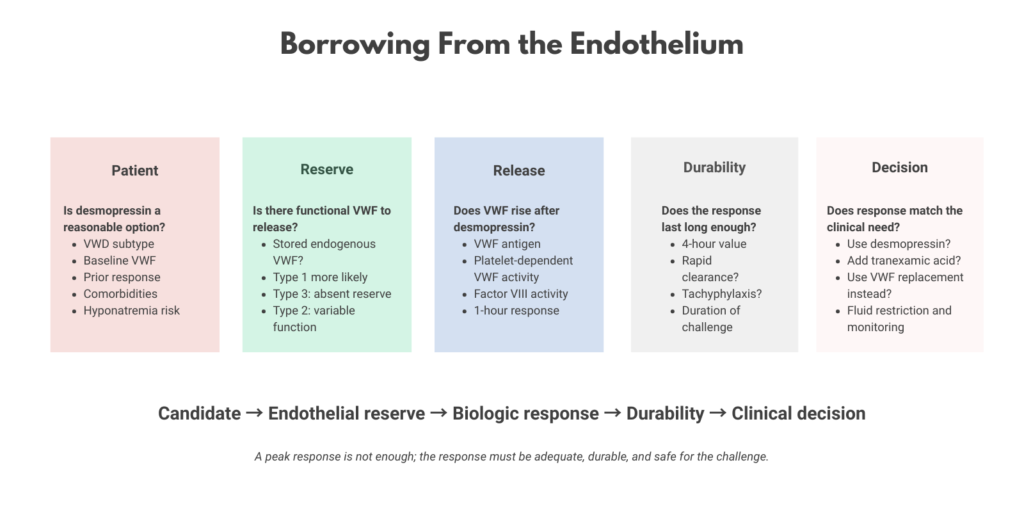
The key questions are therefore:
- Is there VWF to release?
- Is the released VWF functional?
- Will the response last long enough for the clinical challenge?
- Can it be used safely?
The basic therapeutic idea
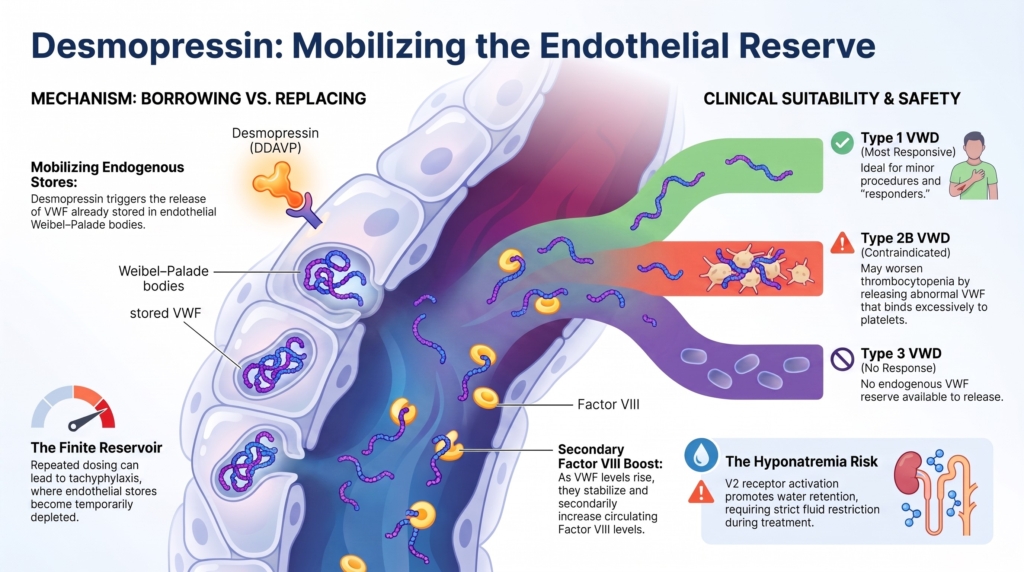
VWF is synthesized in endothelial cells and megakaryocytes. Some VWF is secreted constitutively into plasma. Some is stored, particularly in endothelial Weibel–Palade bodies, where it can be rapidly mobilized during physiologic stress or after desmopressin administration.
Desmopressin pharmacologically activates part of this regulated-release pathway. It increases circulating VWF and, because VWF stabilizes factor VIII, secondarily increases FVIII levels as well.1
The body already uses this pathway during physiologic stress. VWF levels rise with stress, inflammation, exercise, pregnancy, and other physiologic states. Desmopressin enters that biology.
It does not create VWF.
It mobilizes stored VWF.
This is why the therapy is often most useful in patients whose hemostatic capacity is reduced rather than absent.
Borrowing, not replacing
The phrase “borrowing from the endothelium” is deliberate.
VWF concentrates supply exogenous VWF.
Desmopressin mobilizes endogenous VWF.
The distinction explains both the appeal and the limitation of the drug.
Advantages include:
- avoidance of plasma-derived product exposure
- low cost compared with concentrates
- rapid increase in VWF and FVIII in responders
- usefulness for selected minor bleeding episodes or procedures
- potential home or outpatient use in appropriate settings
But the same biology creates limitations.
If there is little or no endogenous VWF to release, desmopressin cannot help much. If the released VWF is abnormal, the laboratory rise may not translate into adequate function. If the released VWF clears rapidly, the response may be short-lived. If repeated doses are given too close together, the releasable endothelial reserve may become depleted.
Desmopressin therefore teaches a central treatment principle in VWD:
therapy works only if it matches the mechanism.
How desmopressin works
Desmopressin is a synthetic analogue of vasopressin. It acts through vasopressin V2 receptors to stimulate endothelial release of stored VWF and increase circulating FVIII.2
Endothelial V2 receptor signaling increases intracellular cAMP, triggering exocytosis of Weibel–Palade bodies. That same receptor biology also explains the drug’s antidiuretic effects in the kidney.
This duality matters. The hemostatic benefit and the hyponatremia risk come from related physiology.
Desmopressin mobilizes an endothelial storage system.
But it also promotes water retention.
Safe use requires remembering both.
What is released
Desmopressin can release relatively large, highly multimerized VWF forms from endothelial stores. These are then subject to normal ADAMTS13 processing and clearance.3
This connects desmopressin to the larger biology of VWF: storage, regulated release, multimer size, shear-dependent function, proteolytic regulation, and clearance.
Desmopressin is therefore not isolated pharmacology.
It is a temporary activation of endothelial hemostatic biology.
Who is most likely to benefit
Desmopressin is most often useful in type 1 VWD, especially when baseline VWF levels are not extremely low and the patient retains releasable, functional VWF.4
That does not mean all type 1 patients respond equally. Response varies with baseline VWF, phenotype, genotype, age, clearance, and other patient-specific factors.5
Some patients with type 2A, type 2M, or type 2N VWD may show a laboratory rise, but the response does not always translate into improved platelet-dependent function or adequate clinical hemostasis. It must be interpreted in relation to the subtype mechanism and the clinical challenge.6
Type 3 VWD is different. Because VWF is virtually absent, there is little or no endogenous VWF reserve to release. Desmopressin is therefore ineffective and is not an appropriate treatment strategy.7
The principle is simple:
no releasable reserve, no meaningful response.
The special caution in type 2B
Type 2B VWD is a major caution zone.
The defect involves increased VWF binding to platelet GPIb. If desmopressin releases more abnormal VWF, it may worsen abnormal VWF–platelet interaction, preferentially deplete high-molecular-weight multimers, and worsen thrombocytopenia.
For this reason, desmopressin is generally avoided and usually considered contraindicated in type 2B VWD.8
This is a useful example of mechanism-guided therapy. A drug that helps by releasing VWF in one subtype may be unsafe in another because the released VWF is biologically different.
Treatment is not simply increasing the level.
Treatment is increasing the right hemostatic function in the right patient.
Temporary correction, not permanent normalization
Desmopressin produces a transient rise in VWF and FVIII. The peak response generally occurs early, often around 30 to 60 minutes after intravenous administration, although timing depends on route and protocol.9
But the correction is temporary. VWF and FVIII subsequently decline as the release effect wanes and baseline production-clearance dynamics reemerge.
A normal peak value does not guarantee sustained hemostatic protection.
That distinction matters for procedures, postoperative bleeding risk, and clearance phenotypes.
Type 1C VWD is the clearest example. Type 1C includes variants associated with accelerated VWF clearance, such as the Vicenza phenotype. In these patients, desmopressin may produce a substantial initial rise, followed by a rapid fall.10
Desmopressin shifts hemostasis temporarily.
It does not reset the disease.
Tachyphylaxis and endothelial reserve
Repeated desmopressin administration can become less effective.
This phenomenon is commonly described as tachyphylaxis and likely reflects depletion of readily releasable endothelial VWF stores and reduced response to repeated stimulation.11
The endothelium is not an infinite reservoir. Desmopressin does not stimulate immediate new synthesis. It accelerates release of what is already available.
As a result, repeated closely spaced doses may produce diminishing VWF and FVIII responses. This is one reason desmopressin is often better suited for short hemostatic challenges than for prolonged coverage.
It may be useful for minor procedures or short bleeding episodes in appropriate patients. It is not reliable as sole therapy when sustained high levels are required, such as major surgery or critical-site bleeding.12
Response depends not only on synthesis.
It depends on the availability of releasable stored VWF.
The desmopressin trial as bridge to the next essay
A desmopressin trial asks a practical question:
Can this patient safely rely on desmopressin for a future hemostatic challenge?
It can assess whether the patient has a meaningful rise in VWF and FVIII, whether the response is durable enough for the intended use, and whether desmopressin is likely to fit the clinical situation.
The 2021 ASH/ISTH/NHF/WFH management guideline suggests performing a desmopressin trial in patients for whom desmopressin is a valid treatment option, particularly when baseline VWF is below 0.30 IU/mL, and suggests against empiric treatment without trial results in that setting.13
The next spoke examines how to perform and interpret the trial. For now, the key point is that response is not just “yes” or “no.” It must be matched to the challenge.
A response that is adequate for a dental procedure may be inadequate for major surgery. A response that peaks well but falls quickly may not support prolonged postoperative risk. A response that improves FVIII but leaves platelet-dependent VWF function impaired may not solve mucosal bleeding.
The desmopressin trial is not merely a lab exercise.
It is a way to turn treatment uncertainty into a plan.
Safety is part of the mechanism
Desmopressin’s safety profile is often favorable, but it is not benign.
Common adverse effects include flushing, headache, dizziness, nausea, tachycardia, blood pressure changes, and fluid retention. The most important serious risk is hyponatremia, which can rarely lead to seizures. Risk is increased by free water intake, hypotonic intravenous fluids, repeated dosing, young age, and certain clinical settings.14
Fluid restriction and patient counseling are therefore part of therapy.
A prescription without a water plan is incomplete.
Desmopressin should be avoided or used only with specialist judgment in patients with significant cardiovascular or cerebrovascular disease, peripheral vascular disease, high thrombotic risk, uncontrolled hypertension, seizure risk, very young age, or high hyponatremia risk.15
Pregnancy requires special judgment. Desmopressin has been used during pregnancy and peripartum care, but randomized-trial evidence is lacking. Fluid balance, oxytocin exposure, preeclampsia, cardiovascular disease, and hyponatremia risk make individualized specialist planning essential.16
The safety lesson mirrors the biologic lesson:
desmopressin works by physiology, and its risks are physiologic too.
Where desmopressin fits
Desmopressin is most appropriate when:
- the patient has a responsive VWD phenotype
- the bleeding challenge is short-lived
- the required hemostatic level is achievable and durable
- there is no contraindication
- fluid restriction and monitoring are feasible
- adjunctive therapy can be added when useful
It is less appropriate when:
- type 3 VWD is present
- type 2B VWD is suspected or confirmed
- the response is unknown and the stakes are high
- major surgery requires sustained coverage
- significant cardiovascular or thrombotic risk is present
- hyponatremia risk is high
- rapid clearance makes response too short-lived
Desmopressin can often be combined with tranexamic acid, particularly for mucosal bleeding, but the overall plan should still be individualized to the patient and the hemostatic challenge.17
What desmopressin teaches
Desmopressin teaches several lessons that extend beyond treatment.
It reminds us that the endothelium is an active hemostatic organ.
It reminds us that VWF biology is stored, dynamic, releasable, and regulated.
It reminds us that laboratory response and clinical response are related but not identical.
It reminds us that a good peak value may not mean durable protection.
It reminds us that therapy can reveal biology.
Most importantly, it prevents a simplistic view of VWD therapy. The choice is not always “replace the missing factor.” Sometimes the better question is:
Can we safely mobilize what is already there?
Clinical synthesis
Desmopressin is physiologic therapy. It does not replace VWF. In responsive patients, it mobilizes endogenous VWF from endothelial storage and secondarily raises FVIII.
Its usefulness depends on releasable reserve, functional integrity, durability of response, and clinical context.
It is often most useful in type 1 VWD.
It is ineffective in type 3 VWD.
It is generally avoided and usually considered contraindicated in type 2B VWD.
In type 2A, 2M, and 2N VWD, response is variable and must be interpreted mechanistically.
Repeated closely spaced dosing can lead to tachyphylaxis.
Hyponatremia prevention requires fluid restriction, counseling, and sometimes electrolyte monitoring.
Desmopressin is not a universal VWD therapy.
It is a precise question asked of the endothelium.
If the endothelium can answer, the drug may be elegant.
If it cannot, replacement or other strategies are needed.
Desmopressin succeeds not because it replaces a missing factor, but because it reveals—and temporarily mobilizes—the patient’s own endothelial reserve.
Evidence anchor: why desmopressin is powerful, limited, and testable
Summary derived from treatment guidelines, desmopressin response studies, monitoring reviews, and expert treatment reviews. The evidence consistently shows that desmopressin is not universal VWD therapy. Its usefulness depends on releasable endothelial VWF reserve, VWF function, durability of response, clinical challenge, and safety context.
| Evidence stream | What it shows | Why it matters | Main limitation |
|---|---|---|---|
| Mechanistic studies and treatment reviews | Desmopressin stimulates endothelial release of stored VWF and produces a secondary rise in FVIII.18 | Desmopressin is mobilization therapy, not replacement therapy. | Mechanistic response does not guarantee clinical adequacy. |
| Type-specific response studies | Response is most predictable in many patients with type 1 VWD, variable in type 2A, 2M, and 2N, absent or inadequate in type 3, and problematic in type 2B.19 | The VWD subtype affects whether releasing endogenous VWF helps, fails, or may cause harm. | Subtype labels do not perfectly predict response in individual patients. |
| Pediatric and adult response variability | Desmopressin response varies across patients, including children, and depends on baseline VWF, phenotype, and individual biology.20 | Response should not be assumed when the clinical stakes are significant. | Studies differ in response criteria and testing protocols. |
| Monitoring and clearance data | A strong early rise may be followed by rapid decline, especially in accelerated-clearance phenotypes such as type 1C.21 | A normal peak value does not guarantee sustained hemostatic protection. | The clinical meaning of a response depends on the procedure and duration of bleeding risk. |
| Safety guidance | Desmopressin can cause water retention and hyponatremia and requires caution in high-risk patients.22 | Fluid restriction, counseling, and selective monitoring are part of safe prescribing. | Risk depends on age, fluids, repeated dosing, comorbidities, and clinical setting. |
| Pregnancy evidence | Desmopressin has been used during pregnancy and peripartum care, but randomized-trial evidence is lacking.23 | Pregnancy and delivery require individualized planning, especially because fluid balance and hyponatremia risk change. | Evidence is limited, and peripartum decisions depend on obstetric context. |
Interpretive note: These evidence streams point in the same direction: desmopressin is a biologically elegant therapy when the patient has releasable, functional VWF and the response is sufficient for the challenge. It is limited when VWF is absent, abnormal, rapidly cleared, or unsafe to mobilize.
Practical takeaway: Desmopressin should not be thought of as “mild VWD treatment.” It is a testable strategy for mobilizing endogenous VWF, useful only when the endothelium can provide enough functional VWF, for long enough, and safely enough.
Guideline perspective: desmopressin as response-dependent therapy
Based primarily on the ASH/ISTH/NHF/WFH 2021 management guideline, supported by desmopressin response studies and expert reviews.
Shared guidance themes
- Desmopressin is an appropriate treatment option for patients in whom endogenous VWF can be released, especially many patients with type 1 VWD.24
- A desmopressin trial is recommended when desmopressin is a valid option and response is uncertain, particularly in type 1 VWD with baseline VWF below 0.30 IU/mL.25
- Desmopressin is generally ineffective in type 3 VWD because there is little or no VWF to release.26
- Desmopressin is generally avoided and usually considered contraindicated in type 2B VWD because it can worsen abnormal VWF-platelet interaction and thrombocytopenia.27
- In type 2A, 2M, and 2N VWD, response may be variable and must be interpreted in relation to the subtype mechanism and clinical challenge.28
- Desmopressin should not be used as sole therapy when sustained high levels are required for major surgery or critical-site bleeding.29
- Fluid restriction and counseling about hyponatremia are part of safe desmopressin use.30
- Pregnancy and peripartum use require individualized specialist planning because randomized-trial evidence is lacking and fluid balance may be complex.31
What guidelines do not eliminate
- the need to know whether the patient responds
- the need to distinguish peak from durability
- the need to match response to procedure duration
- the need to account for type 2 mechanisms
- the need to plan for fluid restriction and hyponatremia risk
- the need to choose VWF replacement when desmopressin is ineffective, unsafe, or insufficient
Practical takeaway: Desmopressin is not a universal VWD drug. It is response-dependent, mechanism-dependent, and challenge-dependent. The key question is not only “Did the VWF rise?” but “Is the response adequate and safe for what this patient needs?”
Reflect & Apply Case
A 26-year-old woman with suspected type 1 VWD is evaluated before dental extraction.
Baseline testing shows:
- VWF antigen: 34 IU/dL
- VWF activity: 31 IU/dL
- Factor VIII activity (FVIII:C): 48 IU/dL
She undergoes a desmopressin trial.
One hour after desmopressin:
- VWF activity: 96 IU/dL
- FVIII: 118 IU/dL
Four hours after desmopressin:
- VWF activity: 52 IU/dL
- FVIII: 72 IU/dL
The pattern is as important as the peak values.
Questions for reflection:
- Does this patient have releasable endogenous VWF?
- Why is the 1-hour response reassuring?
- Why is the 4-hour value important even though it still meets common response criteria?
- Would this response be adequate for a short dental procedure?
- Would the same response be adequate for major surgery?
- What safety counseling is required before using desmopressin?
- How might tranexamic acid or local measures change the plan?
This case illustrates the central lesson:
desmopressin is not just a way to raise a number.
It is a test of endothelial reserve, response durability, and the match between mechanism and clinical challenge.
Test your thinking
An interactive quiz for this topic is being developed and will be added soon.