
Where Evidence Ends and Judgment Begins
Note: The video and audio linked above were generated with the assistance of AI. Clinical accuracy has been reviewed, but no AI-generated content can be guaranteed to be fully error-free.
Why this spoke matters
Clinical practice guidelines are among the most important tools in modern medicine.
They summarize evidence, promote consistency, make clinical reasoning more transparent, and reduce unwarranted variation in care. When thoughtfully developed and effectively implemented, they can improve the quality and consistency of clinical practice.
In von Willebrand disease (VWD), however, applying guidelines is unusually challenging because the biology itself resists simple categorization.
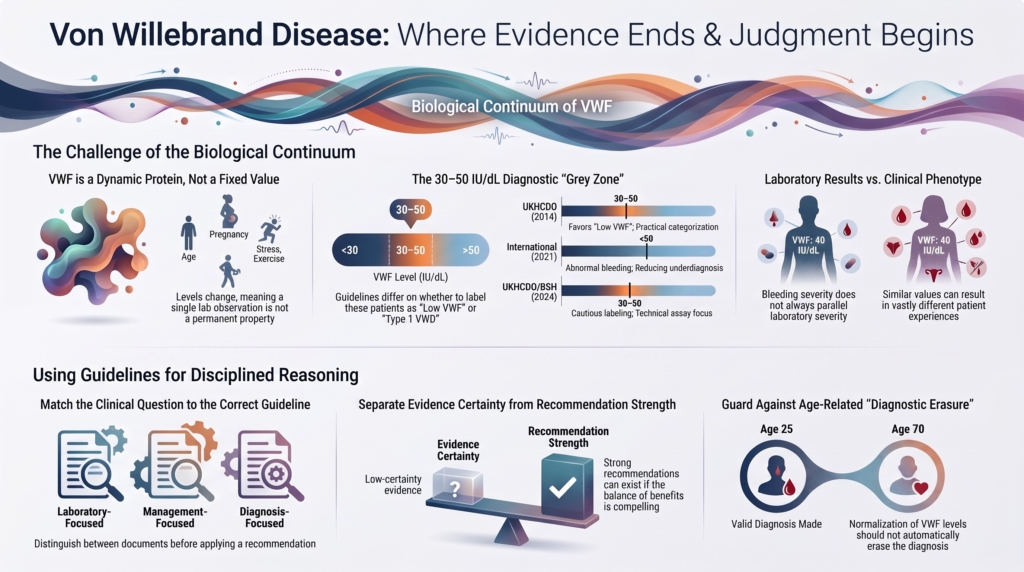
VWF exists along a continuum rather than falling naturally into “normal” and “abnormal.” Its concentration changes with age, pregnancy, inflammation, physiologic stress, exercise, acute bleeding, and comorbid illness. Laboratory assays measure different aspects of VWF biology and may not always agree. Bleeding severity does not invariably parallel laboratory severity. Patients with similar laboratory values may have remarkably different clinical phenotypes.
The clinician is therefore confronted with a recurring tension:
The guideline requires categories.
The patient presents a continuum.
The purpose of a guideline is not to eliminate this tension.
It is to help clinicians navigate it in a disciplined, transparent, and evidence-informed way.
Clinical practice guidelines do not replace clinical reasoning. They discipline it.
Why guidelines exist
Medicine continually balances two competing risks.
The first is inconsistency.
Without shared guidance, similar patients may undergo different diagnostic evaluations, receive different diagnoses, or be offered different treatments depending on where they are seen or who evaluates them.
The second is rigidity.
If every patient is forced into predefined categories, clinically important differences in biology, phenotype, values, and circumstances may be overlooked.
Clinical practice guidelines seek to reduce the first risk without creating the second.
Modern guidelines do far more than summarize expert opinion. They begin with clearly defined clinical questions, systematically review the available evidence, assess its certainty, and weigh the balance of benefits and harms together with patient values and preferences, feasibility, acceptability, resource use, and health equity.1
Two related—but distinct—concepts emerge from this process.
Certainty of evidence reflects confidence that the available evidence estimates the true effect.
Strength of recommendation reflects how strongly a particular course of action should be favored after considering not only the evidence but also benefits and harms, patient values, feasibility, resource implications, and other decision factors.
The two are related, but they are not synonymous.
A strong recommendation may occasionally be justified despite low-certainty evidence when the balance of consequences is compelling.
Conversely, relatively robust evidence may still support only a conditional recommendation when reasonable patients could choose different options based on their individual circumstances or preferences.
Perhaps the greatest contribution of a modern guideline is therefore not that it tells clinicians what to do.
It is that it makes the reasoning behind the recommendation visible.
Why von Willebrand disease challenges guidelines
Few disorders illustrate the tension between continuous biology and categorical clinical decision-making more clearly than VWD.
The challenge begins with the molecule itself.
VWF is not a fixed personal characteristic like blood group.
It is a dynamic plasma protein whose measured concentration changes across time and circumstance.
Acute bleeding and the associated physiologic stress may temporarily increase VWF, obscuring a lower baseline value.
Pregnancy often raises both VWF and factor VIII, particularly in type 1 VWD.
After delivery, those levels fall toward baseline.
A value measured at age 25 may differ substantially from one measured at age 70.
The laboratory result is therefore an observation made under specific biological conditions, not a permanent property of the patient.
The second challenge is that VWF levels are continuously distributed throughout the population.
There is no natural biological cliff at 30 IU/dL or 50 IU/dL.
Diagnostic thresholds are indispensable. They facilitate communication, standardize research, guide treatment, and determine eligibility for care.
But they remain clinical tools, not biological truths.
This distinction is illustrated by the evolution of diagnostic frameworks.
The numerical values themselves changed little.
What changed was the diagnostic meaning assigned to patients with VWF levels between approximately 30 and 50 IU/dL.
The 2014 UKHCDO guideline formalized the practical category of low VWF, recognizing that moderately reduced VWF may contribute to bleeding without necessarily representing classic type 1 VWD. In contrast, the 2021 international diagnosis guideline recommends diagnosing type 1 VWD in patients with abnormal bleeding whose VWF level is below 50 IU/dL, while retaining a threshold below 30 IU/dL regardless of bleeding phenotype.2
The biology did not change.
The interpretation of that biology did.
The third challenge is the bleeding phenotype.
One patient with a VWF activity of 25 IU/dL may experience relatively little spontaneous bleeding.
Another with a value of 40 IU/dL may have lifelong heavy menstrual bleeding, recurrent iron deficiency, postpartum hemorrhage, and excessive bleeding after surgery.
The laboratory value matters.
It does not explain the entire phenotype.
Finally, clinically significant VWD is an uncommon and biologically heterogeneous disorder. Its subtypes differ in mechanism, laboratory findings, treatment response, and bleeding expression. Large randomized trials are difficult to perform, patient populations are small, outcome definitions vary, and many recommendations necessarily rely on observational studies, indirect evidence, or expert consensus.
This is not simply a limitation of guideline development.
It is a consequence of the disease itself.
Biology creates uncertainty before evidence ever begins.
From grading evidence to making decisions
The evolution of VWD guidelines has not been a progression from opinion to evidence.
It has been a progression toward greater transparency about uncertainty.
The NHLBI Expert Panel report (2008) already graded evidence, acknowledged important limitations, and explicitly recognized the continuing role of clinical judgment.3
The UKHCDO guideline (2014) likewise adopted GRADE terminology and openly discussed diagnostic ambiguity, particularly among patients with VWF levels between 30 and 50 IU/dL.4
The major advance of the 2021 international guidelines was not the discovery of uncertainty.
It was the development of a more systematic framework for expressing it.
Recommendations were explicitly linked to evidence certainty, recommendation strength, patient values, implementation considerations, and Evidence-to-Decision frameworks.
The distinction between recommendation categories also became clearer.
A strong recommendation indicates that most informed patients would choose the recommended course of action and that clinicians can usually adopt it as standard practice.
A conditional recommendation—historically referred to as a weak recommendation—recognizes that different informed patients may reasonably choose different approaches depending on their clinical circumstances and personal values.5
A conditional recommendation is therefore not an absence of guidance.
It identifies situations in which the decision-making process becomes as important as the decision itself.
Modern guidelines do not eliminate uncertainty.
They identify where it remains, how much confidence we should place in the evidence, and what factors should influence the final clinical decision.
How the major guidelines differ in purpose
The major VWD guidelines overlap, but they are not interchangeable.
Each was written for a particular time, audience, method, and clinical purpose.
A broad management report cannot be expected to provide the technical detail of a laboratory guideline.
A laboratory guideline cannot answer every question about long-term treatment.
A formal international guideline built around selected priority questions is not the same as a comprehensive clinical manual.
Understanding these differences is essential because a recommendation should not be extrapolated beyond the question it was designed to answer.
The NHLBI Expert Panel report
The 2008 NHLBI Expert Panel report established a broad framework for the diagnosis and management of VWD in the United States.
It integrated:
- bleeding history
- initial laboratory testing
- subtype evaluation
- desmopressin
- VWF replacement
- surgery
- pregnancy
- acquired von Willebrand syndrome
Its importance is both historical and practical.
Many of the field’s central problems were already clearly recognized:
- bleeding symptoms are common in the general population
- no single screening test excludes VWD
- laboratory and clinical phenotypes may diverge
- VWF levels between approximately 30 and 50 IU/dL are difficult to interpret
- treatment must be matched to subtype, bleeding phenotype, and hemostatic challenge
The report graded evidence and openly acknowledged that much of the field rested on limited data and expert judgment.6
Its principal limitation is not that it lacked rigor.
It is that it predates the current international GRADE framework, widespread adoption of newer platelet-dependent activity assays, and contemporary approaches to genetic-variant interpretation.
It remains a foundational document, but not the final authority on every modern assay or diagnostic threshold.
The Nordic guidance
The Nordic guidance emphasized practical diagnosis and management within specialist hemophilia-center systems.
Its value lies less in methodological innovation than in showing how VWD care can be operationalized through:7
- repeat testing
- centralized laboratory expertise
- subtype classification
- desmopressin assessment
- perioperative planning
- pregnancy management
- longitudinal specialist follow-up
This makes it a useful example of guideline implementation in a defined healthcare system.
Its procedural targets and diagnostic cutoffs should be interpreted in light of later international and laboratory guidance.
The UKHCDO guideline
The 2014 UKHCDO guideline gave practical prominence to the concept of low VWF.
For many patients with VWF levels between approximately 30 and 50 IU/dL, the guideline favored treating reduced VWF as a bleeding risk factor rather than automatically classifying every symptomatic patient as having type 1 VWD.
This distinction reflected several concerns.
A disease label may improve recognition, procedural planning, and access to specialist care.
It may also:
- lead clinicians to attribute all bleeding to VWF
- discourage evaluation for an additional hemostatic disorder
- affect insurance or healthcare documentation
- alter family testing
- shape the patient’s understanding of their health and future risk
The UKHCDO guideline therefore emphasized both phenotype and laboratory findings while warning against premature diagnostic closure.8
The guideline did not originate the biological observation that moderately reduced VWF differs from severe quantitative deficiency.
It formalized that distinction into a practical diagnostic category.
The 2021 international diagnosis guideline
The ASH/ISTH/NHF/WFH 2021 guidelines on the diagnosis of von Willebrand disease, referred to hereafter as the 2021 international diagnosis guideline, addressed 11 prioritized clinical questions using systematic evidence review and GRADE methodology.
Its recommendations include:9
- use of bleeding assessment tools at different pretest probabilities
- preference for newer platelet-dependent VWF activity assays
- approach to VWF levels that normalize with age
- diagnostic thresholds for type 1 VWD
- assessment of increased VWF clearance
- activity-to-antigen ratios
- multimer and collagen-binding analysis
- genetic testing for type 2B
- FVIII-binding assays or genetic testing for type 2N
Its diagnostic threshold for type 1 VWD is especially influential:
- VWF below 30 IU/dL, regardless of bleeding phenotype; or
- VWF below 50 IU/dL in a patient with abnormal bleeding
supports the diagnosis, provided the laboratory findings are valid and the pattern is consistent with a quantitative VWF defect.
This framework places substantial value on reducing underdiagnosis and preserving access to care.
It does not imply that all patients between 30 and 50 IU/dL have identical biology, penetrance, or future bleeding risk.
The 2021 international management guideline
The companion 2021 international management guideline addresses selected priority questions rather than every aspect of VWD treatment.
It provides recommendations on:10
- long-term prophylaxis in patients with frequent severe bleeding
- desmopressin trials
- antithrombotic therapy when clinically indicated
- target levels for major surgery
- management of selected minor procedures
- heavy menstrual bleeding
- neuraxial anesthesia
- postpartum tranexamic acid
Its strength lies in the transparency of its evidence-to-decision process.
Its limitation is equally important:
it is not a comprehensive treatment manual.
It does not fully address every question involving:
- product selection
- pregnancy outside its prioritized questions
- recurrent gastrointestinal bleeding
- angiodysplasia
- inhibitors
- refractory bleeding
- complex longitudinal care
- treatment failure
The absence of a recommendation does not imply that the problem is unimportant.
It may simply mean that the question lay outside the guideline’s selected scope.
The 2024 joint UKHCDO/BSH laboratory guideline
The 2024 joint UKHCDO/BSH laboratory guideline is the most detailed contemporary resource for the laboratory diagnosis and monitoring of VWD.
It addresses:11
- specimen collection
- citrate concentration
- transport conditions
- processing time
- assay-specific performance
- activity-to-antigen ratios
- collagen binding
- multimer analysis
- FVIII-binding assays
- ristocetin-induced platelet agglutination
- VWF propeptide testing
- genetic analysis
- acquired von Willebrand syndrome
- treatment and pregnancy monitoring
Its central contribution is a reminder that interpretation begins before the sample reaches the analyzer.
Cold transport, delayed processing, physiologic stress, pregnancy, acute illness, assay imprecision, and interlaboratory variation can all alter the apparent phenotype.
The guideline is intentionally focused on laboratory diagnosis and monitoring.
It should not be treated as a comprehensive clinical-management guideline.
Where the guidelines differ
The major guidelines are complementary in scope.
They are not fully concordant.
The most visible disagreement concerns patients with VWF levels between approximately 30 and 50 IU/dL.
The 2014 UKHCDO framework commonly uses the term low VWF, reflecting caution about labeling all such patients as having type 1 VWD.
The 2021 international diagnosis guideline supports a diagnosis of type 1 VWD when VWF is below 50 IU/dL in a patient with abnormal bleeding.
The 2024 UKHCDO/BSH laboratory guideline remains cautious about unnecessary disease labeling in this range and emphasizes repeat testing, phenotype, assay reliability, and the possibility of additional hemostatic defects.12
This is not merely a dispute about vocabulary.
The diagnostic label may affect:
- access to treatment or specialist services in some healthcare systems
- procedural planning
- family evaluation
- insurance and medical documentation
- the patient’s understanding of their health and future risk
- whether clinicians continue looking for another cause of bleeding
The frameworks differ because they assign different weight to the competing risks of:
- underdiagnosis
- overdiagnosis
- restricted access to care
- diagnostic closure
- biological heterogeneity
Yet they share an essential principle:
A VWF value between 30 and 50 IU/dL cannot interpret itself.
It must be understood in relation to:
- the bleeding phenotype
- testing conditions
- assay performance
- repeat measurements
- family history
- subtype pattern
- competing diagnoses
- clinical consequences
The disagreement therefore illustrates the essay’s central theme.
Guidelines may differ in what they name the patient.
They agree that the number alone is insufficient.
What guidelines answer well
Guidelines are most useful when the clinical question is clearly defined and the relevant variables can be specified.
They can provide disciplined answers to questions such as:
- Which initial assays should be ordered?
- When should a bleeding assessment tool influence testing?
- Which platelet-dependent activity assay is preferred?
- When should an activity-to-antigen discrepancy prompt subtype evaluation?
- When are multimers, collagen binding, FVIII-binding studies, RIPA, or genetic testing useful?
- How should a desmopressin trial be performed and interpreted?
- What laboratory targets should be pursued for major surgery?
- How should selected minor procedures be managed?
- What options should be considered for heavy menstrual bleeding?
- How should third-trimester assessment, neuraxial anesthesia, and postpartum treatment be approached?
- When should VWF replacement be used in selected surgical, bleeding, or prophylactic settings?
Guidelines are particularly powerful when the recommendation is connected to the mechanism behind it.
Consider the preference for newer GPIb-binding assays over the traditional ristocetin cofactor assay.
These include:
- VWF:GPIbR, which remains ristocetin-dependent; and
- VWF:GPIbM, which uses gain-of-function GPIb and does not require ristocetin.
Both generally offer better precision and automation than traditional VWF:RCo, but their mechanisms are not identical.
The traditional ristocetin cofactor assay is vulnerable to:
- poor precision
- limited sensitivity at low levels
- substantial interlaboratory variation
- VWF sequence variants that alter ristocetin-dependent binding without producing an equivalent physiological defect
A falsely low VWF:RCo result may therefore create the appearance of disease—or of a qualitative VWF defect—precisely at the boundary where classification is already difficult.13
The recommendation to prefer newer activity assays is therefore not merely a technical preference.
It follows from how the older assay can fail.
A recommendation becomes easier to apply when its biological and methodological rationale is understood.
Where recommendations still require patient-specific interpretation
Guidelines provide more direction than the phrase “where evidence ends” might initially suggest.
They address:
- diagnostic thresholds
- pregnancy-associated increases in VWF
- normalization of VWF with age
- preferred activity assays
- subtype testing
- desmopressin trials
- major surgery
- heavy menstrual bleeding
- neuraxial anesthesia
- postpartum treatment
But a recommendation still rests on assumptions.
The clinician must determine whether those assumptions are valid for the patient in front of them.
When VWF normalizes with age
The 2021 international diagnosis guideline suggests reconsidering rather than removing a previously confirmed type 1 VWD diagnosis when VWF levels normalize with age.14
That recommendation already answers an important question:
A normalized value should not automatically erase an established diagnosis.
Its application still requires patient-specific interpretation.
The clinician must ask:
- Was the original diagnosis secure?
- Were the low values reproducible?
- Were samples obtained under appropriate conditions?
- Was the historical bleeding phenotype convincing?
- Were the assay methods reliable?
- Were alternative diagnoses considered?
- Has the phenotype changed?
- What future procedures or antithrombotic therapies are anticipated?
- What are the consequences of retaining or removing the diagnosis?
The guideline tells the clinician what not to do automatically.
It cannot reconstruct the patient’s history.
During pregnancy
Pregnancy provides another example.
A normal third-trimester VWF level does not erase an established diagnosis.
The current level is important for:
- delivery planning
- neuraxial anesthesia
- replacement decisions
- postpartum prophylaxis
The nonpregnant phenotype remains relevant because VWF and FVIII may decline rapidly after delivery.
The guideline can define a management framework.
The clinician must still interpret:
- baseline subtype
- prior bleeding
- current levels
- mode of delivery
- anesthesia plan
- postpartum risk
- access to monitoring and treatment
The value answers one question.
It does not answer the entire pregnancy.
When assays disagree
Guidelines also provide substantial direction when laboratory assays conflict.
They can recommend:
- repeating testing
- evaluating preanalytical conditions
- using a preferred platelet-dependent activity assay
- examining activity-to-antigen ratios
- obtaining collagen-binding studies
- performing multimer analysis
- considering RIPA or genetic testing
- assessing FVIII binding when type 2N is suspected
But the clinician must still determine which discordance is biologically meaningful.
A low ristocetin-dependent activity result with preserved GPIbM activity may reflect assay susceptibility rather than impaired platelet binding.
A low activity-to-antigen ratio with normal multimers may suggest type 2M.
A disproportionately low FVIII level may shift attention toward type 2N or hemophilia A.
A pattern that varies dramatically across laboratories may indicate methodological rather than biological instability.
Guidelines define the next tests.
Clinical reasoning integrates the pattern.
When phenotype and laboratory severity diverge
A patient may bleed more than expected from the measured VWF level.
Possible explanations include:
- underestimation of lifetime bleeding exposure
- gynecologic or structural causes
- iron deficiency amplifying symptom burden
- an additional platelet or coagulation disorder
- connective-tissue fragility
- medication effects
- assay values obtained during physiologic elevation
- modifiers that are not captured by standard VWF testing
The guideline may support the diagnosis.
It may not fully explain the phenotype.
The correct response is not to reject the guideline or dismiss the patient.
It is to identify what remains unexplained.
Clinical reasoning does not replace a guideline answer. It tests its applicability, completeness, and consequences.
Reading a guideline critically
A recommendation should not be read as an isolated sentence.
Its meaning depends on:
- the clinical question
- the intended population
- the certainty of evidence
- the recommendation strength
- the remarks
- the document’s scope
- the assumptions required for implementation
A practical reading framework begins with several questions.
What kind of document is this?
Is it primarily a:
- diagnostic guideline
- management guideline
- laboratory guideline
- expert consensus statement
- practical regional handbook
The distinction matters.
A laboratory guideline may define how to perform and interpret an assay without determining whether treatment is indicated.
A management guideline may answer selected procedural questions without addressing long-term follow-up.
A regional handbook may provide highly practical advice shaped by a particular healthcare system.
Scope is part of the recommendation.
What clinical question was actually asked?
Guidelines are usually organized around specific questions.
A recommendation about neuraxial anesthesia does not answer every question about pregnancy.
A recommendation about major surgery does not automatically determine the approach to every minor procedure.
A recommendation about diagnostic thresholds does not fully explain why one patient bleeds more than another.
Before applying a recommendation, ask:
Is this the question my patient is actually presenting?
How certain is the evidence?
Evidence certainty reflects confidence in the estimated effect.
Low certainty does not mean no evidence.
High certainty does not guarantee that every patient should receive the same intervention.
The reader should examine:
- study design
- indirectness
- imprecision
- inconsistency
- risk of bias
- applicability to the current patient
Is the recommendation strong or conditional?
A strong recommendation generally supports a common course of action for most informed patients.
A conditional recommendation indicates that reasonable choices may differ.
It should prompt attention to the factors that may shift the decision:
- bleeding phenotype
- procedure
- age
- comorbidity
- treatment burden
- convenience
- cost
- access
- values
- thrombosis risk
A conditional recommendation does not mean that the clinician may choose arbitrarily.
It means that the reasons for the choice should be made explicit.
What assumptions appear in the remarks?
The remarks are not supplementary decoration.
They may define:
- the population to which the recommendation applies
- required laboratory conditions
- important exceptions
- implementation barriers
- circumstances in which another approach is reasonable
The 2021 international guidelines explicitly state that their remarks and qualifying statements are integral to interpretation.15
Reading only the bold recommendation may remove the very information needed to apply it safely.
Does this patient resemble the population addressed?
A recommendation derived largely from adults with established bleeding exposure may not apply identically to a child who has never undergone surgery or menstruated.
A recommendation based on type 1 VWD may not generalize to type 2B or type 3.
A result obtained during acute bleeding may not reflect baseline physiology.
A patient with substantial cardiovascular disease may face a different risk balance from the population represented in the evidence.
Applicability is not assumed. It is assessed.
What remains uncertain after the recommendation is applied?
A guideline may tell you that the laboratory findings support type 1 VWD.
It may not tell you whether VWD fully explains the phenotype.
It may tell you to achieve specified VWF and FVIII levels for major surgery.
It may not tell you the best strategy in a patient with rapid clearance, poor recovery, angiodysplasia, or high thrombosis risk.
It may recommend reconsidering rather than removing an older diagnosis.
It cannot determine whether the original diagnosis was valid without reviewing the historical evidence.
The final question is therefore:
What uncertainty remains, and does it matter for this patient?
A guideline narrows the field of uncertainty. It does not necessarily close it.
The module as an exercise in guideline application
This spoke is not separate from the rest of the VWD module.
It explains why the module repeatedly asks the learner to move from:
- value to pattern
- pattern to mechanism
- mechanism to phenotype
- phenotype to decision
The companion Low VWF case study follows a patient at the boundary between quantitative deficiency, diagnostic terminology, treatment response, and longitudinal reassessment.
The VWD self-assessment asks the learner to interpret:
- discordant platelet-dependent activity assays
- borderline activity-to-antigen ratios
- changing VWF values
- age-related normalization
- phenotypes that do not fit neatly inside a single category
Those exercises do not ask the learner to ignore the guidelines.
They ask the learner to use them correctly.
The essay states the principle.
The self-assessment makes the learner apply it.
The case shows what happens when the principle meets a real patient.
Clinical synthesis
Clinical practice guidelines represent the best structured synthesis of current evidence and expert judgment.
They are indispensable.
They are also bounded by:
- the questions they ask
- the populations they study
- the outcomes they prioritize
- the assays available when they are written
- the certainty of the underlying evidence
- the healthcare systems in which they are intended to operate
VWD makes those boundaries especially visible.
It reminds clinicians that:
- VWF levels move
- diagnostic thresholds are constructed
- assays have mechanisms and failure modes
- bleeding phenotypes vary
- certainty of evidence and strength of recommendation are not the same
- different guidelines may assign different meaning to the same numerical range
- a recommendation may be clear while its application remains patient-specific
The guideline tells us what is generally recommended.
Clinical reasoning determines whether that recommendation is valid, sufficient, and appropriate here.
The purpose of a guideline is not to eliminate judgment. It is to make judgment more disciplined, transparent, and defensible.
Evidence anchor
| Guideline or evidence stream | What it decides well | What it leaves to clinical interpretation | Main limitation |
|---|---|---|---|
| NHLBI Expert Panel report, 200816 | Established a broad diagnostic and management framework, including bleeding assessment, initial laboratory testing, subtype evaluation, desmopressin, VWF replacement, surgery, and pregnancy. | How newer assays, current thresholds, and contemporary genetic interpretation should modify the original framework. | Predates the current international GRADE framework, widespread use of newer platelet-dependent activity assays, and contemporary genetic standards. |
| Nordic guidance, 201117 | Provides a pragmatic specialist-center approach to repeat testing, subtype diagnosis, desmopressin assessment, procedures, and pregnancy. | How older cutoffs and procedural targets should be adapted to current assays and later international recommendations. | Regional and partly consensus-based; predates major contemporary guideline updates. |
| UKHCDO guideline, 201418 | Formalized and promoted the low VWF category and combined bleeding phenotype with laboratory thresholds and subtype assessment. | Whether a patient in the 30-to-50-IU/dL range is best labeled low VWF or type 1 VWD, and whether another bleeding modifier is present. | Predates the 2021 international recommendations and current laboratory guidance. |
| 2021 international diagnosis guideline19 | Provides transparent recommendations on bleeding assessment tools, initial assays, diagnostic thresholds, age-related normalization, type 1C, activity-to-antigen ratios, and selected subtype testing. | Whether the documented phenotype is fully explained by VWF, how local terminology should be applied, and how the consequences of labeling should be managed. | Addresses 11 prioritized questions rather than every aspect of diagnosis and longitudinal reassessment; several recommendations rest on low- or very-low-certainty evidence. |
| 2021 international management guideline20 | Provides evidence-to-decision guidance for selected questions involving prophylaxis, desmopressin trials, procedures, heavy menstrual bleeding, neuraxial anesthesia, and postpartum tranexamic acid. | Product selection, many complex bleeding situations, inhibitors, refractory gastrointestinal bleeding, and detailed longitudinal management. | Covers selected prioritized questions rather than the full management spectrum; many recommendations are conditional. |
| Joint UKHCDO/BSH laboratory guideline, 202421 | Provides detailed direction on preanalytical conditions, assay selection, ratios, collagen binding, multimer analysis, RIPA, FVIII binding, genetics, and monitoring. | How the laboratory phenotype should be integrated with lifetime bleeding, treatment consequences, and competing diagnoses. | Focuses on laboratory diagnosis and monitoring; broader clinical management is outside its stated scope. |
| Expert reports and reviews22 | Show how experienced clinicians approach gaps involving surgery, prophylaxis, product selection, and difficult bleeding phenotypes. | Whether expert practice can be generalized beyond the settings, products, and healthcare systems discussed. | Lower methodological authority than a formal systematic guideline; may reflect regional practice and expert selection. |
Clinical guidance: using a VWD guideline well
Begin with the clinical question
Do not begin by searching the document for a preferred answer.
First define the decision:
- Is the question diagnosis, classification, laboratory validity, procedural management, pregnancy, treatment selection, or longitudinal reassessment?
- Which guideline was designed to address that question?
- Is the issue actually covered, or are you extrapolating beyond the document’s scope?
A precise question is the first safeguard against misusing a recommendation.
Distinguish certainty of evidence from strength of recommendation
These concepts are related, but they are not interchangeable.
A recommendation may be strong despite low-certainty evidence when the balance of consequences is compelling.
A recommendation may be conditional because patient values, risks, burdens, resources, or feasible alternatives vary.
Read both dimensions.
Read the recommendation with its remarks
The remarks may define:
- who the recommendation applies to
- which testing conditions are assumed
- which exceptions matter
- what implementation barriers exist
- where an alternative approach may be reasonable
Quoting the recommendation without its qualifications may change its meaning.
Match the patient to the population
Ask whether the patient resembles those represented in the evidence.
Pay particular attention to:
- age
- prior hemostatic challenges
- VWD subtype
- bleeding exposure
- pregnancy
- comorbidity
- thrombosis risk
- local assay methodology
- access to monitoring and treatment
Applicability should be demonstrated, not assumed.
Interpret values as patterns
Do not interpret VWF activity, VWF antigen, FVIII, or ratios in isolation.
Ask:
- Is the reduction proportional?
- Is there an activity-to-antigen discrepancy?
- Is FVIII disproportionately low?
- Are the results reproducible?
- Were samples obtained at baseline health?
- Could stress, inflammation, pregnancy, or acute bleeding have elevated VWF?
- Could preanalytical or assay factors explain the pattern?
- Does the phenotype fit the proposed mechanism?
Use shared decision-making when the decision is preference-sensitive
Shared decision-making is especially important for:
- heavy menstrual bleeding therapy
- long-term prophylaxis
- neuraxial anesthesia
- antithrombotic therapy
- reconsideration of an older diagnosis
- treatment choices with different burdens, risks, or routes of administration
It does not mean that diagnostic classification becomes a matter of preference when valid findings clearly satisfy the applicable diagnostic framework.
Identify what the guideline has not answered
After applying the recommendation, ask:
What uncertainty remains, and does it matter for this patient?
The remaining uncertainty may concern:
- whether VWD fully explains the phenotype
- whether another disorder is present
- how durable a treatment response will be
- whether current values reflect baseline biology
- how much hemostatic support a particular procedure requires
- how the balance of bleeding and thrombosis risk changes over time
Practical takeaway: A guideline should narrow uncertainty, reveal assumptions, and improve consistency. It should not substitute for verifying the phenotype, the sample, the assay, the mechanism, and the patient-specific consequences of the decision.
Reflect & Apply Case
A 67-year-old woman was diagnosed with type 1 VWD at age 24 after lifelong heavy menstrual bleeding, recurrent epistaxis, iron deficiency, and excessive bleeding following dental extraction.
Historical records show:
- VWF antigen values of 26 and 31 IU/dL
- platelet-dependent activity values of 24 and 29 IU/dL
- results obtained on separate occasions
- a proportional reduction in activity and antigen
She had a satisfactory desmopressin response and subsequently received procedural prophylaxis without excessive bleeding.
She is now being evaluated before major surgery.
Her current results are:
- VWF antigen: 78 IU/dL
- VWF activity: 74 IU/dL
- FVIII activity: 96 IU/dL
Does she still have VWD?
The guideline provides an answer to part of the question.
The 2021 international diagnosis guideline suggests reconsidering rather than removing the diagnosis in a patient with previously confirmed type 1 VWD whose VWF levels normalize with age.23
That means the current value should not automatically erase the historical diagnosis.
Clinical reasoning must then establish whether the recommendation applies:
- Was the original diagnosis secure?
- Were the historical values reproducibly low?
- Were the samples obtained under appropriate conditions?
- Did the laboratory pattern support a proportional quantitative deficiency?
- Was the bleeding phenotype clinically meaningful?
- Were alternative diagnoses considered?
- Did the desmopressin response provide useful corroborative information and establish a treatment option?
- What does the current VWF level imply for this operation?
- What is the procedure-specific bleeding risk?
- How long will postoperative bleeding risk persist?
- What is the patient’s thrombosis risk?
- Can VWF and FVIII be monitored perioperatively?
In this patient, the historical diagnosis appears well supported.
Her current normal values do not invalidate the documented earlier phenotype.
They may, however, reduce or alter the hemostatic support required for the present operation.
That decision should be based on:
- the nature of the surgery
- the prior bleeding phenotype
- current VWF and FVIII levels
- the prior desmopressin response
- anticipated postoperative risk
- thrombosis risk
- capacity for serial monitoring
The historical diagnosis should not automatically dictate the same prophylaxis used decades earlier.
Nor should the current values be allowed to erase the past.
The guideline has answered the general question and shown the clinician where the remaining work lies.
Test your thinking
An interactive quiz for this topic is being developed and will be added soon.