
Protecting the clot after it forms
Note: The video and audio linked above were generated with the assistance of AI. Clinical accuracy has been reviewed, but no AI-generated content can be guaranteed to be fully error-free.
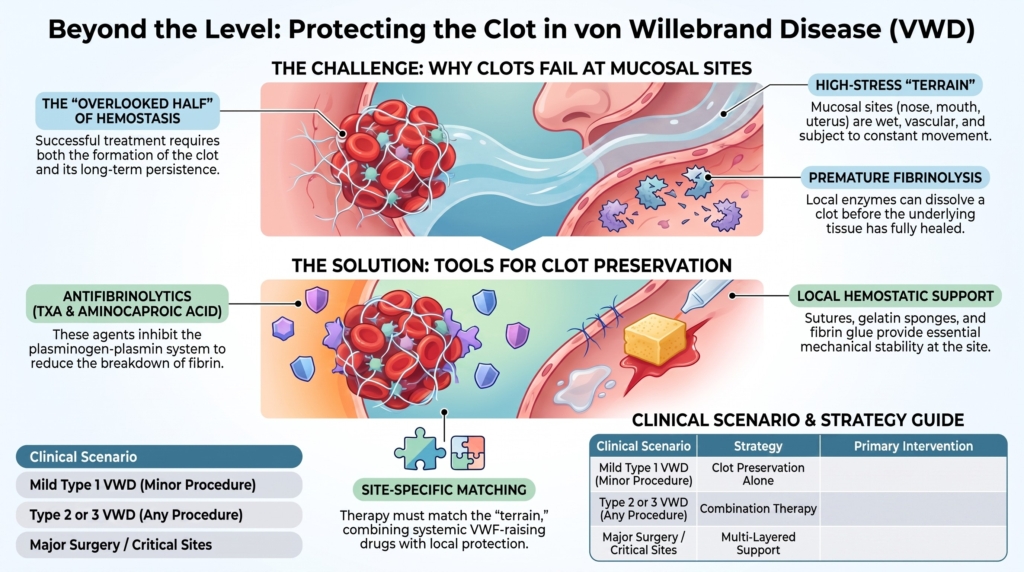
Why this spoke matters
VWD treatment is often framed as raising VWF.
Desmopressin releases it. Concentrates replace it. Laboratory monitoring measures it.
But raising VWF is only part of hemostasis.
A clot must form, and then it must survive.
That is especially important in VWD because many of the most common bleeding sites are mucosal: the nose, mouth, uterus, gastrointestinal tract, dental sockets, and postpartum tissue beds. These are not quiet surfaces. They are wet, mobile, vascular, exposed, and often fibrinolytic.
A clot that forms there may dissolve, loosen, or wash away before healing is complete.
Antifibrinolytics and local hemostatic measures address this part of the problem. They do not ask, “How do we raise the VWF level?” They ask, “How do we protect the clot after it forms?”
The overlooked half of treatment
Hemostasis requires formation and persistence.
First, the system must recognize injury. Platelets must adhere. Coagulation must stabilize the plug. Then the clot must persist long enough for repair.
VWF is central to early platelet capture and factor VIII stabilization. But once a clot forms, the local environment matters. At mucosal surfaces, fibrinolysis can be prominent and mechanical disruption can be frequent. Saliva, menstrual flow, nasal secretions, uterine involution, chewing, coughing, and local tissue movement can all challenge clot stability.
This is why antifibrinolytics are not minor add-ons.
They treat a different part of the bleeding process.
Desmopressin and VWF replacement help build the clot. Antifibrinolytics help preserve it. Local measures help hold it in place.
What antifibrinolytics do
Tranexamic acid and aminocaproic acid inhibit fibrinolysis. They interfere with the plasminogen-plasmin system, reducing breakdown of fibrin.
The goal is not to make a new clot from nothing.
The goal is to prevent premature clot dissolution.
This is why these agents are especially useful at mucosal sites, where fibrinolytic activity is high.1
An important caution is upper urinary tract bleeding or hematuria of uncertain origin, where antifibrinolytics may promote obstructing clots.2
Antifibrinolytics reduce fibrin breakdown. They do not correct platelet adhesion, VWF deficiency, FVIII deficiency, or local structural lesions.
They are supportive therapies in the best sense.
They support the clot while the tissue heals.
Why mucosal bleeding is different
Mucosal bleeding is common in VWD because VWF is especially important for primary hemostasis. But mucosal bleeding is difficult not only because the clot is hard to form. It is also difficult because the clot is hard to keep.
Nasal bleeding recurs because the surface is exposed and easily traumatized. Oral bleeding persists because saliva, chewing, and speech disturb the clot. Dental extraction sites remain vulnerable after the procedure is over. Heavy menstrual bleeding reflects repeated endometrial shedding and repair. Postpartum bleeding occurs in a tissue bed undergoing rapid physiologic remodeling.
GI bleeding deserves special caution. Antifibrinolytics may be adjunctive for some mucosal bleeding, but recurrent GI bleeding in VWD, especially angiodysplasia-associated bleeding, often requires broader evaluation and VWF-directed or other strategies.
Each setting has its own local terrain.
Antifibrinolytics and local measures matter because they treat the terrain.
Tranexamic acid: the central antifibrinolytic
Tranexamic acid is the best-known antifibrinolytic used in VWD. It can be given orally, intravenously, or topically depending on the situation.
It is commonly used for:
- dental procedures
- oral bleeding
- epistaxis
- heavy menstrual bleeding
- minor mucosal procedures
- postpartum bleeding
- adjunctive support around surgery or procedures
The 2021 ASH/ISTH/NHF/WFH management guideline suggests adding tranexamic acid when VWF activity is increased to hemostatic levels with desmopressin or factor concentrate for minor surgery or minor invasive procedures.3
The same guideline suggests tranexamic acid alone rather than raising VWF levels in selected patients with type 1 VWD, baseline platelet-dependent VWF above 0.30 IU/mL, mild bleeding phenotype, and minor mucosal procedures.4
That recommendation makes an important conceptual point: not every bleeding challenge requires correction of VWF. Sometimes protecting the clot is the most proportional intervention.
But the selection criteria matter. Tranexamic acid alone should not be generalized to type 2 VWD, type 3 VWD, major procedures, critical-site surgery, or patients with significant prior bleeding.
Aminocaproic acid: another way to protect the clot
Aminocaproic acid is another antifibrinolytic option. It is less often centered in modern discussion than tranexamic acid, but it remains useful in some settings.
The 2021 guideline acknowledges aminocaproic acid as a reasonable alternative, particularly as an oral rinse in dental procedures or as a liquid formulation in pediatric patients.5
This is practical hematology. The “best” treatment is not only the one with the cleanest mechanism. It is the one the patient can use correctly, safely, and at the site where bleeding occurs.
Dental and oral bleeding: site-specific hemostasis
Dental procedures are a classic setting where antifibrinolytics and local measures matter. The injury is local, the surface is mucosal, saliva disrupts clot stability, chewing and speech create mechanical stress, and the fibrinolytic environment is active.
A plan may include:
- tranexamic acid or aminocaproic acid rinse
- systemic antifibrinolytic therapy
- gelatin sponge
- fibrin glue
- suturing
- pressure
- avoidance of traumatic technique
- coordination with the dental proceduralist
- VWF-raising therapy when needed
Guidelines explicitly note that dental proceduralists may consider local hemostatic measures, such as gelatin sponges, fibrin glue, and tranexamic acid rinse, as part of an individualized procedural plan.6
Dental hemostasis is a multidisciplinary task.
This is not cosmetic detail.
It is mechanism at the surface.
If bleeding is local, part of the treatment must be local.
Epistaxis: the clot has to survive the nose
Epistaxis is common in VWD. It is also common in people without VWD. That makes interpretation difficult.
But once epistaxis is clinically meaningful, treatment must account for local anatomy. The nasal mucosa is exposed, fragile, vascular, and easily re-injured.
A plan may include humidification, nasal emollients, avoidance of trauma, topical vasoconstrictors when appropriate, pressure technique, cautery for focal lesions, topical antifibrinolytic use in selected settings, systemic antifibrinolytic therapy for recurrent mucosal bleeding, and VWF-directed therapy when bleeding is severe or recurrent.
The key is to avoid treating epistaxis only as a systemic factor problem.
Sometimes the missing intervention is not more VWF, but better local control.
Heavy menstrual bleeding: where antifibrinolytics fit
Heavy menstrual bleeding is one of the most important manifestations of VWD. Antifibrinolytics are central here because menstrual bleeding is a recurrent mucosal bleeding challenge.
The 2021 ASH/ISTH/NHF/WFH guideline suggests either hormonal therapy or tranexamic acid over desmopressin for women with VWD and heavy menstrual bleeding who do not wish to conceive, and suggests tranexamic acid over desmopressin for those who wish to conceive.7
But this section is not meant to cover all management of heavy menstrual bleeding. That belongs in its own spoke. Here, the point is narrower: antifibrinolytics are often useful because menstrual bleeding is not only a VWF-level problem. It is also a recurring clot-stability problem.
In many patients with HMB, clot protection and cycle control matter more than episodic factor correction.
Iron deficiency must still be assessed and treated. The guideline emphasizes that iron deficiency and iron-deficiency anemia are associated with adverse outcomes, including reduced health-related quality of life, and that patients with heavy menstrual bleeding should be regularly assessed and treated for iron deficiency and anemia.8
Gynecologic evaluation also matters when symptoms are severe, atypical, persistent, or not explained by the bleeding disorder alone.
VWD may explain bleeding tendency.
It does not exclude uterine pathology.
Postpartum bleeding: antifibrinolytics in a vulnerable interval
The postpartum period is one of the clearest examples of why VWD treatment requires timing.
VWF and FVIII often rise during pregnancy and fall after delivery. Bleeding risk may therefore increase after the moment that looked reassuring.
Tranexamic acid has a role in postpartum management. The 2021 ASH/ISTH/NHF/WFH guideline suggests use of tranexamic acid over not using it in women with type 1 VWD or low VWF levels during the postpartum period, and notes that this may also apply to type 2 and type 3 VWD.9
This should not be read as saying tranexamic acid alone covers all postpartum risk. Patients with type 2 or type 3 VWD may also need VWF-directed therapy depending on VWF and FVIII levels, delivery factors, bleeding history, and clinical risk.
The same guideline provides a good-practice dosing statement for oral tranexamic acid postpartum and highlights the need to educate breastfeeding patients about benefits and safety considerations.10
The deeper lesson is that postpartum care is not only about delivery. It is about the days and weeks after delivery, when clot stability and falling VWF levels may collide.
When antifibrinolytics are enough
Sometimes antifibrinolytic therapy may be the main intervention.
This is most plausible when the challenge is a minor mucosal procedure, the patient has type 1 VWD or low VWF, baseline VWF activity is not severely reduced, the bleeding phenotype is mild, local measures are available, and there is no need for sustained systemic correction.
This does not mean tranexamic acid is “weak therapy.”
It means the intervention matches the problem.
If the clot can form but is likely to dissolve or dislodge, protecting it may be exactly the right strategy.
When antifibrinolytics are not enough
Antifibrinolytics do not replace VWF. They do not correct absent VWF, provide FVIII, fix platelet adhesion, or make a high-risk procedure low-risk by themselves.
They are unlikely to be sufficient alone when VWF is severely deficient, type 3 VWD is present, major surgery is planned, critical-site bleeding risk exists, active bleeding is severe, type 2 disease requires functional VWF replacement, prior bleeding history is significant, or the site requires sustained systemic hemostatic support.
In those settings, antifibrinolytics may still be useful.
But they are adjuncts.
They protect the clot.
They do not build the VWF scaffold needed to form it.
The thrombotic and site-specific safety question
Antifibrinolytics are generally well tolerated in short-term mucosal bleeding settings, but their use still requires attention to site, duration, and competing thrombotic risk.
In most VWD mucosal bleeding situations, they are attractive because they do not raise VWF or FVIII levels. But caution is appropriate when thrombotic risk is high, when antifibrinolytics are combined with prolonged high VWF and FVIII levels, or when bleeding arises from the urinary tract.
The 2021 management guideline notes that in patients at higher risk of thrombosis, it may be desirable to avoid extended periods of very high VWF and FVIII levels combined with extended tranexamic acid use.11
Reviews also caution against antifibrinolytic treatment in hematuria of unknown origin or renal or ureteral bleeding because clot formation in the urinary tract may cause obstruction.12
The right lesson is not fear.
It is context.
A drug that is ideal for oral mucosa may be inappropriate for upper-tract bleeding.
Site matters.
No routine laboratory monitor
Unlike VWF replacement or desmopressin, antifibrinolytics do not have a simple laboratory response marker in ordinary VWD care.
There is no routine VWF activity target for tranexamic acid. No usual “tranexamic acid level” guides mucosal bleeding control.
Monitoring is clinical:
- Is bleeding slowing?
- Is the site stable?
- Is the patient tolerating therapy?
- Is hemoglobin stable?
- Is iron deficiency improving?
- Is bleeding recurring when therapy stops?
For gastrointestinal bleeding, epistaxis, and oral cavity bleeding, reviews describe antifibrinolytics as adjunctive therapy but note that there is no routine laboratory means of monitoring this therapy.13
That matters because it returns the clinician to the patient.
The lab can tell you VWF rose.
The patient tells you whether the clot held.
Local measures are treatment, not decoration
Local measures are sometimes treated as procedural housekeeping.
They should not be.
In mucosal bleeding, they may determine whether systemic therapy succeeds.
Examples include:
- nasal humidification and emollients
- pressure and topical therapy for epistaxis
- dental packing
- suturing
- gelatin sponge
- oxidized cellulose
- fibrin glue
- tranexamic acid rinse
- topical antifibrinolytic approaches
- uterine-directed therapy
- gynecologic procedures when indicated
- endoscopic treatment of accessible GI lesions
Local measures are active hemostatic therapy.
If bleeding is local, therapy must respect the site.
A systemic plan without local hemostasis may fail.
A local plan without systemic support may also fail.
Good care often requires both.
Combination therapy as terrain-matching
Antifibrinolytics often work best as part of combination therapy.
A dental extraction in type 1 VWD may use desmopressin, tranexamic acid rinse, suturing, and packing. A minor mucosal procedure in mild type 1 VWD may use tranexamic acid alone. Major surgery may use VWF replacement plus postoperative monitoring, with antifibrinolytics depending on site and thrombotic risk. Heavy menstrual bleeding may use tranexamic acid as one layer within a broader menstrual and iron plan. Postpartum care may use VWF-directed therapy when needed plus tranexamic acid during the vulnerable interval.14
Combination therapy is not escalation for its own sake. It is recognition that bleeding has multiple layers:
- VWF level
- platelet adhesion
- FVIII support
- local anatomy
- fibrinolysis
- mechanical disruption
- healing time
Effective hemostasis often requires matching therapy to each layer of the problem.
Clinical synthesis
Antifibrinolytics and local hemostatic support protect the clot after it forms. That makes them especially important in VWD, where bleeding is often mucosal and clot stability is repeatedly challenged.
Tranexamic acid and aminocaproic acid do not replace VWF. They inhibit fibrinolysis. They are particularly useful for oral bleeding, dental procedures, epistaxis, heavy menstrual bleeding, minor mucosal procedures, and postpartum bleeding.
Local measures such as packing, suturing, gelatin sponges, fibrin glue, tranexamic acid rinses, nasal care, and site-specific procedural planning are not secondary details. They are part of hemostasis.
The goal is not always to raise VWF.
It is to achieve stable hemostasis.
Good VWD care treats both the systemic defect and the local terrain.
Evidence anchor: why clot protection is part of VWD treatment
Summary derived from treatment guidelines, expert reviews, and monitoring literature. The evidence consistently shows that many VWD bleeding problems are not solved by raising VWF alone. Mucosal surface biology, fibrinolysis, local anatomy, and clinical bleeding response all shape treatment.
| Evidence stream | What it shows | Why it matters | Main limitation |
|---|---|---|---|
| Antifibrinolytic mechanism | Tranexamic acid and aminocaproic acid inhibit fibrinolysis by reducing plasmin-mediated fibrin breakdown.15 | They protect clot persistence rather than correcting VWF deficiency. | They do not replace VWF, provide FVIII, or correct qualitative VWF defects. |
| Minor procedure guidance | Guidelines support adding tranexamic acid to VWF-raising therapy for minor surgery or minor invasive procedures, and allow tranexamic acid alone in selected mild type 1 VWD minor mucosal procedures.16 | Some bleeding challenges can be managed by protecting the clot, not necessarily by raising VWF. | TXA monotherapy applies only to selected low-risk settings, not type 2, type 3, major surgery, or significant bleeding phenotypes. |
| Dental and oral hemostasis | Guidelines endorse local dental measures such as gelatin sponges, fibrin glue, suturing, and tranexamic acid rinse as part of individualized planning.17 | Local measures are active hemostatic therapy, especially where saliva and mechanical disruption threaten clot stability. | Evidence is limited and procedural technique varies. |
| Heavy menstrual bleeding guidance | Guidelines favor hormonal therapy or tranexamic acid over desmopressin for many patients with VWD and HMB, depending on pregnancy goals, and emphasize iron deficiency assessment and treatment.18 | Menstrual bleeding requires attention to clot stability, cycle control, reproductive goals, and iron consequences. | Comparative effectiveness data are limited and patient preference strongly shapes care. |
| Postpartum guidance | Guidelines suggest tranexamic acid postpartum in type 1 VWD or low VWF, with possible application to type 2 and type 3 depending on context.19 | Postpartum risk continues after delivery, when falling VWF and clot stability may collide. | TXA alone may be insufficient in type 2 or type 3 VWD, where VWF-directed therapy may also be needed. |
| Safety and site-specific cautions | Antifibrinolytics require caution with high thrombotic-risk combinations and in hematuria or suspected renal/ureteral bleeding because obstructing clots may occur.20 | The usefulness of clot protection depends on the site and the patient’s competing risks. | Risk is context-dependent and not captured by a simple laboratory threshold. |
| Monitoring literature | Antifibrinolytics have no routine laboratory response marker in ordinary VWD care; monitoring is clinical.21 | The endpoint is whether bleeding slows, the site stabilizes, and the clot holds. | Clinical monitoring may be subjective and requires follow-up. |
Interpretive note: These evidence streams point in the same direction: antifibrinolytics and local measures treat the clot environment. They are most useful when the problem is mucosal clot instability, fibrinolysis, or local disruption, and least sufficient when VWF function itself must be restored.
Practical takeaway: In VWD, the goal is not always to raise VWF. Sometimes the decisive treatment is helping the clot survive.
Guideline perspective: when clot protection is enough, and when it is not
Based primarily on the ASH/ISTH/NHF/WFH 2021 management guideline, supported by treatment and monitoring reviews.
Shared guidance themes
- Tranexamic acid is commonly used for mucosal bleeding and minor procedures, either alone in carefully selected settings or with desmopressin or VWF concentrate when VWF support is needed.22
- Tranexamic acid alone may be reasonable for selected minor mucosal procedures in type 1 VWD with baseline VWF activity above 0.30 IU/mL and a mild bleeding phenotype.23
- Tranexamic acid alone should not be generalized to type 2 VWD, type 3 VWD, major surgery, critical-site procedures, severe bleeding, or patients with significant bleeding history.24
- Aminocaproic acid is a reasonable alternative in selected settings, including oral rinse use for dental procedures or liquid formulation use in children.25
- Dental procedural planning may include local measures such as gelatin sponges, fibrin glue, suturing, pressure, and tranexamic acid rinse.26
- In heavy menstrual bleeding, tranexamic acid and hormonal therapy are major options, with choice shaped by pregnancy goals, patient preference, gynecologic evaluation, and iron deficiency.27
- Postpartum tranexamic acid is suggested for type 1 VWD or low VWF, while type 2 or type 3 VWD may also require VWF-directed therapy depending on the clinical situation.28
- Antifibrinolytics require site-specific caution, especially in hematuria or renal/ureteral bleeding, and risk-aware use when combined with prolonged high VWF and FVIII levels.29
What guidelines do not eliminate
- the need to distinguish minor mucosal bleeding from major or critical-site bleeding
- the need to decide whether VWF must be raised or replaced
- the importance of local anatomy and procedural technique
- the need to monitor clinical bleeding rather than a laboratory antifibrinolytic target
- the limits of TXA monotherapy in type 2, type 3, and severe phenotypes
- the need to treat iron deficiency in heavy menstrual bleeding
- the need for individualized postpartum planning
Practical takeaway: Antifibrinolytics and local measures are not “lesser” therapies. They are the right therapies when the problem is clot survival. But when the problem is absent or dysfunctional VWF, severe bleeding, or sustained procedural risk, clot protection must be paired with VWF-directed treatment.
Reflect & Apply
A 19-year-old woman with type 1 VWD is scheduled for extraction of two wisdom teeth.
Her baseline platelet-dependent VWF activity is 42 IU/dL.
She has a mild bleeding phenotype but a history of prolonged oozing after dental cleaning.
She has not had major surgery.
The laboratory values are reassuring.
The site is not.
Questions for reflection:
- Is the main challenge here systemic hemostasis, local clot stability, or both?
- Would tranexamic acid alone be reasonable, or would you first want a desmopressin response?
- What local measures should be discussed with the dental team?
- Why might a VWF activity target be less important than site-specific clot protection in this setting?
- What would change your plan if she had type 3 VWD?
- What would change your plan if she were undergoing tonsillectomy instead?
This case illustrates the central lesson:
VWD treatment is not only about forming the clot.
It is also about helping the clot survive where the body needs it most.
Test your thinking
An interactive quiz for this topic is being developed and will be added soon.