
Why responsiveness cannot be assumed
Note: The video and audio linked above were generated with the assistance of AI. Clinical accuracy has been reviewed, but no AI-generated content can be guaranteed to be fully error-free.
Why this spoke matters
Desmopressin is tempting because it is elegant.
It is not a blood product.
It is relatively accessible.
It can raise both VWF and factor VIII.
It can be highly effective in selected patients.
But its simplicity is deceptive.
A patient may respond well. A patient may not respond. A patient may peak beautifully yet lose hemostatic protection within hours. A patient may raise factor VIII but not enough platelet-dependent VWF activity. A patient may respond in the laboratory but still require a different plan because the procedure is too risky, the bleeding site is unforgiving, or the response is too short-lived.
That is why the desmopressin trial exists.
It is not just a laboratory exercise.
It is a controlled rehearsal for future hemostatic stress.
What the trial is really asking
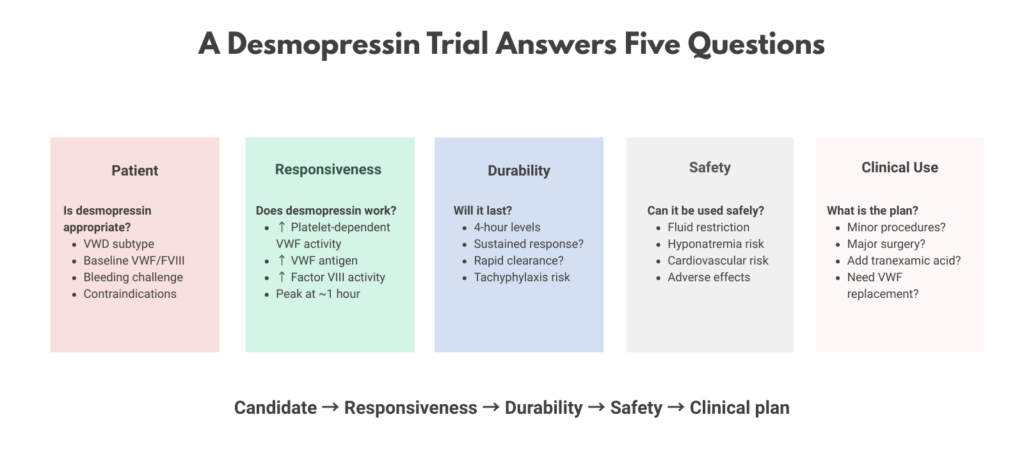
The desmopressin trial asks five linked questions.
Does the patient have releasable endogenous VWF?
How much platelet-dependent VWF activity rises?
How much VWF antigen rises?
How much factor VIII rises?
How quickly do levels peak?
How long do they remain adequate?
Does the pattern suggest rapid clearance?
Is the response sufficient for the clinical challenge we care about?
These are not the same question. A patient can answer one well and another poorly.
That is the central lesson of the trial:
Responsiveness is not only magnitude. It is magnitude, durability, and clinical fit.
Why response cannot be assumed
Desmopressin works only if the patient has stored, releasable, functional VWF. That makes response subtype-dependent and patient-dependent.
In many patients with type 1 VWD, especially those with baseline VWF levels that are not extremely low, desmopressin is often useful. But even within type 1 VWD, response varies with baseline level, age, genotype, clearance, and clinical context.
In type 2 VWD, response is more variable because the released VWF may be qualitatively abnormal. In type 3 VWD, response is not expected because VWF is virtually absent. In type 2B VWD, desmopressin is generally avoided and usually considered contraindicated because releasing abnormal VWF can worsen platelet binding and thrombocytopenia.
This is why a treatment that looks simple on paper becomes individualized at the bedside.
The drug is the same. The endothelial biology is not.
Who needs a trial?
A desmopressin trial is most important when the result will change future management.
It is especially useful when:
- the patient may need desmopressin for procedures
- baseline VWF is low enough that response is uncertain
- a minor surgery or dental procedure is anticipated
- selected type 2 variants are being considered for desmopressin use
- there is concern for accelerated clearance
- future access to urgent therapy may be limited
- the clinician wants to avoid unnecessary VWF concentrate exposure
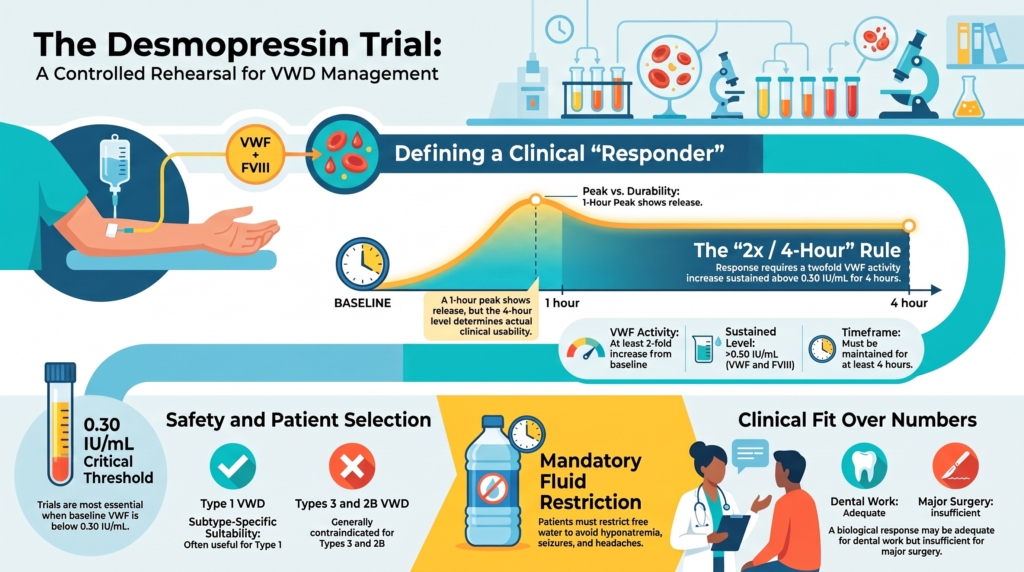
The 2021 ASH/ISTH/NHF/WFH management guideline suggests performing a desmopressin trial in patients for whom desmopressin is a valid treatment option, particularly when baseline VWF is below 0.30 IU/mL, and suggests against treating with desmopressin without trial results in that setting.1
Some adults with type 1 VWD and baseline VWF levels of at least 0.30 IU/mL may be presumed likely to have a laboratory response, but procedure-specific adequacy and safety still require clinical judgment.2
The practical principle is broader than the cutoff:
test before you rely on it for a meaningful hemostatic challenge.
Who should not be trialed casually
A desmopressin trial is not appropriate for every patient.
It is generally not useful in type 3 VWD because there is little or no VWF reserve to release. It is generally avoided and usually considered contraindicated in type 2B VWD because of the risk of increased VWF-platelet binding and thrombocytopenia.
It should be avoided or approached with great caution in patients with active cardiovascular, cerebrovascular, or peripheral vascular disease; seizure disorders; children younger than 2 years; uncontrolled hypertension; substantial thrombotic risk; or settings in which hyponatremia risk cannot be managed safely.3
Pregnancy requires special care. Desmopressin has been used in pregnancy, but randomized trial evidence is lacking, and peripartum fluid shifts, oxytocic medications, preeclampsia, and cardiovascular status all affect safety.4
The trial is meant to reduce uncertainty.
It should not create unnecessary risk.
What to measure
A useful desmopressin trial measures the same biology that will matter during treatment.
At minimum, this usually includes:
- Platelet-dependent VWF activity
- VWF antigen (VWF:Ag)
- Factor VIII activity (FVIII:C)
Many protocols also include:
- CBC and platelet count
- serum sodium when clinically appropriate
- baseline vital signs and post-infusion monitoring
- documentation of adverse symptoms
Platelet count is especially important if there is any concern for type 2B physiology or thrombocytopenia.
VWF activity matters because hemostasis depends on function, not antigen level alone.
Factor VIII matters because VWF stabilizes FVIII, and adequate FVIII activity may be particularly important for surgery and deep-tissue hemostasis.5
The trial should test the biology you intend to rely on.
When to measure
A trial should include a baseline sample.
It should also include a peak measurement. Many protocols measure around 1 hour after desmopressin.
But peak alone is not enough.
A later measurement, often around 4 hours, helps assess durability. This delayed time point is especially important when accelerated clearance is suspected or when the planned use requires coverage beyond a brief interval.6
A patient who peaks well and falls quickly is different from a patient who remains adequately elevated. Both may be called “responsive” in a loose sense.
They are not equally useful clinically.
Peak shows release.
Durability determines usability.
What counts as response?
This is more complicated than it first appears.
Different studies and centers have used different definitions of desmopressin responsiveness. Some emphasize fold-increase over baseline. Some emphasize absolute achieved levels. Some require VWF and factor VIII to exceed specific thresholds. Some distinguish complete response, partial response, and nonresponse. Some emphasize sustained levels at a later time point.
A recent adult single-center study found that the proportion of patients classified as responsive varied widely depending on which literature definition was applied.7
That variability is not just academic. It means the word “responder” is not self-explanatory.
The 2021 ASH/ISTH/NHF/WFH management guideline used a practical response definition: an increase of at least twofold over baseline VWF activity, with sustained VWF and FVIII levels above 0.50 IU/mL for at least 4 hours.8
That definition identifies biological responsiveness, but it does not by itself define procedural adequacy.
A response adequate for a dental extraction may not be adequate for major surgery. A response adequate for a short mucosal procedure may not be adequate for prolonged postoperative risk. A response adequate in a young patient may not be desirable in an older patient with cardiovascular disease.
The trial result must be translated into a clinical plan.
Peak response is not the whole answer
The 1-hour value often attracts attention.
It is dramatic.
It tells the clinician whether desmopressin can mobilize stored VWF and FVIII.
But a beautiful peak can mislead.
A patient may rise from 20 IU/dL to 120 IU/dL at 1 hour and fall near baseline by 4 hours. That pattern teaches something important: the patient has releasable VWF, but the released VWF may not persist.
This is especially important in type 1C VWD, where accelerated clearance can produce a strong early rise followed by rapid decline. Type 1C includes variants associated with increased VWF clearance, such as the Vicenza phenotype.
The trial helps expose this kinetic pattern.
A single peak value would miss it.
A response curve is more informative than a single response value.
Even an excellent initial response does not guarantee that repeated doses will produce the same effect. Desmopressin releases a finite pool of endothelial VWF, and repeated administration over a short interval may produce tachyphylaxis as readily releasable stores become temporarily depleted. For procedures requiring prolonged hemostatic support, this limitation further underscores why a favorable trial does not necessarily mean desmopressin alone will provide adequate coverage.
Response depends on the planned challenge
The same desmopressin trial can be adequate or inadequate depending on what comes next.
For a short dental procedure with tranexamic acid and local measures, a moderate but sustained response may be enough. For major surgery, desmopressin alone is often insufficient, even in a laboratory responder. For a critical-site procedure, relying on desmopressin as sole therapy may be unsafe. For heavy menstrual bleeding, repeated dosing may be limited by tachyphylaxis and hyponatremia risk. For childbirth or postpartum bleeding, fluid balance and obstetric context may dominate the risk calculation.9
Thus, the trial does not produce a universal answer.
It produces a usable response profile.
The clinician must then ask:
usable for what, and for how long?
Laboratory response is not identical to clinical response
A desmopressin trial is a biological response test.
It is not a guarantee of clinical hemostasis.
A patient with adequate laboratory rise may still bleed if the procedure is high risk, local hemostasis is poor, fibrinolysis is prominent, the response is too short, the bleeding phenotype is severe, another hemostatic defect is present, or the clinical challenge exceeds the laboratory correction.
Conversely, a patient with modest laboratory response may do well with local measures and antifibrinolytics for a low-risk mucosal procedure.
A retrospective adult study of peri-procedural desmopressin use found generally favorable outcomes among selected patients, while also emphasizing that bleeding history and procedure invasiveness should be considered beyond DDAVP responsiveness alone.10
That is the right conclusion.
The trial matters.
But it does not replace judgment.
Children and the developing response
Children require special consideration.
A pediatric retrospective study found DDAVP response in most children with type 1 VWD, while response was associated with age and baseline VWF and FVIII levels.11
This is clinically important because children may have limited bleeding history and may not yet have faced major hemostatic challenges. A trial can help clarify future management.
But safety matters.
Desmopressin is generally contraindicated in children younger than 2 years because of hyponatremia and seizure risk.12
In older children, the trial should still be performed with attention to fluid restriction, sodium risk, and the clinical reason for testing.
The purpose is not to collect a number.
It is to prepare safely for future bleeding challenges.
Severe type 1 and type 2 VWD
The trial is especially informative in patients whose response is uncertain.
In severe type 1 and type 2 VWD, response rates are lower and more variable than in typical mild type 1 disease.
A multicenter European study using stringent response criteria found relatively low biological response rates in patients selected for severe type 1 or type 2 VWD, with response differing across subtypes.13
This reinforces a key point: the more severe or qualitative the disorder, the less safe it is to assume DDAVP will be sufficient.
A trial may show response.
It may show partial response.
It may show nonresponse.
It may show response that is biologically interesting but clinically inadequate.
All of these are useful findings.
They prevent future overconfidence.
Safety during the trial
A desmopressin trial should include safety planning.
Patients should be counseled about:
- fluid restriction
- avoidance of excessive free water
- symptoms of hyponatremia
- headache, nausea, confusion, or seizures
- flushing, dizziness, and blood pressure changes
- when to seek medical attention
Serum sodium monitoring may be appropriate in higher-risk settings, repeated dosing, perioperative use, children, older adults, pregnancy-related contexts, or patients with comorbidities.
If intravenous fluids are needed, hypotonic fluids should generally be avoided; isotonic fluids are preferred when clinically appropriate.14
The trial is not only about proving efficacy.
It is also about demonstrating that the drug can be used safely in this patient.
How to document the result
A desmopressin trial should produce a reusable clinical document.
The future clinician should not have to interpret raw data from scratch.
The record should state:
- baseline VWF activity, VWF antigen, and FVIII
- post-DDAVP peak values
- delayed values
- platelet count if relevant
- whether the response met the center’s criteria
- whether response was sustained
- whether any adverse effects occurred
- whether fluid restriction was tolerated
- what clinical situations DDAVP can reasonably cover
- what situations require VWF replacement instead
The most important sentence may be the practical one:
“DDAVP is reasonable for minor mucosal procedures with tranexamic acid and local measures, but should not be used as sole therapy for major surgery.”
Or:
“DDAVP produces an adequate 1-hour rise but rapid decline by 4 hours; use caution for procedures requiring prolonged coverage.”
Or:
“DDAVP is not an appropriate strategy for this patient.”
The trial should become a plan, not just a result.
The trial as patient education
The desmopressin trial is also a teaching moment.
Patients are often told that DDAVP “raises the level.”
That is true, but incomplete.
A better explanation is:
“We are testing whether your body has stored VWF that can be released, how much it rises, and how long it lasts. That will tell us whether this medicine can safely be used for future procedures or bleeding episodes.”
This explanation protects trust. It also helps patients understand why one person with VWD can use DDAVP while another cannot.
The trial teaches the patient that VWD therapy is individualized.
Not everyone needs the same plan.
Not everyone can rely on the same drug.
Clinical synthesis
The desmopressin trial is a controlled rehearsal.
It tests whether a patient can mobilize endogenous VWF and FVIII. It measures not only peak response but durability. It helps identify short-lived responses, including accelerated clearance patterns. It helps determine whether DDAVP is appropriate for future bleeding or procedural challenges. It also clarifies when desmopressin should not be trusted.
A responder is not simply someone whose level rises.
A clinically useful responder is someone whose response is sufficient, sustained, safe, and matched to the intended use.
The trial turns uncertainty into a plan.
That is why responsiveness cannot be assumed.
Evidence anchor: why a desmopressin response cannot be reduced to a single number
Summary derived from treatment guidelines, desmopressin response studies, monitoring reviews, pediatric data, and clinical outcome studies. The evidence consistently shows that a desmopressin response must be interpreted as a pattern, not a single value.
| Evidence stream | What it shows | Why it matters | Main limitation |
|---|---|---|---|
| Guideline response definition | The 2021 ASH/ISTH/NHF/WFH guideline proposed a standardized response definition: at least a twofold increase in VWF activity with sustained VWF and FVIII levels above 0.50 IU/mL for at least 4 hours.15 | A response definition gives clinicians a common language for interpreting trials. | Meeting a biologic response definition does not automatically mean the response is adequate for every procedure. |
| Response-definition variability | The proportion of patients classified as DDAVP responsive varies depending on which published definition is used.16 | “Responder” is not self-explanatory unless the definition and clinical context are specified. | Single-center retrospective data should not be overgeneralized. |
| Severe type 1 and type 2 response studies | Patients with severe type 1 or type 2 VWD have lower and more variable biologic response rates under stringent response criteria.17 | The more severe or qualitative the disorder, the less safe it is to assume DDAVP will be sufficient. | Study populations and response criteria may not match every clinical setting. |
| Pediatric response data | Many children with type 1 VWD respond to DDAVP, but response is associated with age and baseline VWF:RCo and FVIII.18 | Children may need trial-based planning because bleeding history may be limited by lack of prior hemostatic challenges. | Pediatric safety concerns, especially hyponatremia risk, must shape testing and use. |
| Response kinetics and durability | Baseline, peak, and delayed measurements help distinguish release, durability, and possible accelerated clearance.19 | A response curve is more informative than a single response value. | The optimal sampling schedule may vary by center, route, and clinical purpose. |
| Clinical outcome data | Peri-procedural outcomes in selected DDAVP-treated patients are often favorable, but bleeding history and procedural invasiveness still matter beyond laboratory responsiveness.20 | The trial informs clinical planning, but it does not replace judgment. | Retrospective data are shaped by patient selection and local practice patterns. |
Interpretive note: These evidence streams point in the same direction: desmopressin responsiveness is not a binary label. A clinically useful response is sufficient, sustained, safe, and appropriate for the intended hemostatic challenge.
Practical takeaway: A desmopressin trial does not simply ask whether the number rises. It asks whether the response can be trusted.
Guideline perspective: what constitutes an adequate desmopressin response?
Based primarily on the ASH/ISTH/NHF/WFH 2021 management guideline, supported by monitoring reviews, desmopressin response studies, and clinical outcome data.
Shared guidance themes
- A desmopressin trial is recommended when DDAVP is a valid option and response is uncertain, especially when baseline VWF is below 0.30 IU/mL.21
- Some adults with type 1 VWD and baseline VWF levels at least 0.30 IU/mL may be presumed likely to have a laboratory response, but clinical adequacy still depends on the intended use.22
- A useful trial should assess VWF activity, VWF antigen, and FVIII, with both peak and delayed measurements when durability matters.23
- The proposed response definition includes at least a twofold rise in VWF activity and sustained VWF and FVIII levels above 0.50 IU/mL for at least 4 hours.24
- Desmopressin is generally not useful in type 3 VWD and is generally avoided and usually considered contraindicated in type 2B VWD.25
- Fluid restriction, avoidance of excess free water, and attention to hyponatremia risk are part of safe trial planning.26
What guidelines do not eliminate
- the need to interpret the trial in relation to the planned procedure
- the difference between biologic response and clinical protection
- uncertainty in partial or short-lived responses
- safety concerns in children, pregnancy, older adults, and patients with comorbidities
- the need for VWF replacement when DDAVP is insufficient or unsafe
- the need to document a future procedure plan, not just laboratory values
Practical takeaway: Guidelines define response, but clinicians must define adequacy. The key question is not only whether DDAVP works. It is whether it works well enough, long enough, and safely enough for the challenge ahead.
Reflect & Apply Case
A 29-year-old woman with type 1 VWD is evaluated before planned tonsillectomy.
Baseline:
- VWF antigen (VWF:Ag): 28 IU/dL
- Platelet-dependent VWF activity: 24 IU/dL
- Factor VIII activity (FVIII:C): 38 IU/dL
After desmopressin:
1 hour:
- VWF activity: 88 IU/dL
- FVIII: 104 IU/dL
4 hours:
- VWF activity: 41 IU/dL
- FVIII: 66 IU/dL
She has a history of heavy menstrual bleeding and postoperative bleeding after wisdom tooth extraction.
The early rise is reassuring.
The decline is instructive.
By the ASH proposed definition, the 4-hour VWF activity of 41 IU/dL would not meet the sustained response threshold, even though the 1-hour peak is impressive.
Tonsillectomy is a mucosal procedure with substantial delayed bleeding risk, so a short-lived DDAVP response should not be treated like a brief low-risk dental procedure.27
Questions for reflection:
- Is she a biological responder?
- Is her response durable?
- Why might the 1-hour value be misleading?
- Would this response be sufficient for tonsillectomy?
- Would local measures and tranexamic acid change your thinking?
- What safety counseling would be required if DDAVP were used?
- What would you write in her future procedure plan?
This case illustrates the central lesson:
the desmopressin trial does not ask whether the number can rise.
It asks whether the response can be trusted for the challenge ahead.
Test your thinking
An interactive quiz for this topic is being developed and will be added soon.