
Preventing bleeding before it begins
Note: The video and audio linked above were generated with the assistance of AI. Clinical accuracy has been reviewed, but no AI-generated content can be guaranteed to be fully error-free.
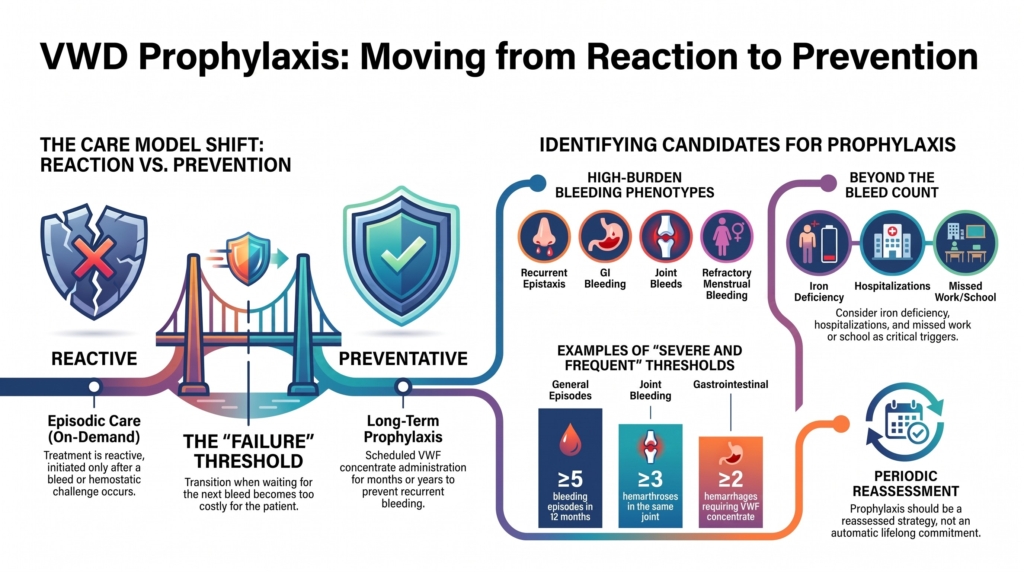
Why this spoke matters
Most patients with von Willebrand disease do not need continuous treatment.
That is one of the major differences between VWD and severe hemophilia.
Many patients need episodic therapy for procedures, childbirth, mucosal bleeding flares, trauma, or specific hemostatic challenges.
But some patients do not fit an episodic model.
Their bleeding recurs. Their anemia returns. Their epistaxis dominates childhood. Their gastrointestinal bleeding sends them back to the hospital. Their joint bleeding limits activity. Their type 3 disease creates repeated risk.
Their life becomes organized around the next bleed.
At that point, treatment is no longer only about responding.
It becomes about prevention.
That is the purpose of long-term prophylaxis.
What prophylaxis means
Long-term prophylaxis means scheduled treatment intended to prevent recurrent bleeding.
It is different from acute treatment of an active bleed, short-term procedural coverage, postpartum support, one-time desmopressin use, or episodic tranexamic acid during a mucosal challenge.
In VWD, prophylaxis usually means regular administration of VWF-containing concentrate over weeks to months or longer.
For evidence-review purposes, prophylaxis has been defined as VWF concentrate given for at least 3 to 6 months at least weekly, or at least once per menstrual cycle for heavy menstrual bleeding. Clinically, however, the concept is broader and should be individualized.1
The clinical idea is simpler:
Prophylaxis is treatment given before the next bleed because waiting has become too costly.
Why VWD prophylaxis is different from hemophilia prophylaxis
In severe hemophilia, prophylaxis is often the standard care model. Factor replacement or nonfactor therapy prevents spontaneous joint bleeding and long-term arthropathy.
In VWD, the situation is different.
Bleeding is often mucosal rather than joint-predominant. The phenotype is heterogeneous. Many patients bleed only during hemostatic challenges. VWF therapy is more complex because VWF also affects FVIII. Venous access, product availability, cost, monitoring, and treatment burden matter.
And for many patients, episodic therapy works well.
This is why prophylaxis is not a default in VWD.
It is a threshold decision.
The clinician asks:
Has episodic care failed this patient?
When episodic treatment fails
Episodic treatment may fail because bleeding is too frequent, too severe, too unpredictable, difficult to treat once it starts, or recurrent from the same site despite appropriate on-demand therapy.
It may fail because bleeding causes iron deficiency, hospitalization, missed work, missed school, activity restriction, transfusion, or fear.
In those settings, the question changes.
Instead of asking:
What do we do when the patient bleeds?
the clinician asks:
Can we reduce the bleeding burden before it happens?
That is the prophylaxis question.
Long-term prophylaxis becomes appropriate when the burden of recurrent bleeding exceeds the burden of preventive treatment.
Who should be considered
The 2021 ASH/ISTH/NHF/WFH management guideline suggests long-term prophylaxis rather than no prophylaxis in patients with VWD who have a history of severe and frequent bleeds. The recommendation is conditional and based on low certainty in the evidence.2
This is a selective recommendation.
It does not mean prophylaxis for everyone with VWD.
It means prophylaxis should be considered when bleeding burden has crossed a clinically meaningful threshold.
Situations that may prompt consideration include:
Mucosal bleeding burden
- recurrent severe epistaxis
- recurrent gastrointestinal bleeding
- angiodysplasia-associated bleeding
- severe or refractory heavy menstrual bleeding
Deep-tissue bleeding burden
- recurrent joint bleeding
- recurrent muscle bleeding
Severe disease or high-risk phenotype
- severe type 3 VWD
- selected severe type 1 or type 2 VWD
- spontaneous life-threatening bleeding
- bleeding requiring repeated VWF concentrate exposure
Life impact
- repeated hospital visits
- transfusion or iron-infusion dependence
- major activity restriction
- high-burden bleeding that impairs quality of life
The key word is not only “severe.”
It is also “frequent.”
A single major bleed may require intensive treatment. Repeated major or clinically disruptive bleeding may require a different model.
What counts as “severe and frequent”?
There is no universally accepted definition.
That uncertainty should be acknowledged.
One study framework used thresholds such as at least 5 bleeding episodes in 12 months, at least 3 hemarthroses in the same joint, or at least 2 gastrointestinal hemorrhages requiring VWF concentrate. These are helpful anchors, but they are not universal criteria.3
Bleeding burden is not only frequency.
A single spontaneous life-threatening hemorrhage may justify considering prophylaxis. A patient with fewer bleeds may still have major quality-of-life impairment. A patient with repeated iron deficiency, emergency visits, or missed school or work may have more burden than the raw bleed count suggests.
The right question is:
Has the bleeding pattern become unacceptable with episodic treatment?
The evidence base
The evidence for prophylaxis in VWD is not as strong as in hemophilia.
That should be said plainly.
The 2021 management guideline found low-certainty evidence for a net health benefit of long-term prophylaxis in patients with VWD and severe, frequent bleeding. The panel concluded that prophylaxis likely reduces recurrent bleeding episodes, such as epistaxis, and may reduce spontaneous bleeding and hemarthrosis, while evidence for other outcomes remains very uncertain.4
The prophylaxis literature is also heterogeneous. Studies differ in VWD subtype, bleeding indication, bleeding severity, product used, dosing schedule, outcome measures, and duration of follow-up.
A systematic review informing the guidelines included one randomized trial and multiple observational studies. It found that VWF-concentrate prophylaxis improved overall bleeding episodes, heavy menstrual bleeding, epistaxis, and time to first bleeding event, and appeared to reduce spontaneous bleeding and hemarthrosis.5
The evidence is imperfect.
The clinical problem is real.
That is often where VWD care lives.
Prophylaxis as a care-model shift
Starting prophylaxis is not just changing the dose.
It is changing the care model.
Episodic care says:
Call when bleeding happens.
Prophylaxis says:
The bleeding pattern itself has become the problem.
That shift matters for patients. It changes schedules, access, cost, identity, monitoring, family routines, school plans, work plans, travel, and expectations.
For some patients, this is liberating.
For others, it is burdensome.
For many, it is both.
That is why prophylaxis should be framed as a reassessed strategy rather than an automatic lifelong commitment.
Severe VWD and prophylaxis
Patients with severe VWD are the most intuitive candidates for prophylaxis.
This includes many patients with type 3 VWD and selected patients with severe type 1 or type 2 disease.
Severe VWD can include recurrent mucosal bleeding, gastrointestinal bleeding, joint bleeding, muscle bleeding, and procedure-related bleeding.
Unlike hemophilia, VWD does not have one universally accepted severity definition based only on a factor level.
Severity reflects a combination of:
- VWF activity
- FVIII level
- subtype
- bleeding phenotype
- bleeding frequency
- treatment requirement
- life impact
Reviews of severe VWD emphasize that prophylaxis has been used particularly in patients with recurrent joint bleeding, severe epistaxis, gastrointestinal bleeding, and other high-burden bleeding phenotypes.6
The indication is not the VWD subtype alone.
It is subtype plus bleeding burden.
Joint bleeding and activity
Joint bleeding is not the classic teaching phenotype of VWD.
But it occurs, especially in severe disease where FVIII can be low.
Repeated joint bleeding can limit mobility, activity, and quality of life.
The 2021 management guideline notes that severe VWD patients can experience significant joint damage, and that physical activity may be limited by bleeding or by fear of bleeding.7
This matters because prophylaxis is sometimes framed only as bleed counting.
But the deeper issue is what bleeding prevents the patient from doing.
A patient who avoids activity because of recurrent bleeding may have disease burden even when the annual bleed count seems modest.
Gastrointestinal bleeding and angiodysplasia
Gastrointestinal bleeding is one of the hardest reasons to use prophylaxis.
It is often recurrent, difficult to localize, and associated with angiodysplasia. It may occur in older patients, in type 2A or type 3 VWD, and in acquired VWF disorders.
Acute treatment may stop a bleeding episode without preventing the next one.
That is why prophylaxis may be considered.
GI bleeding, particularly angiodysplasia-associated bleeding, is a major cause of morbidity and hospitalization in more severely affected VWD populations.8
The “Beyond the Guidelines” review describes recurrent gastrointestinal bleeding as a setting in which a 3- to 6-month course of VWF-concentrate prophylaxis may reduce recurrent bleeding, though optimal dosing remains uncertain.9
This is an evidence-poor zone that requires clinical judgment.
The question is not whether evidence is perfect.
It is whether repeated bleeding has made episodic therapy inadequate.
A note on GI prophylaxis dosing
For recurrent GI bleeding, one expert approach begins with VWF 50 IU/kg twice weekly and escalates if bleeding persists, but optimal dosing is uncertain and should be individualized.10
This should be understood as an expert strategy, not a universal rule.
GI bleeding may require more than replacement:
- endoscopic evaluation
- treatment of angiodysplasia when possible
- iron assessment
- transfusion support when needed
- consideration of antiangiogenic approaches in refractory cases
- coordination with gastroenterology
- reassessment of thrombotic risk and FVIII accumulation
Prophylaxis may help restore hemostatic balance.
It may not remove the vascular lesion.
Heavy menstrual bleeding and prophylaxis
Most heavy menstrual bleeding in VWD is managed with tranexamic acid, hormonal therapy, levonorgestrel intrauterine system, gynecologic care, iron assessment, and selected hemostatic therapy.
Prophylaxis is not first-line for most patients with HMB.
But it should remain visible for patients with severe or refractory bleeding.
VWF concentrate prophylaxis for HMB should be reserved for severe or refractory cases after appropriate gynecologic, antifibrinolytic, hormonal, and iron-directed strategies have been considered. Evidence remains limited, and the 2021 guideline identifies HMB prophylaxis as an area needing further study.11
Recent data also remind us to be cautious. The VWDMin study, comparing recombinant VWF with tranexamic acid for heavy menstrual bleeding in mild or moderate VWD, was stopped early and did not show either treatment to be superior.12
The practical message is balanced:
do not reach for concentrate too early in HMB, but do not make prophylaxis impossible for patients whose menstrual bleeding remains severe despite appropriate first-line strategies.
Recombinant VWF and prophylaxis
Recombinant VWF has expanded the prophylaxis landscape.
It supplies VWF without FVIII. That can be attractive when repeated dosing is needed and FVIII accumulation is a concern.
Recent studies and reviews suggest recombinant VWF can reduce spontaneous bleeding rates in selected patients, including severe and type 3 cohorts, but product availability, indication, monitoring, and patient selection remain central.13
Plasma-derived products also remain central. A recent review notes that the WIL-31 study of a plasma-derived VWF/FVIII product showed a substantial reduction in mean annualized bleeding rate compared with on-demand therapy, without serious adverse events or FVIII accumulation in that study.14
The product question is therefore not simply “plasma-derived versus recombinant.”
It is:
What bleeding pattern are we trying to prevent, and what kind of hemostatic support is needed to prevent it?
Prophylaxis in children
Children require special caution.
Severe VWD can produce important bleeding burden in childhood, including epistaxis, traumatic bleeding, joint bleeding, and procedural bleeding.
But prophylaxis in children carries practical barriers:
- venous access
- infusion tolerability
- family training
- school logistics
- activity planning
- treatment fatigue
The 2021 guideline panel specifically noted that pediatric applicability may differ because of venous access challenges and tolerability of injections.15
This does not mean children should be denied prophylaxis when the phenotype warrants it.
It means the burden of the delivery system must be part of the decision.
Prophylaxis in older adults
Older adults with VWD may face competing risks.
Bleeding may persist or increase with age. VWF levels may rise with age, but normalization does not always mean bleeding risk has disappeared. Cardiovascular disease, antiplatelet therapy, anticoagulation, renal disease, angiodysplasia, frailty, falls, and procedures can all change the treatment terrain.
The 2021 guideline notes that patients with VWD and cardiovascular disease who need antiplatelet or anticoagulant therapy should generally receive necessary antithrombotic treatment, with individualized reassessment of bleeding risk, and that severe bleeding phenotypes may require VWF concentrate prophylaxis while receiving these therapies.16
This is an important principle.
VWD does not exempt patients from thrombosis.
Prophylaxis may sometimes be the strategy that permits appropriate cardiovascular care.
Designing the prophylaxis plan
Starting prophylaxis should be deliberate.
The plan should answer five questions.
Clinical pattern
- What bleeding pattern are we trying to prevent?
- How frequent and severe are the bleeds?
- What has episodic therapy failed to accomplish?
Treatment goals
- What outcome would make prophylaxis worthwhile?
- What does the patient want to regain?
- What bleeding rate would be acceptable?
Regimen design
- What product will be used?
- How often will it be given?
- What adjunctive therapies are needed?
- How will thrombotic risk and FVIII kinetics be handled?
Monitoring
- What outcomes will be tracked?
- How will product use, adherence, iron status, hospitalizations, and quality of life be measured?
Exit strategy
- When will the plan be reassessed?
- What would make us reduce, intensify, change, or stop prophylaxis?
This last question is essential.
Prophylaxis should have an exit or reassessment plan.
Otherwise, a trial of prevention can become an indefinite habit.
Choosing the product
Prophylaxis usually uses VWF-containing concentrate.
The choice of product depends on the clinical question: VWD type, baseline factor VIII activity (FVIII:C), bleeding pattern, need to avoid FVIII accumulation, venous access, home infusion feasibility, product availability, prior response, thrombotic risk, patient preference, cost, and insurance structure.
Plasma-derived VWF/FVIII products have long experience.
Recombinant VWF may be particularly attractive in selected prophylaxis settings because it avoids plasma exposure and does not contain FVIII, though FVIII monitoring remains important when FVIII is co-administered or rises endogenously.
VWF-only products may be particularly attractive in surgery and long-term prophylaxis, including attempts to prevent recurrent gastrointestinal bleeding associated with angiodysplasia.17
The product question should follow the clinical question.
Monitoring prophylaxis
Monitoring prophylaxis is not the same as monitoring surgery.
For surgery, clinicians often monitor levels over days.
For prophylaxis, the central outcome is bleeding burden over time.
Useful monitoring may include:
- bleeding frequency and severity
- need for rescue doses
- emergency visits and hospitalizations
- transfusions, iron deficiency, or anemia
- school or work absence
- pain or joint symptoms
- patient-reported quality of life
- adherence and venous access problems
- factor VIII activity (FVIII:C) when relevant
- thrombotic events or risk factors
- product use and cost
Laboratory levels may help in selected patients, especially when adjusting dosing, evaluating pharmacokinetics, or watching for FVIII accumulation.
But the primary question is clinical:
Is the patient bleeding less, living better, and avoiding unacceptable treatment harm?
Not forever by default
The 2021 guideline explicitly remarks that bleeding symptoms and the need for prophylaxis should be periodically assessed.18
This is not a minor administrative point.
VWD changes over time. Bleeding exposure changes. Menstrual status changes. Pregnancy plans change. Angiodysplasia can evolve. Activity changes. Comorbidities change. VWF levels may rise with age. Antithrombotic therapy may become necessary. Treatment goals may change.
A prophylaxis plan that made sense last year may need revision now.
Long-term therapy should not mean static therapy.
Prevention is powerful.
But it should always be justified by continued benefit.
The burden of prophylaxis
Prophylaxis can reduce bleeding.
It can also add burden.
The burden may include intravenous access, infusion time, home treatment training, cost, insurance approval, product storage, travel limitations, venous access complications, treatment fatigue, monitoring visits, fear of missing doses, and an increased sense of illness identity or treatment dependence.
These burdens matter.
They may be acceptable when bleeding is severe.
They may be unacceptable when bleeding is occasional.
The 2021 guideline panel emphasized that patient values may vary and that frequency and severity of bleeding, patient age, family input, and caregiver input all affect decision-making.19
This is why prophylaxis cannot be defined only by a laboratory value or a bleed count.
It is a lived treatment model.
Ultimately, the decision to begin prophylaxis is a shared one. Bleeding burden, treatment burden, patient goals, lifestyle, and tolerance for uncertainty all influence whether prevention offers more benefit than episodic treatment alone.
Cost and access
Prophylaxis is expensive.
It also requires product access, infusion infrastructure, insurance approval, and clinical expertise.
The 2021 guideline panel noted the high cost of VWF concentrate and the lack of cost-effectiveness studies, while also judging prophylaxis likely acceptable to many patients, especially when access to emergency or acute bleeding care is limited.20
Access can cut in two directions.
High cost may limit use.
But limited access to emergency care may make prevention more valuable.
For a patient far from specialized care, prophylaxis may reduce dependence on repeated rescue.
Equity matters because prophylaxis depends not only on biology, but on health-system structure.
Prophylaxis and mucosal bleeding
Mucosal bleeding is common in VWD.
Epistaxis, heavy menstrual bleeding, oral bleeding, and gastrointestinal bleeding may all drive prophylaxis decisions.
But mucosal bleeding raises a special question:
Should prophylaxis be combined with antifibrinolytic therapy?
The 2021 guideline panel identified the role of concurrent antifibrinolytic therapy with prophylaxis for mucosal bleeding as a research need, specifically including epistaxis, HMB, and gastrointestinal bleeding.21
This reflects a practical truth.
VWF replacement may help form the clot.
Antifibrinolytics may help protect it.
For mucosal bleeding, both layers may matter.
But the evidence for optimal combinations remains limited.
When prophylaxis fails
Prophylaxis may fail.
Bleeding may continue despite scheduled treatment.
When this happens, the question should not be:
Why did prophylaxis fail?
but:
What kind of failure is this?
The dose may be inadequate. The VWF half-life may be short. FVIII kinetics may not match the bleeding risk. Adherence may be difficult. The product or schedule may be wrong. The bleeding site may not be purely hemostatic. Angiodysplasia, uterine pathology, high-shear physiology, alloantibodies, or another bleeding disorder may be contributing.
Failure should trigger re-characterization of the problem, not reflexive escalation.
This is where the next treatment essay, When Treatment Fails, becomes necessary.
Clinical synthesis
Long-term prophylaxis in VWD is not routine therapy for everyone.
It is a strategy for selected patients in whom episodic treatment is not enough.
The strongest candidates are patients with severe and frequent bleeding, especially those with severe VWD, recurrent gastrointestinal bleeding, recurrent epistaxis, joint bleeding, refractory heavy menstrual bleeding, or life-disrupting bleeding despite appropriate episodic care.
The evidence base supports benefit in selected patients, but certainty remains limited.
The decision must integrate bleeding burden, quality of life, VWD type, prior treatment response, product availability, venous access, cost, patient goals, thrombotic risk, and reassessment plans.
Prophylaxis should reduce bleeding.
But it should also reduce the life organized around bleeding.
The goal is not simply fewer bleeding episodes.
It is a life that is no longer organized around bleeding.
Evidence anchor: why prophylaxis is selective in VWD
Summary derived from management guidelines, evidence-review work, severe VWD reviews, treatment updates, and prophylaxis-focused expert reviews. The evidence consistently shows that long-term prophylaxis can reduce bleeding in selected high-burden patients, but the evidence base is limited, heterogeneous, and strongest when bleeding is severe, frequent, recurrent, or life-disrupting.
| Evidence stream | What it shows | Why it matters | Main limitation |
|---|---|---|---|
| Guideline evidence review | The 2021 ASH/ISTH/NHF/WFH guideline conditionally suggests long-term prophylaxis rather than no prophylaxis for patients with VWD who have severe and frequent bleeding.22 | Prophylaxis is a recognized strategy, but for selected patients, not routine care for all VWD. | Evidence certainty is low, and patient selection remains individualized. |
| Evidence-review definitions | For evidence-review purposes, prophylaxis has been defined as VWF concentrate for at least 3–6 months at least weekly, or at least once per menstrual cycle for HMB.23 | A research definition helps organize evidence, but clinical prophylaxis remains a patient-specific care model. | Definitions are not universal clinical rules. |
| Severe VWD experience | Severe VWD, especially type 3 and selected severe type 1 or type 2 disease, may include recurrent mucosal bleeding, GI bleeding, joint bleeding, muscle bleeding, and repeated need for concentrate.24 | The indication is not VWD type alone, but type plus bleeding burden. | Severe VWD cohorts are small and heterogeneous. |
| Study-entry thresholds | One study framework used thresholds such as ≥5 bleeding episodes in 12 months, ≥3 hemarthroses in the same joint, or ≥2 GI hemorrhages requiring VWF concentrate.25 | These thresholds provide useful anchors for “severe and frequent.” | They are study criteria, not validated universal clinical thresholds. |
| GI bleeding and angiodysplasia | GI bleeding, especially angiodysplasia-associated bleeding, is a major morbidity in more severely affected VWD populations and may prompt prophylaxis consideration.26 | Episodic therapy may stop one bleed without preventing the next. | Optimal prophylaxis dosing is uncertain, and lesion-directed care remains necessary. |
| HMB prophylaxis evidence | Prophylaxis data for heavy menstrual bleeding are limited; VWF concentrate prophylaxis should generally be reserved for severe or refractory HMB after gynecologic, antifibrinolytic, hormonal, and iron-directed strategies have been considered.27 | HMB can be high-burden, but concentrate prophylaxis should not replace first-line integrated HMB care. | Applicability of prophylaxis studies to HMB remains limited. |
| Product-specific prophylaxis | Plasma-derived VWF/FVIII and recombinant or VWF-only products differ in FVIII exposure, pharmacokinetics, availability, monitoring needs, and patient selection.28 | Prophylaxis is not product-neutral. Product choice shapes FVIII kinetics, treatment burden, and monitoring strategy. | Availability, licensing, and experience vary by jurisdiction. |
| Reassessment and burden | Guidelines emphasize periodic reassessment; prophylaxis also carries burdens of venous access, infusion logistics, cost, monitoring, and treatment identity.29 | Prophylaxis should reduce bleeding and improve life, not become automatic indefinite treatment. | Patient values, access, and treatment burden vary widely. |
Interpretive note: These evidence streams point in the same direction: prophylaxis in VWD is a selective prevention strategy for high-burden bleeding, not a default extension of replacement therapy. The strongest rationale appears when episodic therapy repeatedly fails to prevent clinically meaningful harm.
Practical takeaway: Prophylaxis is not simply more treatment. It is a decision that waiting for the next bleed has become the wrong model of care.
Guideline perspective: prophylaxis as a conditional, reassessed strategy
Based primarily on the ASH/ISTH/NHF/WFH 2021 management guideline, supported by severe VWD reviews, treatment updates, and expert prophylaxis discussions.
Shared guidance themes
- Long-term prophylaxis may be considered in patients with VWD and a history of severe and frequent bleeding, but the recommendation is conditional and based on low-certainty evidence.30
- Prophylaxis is not routine therapy for all VWD. It is most relevant when bleeding is recurrent, severe, difficult to rescue, life-disrupting, or inadequately controlled with episodic treatment.31
- Study thresholds such as ≥5 bleeding episodes in 12 months, ≥3 hemarthroses in one joint, or ≥2 GI bleeds requiring VWF concentrate may help frame severity, but should not be treated as universal clinical criteria.32
- Severe VWD, especially type 3 disease and selected severe type 1 or type 2 disease, is an important setting for prophylaxis consideration when bleeding burden is high.33
- Recurrent GI bleeding may justify a time-limited prophylaxis trial, but dosing remains uncertain and lesion-directed therapy, iron support, gastroenterology input, and reassessment remain essential.34
- VWF concentrate prophylaxis for HMB should be reserved for severe or refractory cases after appropriate gynecologic, antifibrinolytic, hormonal, and iron-directed strategies have been considered; evidence remains limited.35
- Product choice should account for bleeding pattern, VWD type, baseline factor VIII activity (FVIII:C), FVIII accumulation risk, venous access, home infusion feasibility, product availability, monitoring, cost, and patient preference.36
- In children, prophylaxis decisions should explicitly consider venous access, injection tolerability, caregiver burden, school logistics, and family preferences.37
- In older adults or patients who require antiplatelet or anticoagulant therapy, prophylaxis may sometimes support necessary cardiovascular care, but bleeding and thrombotic risk must be reassessed individually.38
- The need for prophylaxis should be periodically reassessed. Long-term therapy should not mean static therapy.39
What guidelines do not eliminate
- uncertainty in defining “severe and frequent”
- the need to judge quality-of-life burden, not just bleed counts
- uncertainty in optimal GI prophylaxis dosing
- the need for lesion-directed care in angiodysplasia-associated bleeding
- limited evidence for HMB prophylaxis
- product-specific differences in FVIII kinetics and monitoring
- the burden of venous access, cost, and home infusion
- the need to define success before starting therapy
- the need to stop, reduce, intensify, or change prophylaxis when the plan no longer fits
Practical takeaway: Guidelines support prophylaxis when bleeding burden proves that episodic care is failing. They do not turn prophylaxis into a default. The plan should begin with a defined bleeding problem, include measurable goals, and be reassessed over time.
Reflect & Apply Case
A 38-year-old man with type 3 VWD has recurrent epistaxis requiring packing, two hemarthroses in the past year, and three hospital visits for gastrointestinal bleeding over 18 months.
He uses VWF concentrate episodically.
Each bleed requires several days of treatment.
He has missed work repeatedly and avoids exercise because he fears bleeding.
Questions for reflection:
- Has episodic treatment failed?
- Which bleeding pattern most strongly supports prophylaxis?
- What outcomes should be tracked after prophylaxis starts?
- How would gastrointestinal bleeding affect dosing intensity and reassessment?
- What treatment burdens should be discussed before starting?
- What would count as success after 3 to 6 months?
- What would make you escalate, change product, add adjunctive therapy, or stop?
Expert synthesis: Episodic therapy has failed by frequency, severity, multisite bleeding, and quality-of-life burden. Recurrent GI bleeding and hemarthroses are especially strong drivers for prophylaxis. A time-limited prophylaxis trial with predefined outcomes is reasonable, while continuing lesion-directed GI evaluation and tracking bleeding frequency, hospitalizations, rescue therapy, iron status, activity, treatment burden, and patient-reported function.
This case illustrates the central principle:
prophylaxis is not simply more treatment.
It is a different care model, used when waiting for the next bleed has become the problem.
Test your thinking
An interactive quiz for this topic is being developed and will be added soon.