
For Your Healthcare Provider
Have your patient scan this QR code with their smartphone camera to instantly access this educational guide on their device.

A guide for patients with Type 3 von Willebrand disease
Access the Resources
Note: The video and audio linked above were generated with the assistance of AI. Clinical accuracy has been reviewed, but no AI-generated content can be guaranteed to be fully error-free.
Von Willebrand disease type 3 is the rarest and most severe inherited form of von Willebrand disease.
Even so, with appropriate medical care and good planning, most people with type 3 von Willebrand disease can live full lives.
This information is for general education and does not replace medical care. It applies to people who are medically stable. If you are experiencing new or worsening symptoms, contact your doctor or seek emergency care.
First things first
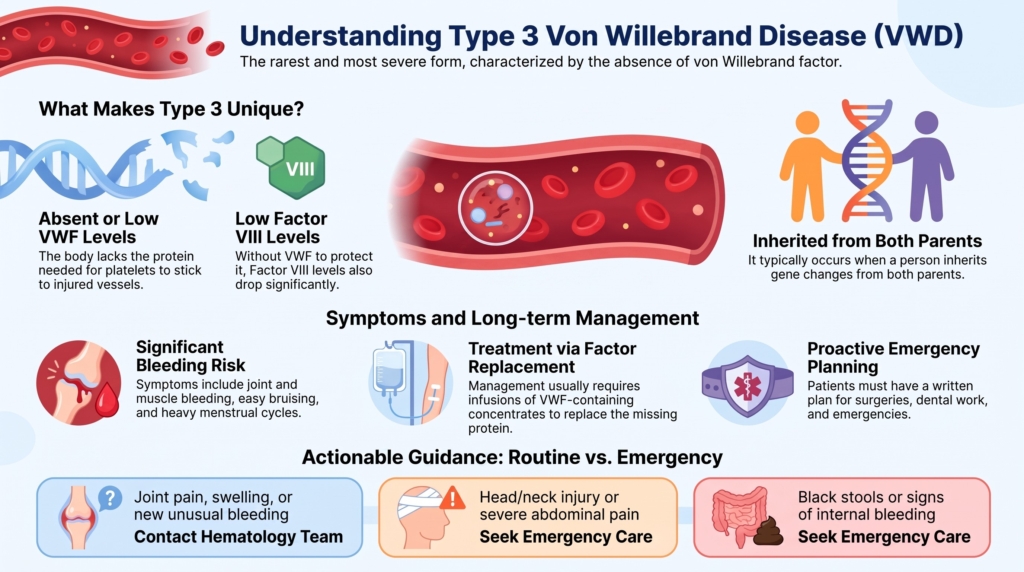
Type 3 von Willebrand disease is uncommon, and it is often diagnosed earlier in life than type 1 or type 2. People with type 3 have very low or absent von Willebrand factor.
Because von Willebrand factor helps protect another clotting protein (factor VIII), people with type 3 often have a low factor VIII level as well. This can make type 3 von Willebrand disease resemble hemophilia in some situations, even though it is a different condition. The low factor VIII is a consequence of low von Willebrand factor, not a separate diagnosis.
This page explains what type 3 means, what kinds of bleeding can occur, and how doctors prevent and treat bleeding safely.
What is type 3 VWD?
In type 3 von Willebrand disease, the body makes little or no von Willebrand factor. This means the body has less ability to form a stable clot after injuries and, in some people, bleeding can occur without a clear trigger.
Because von Willebrand factor is nearly absent, platelets can have trouble sticking to injured blood vessels and factor VIII levels can be low. This combination is what makes type 3 more clinically significant than type 1 or most forms of type 2.
Why it happens (causes)
Type 3 von Willebrand disease is inherited. It often occurs when a person inherits gene changes affecting von Willebrand factor from both parents.
Many families have no prior known history because carriers may have mild symptoms or no symptoms at all.
Because type 3 is rare, diagnosis and long-term management are often coordinated with a hematologist or a specialized bleeding disorders team.
Does it cause symptoms?
Type 3 von Willebrand disease can cause more frequent or more significant bleeding than type 1 or type 2.
Symptoms may include frequent nosebleeds, easy bruising, prolonged bleeding after injuries or procedures, heavy menstrual bleeding, and bleeding into muscles or joints. Some people may also have bleeding from the digestive system, which may require additional evaluation and treatment.
Not everyone has the same bleeding pattern. Doctors focus on both your history and your test results to understand your personal risk.
Is it dangerous?
Type 3 von Willebrand disease can be serious, especially without planning and timely treatment.
The good news is that serious bleeding can often be prevented or treated effectively when it is recognized early and managed with a clear plan. The goal is to anticipate bleeding risk, treat promptly when needed, and avoid delays in care.
If you are newly diagnosed, your hematology team will help you create a clear plan for emergencies, procedures, and pregnancy, and help you understand how to get treatment quickly when it is needed.
How your doctor evaluates it
Testing typically shows very low or absent von Willebrand factor, along with reduced clotting activity on functional tests. Factor VIII levels are often low as well.
Because type 3 has a distinctive test pattern, diagnosis is often more straightforward than for borderline type 1 cases, but doctors may still repeat tests or review results carefully to confirm the pattern.
How is it treated
People with type 3 von Willebrand disease usually need access to treatment that replaces von Willebrand factor.
Treatment may be used:
- to treat active bleeding
- before and after surgeries or dental procedures
- around childbirth
- in some cases, as preventive treatment for people with frequent bleeding
Depending on the situation, treatment may include infusions of von Willebrand factor-containing concentrates and other medications that help stabilize clots.
Your care team will help you understand what treatment you need, when you need it, and where it should be available (home, emergency department, or infusion center). They may also monitor for uncommon complications related to treatment and adjust the plan if needed.
Daily life and self-care
Living well with type 3 von Willebrand disease usually involves planning and preparation, not constant restriction.
Many people can stay active and participate in school, work, and exercise. Some activities may need individualized guidance, especially contact sports or high-impact activities. Your hematology team can help assess what is safest for you based on your bleeding pattern and treatment plan.
Practical steps that often help include carrying medical information, having a plan for urgent bleeding, and letting healthcare providers know about your condition before procedures.
When should I contact my doctor?
Most bleeding symptoms are not emergencies, but with type 3 von Willebrand disease it is important to have a low threshold to check in.
You should contact your doctor if you notice:
- new or unusual bleeding
- bleeding that does not stop with pressure and elevation
- large bruises or painful swelling
- joint pain or swelling, especially if accompanied by warmth or limited movement
- heavy menstrual bleeding that interferes with daily life
- upcoming surgery, dental work, or medical procedures
- pregnancy or plans for pregnancy
- questions about medications that affect bleeding, including aspirin or anti-inflammatory medicines like ibuprofen
Seek emergency care right away for:
- head injury or head trauma
- neck injury
- severe abdominal pain
- black stools, vomiting blood, or signs of significant internal bleeding
- bleeding that is heavy or worsening despite first-aid measures
Your care team can help you decide what can be managed at home, what needs urgent treatment, and what treatment should be given before you arrive.
What is the usual plan going forward?
Most people with type 3 von Willebrand disease are followed by a hematologist, often in partnership with a specialized bleeding disorders team.
The usual plan includes:
- confirming your specific diagnosis and baseline levels
- creating a written plan for procedures, emergencies, and pregnancy
- discussing when preventive therapy is appropriate
- reviewing how to access treatment quickly if bleeding occurs
Over time, the goal is to reduce bleeding episodes, avoid delays in care, and support normal life.
Making sense of it
Type 3 von Willebrand disease is the form of von Willebrand disease where the body makes very little or no von Willebrand factor. Because this protein is central to normal clotting, bleeding risk can be higher than in other types.
The key to safety is not constant worry. It is planning, preparation, and having effective treatment available when it is needed.
Key takeaways
- rare but treatable — type 3 is uncommon, but effective treatments exist and are used successfully by many people
- very low or absent VWF — the body makes little or no von Willebrand factor
- bleeding can be more significant — symptoms may include joint, muscle, or heavy menstrual bleeding
- planning is essential — procedures, pregnancy, and emergencies should have a clear plan
- treatment is usually replacement — VWF-containing concentrates are often needed for bleeding or prevention
For clinicians: Read our detailed guide on how to communicate about Type 3 VWD to patients.