
For Your Healthcare Provider
Have your patient scan this QR code with their smartphone camera to instantly access this educational guide on their device.

A guide for patients for understanding von Willebrand Disease testing
Access the Resources
Note: The video and audio linked above were generated with the assistance of AI. Clinical accuracy has been reviewed, but no AI-generated content can be guaranteed to be fully error-free.
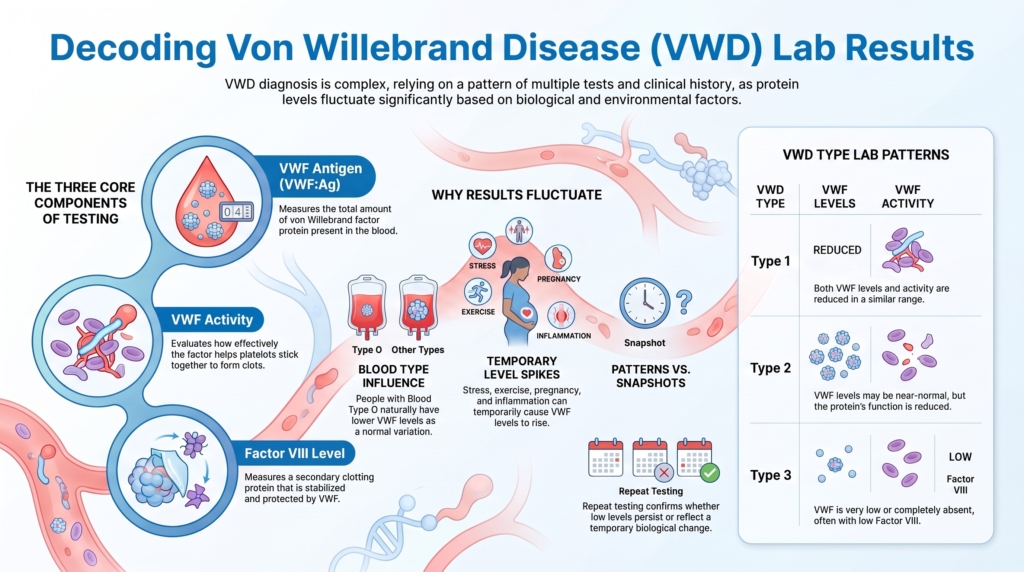
Von Willebrand disease testing is not a single test and not a single number.
Results must be interpreted as a pattern, over time, and in the context of bleeding history.
Borderline or changing values are common and often reflect normal biological variation, not worsening disease.
This information is for general education and does not replace medical care. It applies to people who are medically stable. If you are experiencing new or worsening symptoms, contact your doctor or seek emergency care.
First things first
Testing for von Willebrand disease (VWD) is more complex than many routine blood tests. Levels can change over time, different tests measure different aspects of von Willebrand factor, and results do not always match symptoms exactly.
This can be frustrating or confusing, especially if you are told your results are “borderline,” “inconsistent,” or need to be repeated. That does not mean something was done wrong. It reflects the biology of von Willebrand factor.
This page explains what the tests measure, why results can vary, and how doctors make sense of them.
What is being tested?
Von Willebrand factor (VWF) helps blood clot normally by helping platelets stick to injured blood vessels and by supporting the clotting process.
Testing looks at:
- how much VWF is present
- how well it works
Common components of VWD testing include:
- VWF antigen – how much von Willebrand factor is in the blood
- VWF activity – how well it helps platelets stick (different labs use different activity methods)
- factor VIII level – another clotting protein that is stabilized by VWF
- additional functional tests – sometimes used when type 2 is suspected
No single test can diagnose or exclude von Willebrand disease on its own.
Common test names you may see on lab reports
Different labs use different names. These are often measuring the same ideas.
- VWF:Ag – VWF antigen (amount)
- VWF activity – may appear as VWF:RCo, VWF:GPIbR, VWF:GPIbM, or similar (function)
- factor VIII – may appear as FVIII or FVIII activity
If your report uses different abbreviations, your care team can tell you what each test represents.
Why results can be confusing
Von Willebrand factor levels are dynamic, not fixed.
Levels can rise temporarily with:
- stress or anxiety
- illness or inflammation
- exercise
- pregnancy
- estrogen-containing medications
Levels can be lower in:
- people with blood type O (this is a normal variation, not an illness)
- certain medical conditions
- inherited or acquired forms of VWD
Because of this, a result that is low one day and closer to normal another day is common and expected.
Why tests are often repeated
Doctors often repeat VWD testing to:
- confirm a pattern rather than rely on a single value
- see whether low levels persist over time
- evaluate results when you are well and not under physiologic stress
- clarify borderline results
Repeat testing is a sign of careful interpretation. For borderline or variable results, patterns over time are more reliable than a single snapshot.
What “low,” “borderline,” and “normal” mean
Lab reports often show a reference range, but VWF values exist on a spectrum.
In general:
- clearly low levels are more likely to reflect true VWD and may predict higher bleeding risk
- borderline levels are common and may or may not be associated with meaningful bleeding
- values in the “normal” range do not always rule out a bleeding tendency, especially if symptoms are strong or function is impaired
This is why doctors interpret results together with your bleeding history, family history, and procedure history.
What “borderline” results mean
Many people fall into a gray zone where levels are lower than average but not clearly in the range seen with classic von Willebrand disease.
In these situations, doctors consider:
- bleeding history
- family history
- consistency of results over time
- response to prior procedures or injuries
A borderline number alone does not define risk. The full clinical picture matters more than a cutoff.
Can my levels go back up, and does that mean I am cured?
Can my levels go back up, and does that mean I am cured?
VWF levels can rise with age, pregnancy, inflammation, and hormones. Some people who had low levels at one time may later test closer to the reference range.
If your numbers normalize, it does not automatically mean your bleeding risk is gone. Doctors still pay attention to your bleeding history and how you have done with procedures. The goal is safe planning, not chasing a single number.
How testing helps determine type
Testing patterns help distinguish between different forms of VWD:
- type 1 – low VWF levels, with activity and antigen reduced in a similar range
- type 2 – VWF levels may be near-normal, but function is reduced
- type 3 – very low or absent VWF, often with low factor VIII
- acquired VWD – abnormal results developing later in life, often linked to another condition
This is why understanding which type matters more than the name “von Willebrand disease” alone.
Does testing predict bleeding exactly?
No test can perfectly predict bleeding risk.
Some people with low numbers bleed very little. Others with borderline values may have significant symptoms. This is why doctors weigh:
- laboratory patterns
- bleeding history
- upcoming situations (surgery, dental work, pregnancy)
Testing guides planning, it does not function as a crystal ball.
How test results are used in real life
Doctors use VWD testing to:
- decide whether treatment is needed before procedures
- choose the safest and most effective therapy
- plan around surgery or dental work
- avoid unnecessary treatment when risk is low
The goal is anticipation and prevention, not reacting after bleeding occurs.
When to ask questions about your results
You may want to ask your care team:
- which tests were abnormal, and which were normal?
- do my results suggest a specific type of VWD?
- should testing be repeated, and if so, when and why?
- how do my results fit with my bleeding history?
- do i need special planning for procedures or pregnancy?
These questions help shift the focus from individual numbers to practical care.
Making sense of it
Von Willebrand disease testing works best when results are viewed as patterns over time, not isolated values.
Variation is expected. Borderline results are common. Careful interpretation is a strength, not a weakness, of the diagnostic process.
The purpose of testing is not to label you, it is to help you and your care team plan safely.
Key takeaways
- not a single test — diagnosis relies on multiple tests interpreted together
- levels fluctuate — stress, illness, hormones, and blood type can affect results
- patterns matter most — repeat testing is often appropriate
- numbers don’t equal destiny — bleeding history and context are essential
- testing supports planning — the goal is prevention, not alarm
For clinicians: Read our detailed guide on how to communicate about VWD testing to patients.