
For Your Healthcare Provider
Have your patient scan this QR code with their smartphone camera to instantly access this educational guide on their device.

A guide for individuals with thalassemia trait
Access the Resources
Note: The video and audio linked above were generated with the assistance of AI. Clinical accuracy has been reviewed, but no AI-generated content can be guaranteed to be fully error-free.
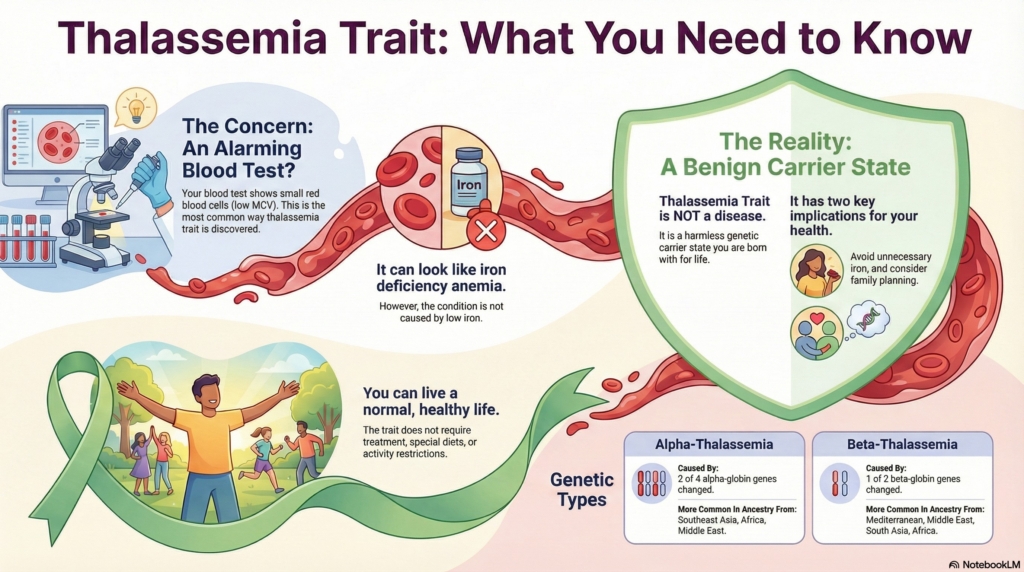
Thalassemia trait is a benign genetic carrier state, not a disease. People with thalassemia trait are healthy, live normal lives, and do not develop thalassemia disease.
It is usually discovered because blood tests show small red blood cells, sometimes with mild anemia, even though iron levels are normal. This can look concerning on paper, but it does not indicate a health problem.
It mainly matters to avoid unnecessary iron supplements and for family planning if your partner also carries a hemoglobin trait.
First things first
Seeing “thalassemia trait” on a blood test can be confusing or alarming, especially if you were told you have anemia or small red blood cells.
The most important thing to know right away is that thalassemia trait is not a disease. It is a benign genetic carrier state that you are born with and will have for life. It does not damage organs, limit activities, or shorten lifespan.
Thalassemia trait is usually discovered because routine blood tests show small red blood cells (a low MCV), sometimes with mild anemia, even though iron levels are normal. This pattern can look like iron deficiency, but it is not caused by low iron.
For most people, thalassemia trait causes no symptoms and requires no treatment. The main reasons it matters are to avoid unnecessary iron supplements and to guide family planning, since two carriers can have a child with a more serious form of thalassemia.
What is thalassemia trait?
Thalassemia trait is a genetic carrier condition. Your body makes slightly less of one component of hemoglobin, so your red blood cells are smaller than usual. You still make enough hemoglobin to stay healthy.
There are two main types:
Alpha-thalassemia trait
People normally have four alpha-globin genes (two from each parent). Having two affected genes causes small red blood cells and sometimes mild anemia.
Some people with only one affected gene are called silent carriers and often have a normal CBC. Knowing this can matter for family planning.
Alpha-thalassemia trait is more common in people with ancestry from Southeast Asia, Africa, and the Middle East, but it occurs in all populations.
Beta-thalassemia trait
People normally have two beta-globin genes. A change in one gene causes small red blood cells, mild anemia, and a higher hemoglobin A₂ level, which helps confirm the diagnosis.
Beta-thalassemia trait is more common in people with Mediterranean, Middle Eastern, South Asian, and African ancestry.
Both forms are benign carrier states. Thalassemia trait does not turn into thalassemia disease. More severe conditions occur only when a child inherits altered genes from both parents, which is why partner testing matters.
Why it happens (causes)
Thalassemia trait is inherited, meaning it is passed from parents to children and present from birth. You cannot develop it later in life or catch it from someone else.
It is more common in people with ancestry from regions where malaria was historically prevalent, because carrying one thalassemia gene provided partial protection against severe malaria. This reflects human genetic adaptation, not illness.
Does it cause symptoms?
Most people with thalassemia trait have no symptoms and feel completely well.
Some people have mild anemia, which usually does not cause noticeable fatigue or limitations. If you experience significant fatigue, shortness of breath, chest discomfort, or reduced exercise tolerance, these are not expected from thalassemia trait alone and should prompt evaluation for another cause.
Is it dangerous?
No. Thalassemia trait itself is not dangerous and does not progress to thalassemia disease.
It becomes important mainly for family planning, because if both parents carry certain hemoglobin gene changes, a child could inherit a more serious condition, such as:
- Beta-thalassemia major, which causes severe anemia starting in infancy
- Hemoglobin H disease, a moderate to severe form of alpha-thalassemia
These conditions require medical care, which is why partner testing and genetic counseling are recommended.
How your doctor evaluates it
Doctors recognize thalassemia trait by looking at patterns on blood tests rather than a single number. Evaluation may include:
- a complete blood count (CBC)
- iron studies to rule out iron deficiency
- hemoglobin electrophoresis (especially for beta-thalassemia trait)
- genetic testing in selected cases, particularly for alpha-thalassemia
If you are pregnant or planning pregnancy, your doctor may recommend partner testing and possibly genetic counseling.
Once the diagnosis is confirmed, it usually does not need repeated testing or specialist follow-up unless circumstances change.
How is it treated
There is no specific treatment for thalassemia trait because it is not an illness.
Iron supplements do not improve thalassemia trait and should be used only if blood tests confirm true iron deficiency. People with thalassemia trait can still become iron deficient from common causes such as heavy menstrual bleeding or pregnancy, and iron is appropriate in those situations.
Daily life and self-care
People with thalassemia trait can:
- exercise normally
- work without restrictions
- donate blood
- live normal, healthy lives
No special diet or lifestyle changes are required. When seeing new clinicians, it helps to mention thalassemia trait so that small red blood cells are not mistaken for iron deficiency.
When should I contact my doctor?
Call your doctor if:
- you are advised to take iron supplements and want to confirm they are necessary
- you are pregnant or planning a pregnancy
- your blood counts change significantly from your usual pattern
- family members are diagnosed with a hemoglobin disorder
What is the usual plan going forward?
For most people, the plan is simple:
- confirm the diagnosis once
- document it clearly in the medical record
- avoid unnecessary iron supplementation
- address family-planning questions when relevant
No routine monitoring is needed unless circumstances change.
Making sense of it
Think of hemoglobin production as a factory with two assembly lines.
With thalassemia trait, one line runs a bit slower than usual, but the other keeps production steady enough that the factory meets its quota.
The products (red blood cells) are smaller, but they work just fine.
Your blood tests reflect this difference, but your body functions normally. The main value of knowing about thalassemia trait is using iron appropriately and planning confidently for the future.
Key takeaways
- thalassemia trait is a carrier condition, not a disease and you are healthy and will remain healthy
- small red blood cells are expected, low mcv with normal iron is typical
- iron only helps if iron is low, supplements do not correct the trait itself
- two genetic types exist, alpha and beta and both are benign
- family planning matters, partner testing helps prevent severe disease in children
For clinicians: Read our detailed guide on how to communicate about thalassemia trait to patients.