
For Your Healthcare Provider
Have your patient scan this QR code with their smartphone camera to instantly access this educational guide on their device.

A guide for patients with Acquired Willebrand disease
Access the Resources
Note: The video and audio linked above were generated with the assistance of AI. Clinical accuracy has been reviewed, but no AI-generated content can be guaranteed to be fully error-free.
Acquired von Willebrand disease is a bleeding condition that develops later in life and is not inherited.
In many cases, treating the underlying cause significantly improves, and sometimes resolves, the bleeding risk and the von Willebrand factor test results.
This information is for general education and does not replace medical care. It applies to people who are medically stable. If you are experiencing new or worsening symptoms, contact your doctor or seek emergency care.
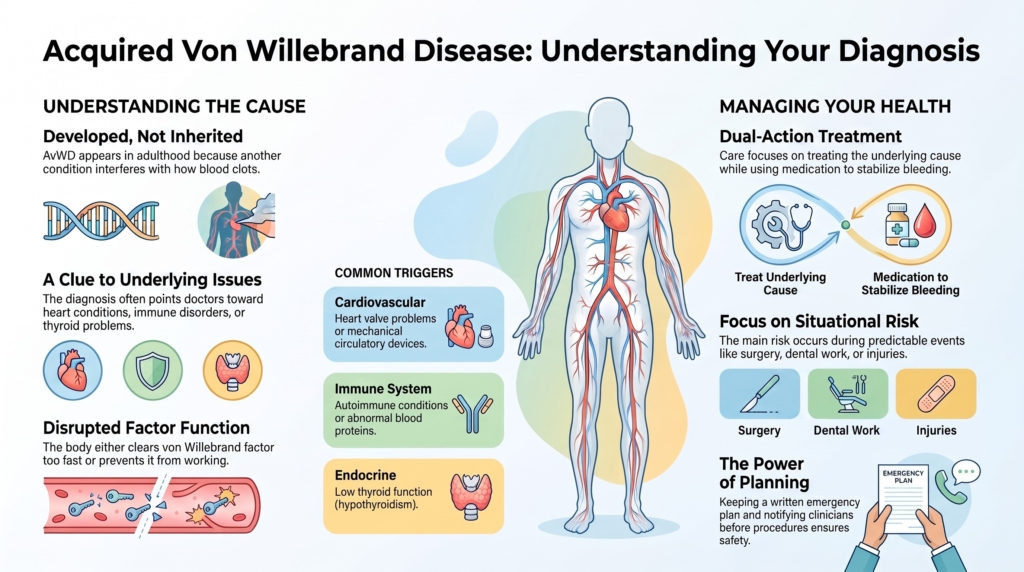
First things first
Most people with von Willebrand disease are born with it (inherited forms). Acquired von Willebrand disease is different. It develops later, often in adulthood, because another medical condition affects von Willebrand factor.
This diagnosis can feel unsettling because it raises an obvious question: “What is causing it?” A helpful frame is that acquired von Willebrand disease is usually a clue, it points your care team toward an underlying issue that can often be identified and addressed. Even when a specific cause is not immediately clear, bleeding risk can still be managed effectively.
This page explains what acquired von Willebrand disease is, why it happens, how it is evaluated, and how bleeding is prevented and treated.
What is type 3 VWD?
Von Willebrand factor helps blood clot normally by helping platelets stick to injured blood vessels and supporting the clotting process.
In acquired von Willebrand disease, von Willebrand factor becomes low or does not work normally because something in the body changes how it is made, how it circulates, or how quickly it is removed from the bloodstream.
Unlike inherited von Willebrand disease, people with acquired von Willebrand disease usually had normal bleeding earlier in life.
Why it happens (causes)
Acquired von Willebrand disease can occur in people with certain medical conditions that affect von Willebrand factor. These conditions range from common and very treatable to less common and more complex. Common categories include:
- conditions that involve the immune system or abnormal blood proteins
- certain blood disorders (sometimes discovered through routine blood testing)
- heart and blood vessel conditions that expose von Willebrand factor to high “shear stress” (for example, some valve problems or mechanical circulatory devices)
- low thyroid function (hypothyroidism), which can lower von Willebrand factor levels in some people
- in uncommon cases, certain medications
Sometimes, the acquired form improves when the underlying condition is treated. In other cases, it continues and requires an ongoing plan for procedures or bleeding episodes.
Does it cause symptoms?
Symptoms can look similar to inherited von Willebrand disease.
Some people bruise easily, have frequent nosebleeds, or bleed longer than expected after cuts. Others notice heavy menstrual bleeding (if menstruating), prolonged bleeding after dental work, or unexpected bleeding with surgery.
Many people are diagnosed only after a bleeding event or when testing is done before a procedure.
Is it dangerous?
For many people, acquired von Willebrand disease is manageable.
The main risk is bleeding during predictable situations such as surgery, dental work, invasive procedures, or major injury. Some people can also have bleeding without a clear trigger, depending on how low or dysfunctional von Willebrand factor becomes and what is causing the problem.
The most important safety step is identifying the underlying cause when possible and creating a clear plan for procedures and emergencies. The bleeding disorder itself is often treatable, and many people live normal lives. If an underlying condition is found, your care team will discuss what that means for your overall health.
How your doctor evaluates it
Evaluation usually includes blood tests that measure the amount of von Willebrand factor and how well it functions. Doctors interpret results as a pattern rather than relying on a single number, and testing may be repeated.
A key part of the workup is looking for an underlying condition that could be causing the acquired form. The specific tests depend on your history and may include evaluation for:
- immune or autoimmune conditions
- abnormal blood proteins
- other blood disorders
- heart valve disease or mechanical circulatory support
- thyroid disease
How is it treated
Treatment has two goals: managing bleeding risk now, and addressing the underlying cause when possible.
Depending on the situation, treatment may include:
- clot-stabilizing medicines for bleeding from the nose or mouth, heavy menstrual bleeding, or around procedures
- medications or infusions that temporarily improve von Willebrand factor activity
- von Willebrand factor-containing concentrates for higher-risk situations
- treatment directed at the underlying condition (for example, addressing a heart valve problem, treating an immune process, correcting low thyroid function, or adjusting a medication if it appears to be contributing)
Because acquired von Willebrand disease can behave differently from inherited forms, treatment plans are individualized.
Daily life and self-care
Many people live normal lives with acquired von Willebrand disease, especially when the underlying cause is identified and treated.
Practical steps that often help include:
- letting clinicians and dentists know about the diagnosis before procedures
- keeping a short summary of your diagnosis and treatment plan with you
- asking before starting medications that may increase bleeding risk
If you have had significant bleeding or need frequent procedures, your hematology team may suggest additional planning steps.
When should I contact my doctor?
Most bleeding symptoms are not emergencies, but it is important to know when to check in.
You should contact your doctor if you notice:
- new or unusual bleeding
- bleeding that takes longer to stop or is harder to control than expected
- heavy menstrual bleeding that interferes with daily life
- upcoming surgery, dental work, or medical procedures
- new symptoms that are concerning or persistent, especially if you are still being evaluated for an underlying cause
- questions about medications that affect bleeding, including aspirin or anti-inflammatory medicines like ibuprofen
Seek emergency care right away for:
- head injury or head trauma
- severe abdominal pain
- black stools, vomiting blood, or signs of significant internal bleeding
- heavy bleeding that is worsening or not responding to first-aid measures
What is the usual plan going forward?
The plan going forward usually includes:
- confirming the diagnosis and the pattern of testing
- evaluating for an underlying cause
- creating a written plan for procedures and emergencies
- reassessing over time, since treating the underlying condition may improve the von Willebrand factor tests and bleeding risk
Some people need only temporary precautions. Others benefit from longer-term follow-up with a hematologist.
Making sense of it
Inherited von Willebrand disease is something you are born with. Acquired von Willebrand disease develops later because another condition interferes with von Willebrand factor.
This can feel like an extra layer of uncertainty at first. The reassuring point is that acquired von Willebrand disease is often a problem your care team can act on: identify a cause when possible, plan ahead for procedures, and use effective treatments when bleeding risk is higher.
Key takeaways
- not inherited — acquired von Willebrand disease develops later in life
- usually has an underlying cause — finding and addressing it can improve bleeding risk
- bleeding is often situational — procedures and injuries are common triggers
- testing is pattern-based — doctors interpret multiple tests together, sometimes over time
- planning prevents problems — a clear procedure and emergency plan is the main safety tool
For clinicians: Read our detailed guide on how to communicate about acquired VWD to patients.