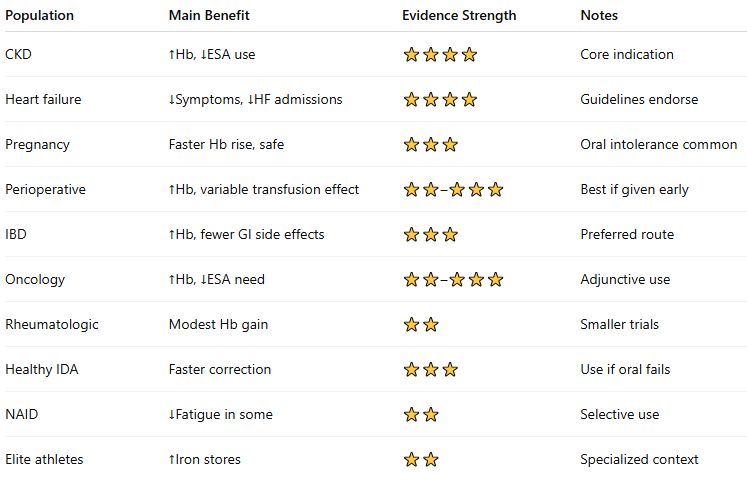
Otherwise Healthy Adults With Iron Deficiency Anemia (e.g., From Menorrhagia):
Evidence Summary:
Several RCTs compare IV versus oral iron in women with iron-deficiency anemia from menstrual or GI blood loss.
Findings:
IV iron (sucrose, carboxymaltose) produces faster hemoglobin and ferritin recovery and earlier symptom relief.
Oral iron remains effective but limited by GI intolerance and slower correction.
Interpretation:
In straightforward IDA, IV iron is not first-line, but is appropriate when oral therapy fails, is intolerable, or rapid restoration is needed (e.g., pre-op or severe menorrhagia).
Non-Anemic Iron Deficiency:
Evidence Summary:
Small RCTs in non-anemic individuals with low ferritin, often women with fatigue or chronic symptoms.
Findings:
IV iron can reduce fatigue scores and improve well-being when ferritin <50 µg/L.
No consistent improvement in objective performance or cognition.
Response varies by baseline iron status and symptom burden.
Interpretation:
IV iron may be symptomatically helpful in select NAID patients, but evidence is heterogeneous; use should be individualized and generally after oral trial.
Elite Athletes:
Evidence Summary:
Small physiologic RCTs in endurance athletes with low ferritin or training at altitude.
Findings:
IV (or IM) iron increases ferritin and TSAT, sometimes improving VO₂max and training adaptation.
Performance gains are inconsistent and small.
Greater benefit seen in female and altitude-exposed athletes.
Interpretation:
IV iron can be useful for iron-deficient athletes when oral therapy fails or time is limited, but routine use is not recommended; must follow anti-doping (WADA) infusion limits.
Chronic Kidney Disease (CKD):
Evidence Summary:
CKD is the most extensively studied setting for IV iron, both in dialysis-dependent and non-dialysis patients. Trials have compared IV versus oral iron and tested different IV formulations and dosing strategies.
Findings:
IV iron consistently raises hemoglobin faster and more reliably than oral iron.
Major RCTs (e.g., DRIVE, FIND-CKD, PIVOTAL) show safety when ferritin and TSAT are appropriately monitored.
Infection and cardiovascular risk remain low with current protocols.
Interpretation:
IV iron is standard of care in CKD-associated anemia, particularly when oral therapy is ineffective or rapid correction is desired.
Evidence level: Strongest and most mature across all populations.
Heart Failure:
Evidence Summary:
RCTs have evaluated IV iron in patients with heart failure and iron deficiency, with or without anemia.
Findings:
Trials such as FAIR-HF, CONFIRM-HF, AFFIRM-AHF, and IRONMAN show improved functional status, exercise tolerance, and quality of life.
Some trials demonstrate fewer heart-failure–related hospitalizations.
Mortality impact remains less certain.
Interpretation:
IV iron (especially ferric carboxymaltose or ferric derisomaltose) is recommended in HFrEF with iron deficiency to improve symptoms and reduce rehospitalization risk.
Evidence level: High, reflected in guideline recommendations (ACC/AHA, ESC).
Pregnancy / Postpartum:
Evidence Summary:
Multiple RCTs compare IV versus oral iron for iron deficiency anemia during pregnancy or postpartum.
Findings:
IV iron (iron sucrose, ferric carboxymaltose) yields faster hemoglobin recovery, higher ferritin, and better tolerance.
Decreases fatigue and improves maternal well-being.
No increase in adverse obstetric or neonatal outcomes.
Interpretation:
IV iron is safe and effective in the second and third trimesters or postpartum when oral iron fails, is not tolerated, or rapid repletion is necessary.
Evidence level: Moderate to high, depending on formulation.
Perioperative / Surgical:
Evidence Summary:
IV iron has been tested as preoperative optimization therapy in anemic or iron-deficient surgical patients.
Findings:
IV iron raises preoperative hemoglobin and iron stores.
Evidence for reducing transfusion or improving outcomes is mixed, particularly if given <1–2 weeks before surgery.
Works best when administered early and combined with erythropoietin in select cases.
Interpretation:
IV iron is useful preoperatively in iron-deficient patients when there’s adequate lead time; benefit on hard outcomes varies.
Evidence level: Moderate, supportive for early preoperative use in iron-deficient patients.
Inflammatory Bowel Disease (IBD):
Evidence Summary:
Several RCTs compare IV versus oral iron in Crohn’s disease and ulcerative colitis.
Findings:
IV iron (iron sucrose, ferric carboxymaltose) corrects anemia more effectively and with fewer gastrointestinal side effects than oral formulations.
Improves fatigue and quality of life.
Interpretation:
IV iron is preferred in active IBD or when oral iron causes GI intolerance or mucosal irritation.
Evidence level: Moderate to high.
Oncology / Chemotherapy-Induced Anemia:
Evidence Summary:
RCTs evaluate IV iron alone or in combination with ESA therapy in patients receiving chemotherapy.
Findings:
IV iron increases hemoglobin response and reduces ESA requirements.
Modest improvement in quality of life; no clear survival impact.
Safe across cancer types.
Interpretation:
IV iron is reasonable adjunctive therapy for chemotherapy-induced anemia, particularly in ESA-treated patients with low iron indices.
Evidence level: Moderate, but often limited by heterogeneity of cancer type and concurrent therapies.
Chronic Inflammatory / Rheumatologic Disorders:
Evidence Summary:
Smaller RCTs in rheumatoid arthritis and other inflammatory diseases.
Findings:
IV iron improves hemoglobin and fatigue modestly.
Safety profile similar to that in IBD and CKD.
Interpretation:
IV iron can be considered in chronic inflammation–associated anemia when functional iron deficiency is present.
Evidence level: Low to moderate.
Miscellaneous / Other Populations:
Heart and lung transplant candidates, restless legs syndrome, bariatric surgery patients, and heart failure with preserved EF (HFpEF) — emerging or pilot RCTs suggest benefit but are not yet guideline-strength.