
What it means to live between normal variation and disease
Note: The video and audio linked above were generated with the assistance of AI. Clinical accuracy has been reviewed, but no AI-generated content can be guaranteed to be fully error-free.
Why this spoke matters
Medicine needs thresholds. Without thresholds, diagnosis becomes vague, research becomes difficult, insurance becomes inconsistent, treatment eligibility becomes unstable, and clinical communication becomes imprecise.
But thresholds also create diagnostic borderlands.
A patient is just above the line. Or just below it. A level is 52 IU/dL, then 46 IU/dL, then 61 IU/dL. One clinician says normal. Another says low. Another says type 1 VWD. Another says borderline.
The patient is left asking:
- Do I have a disease?
- Do I have a risk factor?
- Do I have a label?
- Do I need treatment?
- Do my children need testing?
- Should I tell the surgeon?
- Will anyone believe me if I bleed?
In von Willebrand disease (VWD), the border between normal variation and disease is not just a laboratory problem.
It is a human problem.
The necessity of lines
Thresholds are not arbitrary in the careless sense. They emerge from evidence, expert judgment, assay limitations, population distributions, bleeding studies, and the need to make decisions. But they are also lines drawn across a biologic continuum.
Clinicians need to decide when to diagnose, when to test family members, when to plan surgery, when to recommend desmopressin testing, when to use tranexamic acid, when to avoid unnecessary treatment, and when to reassure.
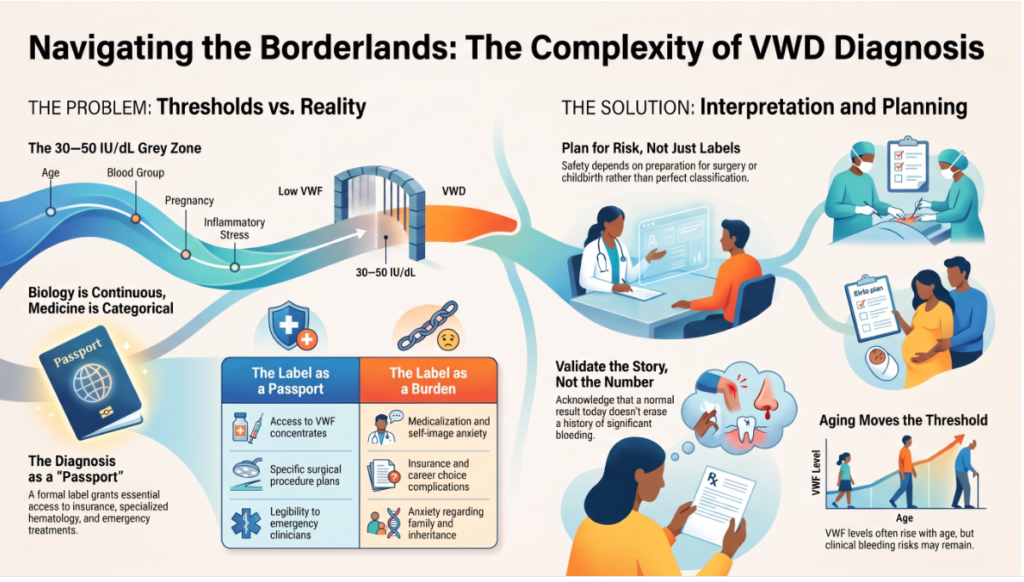
In VWD, commonly used thresholds such as 30 IU/dL and 50 IU/dL help organize care. They are practical. They are useful. They are necessary.
But they are not cliffs in nature.
Thresholds are tools, not truths in nature.1
The continuum problem
VWF levels vary widely in the general population. They are influenced by blood group, age, stress, inflammation, exercise, pregnancy, estrogen exposure, malignancy, and other modifiers. They can fluctuate within the same person. They can rise over time. They can be temporarily elevated at the moment of testing.
This means that one number does not fully define the person.
A VWF activity of 49 IU/dL and 51 IU/dL may not represent biologically different states. But clinically, those numbers may be treated differently.
This is the central tension in VWD:
biology is continuous, but medicine often has to act categorically.
Sadler framed the problem clearly: the distinction between normal and low VWF is partly arbitrary, bleeding risk increases as VWF falls, but the relationship is not strong until VWF is very low; mild bleeding symptoms are also common in apparently healthy populations.2
Guidelines differ because tradeoffs differ
The borderland is visible in the guidelines themselves.
Older UK and Nordic approaches were cautious about calling the 30 to 50 IU/dL range VWD. They often treated symptomatic patients in this range as having low VWF: a primary hemostatic bleeding tendency with reduced VWF as a risk factor rather than definite VWD.3
The 2021 ASH/ISTH/NHF/WFH diagnostic guideline moved differently. It recommends diagnosing type 1 VWD in patients with VWF levels below 0.30 IU/mL regardless of bleeding, and in patients with abnormal bleeding and VWF levels below 0.50 IU/mL. This reflects a high value placed on not missing affected patients and ensuring access to care.4
The 2024 BSH laboratory guideline preserves caution, emphasizing that the association between VWF level, bleeding, and VWF variants is weaker in the 30 to 50 IU/dL range, that other hemostatic contributors may coexist, and that unnecessary diagnosis and incomplete investigation are both hazards.5
This disagreement is not failure. Guidelines differ because evidence gaps, assay limitations, feasibility, health-system context, and values differ. Different guidance documents operationalize different acceptable errors: missed diagnosis, overdiagnosis, restricted access, unnecessary labeling, incomplete investigation, or excessive certainty.
The borderland is not only biological.
It is ethical.
The borderland patient
A borderland patient is not imaginary. They are the person whose VWF levels fall near diagnostic thresholds.
They may have mild bleeding, significant bleeding, or little bleeding because they have not yet encountered a major hemostatic challenge. They may have blood group O. They may have heavy menstrual bleeding, iron deficiency, recurrent epistaxis, or a family history that is suggestive but not confirmed. They may have one low result and one normal result. They may have been diagnosed as a child and “undiagnosed” as an adult.
They may have phenotype without stable classification.
They may be told they have low VWF rather than VWD. They may be told the label does not matter.
But labels do matter.
They shape what happens next.
The diagnosis as passport
A diagnosis can function like a passport. It grants entry into certain forms of care:
- hematology follow-up
- procedure planning
- insurance coverage
- access to tappropriate hemostatic therapy
- desmopressin testing or treatment
- emergency letters
- school accommodations
- family testing
- patient education
A diagnosis can make bleeding legible to clinicians who have never met the patient. It can reduce the burden of explanation. It can say: this history has a name.
Without the label, the story may have to be retold each time.
But if the patient is told they do not quite meet the threshold, they may lose that passport. Their bleeding may remain real, but their access may become uncertain. This is one reason diagnostic thresholds carry emotional and practical weight.
The 2021 ASH/ISTH/NHF/WFH diagnostic guideline explicitly weighed this access problem. Its type 1 VWD threshold recommendation reflects a high value placed on avoiding missed diagnosis and ensuring access to care for symptomatic patients.6
The diagnosis as burden
A diagnosis can also burden. It can create anxiety, medicalize a person, affect self-image, complicate insurance or career choices, reshape family planning, and create fear around children. It can make normal bruising feel ominous. It can turn every nosebleed into evidence. It can turn family history into responsibility.
The same label that grants access can also create vulnerability.
This is why overdiagnosis matters.
A VWD label should not be applied casually. Recent commentary has emphasized that labeling the entire borderline group as type 1 VWD may improve access in some settings but risks false-positive diagnosis and overmedicalization in others, especially when VWF is modestly reduced and bleeding symptoms are nonspecific.7
The patient near the boundary needs neither dismissal nor reflex labeling.
They need careful interpretation.
Low VWF as a border concept
The term “low VWF” emerged to describe people with VWF levels below the usual reference range but not as low as classic type 1 VWD. It acknowledged that levels in the 30 to 50 IU/dL range may increase bleeding risk without always representing a monogenic inherited bleeding disorder.
This was useful. But it also created ambiguity. It was meant to clarify risk, but it often shifts uncertainty into language.
Patients could hear:
- you are low, but not diseased
- you have a risk factor, but not a disorder
- your bleeding matters, but perhaps less
- you are not normal, but not diagnostic
Earlier consensus approaches separated type 1 VWD from low VWF, often reserving type 1 VWD for lower levels and treating the 30 to 50 IU/dL range as a risk state. The 2021 ASH/ISTH/NHF/WFH guideline moved away from that distinction for symptomatic patients, recommending type 1 VWD for those with abnormal bleeding and VWF levels below 0.50 IU/mL.8
This did not eliminate the borderland.
It moved the language around it.
Assay uncertainty as identity uncertainty
Laboratory numbers feel precise, but VWF testing is vulnerable to context.
VWF levels may be elevated by inflammation, exercise, surgery, pregnancy, acute bleeding, stress, and comorbid illness. Samples can be affected by collection, processing, transport, refrigeration, freezing, thawing, and interlaboratory variation. The 2024 BSH laboratory guideline emphasizes that VWD diagnosis should generally be confirmed on samples collected on two separate occasions, and that abnormal results may need confirmation at a specialist center with expertise in both testing and interpretation.9
This matters because the patient does not experience the result as an assay artifact. They experience it as a statement about themselves.
Normal. Low. Borderline. Diagnostic. No longer diagnostic.
When the number moves, identity may move with it. Analytical variability becomes personal instability.
Bleeding scores help but do not solve the borderland
Bleeding assessment tools help standardize the history. They make clinicians ask more carefully. They reduce reliance on vague impressions such as “bleeds a lot” or “does not bleed.”
But they do not eliminate uncertainty.
Bleeding histories are subjective. Bleeding symptoms are common in the general population. Children and young patients may not yet have faced major hemostatic challenges. Treatment can alter the apparent bleeding history. A bleeding score may support suspicion, document severity, or help decide who needs testing, but it does not by itself diagnose or exclude VWD.10
Standardization reduces variability.
It does not eliminate ambiguity.
No single test can carry the diagnosis
VWF is not one function. It binds platelets, binds collagen, carries FVIII, circulates as multimers, responds to endothelial stimulation, and changes with physiologic context. VWD is therefore not captured by a single assay.
Initial testing usually includes VWF antigen, platelet-dependent VWF activity, and FVIII. Additional tests such as collagen binding, multimer analysis, FVIII-binding assays, RIPA, desmopressin response, or genetic testing may be needed depending on the pattern.11
Ratios also help, especially platelet-dependent activity-to-antigen ratios that distinguish type 1 from type 2 patterns. But ratio cutoffs differ across guidance, and assay variability affects sensitivity and specificity. Even ratios are tools, not verdicts.12
Diagnosis emerges from patterns, not isolated values.
The laboratory contributes a pattern.
It does not replace the patient.
When labels change
A patient may receive one label at one time and another later.
As a child: possible VWD.
As a teenager: type 1 VWD.
As an adult: low VWF.
During pregnancy: normal VWF.
In older age: no current laboratory evidence of VWD.
These shifts may be scientifically explainable. VWF changes with age, inflammation, pregnancy, and physiologic state. The biology evolves. The interpretation shifts. But for the patient, changing labels can feel destabilizing.
Was I sick? Am I still sick? Did I outgrow it? Was I misdiagnosed? Did my bleeding not count? Should I still tell surgeons? Should my children be tested?
A changing label is not merely a correction. It is a revision of personal history.
Aging and the moving threshold
Aging is one of the most important reasons the borderland moves. VWF levels often rise over time. A person first tested in childhood may fall below 30 IU/dL. The same person first tested in adulthood may fall in the 30 to 50 IU/dL range. The same person first tested later in life may test above 50 IU/dL.
Age moves patients across thresholds without necessarily changing their story.
Recent analyses of low VWF and type 1 VWD cohorts support this age-dependent evolution. In some patients with prior type 1 VWD, VWF levels increase into the low VWF range or even into the normal range, while bleeding phenotype may remain similar.13
The first VWF test is therefore not only a result.
It is a timestamp.
The experience of being “undiagnosed”
Removing a diagnosis can be appropriate. Some people carry historical VWD labels that are no longer supported by bleeding history or repeated laboratory testing. “Undiagnosing” may reduce anxiety, unnecessary treatment, and procedural overplanning.
But it must be done carefully.
The 2021 ASH/ISTH/NHF/WFH diagnostic guideline suggests reconsidering, rather than simply removing, the diagnosis in patients with previously confirmed type 1 VWD whose VWF levels normalize with age. The guideline explicitly notes that aging and comorbidities can increase VWF levels, but the relationship between higher levels and bleeding symptoms is not established, and decisions should consider patient values and shared decision-making.14
A patient may feel that a past explanation is being taken away. They may feel that years of bleeding are being reinterpreted as insignificant. They may worry that future clinicians will not take them seriously.
Thoughtful “undiagnosing” requires more than saying current labs are normal. It requires reviewing the original evidence, bleeding history, family history, prior hemostatic challenges, current levels, and future risk.15
Reassessment should distinguish between current laboratory normalization and the historical question of whether the patient had clinically meaningful bleeding risk at the time of diagnosis.
Removal of a label should not remove meaning.
The diagnosis should not be removed by erasing the story. It should be revised by explaining the story better.
Identity and uncertainty
Patients do not always want a diagnosis. They want clarity.
A diagnosis can provide clarity. But a borderline diagnosis can provide uncertainty with a name. Borderline diagnosis converts biological uncertainty into lived ambiguity.
The patient may wonder whether they are a “real” bleeding-disorder patient. They may feel uncomfortable claiming the label. They may feel guilty using treatment. They may feel dismissed without the label. They may feel anxious with it.
This is the identity burden of borderland disease.
The person is not simply sick or well.
They are conditionally vulnerable.
That is harder to explain.
Conditional vulnerability
VWD is often not a disease of constant impairment. It is a disease of context-dependent risk.
The patient may be well during ordinary life but vulnerable during:
- menstruation
- dental extraction
- surgery
- childbirth
- postpartum healing
- trauma
- anticoagulation
- gastrointestinal angiodysplasia
This matters especially near thresholds. A patient may not need daily treatment. They may need situational recognition. This is why the binary of disease versus no disease is often too crude.
The practical question is:
What situations require a plan?
Treatment planning can matter more than label purity
Diagnostic precision matters. But in the borderland, the immediate clinical question is often not, “What is the perfect label?” It is, “What is the safest plan for this situation?”
The 2021 management guideline repeatedly emphasizes individualized decisions based on subtype, bleeding phenotype, procedure type, treatment response, patient goals, and shared decision-making. Minor mucosal procedures, major surgery, heavy menstrual bleeding, pregnancy, postpartum care, neuraxial anesthesia, and antithrombotic therapy each require a different risk calculation.16
This is why a patient near the threshold may still need a procedure plan, an emergency letter, tranexamic acid, desmopressin testing, iron management, or hematology input even if the diagnostic label remains provisional.
Safety often depends more on preparation than on perfect classification.
The label should support care.
It should not substitute for care.
The moral weight of numbers
Numbers often feel objective. A VWF level seems cleaner than a story.
But in borderland VWD, numbers carry moral weight.
Above the threshold: normal.
Below the threshold: abnormal.
Normal can sound like: you should not be bleeding.
Abnormal can sound like: you are officially vulnerable.
The number may affect whether the patient feels entitled to care. But numbers do not suffer.
People do.
Numbers classify. They do not experience. The number should guide interpretation. It should not invalidate experience.
The problem of “not abnormal enough”
Many patients with borderline conditions encounter the phrase, explicit or implicit:
not abnormal enough.
Not low enough. Not severe enough. Not frequent enough. Not anemic enough. Not diagnostic enough.
In VWD, this can be particularly painful because bleeding may be episodic and exposure-dependent. A patient may not be abnormal enough in clinic but abnormal enough in childbirth. Not abnormal enough today but abnormal enough after dental extraction. Not abnormal enough for a diagnosis but abnormal enough to need a plan.
Thresholds can exclude the very patients most likely to be overlooked.
The question should not be only:
Does the patient meet criteria?
It should also be:
What risk are we trying to prevent?
Borderlines in childhood
Children are especially likely to live in diagnostic borderlands. They may have bruising or nosebleeds that are common in childhood. They may not yet have had surgery, dental extraction, menstruation, childbirth, or major trauma. Their family history may be incomplete. A clinician may reasonably hesitate to make a lifelong diagnosis.
At the same time, a child with borderline levels may be scheduled for tonsillectomy or another high-risk procedure.
Unexposed does not mean unaffected.
In these situations, it may be safest to plan for bleeding risk even while the long-term diagnosis remains under evaluation. Recent low-VWF diagnostic discussions emphasize the difficulty of interpreting patients with levels in the 30 to 50 IU/dL range who have no or minimal bleeding history but have not yet faced significant hemostatic challenges.17
A provisional plan is not the same as a permanent label.
Borderlines in pregnancy
Pregnancy creates another borderland. VWF and FVIII often rise, especially in type 1 VWD and low VWF. A patient may test in the normal range during pregnancy. That can be reassuring for delivery planning, but it should not automatically erase the underlying history.
Physiologic normalization is temporary, not curative.
After delivery, levels fall. The postpartum period may reveal baseline vulnerability again. Pregnancy shows that thresholds are time-dependent.
A number in the third trimester is not the same as a number six months postpartum.
The timing of the threshold matters.
Borderlines in aging
Aging also changes VWF levels. Some patients previously diagnosed with type 1 VWD may later have normal VWF levels. This may reduce risk in some situations, but it may not erase a history of bleeding.
Rising levels do not erase historical physiology.
Aging also may not protect against later-life problems such as angiodysplasia, aortic stenosis, antiplatelet therapy, anticoagulation, falls, or surgery.
The older patient may move above one threshold while crossing into new hemostatic challenges.
Aging can normalize a number while complicating the life.
The family borderland
VWD creates family borderlands.
One family member has a diagnosis. Another has borderline levels. Another has heavy periods but normal testing. Another has nosebleeds but never sought care. Another has a child with type 3 VWD and parents with low-normal levels.
The family may ask:
- Who has it?
- Who needs testing?
- Who needs treatment?
- Who is responsible for telling whom?
- Which relatives should plan before surgery or childbirth?
Inheritance makes diagnosis communal. Thresholds applied to individuals reverberate through families.
The ASH/ISTH/NHF/WFH guideline considered whether family history alone should diagnose type 1 VWD in people with VWF levels of 30 to 50 IU/dL, but it did not make that recommendation because of concern about inaccurate diagnosis in relatives. This captures the dilemma: family history matters, but it is not a substitute for phenotype and context.18
When not labeling is also an action
It may seem that not diagnosing is neutral.
It is not.
Not labeling may reduce anxiety, overmedicalization, unnecessary therapy, and the consequences of a disease identity. But it may also reduce access, weaken procedure planning, and increase the patient’s burden of explanation.
Likewise, labeling may improve access and planning. But it may create anxiety, overdiagnosis, and a sense of fragility.
Silence shapes care as much as naming.
There is no language without consequences.
The task is to choose the language that best supports safe care and honest uncertainty.
What clinicians can say
Clinicians can help by naming the uncertainty rather than hiding it.
For example:
- Your levels are near the diagnostic boundary, and your bleeding history matters in how we interpret them.
- You may not need a lifelong disease label today, but you do need a plan for surgery.
- Your current VWF level is normal, but your prior bleeding history remains relevant.
- This may be best understood as a bleeding risk state rather than a severe bleeding disorder.
- The label is less important than knowing what to do before procedures, childbirth, or major bleeding.
- We will not ignore your bleeding history just because today’s number is above the threshold.
- We will not diagnose VWD from a borderline number alone.
- Blood group O may partly explain lower VWF values, but it does not erase the bleeding phenotype.
This language preserves both safety and humility.
What the borderland requires
Borderland VWD requires more than a yes-or-no answer. It requires a structured account of risk.
The clinical record should make clear:
- the lowest documented VWF levels
- whether levels were repeated
- the conditions under which testing occurred
- bleeding history before treatment
- prior dental, surgical, menstrual, obstetric, and traumatic challenges
- family history
- desmopressin response if known
- what treatment has worked
- what future situations require a plan
- whether the diagnosis is definite, probable, possible, historical, or no longer supported
Documentation should carry nuance that labels cannot. This approach prevents the label from doing too much work.
It lets the story carry the uncertainty.
The ethics of thresholds
Thresholds are ethically necessary. They make care more consistent. They prevent arbitrary decision-making. They reduce chaos.
But thresholds also create winners and losers. They determine who qualifies, who waits, who explains, who receives treatment, who gets reassured, and who feels dismissed.
Thresholds organize care, but they also distribute recognition.
The ethical task is not to eliminate thresholds. That is impossible. The ethical task is to remember what thresholds are: tools for decision-making, not measures of human worth or suffering.
A number can guide care.
It should not define the person.
Clinical synthesis
VWF levels exist on a continuum. Clinical care requires thresholds. Patients near those thresholds live in the borderland between normal variation, bleeding risk, low VWF, type 1 VWD, and sometimes no current laboratory evidence of disease.
This borderland is scientifically difficult and emotionally consequential. Low VWF may behave like a risk factor in some people, a clinically meaningful bleeding disorder in others, and an uncertain state in those who have not yet been challenged. Aging, pregnancy, stress, inflammation, assay variability, family history, and prior bleeding all complicate interpretation.
Guidelines differ because the tradeoffs are real: missed diagnosis versus overdiagnosis, access versus medicalization, categorical labels versus continuous biology. The task is not to force certainty where biology does not provide it. Nor is it to abandon thresholds altogether.
The task is to use thresholds carefully, preserve the bleeding story, plan for meaningful risk, and speak honestly about uncertainty.
Patients near the line need more than a number.
They need an explanation.
In VWD, the threshold is not the conclusion. It is the beginning of interpretation.
Evidence anchor: why diagnostic borderlands exist in VWD
Summary derived from diagnostic guidelines, laboratory guidance, low-VWF literature, bleeding-assessment studies, and management guidance. The evidence consistently shows that VWF biology is continuous, VWF testing is context-sensitive, and clinical care nevertheless requires thresholds.
| Evidence stream | What it shows | Why it matters | Main limitation |
|---|---|---|---|
| Continuous VWF distribution | VWF levels vary continuously across the population, and the boundary between “normal,” “low VWF,” and type 1 VWD is partly conventional.19 | Thresholds are useful decision tools, but they are not biological cliffs. | Population distributions do not determine individual bleeding risk. |
| Guideline threshold differences | Older UK and Nordic approaches often treated the 30–50 IU/dL range as low VWF or a bleeding risk factor. The 2021 ASH/ISTH/NHF/WFH guideline recommends type 1 VWD for VWF <0.30 IU/mL regardless of bleeding and for VWF <0.50 IU/mL in patients with abnormal bleeding. The 2024 BSH laboratory guideline emphasizes caution in the 30–50 IU/dL range.20 | Guidelines reflect evidence gaps, assay limitations, health-system context, and different weighting of missed diagnosis versus overdiagnosis. | Guideline thresholds cannot remove the need for individualized interpretation. |
| Low VWF heterogeneity | Patients with VWF 30–50 IU/dL are heterogeneous. Some have significant mucocutaneous bleeding, HMB, postpartum hemorrhage, or procedure-related bleeding; others have little bleeding or limited hemostatic exposure. Pathogenic VWF variants are less common than in classic type 1 VWD.21 | The same VWF level may carry different meaning depending on bleeding history, family history, prior challenges, and modifiers. | Low VWF does not behave as a single biologic or clinical entity. |
| Testing context and assay variability | VWF levels are affected by stress, inflammation, acute bleeding, pregnancy, age, blood group, and comorbid conditions. Preanalytic and analytic factors also affect results. Abnormal results often require confirmation on repeat samples and sometimes specialist-laboratory interpretation.22 | Borderline numbers may reflect biology, context, assay variability, or a mixture of all three. | Repeat testing can clarify the pattern but may also prolong uncertainty. |
| Bleeding assessment tools | BATs help structure and standardize bleeding history, especially in low-pretest-probability settings, but they should not be used alone to diagnose or exclude VWD in referral or high-probability contexts.23 | Bleeding history matters, but it must be interpreted with context and laboratory pattern. | Bleeding symptoms are common, and young patients may not yet have had major hemostatic challenges. |
| Aging and diagnostic reassessment | VWF levels may rise with age, and some patients previously diagnosed with type 1 VWD may later have VWF levels in the low or normal range. ASH/ISTH/NHF/WFH suggests reconsidering, rather than simply removing, a previously confirmed diagnosis when levels normalize with age.24 | A current value does not automatically erase prior bleeding phenotype or historical diagnostic evidence. | The relationship between age-related normalization and future bleeding risk remains incompletely defined. |
| Management as situational planning | Management guidance emphasizes individualized planning based on subtype, bleeding phenotype, procedure type, treatment response, reproductive goals, and shared decision-making.25 | For borderland patients, the key practical question is often not only “What is the label?” but “What situations require a plan?” | Evidence certainty is limited for many management questions, so judgment remains central. |
Interpretive note: These evidence streams point in the same direction: diagnostic borderlands are not mistakes in VWD care. They are expected when continuous biology, variable bleeding histories, imperfect assays, and categorical clinical decisions meet. The goal is not to pretend the borderland is certain. The goal is to make uncertainty safe.
Interpretive guidance: caring for patients near the diagnostic threshold
Based on diagnostic guidelines, laboratory guidance, low-VWF literature, and management recommendations.
When a patient sits near the threshold, interpret the number with:
- the lowest documented VWF antigen and activity levels
- whether low values were repeated
- the conditions under which testing occurred
- blood group, age, pregnancy, inflammation, stress, acute bleeding, estrogen exposure, and comorbid illness
- bleeding history before treatment
- HMB, iron deficiency, epistaxis, bruising, dental bleeding, surgical bleeding, postpartum bleeding, and GI bleeding
- prior hemostatic challenges faced and not yet faced
- family history of bleeding, iron deficiency, postpartum hemorrhage, transfusion, early hysterectomy, or known VWD
- desmopressin response, if known
- prior effective therapies and therapies that failed
- upcoming risk situations, such as tonsillectomy, dental extraction, pregnancy, delivery, colonoscopy, surgery, trauma, or anticoagulation
Avoid common interpretive errors
- treating 49 IU/dL and 51 IU/dL as biologically different states
- treating blood group O as an explanation that erases bleeding
- using one normal value to dismiss a consistent bleeding phenotype
- diagnosing VWD from a borderline number alone
- withholding a procedure plan because the label is provisional
- assuming a child with limited bleeding history is low risk if they have not yet been challenged
- removing a historical diagnosis without reviewing the original evidence
- letting the label replace the clinical plan
Useful language
Instead of:
“Your labs are normal.”
Try:
“This value is reassuring, but we should interpret it with your prior values, bleeding history, and the situation we are planning for.”
Instead of:
“You do not quite meet criteria.”
Try:
“You are near the diagnostic boundary. That means we should be careful about both overlabeling and underplanning.”
Instead of:
“It is probably just blood group O.”
Try:
“Blood group O may contribute to lower VWF levels, but it does not erase your bleeding history.”
Instead of:
“You may not have VWD.”
Try:
“The label is uncertain, but the bleeding history is still clinically useful. Let’s decide what situations need a plan.”
Instead of:
“Your VWF normalized, so you no longer have a bleeding disorder.”
Try:
“Your current VWF level is higher than before. We should reconsider the diagnosis thoughtfully rather than erase the history.”
Practical takeaway: Borderland VWD requires a structured account of risk, not a forced yes-or-no answer. The best care preserves uncertainty, documents the bleeding story, plans for meaningful challenges, and avoids both reflex labeling and reflex dismissal.
Reflect & Apply Case
A 9-year-old boy is referred before tonsillectomy because of recurrent epistaxis and easy bruising.
His VWF activity values over two years are 54 IU/dL, 46 IU/dL, and 52 IU/dL. VWF antigen is similar. FVIII is normal. He is blood group O. He has never had surgery, dental extraction, major trauma, or other significant hemostatic challenges. His mother reports heavy periods and iron deficiency but has never been diagnosed with a bleeding disorder.
His parents ask:
“Does he have von Willebrand disease, or is this just borderline?”
Questions for reflection:
- Why is this not answered by a single VWF value?
- What parts of the history increase concern?
- What major hemostatic challenges has he not yet faced?
- How should blood group O be interpreted without dismissing risk?
- How might the answer affect surgical planning and family understanding?
- What would be the danger of reflex labeling?
- What would be the danger of dismissing the label entirely?
- What plan should he have before tonsillectomy?
This case illustrates the central lesson:
The line between normal variation and disease is not answered by the number alone. It is interpreted through bleeding history, family history, prior challenges, and the risk ahead.
Test your thinking
A short quiz on thresholds, identity, and the borderlands of diagnosis in VWD.