
How different organisms keep glycolysis running when oxygen disappears
Introduction
Glycolysis is one of the most ancient metabolic pathways in biology.
It allows cells to extract energy from glucose without requiring oxygen. In the process, glucose is converted to pyruvate while producing small amounts of ATP.
But glycolysis carries a hidden constraint.
During glycolysis, NAD⁺ is reduced to NADH. For glycolysis to continue, NADH must be converted back to NAD⁺. If this regeneration step fails, glycolysis stops and ATP production ceases.
Under aerobic conditions, this problem is solved in mitochondria. NADH transfers electrons to the electron transport chain, and oxygen ultimately serves as the terminal electron acceptor.
When oxygen is absent, that pathway is no longer available.
Cells must therefore find another way to regenerate NAD⁺.
Across the tree of life, organisms have evolved several different solutions to this biochemical bottleneck.
The pyruvate branch point
Glycolysis ends with the production of pyruvate.
Pyruvate therefore sits at a critical metabolic junction. In the absence of oxygen, the fate of pyruvate determines whether NAD⁺ can be regenerated and glycolysis can continue.
Different organisms solve this problem in different ways.
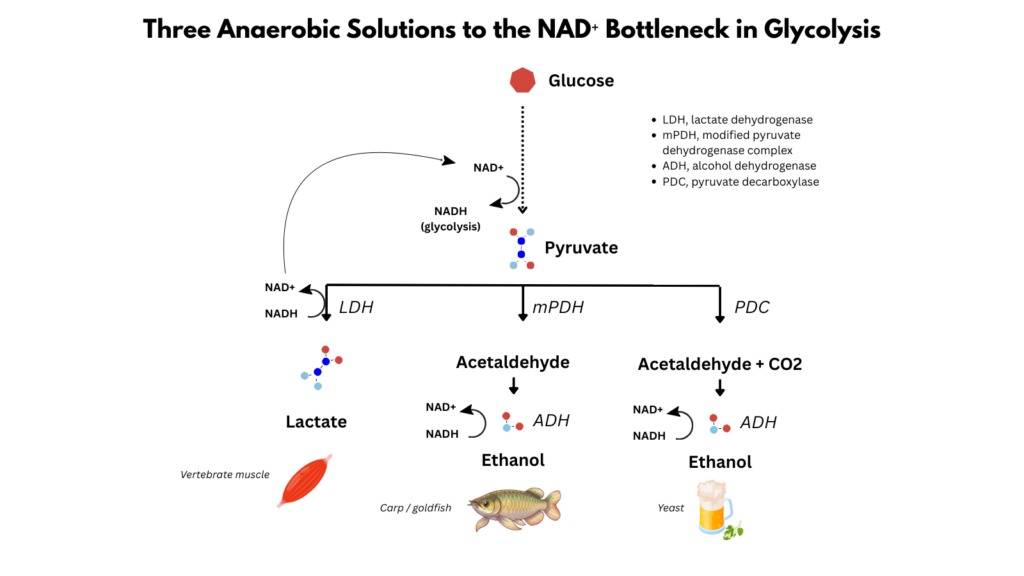
Solution 1: Lactate production in vertebrates
Most vertebrate tissues regenerate NAD⁺ by converting pyruvate into lactate.
This reaction is catalyzed by lactate dehydrogenase:
pyruvate + NADH → lactate + NAD⁺
By oxidizing NADH back to NAD⁺, the reaction allows glycolysis to continue producing ATP even when oxygen delivery is insufficient.
This pathway supports short bursts of anaerobic metabolism, such as during intense exercise.
However, it has a limitation.
Lactate accumulates in tissues and blood. If oxygen deprivation persists, the resulting acidosis becomes physiologically limiting.
For most vertebrates, anaerobic metabolism therefore supports survival for minutes to hours, but not for extended periods.
Solution 2: Ethanol production in carp and goldfish
A remarkable alternative strategy has evolved in crucian carp and goldfish.1
These fish inhabit ponds and lakes in northern climates where winter ice can isolate the water from the atmosphere for months. During this time, oxygen levels in the water may fall to nearly zero.
Many fish cannot survive such conditions. But crucian carp and goldfish can tolerate prolonged complete anoxia.
Cold itself is not the critical challenge. Many fish tolerate cold temperatures without special metabolic adaptations. The problem is the absence of oxygen.
Instead of converting pyruvate to lactate, these species convert it to ethanol.2
The pathway proceeds in two steps:
pyruvate → acetaldehyde (modified pyruvate dehydrogenase complex)
acetaldehyde → ethanol (alcohol dehydrogenase)
The second reaction regenerates NAD⁺, allowing glycolysis to continue in the absence of oxygen.
The crucial advantage is that ethanol diffuses across the gills into the surrounding water.
Rather than accumulating as an acid in tissues, the metabolic end product simply leaves the body.
This unusual strategy allows crucian carp and goldfish to survive months of anoxia beneath frozen lakes.
Evidence for ethanol production in crucian carp
The biochemical basis of ethanol production in crucian carp and goldfish was clarified in a 2017 study examining fish exposed to prolonged anoxia.
Researchers found that skeletal muscle metabolism shifts to an alternative pathway that converts pyruvate to acetaldehyde and then to ethanol, regenerating NAD⁺ and allowing glycolysis to continue in the absence of oxygen.
Key findings included:
- Activation of an ethanol-producing pathway in skeletal muscle
- Conversion of pyruvate → acetaldehyde → ethanol, avoiding lactate accumulation
- High circulating ethanol concentrations, reaching ~50 mg per 100 mL
- Evolution of the pathway after a whole-genome duplication in cyprinid fish
Ethanol produced in muscle diffuses across the gills into the surrounding water, preventing the buildup of lactic acid during prolonged anoxia.
Source:
Fagernes CE et al. Scientific Reports. 2017.
A fish that survives winter by making alcohol
Crucian carp and goldfish can survive months in oxygen-depleted ponds beneath winter ice. When oxygen disappears, most vertebrates convert pyruvate to lactate, leading to the buildup of lactic acid.
Crucian carp and goldfish use a different strategy. They convert metabolic products into ethanol, which diffuses out through the gills. By exporting ethanol rather than accumulating lactate, the fish avoid lethal lactic acidosis and can survive prolonged anoxia.
Researchers studying these fish in oxygen-free tanks found that their metabolism shifts to an ethanol-producing pathway when oxygen levels fall. The resulting blood alcohol concentrations can exceed 50 mg per 100 mL, levels above the legal driving limit in many countries.
Do the fish actually get drunk? As one of the researchers noted, it is difficult to tell. Under the ice, the fish drastically reduce activity to conserve energy, making it hard to distinguish behavioral effects of alcohol from the normal survival strategy.
This unusual adaptation appears to have evolved about 8 million years ago, when the ancestor of modern carp and goldfish underwent a whole-genome duplication that allowed a modified enzyme system to evolve.
The ability to tolerate anoxic water gives these fish an ecological advantage: they can survive winter conditions that kill or drive away other species.
Adapted from:
How Do Goldfish Survive Winter? They Make Alcohol.
Smithsonian Magazine, August 14, 2017.
Solution 3: Alcoholic fermentation in yeast
Yeast employ a related strategy.
Under anaerobic conditions, yeast convert pyruvate to ethanol and carbon dioxide through two enzymatic steps:
pyruvate → acetaldehyde + CO₂ (pyruvate decarboxylase)
acetaldehyde → ethanol (alcohol dehydrogenase)
As in the other pathways, the key purpose is to regenerate NAD⁺ from NADH.
The production of ethanol and CO₂ allows glycolysis to continue in the absence of oxygen.
This metabolic pathway underlies familiar processes such as bread rising and alcoholic fermentation.
Why most fish do not use ethanol metabolism
Although ethanol production allows extraordinary tolerance of anoxia, most fish do not rely on this pathway.
Many aquatic environments retain at least small amounts of oxygen even during winter. Fish may also move to deeper water, reduce activity, or tolerate limited periods of lactate accumulation.
The ethanol pathway appears to have evolved in species that routinely face prolonged and unavoidable anoxia, such as shallow lakes that become sealed beneath ice and snow for months.
In these environments, conventional lactate metabolism would eventually become lethal.
Three solutions to the same biochemical constraint
Although these pathways appear different, they solve the same fundamental problem.
During glycolysis:
NAD⁺ → NADH
Unless NAD⁺ is regenerated, glycolysis stops.
Different organisms therefore evolved different strategies to restore NAD⁺:
| Organism | Anaerobic product | Physiological consequence |
|---|---|---|
| Most vertebrates | Lactate | Rapid NAD⁺ regeneration but lactate accumulation |
| Carp and goldfish | Ethanol | Ethanol diffuses out through gills, preventing acid buildup |
| Yeast | Ethanol + CO₂ | Supports fermentation and continued glycolysis |
Each pathway represents a different evolutionary solution to the same metabolic bottleneck.
The deeper lesson
Metabolism is often presented as a fixed set of biochemical reactions.
In reality, it is a collection of solutions to physical and chemical constraints.
The NAD⁺ requirement of glycolysis is one such constraint.
Lactate production, alcoholic fermentation, and ethanol excretion in fish are not arbitrary pathways. They are evolutionary answers to the same problem:
How can cells regenerate NAD⁺ when oxygen is unavailable?
Different organisms arrived at different answers.
But the constraint they are solving is the same.
At a deeper level, this story is about oxygen itself. When oxygen is plentiful, cells rely on mitochondrial respiration to regenerate NAD⁺ and extract large amounts of energy from glucose. When oxygen disappears, organisms must find alternative ways to keep metabolism running.
Across levels of biology—from metabolic pathways to oxygen transport systems—the central challenge is the same.
Life is built around oxygen, but it must also survive when oxygen is scarce.