
Diagnosis and Treatment of von Willebrand Disease in 2024 and Beyond
James P, Leebeek F, Casari C, Lillicrap D. Diagnosis and treatment of von Willebrand disease in 2024 and beyond. Haemophilia. 2024;30(Suppl 3):103–111.
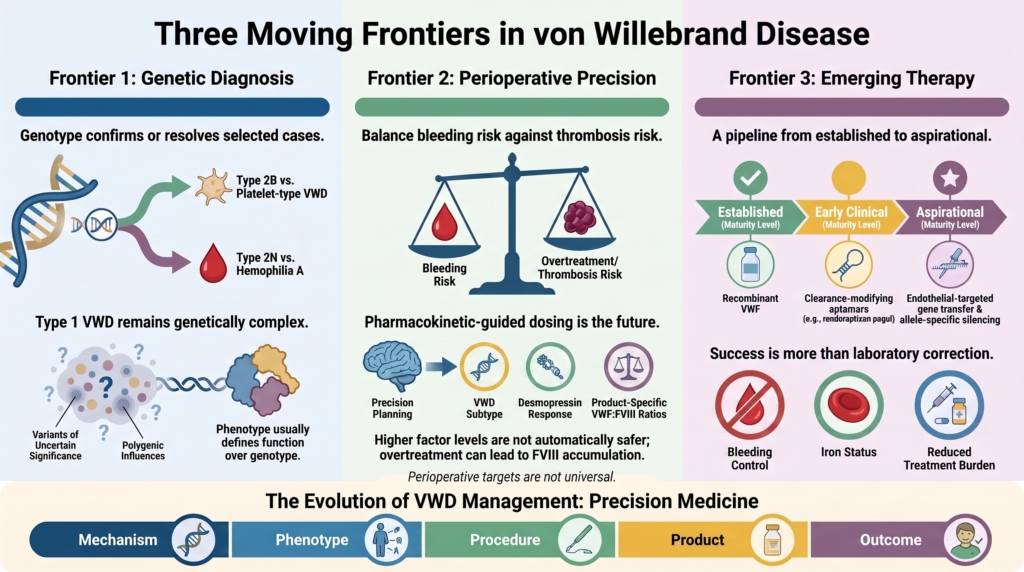
Why read this review?
Read this review if you want to understand where VWD care was changing most rapidly in 2024.
The article does not attempt to provide a comprehensive account of VWD. Instead, it concentrates on three moving frontiers:
- molecular diagnosis and genetic therapy;
- peri-procedural management;
- emerging treatment strategies.
Its distinctive value is not simply that it describes new technologies. It shows why progress in VWD requires more than adding new tests or products.
Genetic results must be interpreted through phenotype.
Perioperative factor targets must be balanced against FVIII accumulation, thrombosis risk, procedure type, and product pharmacokinetics.
Novel therapies must overcome the unusual cellular biology of VWF and ultimately improve outcomes that matter to patients.
Taken together, these sections support a broader movement toward mechanism- and context-specific care, although that precision-medicine framing is an interpretation of the review rather than its formally stated thesis.
What scholarly job does it perform?
Frontier report
This is a selective, forward-looking review of areas in active transition.
It asks:
Where is VWD care changing, and what obstacles must be overcome before innovation becomes routine practice?
The article is best understood as a curated report from the leading edge of the field—not as a complete map of diagnosis and treatment.
Its selectivity is both its strength and its limitation.
Review at a glance
| Feature | Assessment |
|---|---|
| Publication year | 2024 |
| Review type | Focused narrative frontier report |
| Best audience | Hematologists seeking an update on genetics, surgery, and therapeutic development |
| Best use | Distinguishing established practice from emerging and aspirational approaches |
| Distinctive contribution | Connects selective molecular diagnosis, individualized perioperative management, and the therapeutic pipeline |
| Evidence-selection method | Narrative expert review; no reproducible search strategy or formal evidence grading is reported |
| Scope | Genetics, gene-based strategies, peri-procedural care, recombinant VWF, and emerging nonreplacement therapies |
| Read with caution | The paper moves between guidelines, observational cohorts, case reports, small early-phase studies, preclinical models, and expert interpretation |
Best consulted for
- where genetic testing is most clinically useful;
- why phenotype and genotype must be interpreted together;
- the limited genetic clarity of type 1 VWD and low VWF;
- perioperative monitoring of both VWF and FVIII;
- FVIII accumulation during replacement;
- product-specific pharmacokinetics;
- the promise and limitations of PK-guided dosing;
- recombinant VWF;
- off-label use of emicizumab in severe VWD;
- clearance-modifying therapies;
- generalized hemostatic strategies;
- gene transfer and allele-specific silencing;
- the distinction between established, emerging, and aspirational treatment.
Not sufficient alone for
- a comprehensive VWD diagnostic algorithm;
- complete management of heavy menstrual bleeding;
- pregnancy and postpartum care;
- gastrointestinal bleeding and angiodysplasia;
- individualized product dosing;
- definitive perioperative targets;
- current regulatory or trial status in 2026.
Central thesis
The article itself is organized by topic rather than around one explicit unifying argument.
Taken together, however, its three sections support a broader conclusion:
Progress in VWD will depend on matching molecular mechanism, clinical phenotype, procedure, product, and treatment response more precisely than current one-size-fits-all approaches allow.
That synthesis appears differently across the paper.
In genetics
Sequencing is most useful when the suspected mechanism is sufficiently specific for the result to be interpretable.
In perioperative care
Treatment must balance adequate hemostasis against excessive replacement, FVIII accumulation, thrombosis, and unnecessary exposure.
In future therapy
New agents may replace VWF, prolong its survival, bypass one of its functions, amplify thrombin generation, or suppress a dominant pathogenic allele.
The paper’s larger message is therefore not that one new technology will transform VWD.
It is that several areas of care are moving from category-based treatment toward mechanism- and context-based decision-making.
The conceptual model
1. Genetic testing helps most when the phenotype points to a specific mechanism
The review identifies settings in which molecular testing can be particularly useful:
- confirming selected type 2 subtypes;
- distinguishing type 2B VWD from platelet-type VWD;
- distinguishing type 2N VWD from nonsevere hemophilia A;
- defining type 3 genotypes for reproductive counseling;
- clarifying inheritance;
- and occasionally supporting differentiation of congenital VWD from acquired von Willebrand syndrome.
Phenotypic testing usually establishes the functional classification.
Genotype may then:
- confirm the suspected subtype;
- explain an unusual phenotype;
- or resolve ambiguity when functional testing is incomplete, unavailable, or confounded.
The congenital-versus-acquired distinction requires particular caution.
A clearly pathogenic, phenotype-concordant variant may support inherited VWD. But a negative genetic result does not establish acquired VWS because many patients with type 1 VWD or low VWF have no identifiable pathogenic VWF variant.
The diagnosis of acquired VWS still depends on:
- age and timing of onset;
- family history;
- associated disease;
- laboratory pattern;
- and response to treatment of the underlying disorder.
2. Type 1 VWD and low VWF remain genetically difficult
The review contrasts the high molecular yield in many type 2 and type 3 phenotypes with the uncertainty of mild quantitative VWD.
In a large type 1 cohort, candidate coding variants were identified in approximately 65% of index cases, but the certainty that each variant was pathogenic varied.
This distinction matters.
A candidate variant is not the same as a definitively disease-causing variant.
The authors emphasize:
- variants of uncertain significance;
- incomplete penetrance;
- phenotype–genotype discordance;
- ABO effects;
- polygenic influences;
- and additional modifiers of baseline VWF.
This supports the view that type 1 VWD and low VWF are not straightforward single-gene disorders.
The paper appears to anticipate a future in which polygenic risk models may be more informative than sequencing VWF alone for mild quantitative phenotypes.
That is an important stance—but still a direction of travel, not an established clinical tool.
3. Genotype supports classification but does not replace phenotype
The authors retain a phenotype-first framework.
That is clinically sensible because:
- functional defects define how VWF behaves;
- the same gene may produce different phenotypes;
- novel variants may be difficult to interpret;
- and laboratory relationships often determine immediate management.
Yet genotype may occasionally become decisive when phenotypic findings are ambiguous.
Examples include:
- distinguishing a VWF gain-of-function defect from a platelet-receptor defect;
- separating defective FVIII binding from mild hemophilia A;
- or resolving a subtle qualitative phenotype.
A more precise formulation is therefore:
Phenotypic testing usually establishes the functional classification, while genotype can confirm—or occasionally resolve—the subtype.
4. VWF gene therapy is a cellular-engineering problem
The review explains why gene therapy for VWD has lagged behind hemophilia.
The difficulty is not simply the size of the VWF cDNA.
Successful therapy would also need to reproduce:
- correct dimerization and multimerization;
- intracellular processing;
- glycosylation;
- endothelial trafficking;
- Weibel–Palade body storage;
- regulated secretion;
- and shear-dependent function.
Endothelial targeting remains particularly challenging.
VWF cannot simply be produced as a truncated soluble protein without risking loss of critical function.
The therapeutic problem is therefore:
How can gene delivery recreate the cellular life cycle of VWF rather than merely produce antigen?
That is a much harder task than replacing a circulating coagulation factor.
5. Allele-specific silencing may suit selected dominant phenotypes
For some dominant-negative type 2 variants, adding more VWF may not be the optimal strategy.
An alternative is to:
- suppress expression of the mutant allele;
- preserve production from the normal allele;
- reduce interference with normal multimer formation.
Preclinical small-interfering RNA work provides proof of principle.
This strategy is not applicable to every type 2 phenotype.
It is most plausible when:
- the disease results from a dominant-negative allele;
- the normal allele can produce sufficient functional protein;
- selective suppression is achievable;
- and endothelial delivery can be solved.
At publication, this remained a preclinical concept rather than a clinical therapy.
Perioperative care as a balancing problem
1. The goal is not simply to raise factor levels
Perioperative treatment must achieve adequate hemostasis.
But the authors also emphasize the risks of:
- excessive FVIII accumulation;
- thrombosis;
- unnecessary concentrate exposure;
- prolonged treatment;
- cost;
- and imprecise dosing.
The problem is therefore not merely:
How high should the levels be?
It is:
How much treatment is enough for this patient, with this product, undergoing this procedure—without creating avoidable harm?
That is the review’s most important perioperative insight.
2. Surgical targets are operational guides, not universal truths
For major procedures, the review describes targets near 1.00 IU/mL around surgery and postoperative troughs above 0.50 IU/mL.
But it repeatedly acknowledges that optimal targets remain uncertain and procedure-dependent.
The perioperative table brings together:
- desmopressin dosing;
- concentrate ranges;
- target peaks;
- trough levels;
- and treatment durations extending to 7–10 days.
That table should not be read as one unified evidence-graded protocol.
Some recommendations reflect:
- the 2021 international guideline;
- older guidance;
- cohort experience;
- or expert practice.
The 2021 guideline did not provide a clear recommendation beyond the first three postoperative days.
The table is therefore an operational synthesis, not proof that one target and duration are optimal for every major procedure.
3. The available surgical evidence supports feasibility, not an optimal threshold
The review cites a systematic analysis in which maintaining both VWF and FVIII above 0.50 IU/mL for at least three days was associated with excellent hemostatic efficacy in a high proportion of major surgeries.
That is reassuring.
But the underlying evidence consisted largely of heterogeneous case series with:
- variable definitions;
- nonrandomized treatment;
- selection bias;
- and probable publication bias.
These data show that the approach can work.
They do not prove that:
- lower targets would fail;
- higher targets are better;
- or one duration is optimal.
The review’s numerical precision should therefore be interpreted in the context of low-certainty comparative evidence.
4. FVIII accumulation is real; its thrombotic threshold is uncertain
Repeated infusion of VWF-containing concentrates can cause substantial FVIII accumulation because infused VWF stabilizes endogenous FVIII and slows its clearance.
A Dutch perioperative cohort showed postoperative FVIII troughs substantially above intended targets.
This finding supports:
- measurement of FVIII as well as VWF;
- product-aware dosing;
- and adjustment during repeated replacement.
Excessive FVIII is a plausible thrombotic concern.
However, the level at which FVIII accumulation produces excess perioperative thrombosis in VWD is not well established.
The review also cites a 4% venous thrombosis incidence in two studies involving selected patients with perioperative VWF and FVIII levels above 1.50 IU/mL.
That figure should not be generalized to:
- all surgical patients with VWD;
- all concentrate use;
- or all patients with transiently high factor levels.
These patients may also have had age-, procedure-, or comorbidity-related thrombosis risks.
The appropriate conclusion is:
FVIII accumulation deserves active monitoring because it may contribute to thrombosis, but the causal threshold and magnitude of risk remain uncertain.
5. Product composition and pharmacokinetics matter
Different products contain different proportions of VWF and FVIII.
That affects:
- early FVIII correction;
- later endogenous FVIII stabilization;
- accumulation during repeated dosing;
- and the timing of laboratory monitoring.
Pure plasma-derived or recombinant VWF may produce less direct FVIII loading than combined VWF/FVIII concentrates and may be considered in selected patients at high thrombotic risk.
That does not establish superiority.
Thrombotic events have also occurred with pure VWF products, and endogenous FVIII can still rise after VWF replacement.
The more general lesson is:
Product-specific VWF:FVIII composition and pharmacokinetics must be considered; findings from one product cannot automatically be generalized to another.
6. PK-guided dosing is promising but investigational
Earlier attempts at PK-guided dosing were disappointing.
The review describes a newer integrated population model designed to capture the interaction between VWF and FVIII, including the effect of VWF on FVIII clearance.
Such models may improve prediction of:
- factor accumulation;
- dose requirements;
- timing;
- and interval adjustment.
But at publication:
- prospective outcome benefit had not been established;
- the model was being evaluated;
- and its performance was tied to particular product characteristics.
Bayesian forecasting is therefore a promising direction, not a proven standard of care.
The treatment pipeline
1. Established therapy: recombinant VWF
Recombinant VWF is an established treatment option, with evidence for:
- on-demand treatment;
- surgical management;
- prophylaxis;
- and investigation in heavy menstrual bleeding.
It should not be grouped casually with speculative therapies merely because it is newer than plasma-derived concentrates.
The VWDMin trial is particularly instructive.
Recombinant VWF did not demonstrate superiority over tranexamic acid for heavy menstrual bleeding under the studied conditions, and substantial residual menstrual bleeding remained with both strategies.
This does not prove:
- equivalence;
- no effect;
- universal failure of recombinant VWF;
- or superiority of tranexamic acid.
It shows that the trial failed to demonstrate superiority and that neither approach eliminated the burden of heavy menstrual bleeding.
2. Off-label case experience: emicizumab
The review discusses emicizumab in severe VWD, including type 3 disease with and without inhibitors.
The attraction is mechanistic:
- emicizumab can support FVIII-like cofactor activity;
- it may reduce bleeding despite absent or ineffective VWF;
- and it may be particularly appealing when inhibitors complicate replacement.
But the evidence described is primarily case-based.
Emicizumab was not established as routine VWD therapy.
Its use should be understood as:
off-label expert experience in selected severe cases
rather than comparative proof of efficacy or safety.
3. Very early clinical evidence: rondoraptivon pegol
The review describes rondoraptivon pegol, a pegylated aptamer that binds the VWF A1 domain and reduces clearance.
A small phase 2 study included five patients with type 2B VWD.
This is proof of clinical concept, not a mature efficacy program.
The therapy should be classified as:
very early clinical development as described in the 2024 review
not as an established or near-routine option.
4. Preclinical and early translational hemostatic amplification
The paper discusses broader agents that may enhance hemostasis across bleeding disorders.
VGA039
The review describes in vitro or ex vivo activity in VWF-deficient plasma.
For VWD, this belongs in the preclinical or early translational category, even if the agent is being developed more broadly elsewhere.
HMB-001
The work discussed focused primarily on models of Glanzmann thrombasthenia, with VWD presented as a possible future application.
It should not be described as a VWD clinical therapy at the evidence level reviewed.
Mechanism-independent amplification of thrombin generation could broaden applicability.
But it also raises a central safety question:
How much hemostatic amplification can be achieved without unacceptable thrombosis risk?
5. Preclinical platelet-inspired and VWF-prolonging strategies
Platelet-inspired nanoparticles
These aim to recreate aspects of platelet adhesion or aggregation.
The evidence described is preclinical, including mouse and microfluidic models.
KB-V13A12
This albumin-linking nanobody construct is designed to prolong VWF survival.
The evidence described is preclinical mouse work.
These concepts are scientifically attractive.
They remain far from established clinical use.
It is also important not to collapse all clearance-modifying approaches into one class:
- BT200/rondoraptivon pegol is an aptamer;
- KB-V13A12 is a nanobody-based construct.
6. Aspirational strategies: gene transfer and allele-specific silencing
Gene transfer remains distant from routine use because it must overcome:
- gene size;
- endothelial targeting;
- correct multimerization;
- storage;
- regulated release;
- and long-term expression.
Allele-specific silencing has preclinical proof of concept in selected dominant-negative disease.
The major barrier remains delivery to the relevant endothelial compartment.
These approaches belong in the aspirational horizon.
What this review uniquely offers
A three-horizon view of innovation
The review’s visual synopsis is valuable because it separates treatment maturity.
Present or established
- conventional replacement;
- desmopressin;
- antifibrinolytics;
- recombinant VWF;
- selective genetic testing.
Emerging
- refined PK-guided dosing;
- off-label emicizumab experience;
- early clearance-modifying trials;
- selected generalized hemostatic approaches.
Aspirational
- endothelial gene transfer;
- allele-specific silencing;
- synthetic platelet mimetics;
- long-acting nanobody constructs.
This prevents the future-therapy section from becoming a flat list in which every agent appears equally close to practice.
A clear account of where genetics helps—and where it does not
The review provides a useful rule:
Genetic testing works best when the suspected phenotype is mechanistically specific.
It is often valuable in type 2 and type 3 VWD.
It is much less decisive in type 1 VWD and low VWF, where:
- candidate variants are common;
- pathogenicity may be uncertain;
- penetrance varies;
- and polygenic effects matter.
That is the genetic foundation beneath the instability of mild VWF labels.
A physiological interpretation of surgical monitoring
The paper explains why perioperative management cannot focus on VWF activity alone.
VWF stabilizes FVIII.
Replacement therefore changes both proteins over time.
That mechanism transforms a target table into a dynamic model:
the product administered today alters the clearance and accumulation of another factor tomorrow
This is the physiological reason to monitor both VWF and FVIII.
A reminder that innovation must improve lived outcomes
The review recognizes that current therapies are often effective in controlling acute bleeding while patients—especially those with heavy menstrual bleeding—continue to experience:
- iron deficiency;
- impaired quality of life;
- treatment burden;
- and persistent symptoms.
This creates a critical standard for future therapy:
Laboratory improvement is not enough.
Novel treatments should be judged by:
- fewer bleeding episodes;
- less menstrual blood loss;
- improved iron status;
- reduced treatment burden;
- better quality of life;
- and acceptable safety.
An opening toward the nonhemostatic biology of VWF
The paper closes by pointing toward VWF functions beyond conventional hemostasis, including vascular, angiogenic, and inflammatory biology.
That is important because some difficult manifestations—particularly angiodysplasia-associated bleeding—cannot be fully understood as failure of clot formation alone.
This final perspective reconnects the frontier review to the endothelial and vessel-wall biology emphasized by the Nature Primer.
Where interpretation begins
1. “Precision medicine” is a useful synthesis, not the paper’s formal structure
The article is organized around three selected topics.
It does not formally present one unified precision-medicine framework.
The interpretation that these sections together represent movement toward mechanism- and context-specific care is reasonable—but should be recognized as synthesis rather than direct authorial thesis.
2. The review favors selective molecular diagnosis
The authors are not genomically maximalist.
They emphasize that sequencing is most useful when it:
- confirms a suspected qualitative mechanism;
- distinguishes a phenocopy;
- clarifies inheritance;
- or changes counseling.
This is a pragmatic position.
It resists the assumption that more sequencing necessarily produces more certainty.
3. The perioperative table appears more definitive than the evidence
The table provides useful operational guidance.
But the narrative repeatedly exposes uncertainty around:
- target levels;
- duration;
- product selection;
- thromboprophylaxis;
- age-related normalization;
- and PK-guided dosing.
Some recommendations come from different guidance documents with different evidence bases.
The table should therefore be read as:
a practical synthesis of available recommendations and expert practice
not as a single validated protocol.
4. High FVIII is treated as a warning signal, not proven causation
The paper interprets postoperative FVIII accumulation as a reason for closer monitoring and more individualized dosing.
That is clinically persuasive.
But observational evidence does not establish a precise causal relationship between:
- a given FVIII level;
- and perioperative thrombosis in VWD.
The review’s concern is justified.
The quantitative risk remains uncertain.
5. The future section reflects very different levels of evidence
The paper’s most important reading challenge is maturity discrimination.
Within a few pages, it discusses:
- established recombinant therapy;
- off-label case experience;
- five-patient phase 2 data;
- in vitro experiments;
- mouse models;
- and aspirational gene strategies.
Appearance in the same review does not imply equal readiness.
The reader must continually ask:
What level of evidence supports this intervention today?
6. The review is also an argument for investment
The authors suggest that therapeutic development in VWD has lagged behind hemophilia because of:
- biological complexity;
- heterogeneous phenotypes;
- under-recognized burden;
- and trial-design difficulty.
This is not neutral description alone.
It is also advocacy for greater scientific and therapeutic attention to VWD.
What it decides for the reader
The review supports several practical conclusions:
- use genetic testing selectively;
- let phenotype and genotype inform one another;
- do not assume that a negative genetic test excludes inherited mild VWD;
- interpret type 1 candidate variants cautiously;
- monitor both VWF and FVIII during perioperative replacement;
- account for product-specific VWF:FVIII composition and pharmacokinetics;
- regard factor targets and durations as contextual rather than universal;
- recognize FVIII accumulation as a clinically relevant safety concern;
- treat PK-guided dosing as promising but investigational;
- distinguish established therapy from off-label, early clinical, preclinical, and aspirational strategies;
- judge innovation by patient-important outcomes rather than laboratory correction alone.
What it leaves open
The review leaves major questions unanswered:
- When should type 1 VWD undergo sequencing?
- How should polygenic information be used clinically?
- Which variants of uncertain significance should influence care?
- Can a negative genetic test ever meaningfully support acquired VWS?
- Which perioperative VWF and FVIII targets are optimal?
- How long should postoperative replacement continue?
- Which product is best for a given patient and procedure?
- At what factor level does thrombotic risk become clinically important?
- Does PK-guided dosing improve bleeding, thrombosis, cost, or quality of life?
- When should thromboprophylaxis be used?
- Can perioperative treatment safely be withheld in older patients whose VWF levels have normalized?
- Which emerging agents will meaningfully reduce bleeding burden?
- Can gene-based therapy reproduce endothelial VWF biology?
- Which strategies will be safe, scalable, and affordable?
The paper is most useful as a map of active transition—not a declaration that these problems have been solved.
What has changed since publication?
This review describes the field as of 2024.
The sections on basic principles remain useful, but the therapeutic pipeline is highly time-sensitive.
Before using the paper to guide current clinical interpretation, the following should be checked against contemporary trial registries, regulatory sources, and primary publications:
- rondoraptivon pegol;
- VGA039;
- HMB-001;
- emicizumab studies in VWD;
- KB-V13A12;
- PK-guided dosing programs;
- gene-transfer platforms;
- and allele-specific silencing programs.
Status described in this entry reflects the 2024 review and should not be assumed to represent current 2026 regulatory or development status.
The maturity labels used here describe the evidence presented in the source article, not necessarily the status of each program today.
Strengths
- Focuses on three areas of genuine change.
- Clearly distinguishes where genetic testing helps and where it remains ambiguous.
- Explains why phenotype still matters.
- Links perioperative targets to VWF–FVIII physiology.
- Highlights FVIII accumulation as a practical safety issue.
- Treats pharmacokinetic dosing with appropriate caution.
- Separates present, emerging, and aspirational therapeutic horizons.
- Acknowledges persistent quality-of-life burden despite available therapy.
- Connects future treatment to patient-important outcomes.
- Points toward nonhemostatic VWF biology as a future frontier.
Limitations
- It is a narrative expert review without a systematic search strategy or formal evidence grading.
- It is a selective supplement article rather than a comprehensive VWD review.
- Its title is broader than its actual three-topic scope.
- The perioperative table combines recommendations from multiple sources with differing evidence bases.
- Some dosing targets and treatment durations are context-specific but may appear universal.
- Several perioperative conclusions rely on observational studies and expert judgment.
- High postoperative FVIII is documented, but the causal thrombosis threshold remains uncertain.
- PK models may be product-specific and cannot automatically be generalized across concentrates.
- The molecular-diagnosis section is strongest for type 2 and type 3 VWD and less definitive for type 1 disease.
- Genetic testing cannot reliably distinguish inherited mild VWD from acquired VWS when no pathogenic variant is found.
- The future-therapy section combines established treatment, off-label use, early human studies, preclinical models, and aspirational technologies.
- Several pipeline discussions rely on case-level, abstract-level, or very small early-phase evidence.
- Therapeutic status may become obsolete rapidly.
- Several authors report research, consultancy, or intellectual-property relationships relevant to diagnostics and emerging therapies.
How to read this review
Read it through three questions.
First: Where does genetics actually change care?
For each use of sequencing, ask:
- Does it confirm a suspected mechanism?
- Does it distinguish a phenocopy?
- Does it clarify inheritance?
- Does it change counseling or treatment?
- Or does it merely generate a variant of uncertain significance?
Second: Where does perioperative precision exceed the evidence?
Compare the apparent clarity of the target table with the uncertainty in the text.
Mark where recommendations arise from:
- international guidelines;
- older guidance;
- observational cohorts;
- pharmacokinetic models;
- or expert practice.
Third: How mature is each therapy?
Classify each intervention as:
- established;
- off-label case-based;
- early clinical;
- preclinical or translational;
- aspirational.
Do not let a forward-looking review flatten those categories.
Clinical pearls
- Genetic testing is most useful when it clarifies subtype, phenocopy, inheritance, or counseling.
- Phenotypic testing usually establishes function; genotype may confirm or resolve ambiguity.
- A negative genetic result does not establish acquired VWS.
- Type 1 VWD and low VWF are genetically complex, and candidate variants are not always clearly pathogenic.
- Product-specific VWF:FVIII composition and pharmacokinetics matter.
- Perioperative care requires monitoring both VWF and FVIII.
- Repeated replacement can produce substantial FVIII accumulation.
- Excessive FVIII is a plausible thrombotic concern, but the precise risk threshold is unknown.
- Perioperative tables are operational frameworks, not universal evidence-based protocols.
- PK-guided dosing is promising, but clinical outcome benefit had not been established at publication.
- Recombinant VWF is established therapy, not merely a future concept.
- In VWDMin, recombinant VWF did not demonstrate superiority over tranexamic acid, and residual menstrual bleeding remained substantial with both strategies.
- Emicizumab use in severe VWD was based mainly on off-label case experience.
- Very small early-phase studies should not be mistaken for mature efficacy evidence.
- Mechanism-independent hemostatic amplification may broaden treatment but requires careful assessment of thrombosis risk.
- Gene therapy for VWD must reproduce endothelial processing, multimerization, storage, and release—not merely protein expression.
- Future therapies should be judged by bleeding, iron status, quality of life, burden, and safety—not laboratory correction alone.
Where it fits in the VWD module
This review shifts the Review Library from classification debates toward areas of active therapeutic and implementation change.
It connects most directly to:
- Classification as a Tool
- Genetic Testing in VWD
- Diagnostic Test Atlas
- Type 2B VWD
- Type 2N VWD
- VWF Replacement Therapy
- Surgery and Procedures
- Long-Term Prophylaxis
- Heavy Menstrual Bleeding and Iron Deficiency
- When Treatment Fails
- Angiodysplasia and Gastrointestinal Bleeding
- Future Therapies
- Gene Therapy
Its role differs from the preceding entries:
- the Nature Primer organizes the field;
- O’Donnell and Baker challenge the low-VWF category;
- Brenner and colleagues reconsider the diagnostic label over time;
- this review asks where diagnosis, implementation, and treatment may go next.
Read next
For the complete disease map
Seidizadeh O, Eikenboom JCJ, Denis CV, et al. von Willebrand disease. Nature Reviews Disease Primers. 2024.
Read this for the broader integration of VWF biology, diagnosis, classification, and treatment.
For deeper molecular interpretation
Itzhar-Baikian N, Boisseau P, Joly B, Veyradier A. Updated overview on von Willebrand disease: focus on the interest of genotyping.
Read this for more detailed consideration of genotype–phenotype relationships and molecular testing.
For difficult real-world scenarios
Abou-Ismail MY, James PD, Flood VH, Connell NT. Beyond the guidelines: how we approach challenging scenarios in the diagnosis and management of von Willebrand disease.
Read this for expert reasoning where recommendations are limited or incomplete.
For therapeutic innovation
Read a current focused review on emerging VWD therapies alongside updated trial registries and primary studies.
The pipeline described in this 2024 article should not be assumed to remain current without verification.
For the historical comparison
Leebeek FWG, Eikenboom JCJ. Von Willebrand’s disease. New England Journal of Medicine. 2016.
Read this to see how genetics, recombinant VWF, surgery, and future therapy were framed before the current wave of molecular and nonreplacement strategies.
Bottom line
This review is a focused report on three areas in which VWD care was evolving in 2024:
- selective molecular diagnosis;
- individualized perioperative management;
- and emerging therapy.
Its strongest contribution is showing why progress in VWD requires more than adding new tests or products.
Genetic results must be interpreted through phenotype.
Perioperative targets must be balanced against FVIII accumulation, thrombosis risk, product composition, and procedural context.
Novel therapies must overcome the complex cellular biology of VWF and demonstrate benefits that patients can feel.
The paper is most useful as a map of active transition.
Its surgical tables combine evidence with expert practice, and its therapeutic pipeline spans established treatment, off-label experience, early clinical studies, preclinical concepts, and distant aspirations.
Read it not as a forecast guaranteed to come true, but as a guide to the problems the field must solve before the future becomes practice.
Reflect and discuss
- When does genetic testing add clinically useful information, and when does it merely add uncertainty?
- Should phenotype remain primary if molecular classification becomes more precise?
- Can a negative VWF genetic result ever meaningfully support acquired VWS?
- Is perioperative personalization mainly about preventing bleeding, avoiding overtreatment, or both?
- How should clinicians balance adequate replacement against FVIII accumulation and thrombosis risk?
- What evidence would be required before PK-guided dosing becomes routine?
- How should readers distinguish an established therapy from off-label experience, early clinical evidence, and preclinical possibility?
- Which future strategy addresses the most important unmet need rather than simply correcting a laboratory abnormality?
- What would count as a meaningful advance for heavy menstrual bleeding: fewer bleeding days, improved iron status, better quality of life, reduced treatment burden, or all of these?
- Which parts of the review are durable principles, and which require active updating because the underlying pipeline may already have changed?