
(Un) Diagnosing von Willebrand disease
Brenner MK, Christopherson PA, Flood VH. (Un) Diagnosing von Willebrand disease. Hematology Am Soc Hematol Educ Program. 2025:127–130.
Why read this review?
Most reviews explain how to diagnose a disease.
This review asks the reverse question:
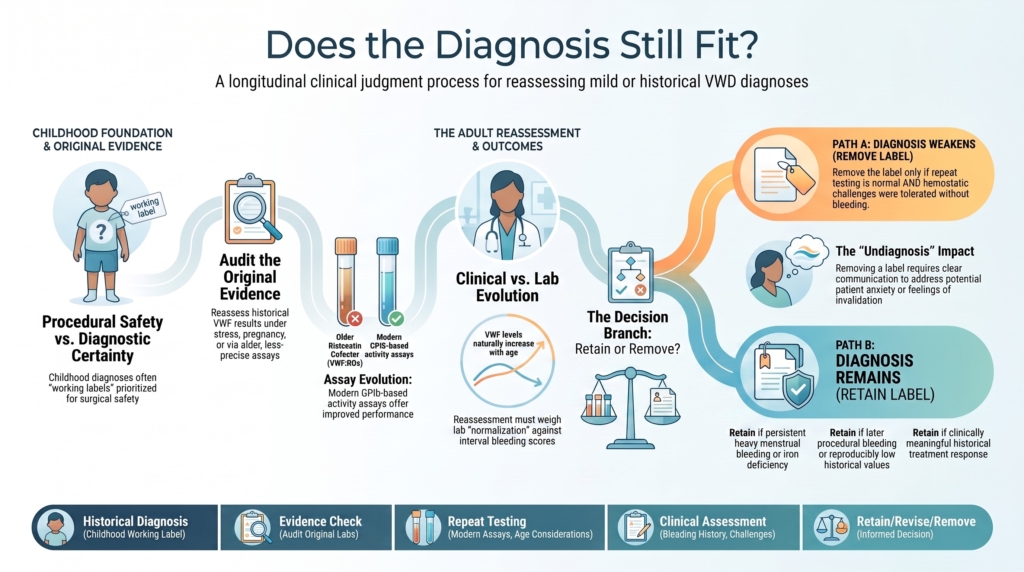
When should a historical diagnosis of von Willebrand disease be reconsidered—and when should it be retained?
Its focus is not secure type 2, type 3, or unequivocal severe type 1 VWD. It addresses the more difficult territory of mild, historical, or incompletely documented diagnoses, particularly those assigned in childhood on the basis of borderline VWF levels and limited bleeding exposure.
Through one child followed into two contrasting adult scenarios, the authors show how assay validity, repeat testing, age, interval bleeding, and subsequent hemostatic challenges may either weaken or reinforce an earlier diagnosis.
What scholarly job does it perform?
Diagnostic critique and longitudinal reassessment
This is not a comprehensive review of VWD biology, classification, or treatment.
It is a short, case-based argument about diagnostic stewardship.
The authors examine two opposing forms of error:
- allowing a weak or outdated diagnosis to persist indefinitely;
- removing a diagnosis simply because current VWF values have entered the normal range.
The review therefore asks clinicians to treat a mild historical diagnosis not as an immutable fact, but as a clinical judgment that should remain accountable to new evidence.
Review at a glance
| Feature | Assessment |
|---|---|
| Publication year | 2025 |
| Review type | Short narrative expert review organized around a longitudinal clinical case |
| Best audience | Pediatric and adult hematologists caring for patients with mild or historical VWD diagnoses |
| Best use | Reassessing diagnoses based on borderline childhood values, limited bleeding history, older assays, or later normalization |
| Distinctive contribution | Treats mild VWD diagnosis as a longitudinal judgment rather than an irreversible event |
| Evidence-selection method | Narrative expert review; no reproducible search strategy is reported |
| Scope | Childhood diagnosis, assay validity, age-related VWF change, interval bleeding, and diagnostic removal or retention |
| Read with caution | The article offers a conceptual framework, not a validated rule for “undiagnosis” |
Best consulted for
- mild type 1 or low-VWF diagnoses made in childhood;
- historical VWD labels supported by limited documentation;
- age-related increases in VWF;
- assay and preanalytic failure modes;
- reassessment after later surgeries, dental procedures, menstruation, or other hemostatic challenges;
- use of interval bleeding history;
- communicating the possibility of removing a long-standing diagnosis.
Not sufficient alone for
- secure type 2 or type 3 diagnosis;
- comprehensive subtype classification;
- full treatment selection;
- detailed perioperative planning;
- a standardized operational definition of “undiagnosis.”
The article contains meaningful procedural-management discussion, but it uses surgery primarily to illustrate how clinicians act when diagnostic certainty is incomplete.
Central thesis
The central thesis is:
Mild, historical, or incompletely documented VWD diagnoses should remain open to reassessment as new clinical and laboratory evidence accumulates.
That evidence may include:
- repeated VWF testing;
- improved assay methodology;
- recognition of preanalytic error;
- age-related changes in VWF;
- newly acquired bleeding history;
- absence of bleeding during later hemostatic challenges;
- or persistence of clinically important bleeding despite normal current levels.
The article does not argue that every VWD diagnosis is perpetually provisional.
Rather, it argues that neither automatic retention nor automatic removal of a mild or uncertain historical label represents good diagnostic practice.
A useful way to express the authors’ position is:
The diagnosis should be treated as a clinical hypothesis that remains answerable to evidence over time.
The conceptual model
1. A working diagnosis may be necessary before certainty is complete
The review begins with a five-year-old evaluated before tonsillectomy.
She has:
- easy bruising and occasional epistaxis;
- an ISTH bleeding assessment tool score of 3;
- VWF antigen of 42 IU/dL;
- VWF activity of 43 IU/dL;
- and an upcoming high-risk airway procedure.
The clinician formally diagnoses type 1 VWD, performs a desmopressin trial, and treats the tonsillectomy with desmopressin and postoperative antifibrinolytic therapy. The procedure is uncomplicated.
The case illustrates a practical reality:
A clinician may assign a working diagnosis and treat a high-risk procedure while recognizing that the long-term label may later require reassessment.
Protecting the patient during an immediate hemostatic challenge and determining whether the diagnosis should remain permanent are related—but not identical—decisions.
2. Borderline childhood phenotypes require integration
The paper focuses on the ambiguous 30–50 IU/dL range.
In borderline quantitative phenotypes, diagnosis depends on the convergence of:
- bleeding history;
- VWF antigen and activity;
- family context;
- age;
- assay validity;
- sampling conditions;
- and repeated assessment.
Minor bruising and epistaxis are common in childhood. Young patients may also have had few meaningful hemostatic challenges, limiting the value of an apparently mild history.
At the same time, a mildly low VWF result may reflect:
- age-related physiology;
- assay imprecision;
- a benign variant affecting ristocetin-dependent testing;
- sample-handling error;
- or true quantitative VWF deficiency.
The diagnostic problem is therefore not merely that the value is borderline.
It is that both the phenotype and the laboratory evidence may be uncertain.
3. Diagnostic reassessment begins by asking whether the original laboratory evidence was trustworthy
One of the review’s most important contributions is its attention to assay methodology and preanalytic validity.
The authors discuss:
- limitations and poor precision of VWF ristocetin cofactor testing;
- improved reliability of newer VWF:GPIbM assays;
- benign VWF variants that disproportionately affect ristocetin-dependent results;
- falsely low values caused by improper specimen handling;
- stress-related elevation of VWF;
- pregnancy-related normalization;
- and the need to interpret repeat testing in biological context.
The relevant question is not simply:
Was the original result low?
It is:
Was the original result methodologically and biologically interpretable?
A historical diagnosis may weaken because the patient’s biology changed.
But it may also weaken because the original evidence was never sufficiently secure.
4. Adults inherit diagnostic labels
When the patient returns as an adult, the diagnosis no longer appears tentative.
It has become embedded in:
- the medical record;
- procedural planning;
- treatment expectations;
- family understanding;
- and the patient’s identity.
Yet the evidence supporting it may not have been revisited.
The adult hematologist must therefore reconstruct the original diagnosis:
- Were the low values reproduced?
- Which activity assay was used?
- Were the samples handled correctly?
- Were the results obtained under interpretable baseline conditions?
- Was the bleeding history truly abnormal for age?
- What happened during menstruation, sports, dental work, trauma, or later surgery?
A historical diagnosis should not be accepted solely because it is historical.
5. The two adult scenarios show why current VWF levels are not decisive
The article presents two possible futures for the same patient at age 25.
Scenario 1: The diagnosis weakens
The patient has:
- normal current VWF values;
- no meaningful interval bleeding;
- normal menstrual experience;
- no excessive bruising during sports;
- and an interim bleeding score of 0.
In this setting, the authors consider removal of the diagnosis reasonable. They also discuss untreated wisdom-tooth extraction as a possible later hemostatic test, although that suggestion is case-specific rather than a general management rule.
Scenario 2: The diagnosis remains difficult to remove
The patient instead reports:
- heavy menstrual bleeding;
- prior iron-deficiency anemia;
- ongoing spontaneous bruising;
- and continued clinical symptoms despite normal current VWF values.
Here, rising or normalized VWF levels do not by themselves establish that the historical bleeding phenotype or future procedural risk has resolved.
The contrast is the intellectual center of the article:
The laboratory trajectory alone does not decide whether the diagnosis still fits.
6. New evidence can either weaken or reinforce the label
Evidence that may weaken the original diagnosis includes:
- repeatedly normal contemporary testing;
- absence of interval bleeding;
- tolerated hemostatic challenges without abnormal bleeding;
- recognition that the original value may have reflected assay or preanalytic error;
- or a childhood phenotype composed only of common minor symptoms.
Evidence that may reinforce the diagnosis includes:
- persistent heavy menstrual bleeding;
- iron deficiency attributable to bleeding;
- spontaneous or disproportionate bruising;
- bleeding during later procedures;
- reproducibly low historical values;
- or a clinically meaningful response to hemostatic therapy.
“Undiagnosis” is therefore not the removal of a label after one normal test.
It is a judgment about the direction and coherence of the accumulated evidence.
What this review uniquely offers
1. A pediatric-to-adult diagnostic arc
The same patient is viewed first through childhood uncertainty and later through adult reassessment.
That structure shows how the meaning of evidence changes with time.
A five-year-old with limited procedural exposure and borderline VWF is not the same diagnostic problem as a 25-year-old with years of menstrual, athletic, dental, and surgical history.
2. Two contrasting adult outcomes
The review’s most effective teaching device is the presentation of two possible adult trajectories for the same child.
In one, normal levels and an absence of interval bleeding support diagnostic removal.
In the other, ongoing heavy menstrual bleeding, iron-deficiency anemia, and bruising make removal much harder to justify.
This demonstrates that the same laboratory result can have different meanings depending on the phenotype surrounding it.
3. A conceptual framework for “undiagnosis”
The review does not provide a validated algorithm.
It does not specify:
- how many normal tests are required;
- how many tolerated procedures are enough;
- which BAT threshold should trigger removal;
- or how often reassessment should occur.
Its contribution is more fundamental:
It makes removal of a diagnosis a legitimate clinical act that deserves the same care as assigning one.
Undiagnosis may reflect either:
- changing evidence over time;
- or recognition that the original diagnosis was never sufficiently secure.
4. The interim bleeding score
A cumulative BAT records the most severe historical event in each domain and may remain elevated even when no new bleeding is occurring.
The review highlights the interim bleeding score, which focuses on bleeding that has occurred since the previous assessment.
This distinction is especially useful during longitudinal follow-up:
- the cumulative BAT asks what has ever happened;
- the interim score asks what has happened recently.
A normal interim score does not erase prior symptoms, but it can help determine whether the phenotype remains active.
5. The emotional consequences of removing a diagnosis
The paper recognizes that diagnosis is not only biomedical.
Patients may have:
- grown up identifying with the VWD community;
- organized procedures and life decisions around the label;
- experienced real bleeding symptoms;
- or understood the diagnosis as validation that those symptoms were believed.
Removing the diagnosis may therefore feel like invalidation, even when reassessment is clinically justified.
This is one of the review’s most distinctive contributions. Diagnostic stewardship requires attention to the consequences of both retaining and removing a label.
6. The admission that management may precede certainty
The authors acknowledge that evidence for procedural treatment in mild type 1 VWD and low VWF is limited.
Yet high-risk procedures—especially those involving the airway or critical organs—may still justify treatment while the diagnostic question remains unresolved.
This is an important clinical admission:
Management sometimes has to run ahead of diagnostic certainty.
The review does not hide that tension. It uses it to show why procedural prudence should not automatically harden into a lifelong diagnosis.
Where interpretation begins
1. The authors favor reassessment over diagnostic inertia
The paper argues that mild historical diagnoses should not persist merely because no one has revisited them.
That position reflects concern about:
- unnecessary hemostatic treatment;
- restrictions on activity;
- medical-record consequences;
- anxiety surrounding procedures;
- and the burden of carrying an inaccurate inherited bleeding-disorder label.
But the review does not endorse reflexive “undiagnosis.”
Its preferred approach is structured reconsideration.
2. In borderline or normalized cases, phenotype carries substantial interpretive weight
The article repeatedly returns to bleeding history.
The correct conclusion is not that phenotype always outweighs laboratory evidence. Very low VWF, type 3 disease, or a convincing type 2 pattern may carry major diagnostic weight even with limited hemostatic exposure.
Rather:
In borderline or normalized cases, the bleeding history often carries more interpretive weight than an isolated laboratory result.
That is especially true when the original abnormality was mild, obtained with an older assay, or unsupported by later clinical experience.
3. The article occupies a third position in the low-VWF debate
The review sits near the literature that treats low VWF as heterogeneous and often distinct from classic genetically determined type 1 VWD.
But its principal argument is narrower than a simple lumping-versus-splitting debate.
It does not primarily ask:
What should all patients with VWF levels of 30–50 IU/dL be called?
It asks:
Does this particular diagnosis still fit this particular patient after new evidence has accumulated?
That is a position about diagnostic humility, not merely classification.
The review therefore adds a third voice to the low-VWF conversation:
- some reviews argue for incorporating symptomatic low VWF into type 1 VWD;
- others defend low VWF as a distinct clinical category;
- this review insists that, whatever label is chosen initially, its continued validity must be reassessed over time.
4. The paper separates procedural prudence from diagnostic certainty
The authors accept that high-risk procedures may justify treatment even when the diagnosis remains unsettled.
That is particularly true when bleeding would be difficult to control after the fact.
The review therefore distinguishes two questions:
What must be done to keep this procedure safe?
and
What diagnosis should this patient carry for life?
Those questions may have different answers.
5. The wisdom-tooth scenario reveals both the paper’s value and its limit
In the reassuring adult scenario, the authors consider untreated wisdom-tooth extraction reasonable.
That suggestion should be understood as:
- case-specific;
- dependent on reassuring repeat testing and interval history;
- and part of individualized decision-making.
It is not a validated general rule for every patient with a historical mild VWD diagnosis.
The example reveals the confidence of experienced clinicians reasoning through uncertainty—but also the built-in limitation of a short expert review.
What it decides for the reader
The review supports several practical conclusions:
- mild or poorly documented childhood diagnoses may warrant reassessment in adulthood;
- repeat testing is informative only when assay method, sampling conditions, and preanalytic quality are considered;
- current VWF normalization alone does not establish that bleeding risk has resolved;
- absence of bleeding during meaningful later challenges can weaken an earlier diagnosis;
- persistent bleeding despite normal levels should prompt caution before removing the label and may justify evaluation for other causes;
- an interim bleeding score may be more informative than repeatedly relying on the cumulative BAT;
- procedural treatment may be appropriate even when the lifelong diagnosis remains unsettled;
- removal of a diagnosis requires patient-centered communication.
What it leaves open
The review does not establish:
- a minimum number of normal repeat tests;
- a standard interval for reassessment;
- a required number or type of tolerated hemostatic challenges;
- a universal BAT or interim-score threshold;
- a validated algorithm for diagnosis removal;
- or the precise relationship between age-related VWF increases and future bleeding risk.
It also leaves unresolved a deeper question:
When laboratory phenotype, bleeding history, and historical identity no longer point in the same direction, which should define the diagnosis?
The review makes that problem visible without pretending to solve it.
Strengths
- Introduces an under-recognized diagnostic task.
- Uses a single longitudinal case effectively.
- Connects pediatric diagnosis with adult reassessment.
- Uses two contrasting adult outcomes to show why current VWF values are not decisive.
- Distinguishes procedural prudence from lifelong labeling.
- Highlights assay and preanalytic failure modes.
- Introduces the interim bleeding score as a longitudinal tool.
- Acknowledges the emotional and identity consequences of removing a diagnosis.
- Makes uncertainty clinically actionable without reducing it to an algorithm.
Limitations
- The article is only four pages.
- It is organized largely around one constructed longitudinal case.
- It is a narrative expert review without systematic evidence selection.
- It offers a conceptual framework rather than a validated operational definition of “undiagnosis.”
- Its age figure combines separate pediatric and adult cohorts rather than following the same individuals longitudinally.
- Evidence relating age-associated VWF increases to changes in bleeding risk remains sparse.
- The untreated wisdom-tooth extraction example is case-specific and should not be generalized.
- The review contains useful procedural discussion but is not sufficient for comprehensive perioperative planning.
- Its arguments apply mainly to mild, historical, or uncertain diagnoses—not to secure type 2, type 3, or unequivocal severe type 1 VWD.
How to read this review
Read the article as a comparison between two adult futures arising from the same childhood diagnosis.
Ask at each stage:
- What evidence supported the original diagnosis?
- Was that evidence trustworthy?
- What new information accumulated with time?
- Does that information weaken or reinforce the label?
- What are the clinical and emotional consequences of keeping or removing it?
Pay particular attention to the difference between:
the cumulative bleeding history
and
bleeding that has occurred since the previous assessment
That distinction is central to longitudinal diagnosis.
Clinical pearls
- A secure severe VWD phenotype and a borderline historical diagnosis are not the same reassessment problem.
- A working childhood diagnosis may be reasonable for procedural safety without necessarily deserving permanent status.
- In borderline quantitative phenotypes, diagnosis depends on converging clinical and laboratory evidence.
- Diagnostic reassessment begins by asking whether the original assay and sample were trustworthy.
- Repeat testing is useful only when assay method, sample handling, and biological context are interpretable.
- Rising VWF levels with age do not by themselves establish that the historical bleeding phenotype or future procedural risk has resolved.
- Absence of bleeding during meaningful later challenges can provide evidence against a historical mild diagnosis.
- The cumulative BAT may preserve remote symptoms, whereas an interim bleeding score helps identify newly occurring bleeding.
- Undiagnosis may reflect changing evidence or recognition that the original diagnosis was never sufficiently secure.
- Removing a diagnosis may represent good care, but it may also feel invalidating unless the reasoning is explained carefully.
Where it fits in the VWD module
This review belongs at the intersection of diagnosis, low VWF, and longitudinal care.
It connects most directly to:
- Laboratory Pitfalls and Repeat Testing
- Where Diagnostic Thresholds Break Down
- Lab–Phenotype Mismatch
- Normal VWF Variation versus Disease
- Bleeding Assessment Tools
- Long-Term Follow-up and Reassessment
- Prognosis and Life Course
- Surgery and Procedures
It also functions as the clinical companion to literature showing that VWF levels and BAT performance change with age.
Read next
For the broader contemporary framework
Seidizadeh O, Eikenboom JCJ, Denis CV, et al. von Willebrand disease. Nature Reviews Disease Primers. 2024.
Read this for the integrated biological and diagnostic map within which reassessment occurs.
For the low-VWF controversy
O’Donnell JS. Low von Willebrand factor—unraveling an enigma wrapped in a conundrum.
Read this for the argument that the 30–50 IU/dL range represents heterogeneous biology rather than a uniform mild form of type 1 VWD.
For the historical critique
Sadler JE. von Willebrand disease type 1: a diagnosis in search of a disease. Blood. 2003.
Read this as an earlier challenge to the biological and diagnostic coherence of mild quantitative VWD.
For the formal recommendation
ASH/ISTH/NHF/WFH 2021 diagnostic guideline
Read this for the recommendation to reconsider—rather than simply remove—the diagnosis in patients whose previously confirmed type 1 VWD levels normalize with age.
For the original longitudinal evidence
Read the age-related VWF and bleeding-assessment literature alongside this review to examine whether changing measurements, changing opportunity, and changing biology point in the same direction.
Bottom line
This review reframes mild or historically uncertain VWD diagnosis as a longitudinal clinical judgment.
Through a child followed into two contrasting adult scenarios, it shows that assay validity, repeat testing, interval bleeding, age, and later hemostatic challenges may either weaken or reinforce an earlier diagnosis.
Its contribution is conceptual rather than algorithmic. It explains why neither automatic retention nor automatic removal of a VWD label is appropriate—and why “undiagnosis” demands the same evidentiary care, clinical judgment, and patient-centered communication as diagnosis itself.