
Oct

7

2026

Perioperative Management of Congenital Factor VII Deficiency

By Cilomar Martins, MD and Amy D. Shapiro, MD

Curbside Consult Rare Bleeding Disorders
Cilomar Martins, MD
Case & Questions Cilomar Martins, MD Hematology Fellow, Beth Israel Deaconess Medical Center
Amy D. Shapiro, MD
Expert Commentary Amy D. Shapiro, MD Innovative Hematology / Indiana Hemophilia & Thrombosis Center
Case at a Glance

Isolated Prolonged PT in a Patient Heading to Dialysis

38-year-old man with stage 4 CKD. No personal or family history of abnormal bleeding, including after a native kidney biopsy.

PT / INRProlonged
FVII activity20–22%
FII · FV · FXNormal
Mixing studyCorrected
InhibitorNone
Diagnosis: Congenital factor VII deficiency without an inhibitor. With FVII activity above 10% and no bleeding phenotype, no routine prophylaxis was recommended; the patient was counseled to notify hematology before any invasive procedure.
  1. Referral Abnormal PT on routine workup

    Isolated FVII deficiency identified during CKD evaluation.

    Observation only
  2. +14 months Hernia repair with mesh

    Before peritoneal dialysis. rFVIIa immediately pre-op, renally adjusted oral TXA post-op.

    No bleeding
  3. +2 weeks Tunneled HD catheter

    Readmitted for dialysate leak. rFVIIa 15 µg/kg within 1 h pre-procedure, PT/INR check, TXA for 5–7 days.

    No bleeding
Read the full case presentation

A 38-year-old man with stage 4 chronic kidney disease was referred to hematology after persistent prolongation of the prothrombin time (PT/INR) was identified during routine evaluation. He had no personal or family history of abnormal bleeding, including following a recent native kidney biopsy. Laboratory evaluation demonstrated an isolated factor VII activity level of approximately 20–22%, with normal factor II, V, and X levels. Mixing studies corrected the prolonged PT, consistent with congenital factor VII deficiency without an inhibitor. Given his factor VII activity above 10% and absence of a bleeding phenotype, no routine prophylactic therapy was recommended. However, he was counseled to notify hematology before any invasive procedure because perioperative replacement therapy could be required.

Fourteen months later, the patient underwent elective ventral and umbilical hernia repair with mesh in preparation for peritoneal dialysis. He received recombinant activated factor VII (rFVIIa) 1000 mg immediately before surgery, followed by kidney function adjusted oral tranexamic acid (TXA) postoperatively, with an uncomplicated recovery and no bleeding events. Two weeks later, he was readmitted after developing dialysate leakage from the surgical site requiring tunneled hemodialysis catheter placement. Hematology again recommended peri-procedural hemostatic support with rFVIIa (15 µg/kg administered within one hour before the procedure), PT/INR assessment after dosing to confirm correction, and TXA for 5–7 days post-procedure. The catheter placement was completed without bleeding complications.

Clinical Questions & Expert Commentary

Five Questions from the Fellow

Each question was posed by Dr. Martins. Form your own answer first, then reveal Dr. Shapiro’s commentary.

1 2 3 4 5
1Fellow’s Question

In asymptomatic patients with mild congenital factor VII deficiency, what factors should guide decisions regarding perioperative prophylaxis?

Expert CommentaryAmy D. Shapiro, MD

The correlation between residual FVII activity (FVII:c) level and bleeding phenotype is poor. Patients with severe disease may have variable bleeding phenotypes and the observation of asymptomatic patients with levels <1% is not rare while patients with FVII:c level above 5% with a history of severe hemorrhages have been reported. Baseline levels of FVII:c that are protective against bleeding in different clinical scenarios are not well defined, ranging from 8% to 15%–20%. It is generally accepted that FVII:c levels above 20% can protect from spontaneous bleedings, and data from the International Registry on Congenital Factor VII Deficiency (IRF7) and The Seven Treatment Evaluation Registry (STER) have shown a minimal clinical relevance for FVII:c above 26%.

There are a few issues to consider in the diagnostic pathway for patients with FVII deficiency with levels as demonstrated in the patient you present. One issue is to ensure that you are aware of the reagents utilized in the laboratory to determine FVII:c. Rabbit brain thromboplastin may give falsely low levels. Use of recombinant human tissue factor provides the most accurate reliable results. FVII plasma levels can be influenced by FVII gene polymorphisms. Several studies on the molecular structure and genetic diagnosis of FVII have been performed. Obtaining a FVII antigenic level is not required for diagnosis and is only used to differentiate Type I (quantitative defects with decreased FVII:c and FVII:Ag) from Type II (qualitative defects with low FVII:c and normal FVII:Ag) deficiency. The FVII:Ag does not support prediction of bleeding tendency but may contribute to clarifying the role of specific mutational mechanisms of the genetic alteration.

In addition, with FVII levels in the 20% or above range, it is difficult to determine if the affected individual carries a heterozygous alteration of the F7 gene or if they have a homozygous/compound heterozygous alteration. Heterozygous patients usually do not experience severe symptoms. In heterozygous individuals, a proportion of the FVII present will be from the normal allele whereas in homozygous/compound heterozygous individuals the residual FVII:c is a result of two altered proteins produced from two altered alleles. Therefore, genetic testing can be helpful in patients from the standpoint to determine bleeding risk but also to provide genetic counseling. In addition, the alteration identified may provide further information as the structural effect on the coagulation protein produced which also helps to predict bleeding risk.

Bleeding may be acute, in the setting of the procedure or within the first 24 hours, or may be delayed. Therefore, hemostatic coverage must consider both phases to ensure adequate hemostasis and healing. Based upon the surgical procedure replacement with rFVIIa in mild FVII deficiency can be provided at doses as low as 15 ugm/kg/dose for mild disease whereas the standard dose for FVII deficiency is listed as 15-30 mcg/kg/dose.
2Fellow’s Question

What is the optimal dosing strategy and duration of recombinant activated factor VII for minor versus major surgical procedures?

Expert CommentaryAmy D. Shapiro, MD

As with any procedure in an individual with a bleeding disorder, important considerations include the level of severity and the length of hemostatic coverage based upon the type of procedure performed, either minor or major. The definition of procedures generally pivots around whether a body cavity has been entered (major) versus simple procedures not violating a body cavity and often on an outpatient basis. High risk procedures also include tonsillectomy. Hip replacements are now done on an outpatient basis, so this criterion is no longer the only guide. Hemostatic coverage is often provided for 1-5 days for minor procedures based upon the actual procedure performed and may include rFVIIa with more prolonged use of an antifibrinolytic agent. For example, with dental procedures or interventions, although hemostatic coverage with rFVIIa may only be required for the actual procedure, an antifibrinolytic may be utilized to prevent early clot lysis and prevent delayed bleeding.

Major procedures often require more intensive hemostatic coverage with rFVIIa which is usually administered every 4-6 hours and antifibrinolytics may also be concomitantly administered based upon the procedure, and the patients’ personal history of treatment and outcomes with past procedures. Additionally, procedure and patient thrombotic risk also should be considered. There are registries and case series that report hemostatic coverage and outcome in FVII deficiency. Therefore, clinical management relies heavily on data from international registries and retrospective case series due to the scarcity of randomized controlled trials (RCTs). As bleeding manifestations do not always correlate well with plasma FVII activity levels, these registries provide critical real-world evidence to plan and adjust hemostatic treatment. Major procedures usually require some form of hemostatic coverage for 10-14 days. The type of hemostatic coverage depends on the factor deficiency, the level of deficiency and the products available including adjunctive treatments. Monitoring can be performed with a PT and a FVII activity level usually as a trough level prior to infusion of rFVIIa. Reference Nordic Guidelines.

3Fellow’s Question

What factor VII activity level is considered sufficient to achieve hemostasis in the perioperative setting?

Expert CommentaryAmy D. Shapiro, MD

The minimal level of FVII level required for hemostasis is often considered a level of approximately >20%. For patients whose baseline level or bleeding phenotype falls within the severe category initially targeting higher levels in the immediate surgical setting and post-operative period may be required. rFVIIa has a very short half-life therefore if repeat dosing is required, it is often administered every 4-6 hours. The bleeding phenotype and prior surgical experience with or without treatment should also be used to guide future surgical planning.

One specific important note regarding the presented case is that this patient has chronic renal insufficiency which is associated with acquired hemostatic abnormalities including platelet function interference which can compound the bleeding risk in this patient.

4Fellow’s Question

What role does adjunctive antifibrinolytic therapy play in the perioperative management of factor VII deficiency?

Expert CommentaryAmy D. Shapiro, MD

Antifibrinolytic agents have been widely used in the management of individuals with bleeding disorders including FVII deficiency. Antifibrinolytic agents prevent the breakdown of blood clots by blocking the activation of plasminogen into plasmin. By preserving the clots that do form, these agents significantly minimize the frequency, dose, and duration required for expensive clotting factor replacements (such as recombinant activated factor VII).

5Fellow’s Question

How should patients with congenital factor VII deficiency be counseled regarding future invasive procedures and long-term follow-up?

Expert CommentaryAmy D. Shapiro, MD

Counseling for all patients with bleeding disorders includes maintenance of open communication between patient/family and caregivers regarding all planned interventions or occurrence of acute intercurrent events. Individuals with mild bleeding disorders often forget their underlying bleeding disorder and may not remain in close communication with care providers; mild deficient individuals also may have difficulty distinguishing between an injury and an injury precipitated bleeding event which often occur concurrently. Genetic testing and counseling may be quite helpful in FVII deficiency for understanding bleeding risk and potential for other affected individuals within the family unit.

From the Fellow

Key Takeaways

By Cilomar Martins, MD
Clinical Pearl “Factor VII levels do not predict bleeding risk!”

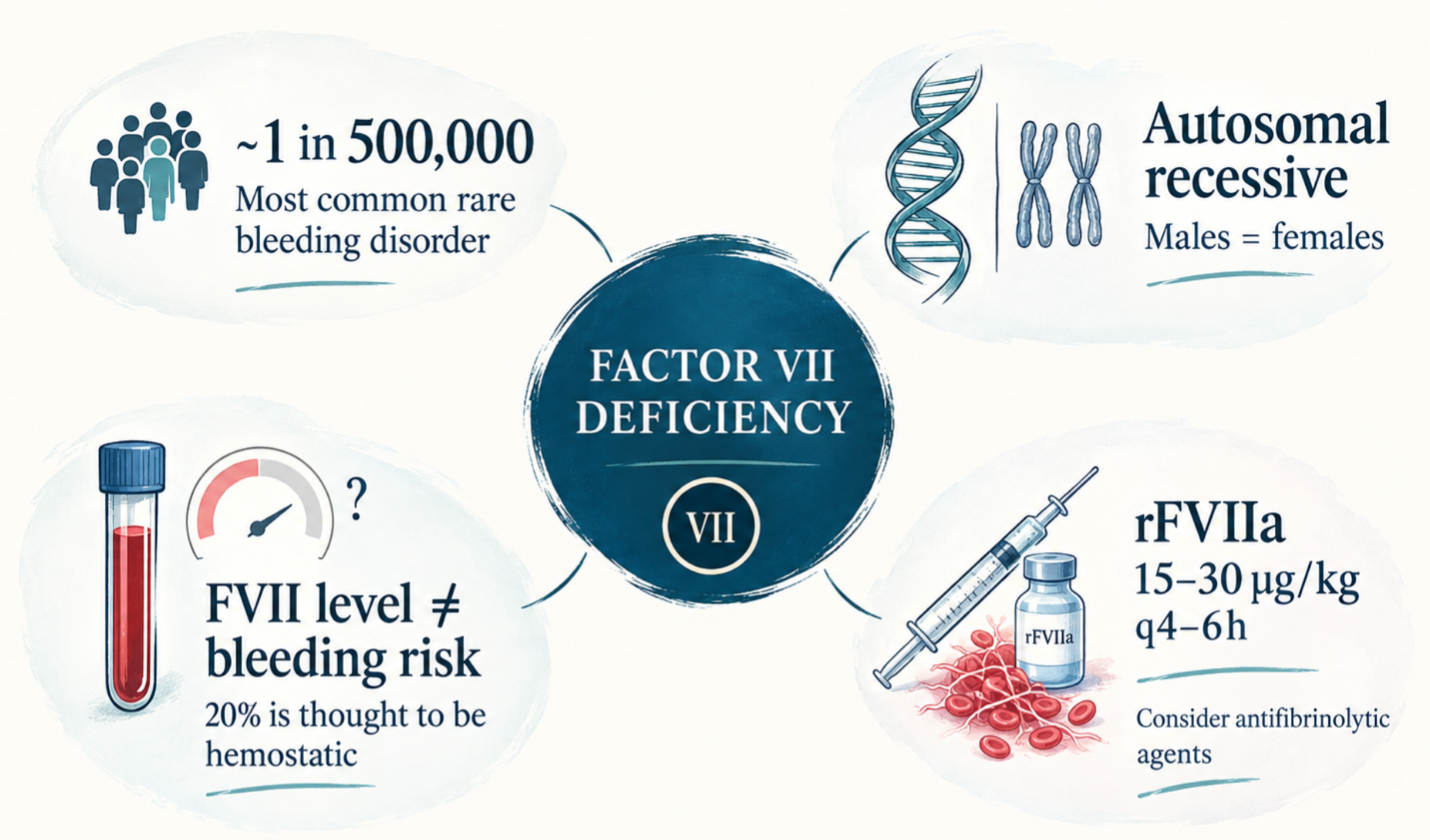
Factor VII deficiency is the most common of the rare inherited bleeding disorders (autosomal recessive), and it affects approximately 1 in 500,000 people. One of the most important pearls is that factor VII levels do not predict bleeding risk! This means that even patients with very low levels may have relatively mild bleeding, while others with higher levels may experience more significant bleeding.

This makes management somewhat challenging, especially around procedures and surgeries, because there are no high-quality randomized studies defining the optimal perioperative strategy. Recommendations are largely based on case series and expert opinion.

Genetic testing can sometimes provide additional information about bleeding phenotype and may help with risk prediction. When hemostatic replacement is needed, recombinant activated factor VII (rFVIIa) is commonly used. Importantly, the dose is much lower than the dose used for hemophilia with inhibitors: approximately 15 to 30 µg/kg every 4 to 6 hours (rFVIIa has a very short half-life therefore frequent dosing is often needed), with the exact regimen tailored to the bleeding episode or procedure. Antifibrinolytic agents can also be used as adjuncts, although the patient’s underlying thrombotic risk must be considered.

Factor VII deficiency infographic
Visual MemoryImage created by the fellow with ChatGPT
References (12)
  1. https://rarecoagulationdisorders.org/disorder/factor-vii-deficiency/disorder-overview/
  2. Bernardi F., Marchetti G., Pinotti M., Arcieri P., Baroncini C., Papacchini M., Zepponi E., Ursicino N., Chiarotti F., Mariani G. Factor VII gene polymorphisms contribute about one third of the factor VII level variation in plasma. Arterioscler. Thromb. Vasc. Biol. 1996;16:72–76.
  3. Mariani G, Herrmann FH, Bernardi F, Schved JF, Auerswald G, Ingerslev J. Clinical manifestations, management, and molecular genetics in congenital factor VII deficiency: the International Registry on Congenital Factor VII Deficiency (IRF7). Blood. 2000 Jul 1;96(1):374.
  4. Mariani G, Dolce A, Batorova A, Auerswald G, Schved JF, Siragusa S, Napolitano M, Knudsen JB, Ingerslev J; STER and the International Factor VII Deficiency Study Groups. Recombinant, activated factor VII for surgery in factor VII deficiency: a prospective evaluation – the surgical STER. Br J Haematol. 2011 Feb;152(3):340-6.
  5. Sekiya A, Morishita E, Maruyama K, Asakura H, Nakao S, Ohtake S. [Significant decrease in factor VII activity by tissue thromboplastin derived from rabbit brain in a patient with congenital factor VII deficiency (FVII Padua)]. Rinsho Ketsueki. 2012 Mar;53(3):357-60.
  6. Di Minno M.N., Dolce A., Mariani G., STER Study Group Bleeding symptoms at disease presentation and prediction of ensuing bleeding in inherited FVII deficiency. Thromb. Haemost. 2013;109:1051–1059.
  7. Sevenet PO, Kaczor DA, Depasse F. Factor VII Deficiency: From Basics to Clinical Laboratory Diagnosis and Patient Management. Clin Appl Thromb Hemost. 2017 Oct;23(7):703-710.
  8. Napolitano M, Siragusa S, Mariani G. Factor VII Deficiency: Clinical Phenotype, Genotype and Therapy. J Clin Med. 2017 Mar 28;6(4):38.
  9. Di Minno MND, Napolitano M, Dolce A, Mariani G; STER Study Group. Role of clinical and laboratory parameters for treatment choice in patients with inherited FVII deficiency undergoing surgical procedures: evidence from the STER registry. Br J Haematol. 2018 Feb;180(4):563-570.
  10. https://nordhemophilia.org/wp-content/uploads/2024/06/Factor-VII-deficiency-March-final-2020.pdf Accessed Sept 15, 2026
  11. Factor VII Deficiency – Practical Nordic Guideline for Diagnosis and Management; https://guidelines.nordhemophilia.org/fvii/ Accessed Sept 15, 2026
  12. Safdari SM, Shams M, Alavi S, Dorgalaleh A. Factor VII Padua: a systematic review of reported cases, diagnosis, clinical manifestations, and management strategies. Ann Hematol. 2026 May 12;105(7):318.
About the Contributors

Meet the Authors

Cilomar Martins, MD
Case & Questions

Cilomar Martins MD is a hematology-focused fellow at Beth Israel Deaconess Medical Center. He completed medical school in Brazil, where he also completed Internal Medicine residency and Palliative Care fellowship before moving to the United States. He then completed residency at Mass General Brigham, Salem Hospital. His clinical focus is both classical and malignant hematology.

Amy D. Shapiro, MD
Expert Commentary

Dr. Amy Shapiro, MD, is Chief Clinical Officer of Innovative Hematology/Indiana Hemophilia and Thrombosis Center in Indianapolis and Adjunct Senior Investigator, Clinical Track at the Blood Research Institute, Blood Center of Wisconsin in Milwaukee Wisconsin. After receiving her medical training at New York University School of Medicine in New York City, Dr Shapiro completed her pediatric internship, residency, and fellowship in pediatric hematology/oncology at the University of Colorado Health Sciences Center in Denver.