
For Your Healthcare Provider
Have your patient scan this QR code with their smartphone camera to instantly access this educational guide on their device.

A practical guide to diet, supplements, and long-term care
Iron deficiency is often not a one-time event.
For many people, it is something that needs to be managed over time, alongside medical care.
This page answers common questions patients ask after iron deficiency is diagnosed or treated, including what to eat, how to take iron, what to expect after IV iron, and how to reduce the risk of recurrence.
First things first
Iron deficiency is usually treated medically first.
Diet and lifestyle matter, but most people cannot correct iron deficiency with diet alone once iron stores are low. Food and supplements play different roles at different stages of recovery.
The goal of daily-life strategies is to support treatment and reduce recurrence, not to replace medical care.
Does diet matter for iron deficiency?
Yes — but with important limits.
Iron in food helps maintain iron levels once they are restored. It supports long-term balance and overall nutrition. However, diet alone usually does not provide enough iron to rebuild iron stores once deficiency is established.
This is because the body can absorb only a limited amount of iron each day, even from iron-rich meals. When iron deficiency is present, the gap between how much iron is needed and how much can be absorbed from food is often too large.
There are two main types of iron in food:
- heme iron, found in meat and seafood, which is absorbed more efficiently
- non-heme iron, found in plant-based foods, which is absorbed less efficiently
Ongoing blood loss, inflammation, or absorption problems can further reduce how much iron the body can take in from diet.
Bottom line:
Food is supportive, not corrective. Diet works best for maintenance, not repletion.
Do I need to eat meat?
Not necessarily.
People who follow vegetarian, vegan, or pescatarian diets can maintain adequate iron levels, but iron intake needs to be intentional, and supplementation is often still required when iron stores are low.
Plant-based diets provide iron, but absorption is lower. Some people do well long-term without meat, while others continue to need oral or IV iron despite careful diet choices.
This is not a failure of the diet. It reflects how the body absorbs iron.
How much steak equals one iron pill?
This is a common and reasonable question.
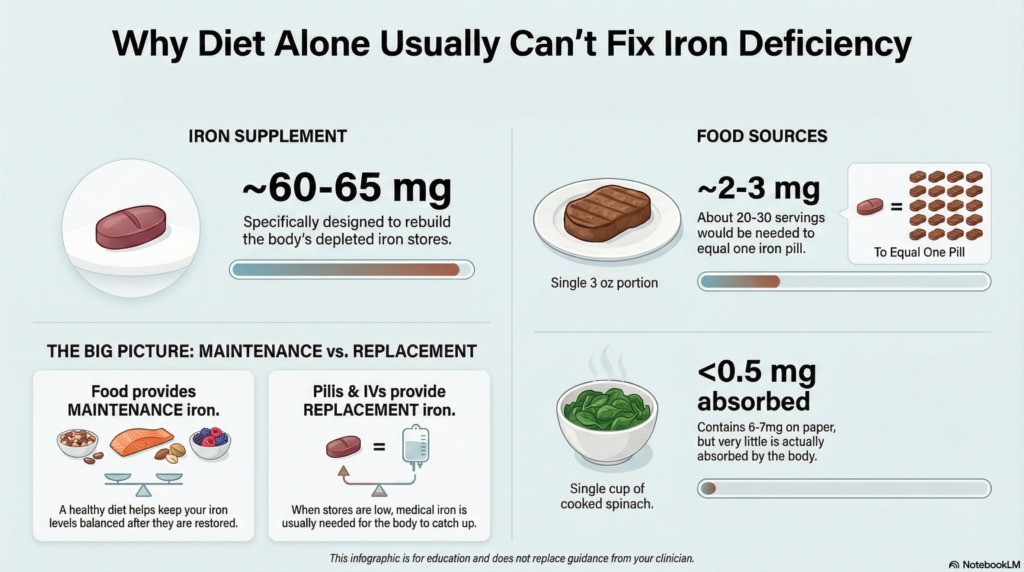
A typical iron supplement contains about 60–65 mg of elemental iron.
By comparison, a 3-ounce serving of beef (about the size of a deck of cards) contains about 2–3 mg of iron.
That means you would need roughly 20–30 servings of steak to equal the iron content of a single iron pill.
Even this comparison is misleading in an important way.
Only a fraction of iron in food is absorbed, while iron supplements are designed to deliver much larger amounts specifically to rebuild iron stores.
This is why diet alone is usually not enough to correct iron deficiency once iron stores are low, even though iron-rich foods remain healthy and supportive.
What about vegetables and iron?
Many vegetables contain iron, and some appear to contain more iron on paper than meat. The key difference is bioavailability — how much iron the body can actually absorb.
Iron from plant-based foods is non-heme iron, which is absorbed much less efficiently than heme iron. Absorption is often 5% or less, and can be further reduced by naturally occurring compounds such as phytates and oxalates.
For example:
- cooked spinach contains about 6–7 mg of iron per cup
- because absorption is low, the body may absorb less than 0.5 mg from that cup
To match the absorbed iron from a single 60–65 mg iron pill, a person would need to eat many pounds of spinach every day, which is neither realistic nor healthy.
Vegetables are nutritious and important, but once iron deficiency is present, diet alone is rarely sufficient to restore iron stores, especially if iron loss is ongoing.
A helpful way to think about it
Food provides maintenance iron.
Supplements and IV iron provide replacement iron.
When iron stores are already depleted, the body usually needs medical treatment to rebuild those stores. Once iron levels recover, diet helps support balance and reduce the risk of recurrence.
Think of diet as part of long-term support, not as the main treatment for iron deficiency.
How iron pills are dosed
When doctors talk about iron supplements, they focus on elemental iron, not the total weight of the pill.
Elemental iron is the amount your body can actually use.
Different iron pills contain very different amounts of elemental iron, even if the pills look similar or have the same total weight listed on the label.
For many adults with iron deficiency, a common starting target is about 60–65 mg of elemental iron, taken:
- once daily, or
- every other day
Your clinician may recommend a different dose or schedule based on tolerance, response, and the cause of iron deficiency.
More iron is not always better.
This can feel counterintuitive, but taking very high doses of iron does not necessarily lead to better absorption.
When the body is exposed to large amounts of iron at once, it responds by limiting how much iron it absorbs from the gut. As a result, higher doses may lead to more side effects without delivering more usable iron.
This is why many people do just as well, or better, with moderate doses taken once daily or every other day rather than very high doses taken multiple times per day.
Choosing an iron supplement
There is no single “best” iron pill for everyone.
Common forms include ferrous sulfate, ferrous gluconate, ferrous fumarate, and others. What matters most is:
- the dose your clinician recommends
- how well you tolerate it
- whether you can take it consistently
Higher doses are not always better and can increase side effects without improving absorption.
How to take iron for best absorption
Many people now take iron once daily or every other day.
This approach can improve absorption and reduce side effects.
General principles include:
• iron is absorbed better on an empty stomach, but taking it with food is reasonable if side effects occur
• vitamin C may help absorption but is not required for everyone
Vitamin C can help increase iron absorption for some people, especially with non-heme iron. Many people absorb iron well without it, and overall dose, schedule, and consistency matter far more than adding vitamin C. If vitamin C causes stomach upset or feels burdensome, it is reasonable to skip it.
• calcium, tea, coffee, and some medications can reduce absorption if taken at the same time
There is no single perfect method. The best plan is the one you can follow consistently.
Side effects and how to manage them
About one in three people experience side effects from oral iron.
Common effects include constipation, nausea, stomach discomfort, and less commonly diarrhea.
Helpful strategies may include:
- lowering the dose
- switching formulations
- taking iron every other day
- taking iron with food
- stopping and reassessing if symptoms are significant
Side effects are common and manageable. They are not a sign that iron is unsafe.
After IV iron: do I need to take iron afterward?
Not always.
Whether iron is needed after IV iron depends on why iron deficiency occurred in the first place.
Some people do well with monitoring alone. Others benefit from intermittent oral iron to slow recurrence. A few need repeat IV iron over time.
Recurrence of iron deficiency does not mean treatment failed and does not mean something dangerous is happening. It usually reflects ongoing iron loss or absorption issues.
Your clinician will help tailor a plan based on your situation.
Monitoring and follow-up
Feeling better does not always mean iron stores are fully restored.
Doctors often monitor hemoglobin and iron studies weeks to months after treatment to confirm recovery and guide next steps.
Follow-up helps ensure iron deficiency is corrected fully and helps detect recurrence early.
When should I contact my doctor?
You should reach out if:
- fatigue, shortness of breath, or other symptoms return
- side effects make iron hard to tolerate
- bleeding symptoms develop
- iron levels fall again after treatment
Seek urgent medical care for chest pain, severe shortness of breath at rest, or feeling faint.
Making sense of it
Iron deficiency reflects both iron balance and the cause behind it.
Treatment restores iron. Understanding the cause helps prevent it from coming back. Diet, supplements, IV iron, and monitoring all play supporting roles.
With a thoughtful plan, most people manage iron deficiency well and regain normal energy and function.
Key takeaways
- most people cannot correct iron deficiency with diet alone
- iron supplements and IV iron restore iron stores more effectively than food
- how you take iron matters as much as which iron you take
- IV iron corrects iron quickly but does not prevent recurrence by itself
- long-term plans depend on why iron deficiency occurred
For clinicians: Read our detailed guide on how to communicate about living with iron deficiency to patients.