
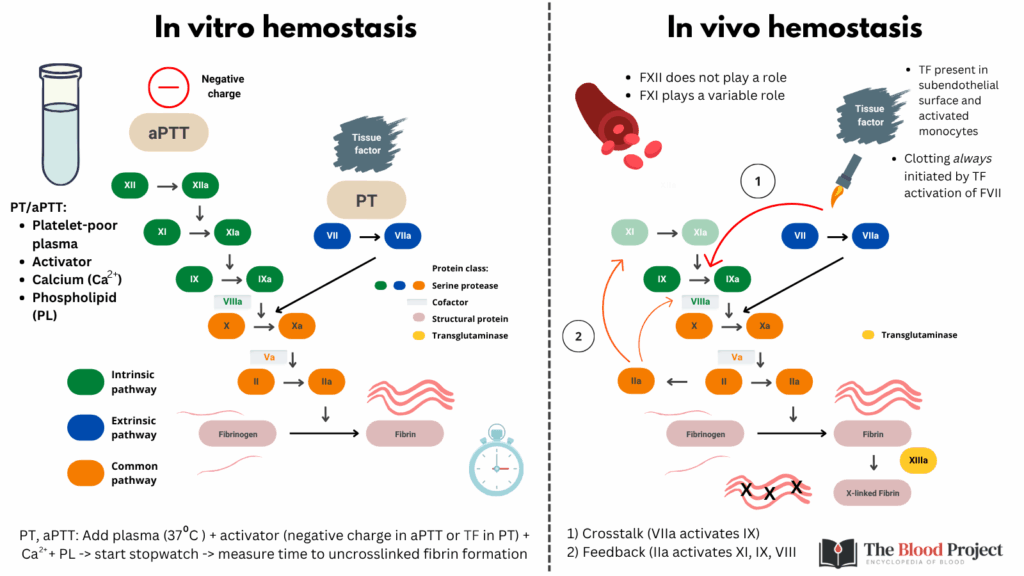
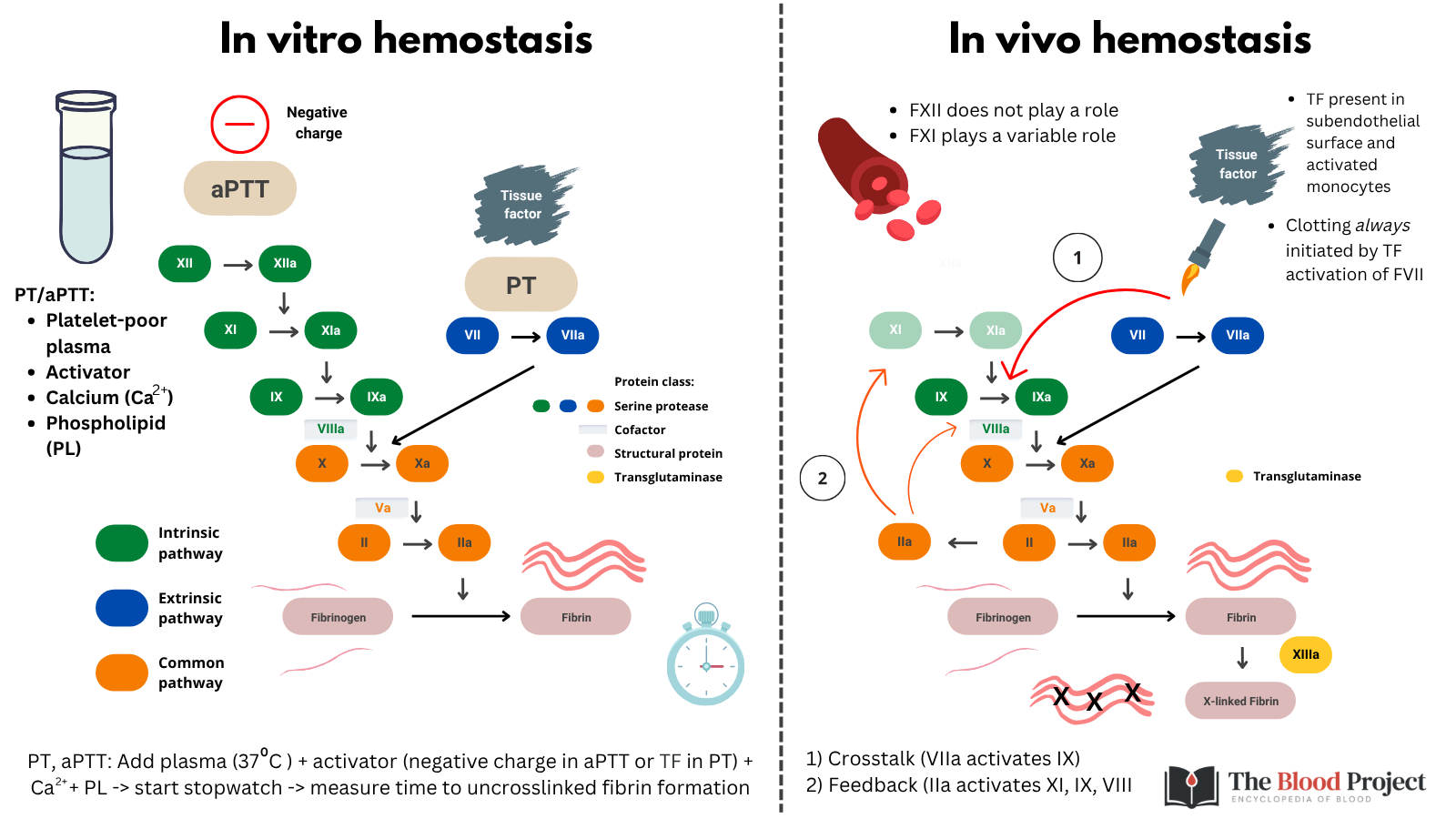
For larger image, click here.
In vitro clotting:
- Definition
- The cascade of coagulation reactions observed in test tubes under controlled conditions. This forms the basis of classical coagulation pathways: intrinsic, extrinsic, and common.
- Triggers:
- Intrinsic pathway: Activated by negatively charged surfaces (e.g., glass) → Factor XII activation
- Extrinsic pathway: Initiated by adding tissue factor (TF)
- Common pathway: Factor Xa converts prothrombin → thrombin → fibrin
- Clinical Tests Based on In Vitro Clotting:
| Test | Assesses |
|---|---|
| PT (prothrombin time) | Extrinsic & common pathways (factors VII, X, V, II, fibrinogen) |
| aPTT (activated partial thromboplastin time) | Intrinsic & common pathways (factors XII, XI, IX, VIII, X, V, II, fibrinogen) |
| TT (Thrombin Time) | Final step: fibrinogen → fibrin |
| Mixing studies | Factor deficiencies vs inhibitors |
| Specific factor assays | Quantify individual clotting factors |
- Limitations:
- Does not fully reflect how clotting occurs in the body
- Factor XII, key in intrinsic in vitro pathway, is not required in vivo (people with FXII deficiency do not bleed)
In vivo clotting:
- Definition:
- The physiologic process of hemostasis that occurs after vascular injury, involving a tightly regulated interaction between the vascular wall, platelets, and coagulation factors.
- Modern understanding: the cell-based model (this model has replaced the “cascade” as the framework for understanding clotting in vivo:
- Initiation:
- Exposure of tissue factor (TF) on damaged subendothelial cells
- TF binds factor VIIa → activates factors IX and X → small amounts of thrombin formed
- Amplification:
- Thrombin activates platelets, factors V, VIII, and XI
- Localizes and enhances coagulation at the injury site
- Propagation:
- On the surface of activated platelets: massive generation of thrombin via tenase (FVIIIa–FIXa) and prothrombinase (FVa–Xa) complexes
- Leads to fibrin formation and stable clot
- Initiation:
Bottom line: The classic coagulation cascade is great for the lab, but real-life clotting happens on cells, not just in tubes. Always interpret PT/aPTT results in clinical context!