
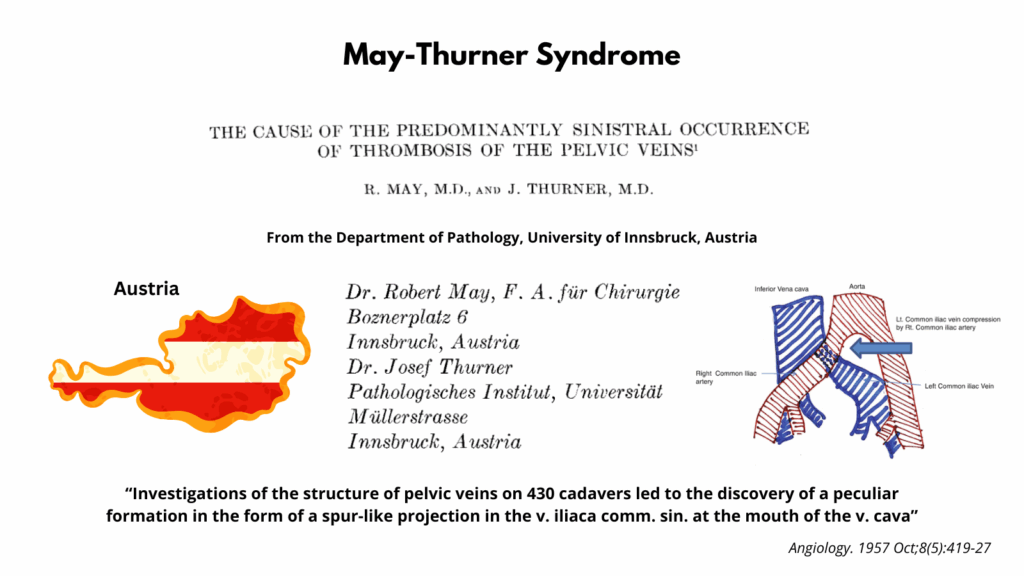
May-Thurner Syndrome (MTS), also known as iliac vein compression syndrome, is a vascular condition in which the right common iliac artery compresses the left common iliac vein against the lumbar spine. This mechanical compression increases the risk of deep vein thrombosis (DVT) in the left lower extremity. The eponym “May-Thurner Syndrome” honors Dr. Robert May and Dr. Josef Thurner, two Austrian physicians who first described the condition in 1957.
- Dr. Robert May was an Austrian vascular surgeon.
- Dr. Josef Thurner was an Austrian pathologist.
- Together, they published a seminal paper based on autopsy studies in which they found that 22% of cadavers had thickened left iliac vein intima due to chronic compression by the overlying right common iliac artery.
- This mechanical compression was thought to predispose patients to left-sided deep vein thrombosis (DVT).
Historical Note: While the anatomical configuration they described was known earlier, it was May and Thurner who correlated the anatomic finding with clinical pathology (i.e., DVT) and provided a histopathologic basis for the syndrome, leading to the adoption of their names in the eponym May-Thurner Syndrome.

References:
May R, Thurner J. The cause of the predominantly sinistral occurrence of thrombosis of the pelvic veins. Angiology. 1957 Oct;8(5):419-27.
Harbin MM and Lutsey PL. May-Thurner syndrome: History of understanding and need for defining population prevalence. J Thromb Haemost. 2020 Mar;18(3):534-542.