
The physical exam as judgment in a data-forward specialty
Note: The video and audio linked above were generated with the assistance of AI. Clinical accuracy has been reviewed, but no AI-generated content can be guaranteed to be fully error-free.
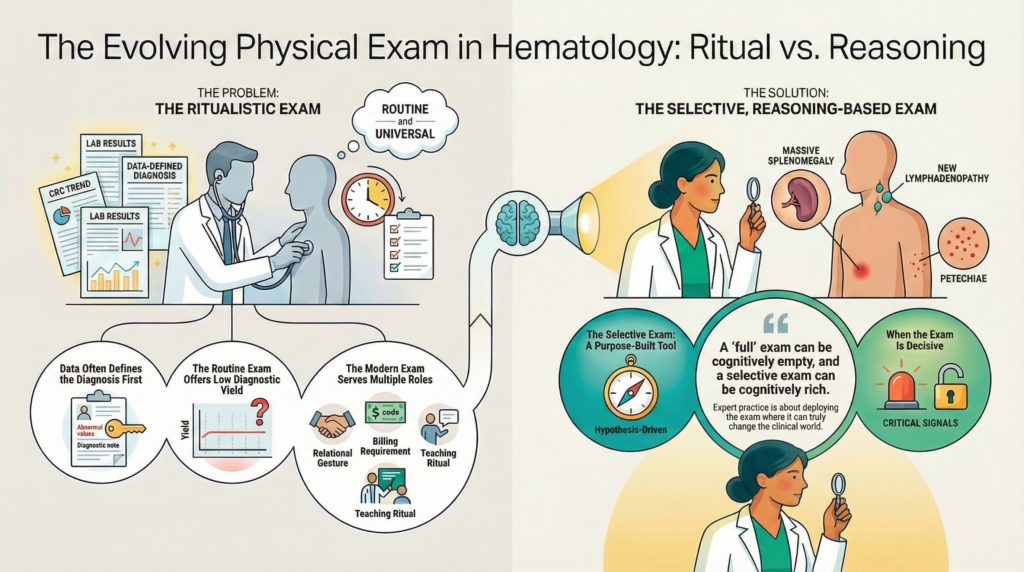
In many outpatient hematology clinics, the most powerful diagnostic instrument is not a stethoscope.
It is a ferritin level.
Or a CBC trend.
Or a peripheral smear.
Or a molecular test.
This is not a failure of bedside medicine.
It is a reflection of how hematology has evolved.
The question is no longer whether the physical exam matters.
It is when it matters, why it matters, and what work we believe it is actually doing.
Ritual is not the same as reasoning in modern hematology
In classic medical training, the physical exam was treated as a universal first move.
Inspect the head and neck.
Listen to the heart.
Listen to the lungs.
Palpate the abdomen.
Inspect the skin.
Examine the extremities.
This sequence became ritualized.
But ritual is not the same as reasoning.
In modern hematology, many common outpatient problems are already tightly constrained by laboratory data before the patient ever walks into the room:
iron deficiency anemia
stable thrombocytopenia
chronic lymphocytosis
monoclonal gammopathy
In these settings, the exam rarely:
narrows the diagnosis
changes urgency
alters management
improves safety
That does not mean the exam is meaningless.
It means its function has shifted.
By selective examination, I do not mean an abbreviated or careless exam.
I mean a purpose-built, hypothesis-driven exam, designed to answer specific terrain-defining questions for this patient, in this clinical context.
Selective does not mean doing less.
It means doing what matters.
Because a “full” exam can still be cognitively empty, and a selective exam can be cognitively rich.
There are important exceptions.
In selected thrombocytopenia cases, the physical exam can still define terrain. Palpable splenomegaly may immediately reframe the problem toward hypersplenism, portal hypertension, or systemic disease, changing both evaluation and urgency.
This is exactly what selective examination looks like in practice:
not abandoning the exam, but deploying it where it can actually change the clinical world.
The exam now does different kinds of work in practice
In contemporary practice, the physical exam often serves multiple roles at once:
- a clinical tool
- a relational gesture
- a teaching ritual
- a billing requirement
- a documentation artifact1
Those are not the same thing.
A clinician may listen to heart and lungs knowing, in real time, that the diagnostic yield is extremely low, but that the act itself:
- reassures the patient
- signals attentiveness
- fulfills documentation criteria
- protects against audit risk
The exam is being done — but not always for diagnostic reasons.
Every experienced clinician recognizes this, even if it is rarely named.
The stethoscope as symbol more than instrument
The stethoscope remains one of medicine’s most powerful symbols.
It signals:
I am a doctor.
I am paying attention.
I am here.
In many hematology encounters, it is used less as a diagnostic instrument and more as a marker of presence.
That is not trivial.
But it is different from saying it is diagnostically necessary.
Perhaps the better question is not:
Does a hematologist have to carry a stethoscope?
But:
When does the stethoscope change the terrain?
The physical exam as an Orientation instrument
In Consult Practice terms, the physical exam is an Orientation tool.
It can:
- define terrain
- confirm terrain already suggested by data
- or add little to either
The cognitive question is not whether to examine.
It is whether the exam will meaningfully shape the problem space.
Expert clinicians already practice this, even if they were trained not to say it out loud.
They ask, often implicitly:
Will this exam:
- define the clinical terrain?
- change urgency?
- uncover hidden danger?
- alter management?
- meaningfully reduce uncertainty?
If the answer is no, the exam may still be performed.
But it is not doing primary diagnostic work.
Data-constrained terrain in modern hematology
Hematology is a specialty built on measurable physiology.
Ferritin defines iron deficiency.
Flow cytometry defines clonal populations.
Reticulocytes define marrow response.
Molecular testing defines disease biology.
By the time a patient with iron deficiency anemia arrives in clinic, the key diagnostic question is often already answered.
Looking at nails or tongue may still be useful.
Listening to heart and lungs almost never changes the problem space.
Palpating the abdomen rarely alters core reasoning.
Instead, when the exam matters at all, it is usually confirmatory of physiologic impact — how the anemia is being tolerated — not defining of cause.
It may reflect how the anemia is being tolerated, not why it exists.
The terrain is already constrained by data.
Patients understand this more than we think
Many patients with chronic blood count abnormalities come into clinic hoping not to be examined.
Not because they distrust physicians.
But because they intuitively understand how hematologic decisions are actually made.
They know that the blood tests are doing the diagnostic work.
They come primarily for:
- explanation
- interpretation
- reassurance
- a plan
From the patient’s point of view, a low-yield physical exam can feel:
- irrelevant to the problem they came for
- intrusive without clear benefit
- performative rather than purposeful
That’s not anti-doctor.
It’s data-literate patient reasoning.
This creates a quiet tension not between patients and clinicians, but between two different systems:
- what clinical reasoning actually requires
- and what administrative and documentation frameworks still expect
In modern hematology, patients often recognize this mismatch before the system does.
When the physical exam truly matters
There are hematology terrains where the exam is decisive:
- massive splenomegaly
- new lymphadenopathy
- petechiae or purpura
- focal neurologic findings
- signs of bleeding
- signs of deep vein thrombosis
- volume overload
In these settings, the exam:
- defines terrain
- changes urgency
- alters execution
Here, the exam is not ritual.
It is signal.
Selectivity carries risk
Selective examination is terrain-targeted, not incomplete.
A selective physical exam is not a shortcut and not an incomplete exam.
It is a purpose-built exam, designed to answer specific terrain-defining questions.
In Consult Practice terms, the physical exam is an Orientation tool.
Its job is not to catalog the body.
Its job is to determine whether physical findings reframe the hematologic problem space.
Because a “full” exam can still be cognitively empty, and a selective exam can be cognitively rich.
In modern hematology, this means the exam is deployed to look for findings that would change the clinical terrain, not to perform a universal head-to-toe ritual.
In iron deficiency anemia, for example, a selective exam may reasonably focus on:
- nails and tongue to confirm phenotype
- cardiovascular exam if anemia is severe, to assess physiologic impact (flow murmur, tachycardia, heart failure signs)
- skin or mucosa for evidence of bleeding
This is not skipping the exam.
It is using the exam for what it is best at: terrain definition.
The danger is not that the exam is selective.
The danger is assuming that data alone have fully defined the terrain, and therefore failing to ask whether there is a hematologically meaningful physical finding that could reframe the problem.
Selective examination is not about searching for incidental disease.
It is about identifying physical findings that would change how the hematologic problem is understood, prioritized, or acted upon.
That is expert selectivity.
Teaching selectivity is teaching judgment
Trainees learn by imitation.
If they see attendings perform comprehensive exams without explaining what the exam is meant to accomplish cognitively, they may learn:
- that exams are always required
- that exams always matter diagnostically
- that exams substitute for thinking
That is not how experts actually work.
Experts are selective.
They deploy the exam when it changes terrain, posture, or action.
They may still examine for relational or administrative reasons.
But they do not confuse those reasons with diagnostic necessity.
Teaching that distinction is part of teaching clinical judgment.
The deeper tension: reasoning vs documentation
Modern clinicians practice at the intersection of:
clinical reasoning
and administrative documentation
Sometimes those align.
Often they do not.
The physical exam is one of the clearest places where this divergence is felt.
Naming that is not cynicism.
It is realism.
More precise bedside medicine
The stethoscope still belongs in a hematologist’s pocket.
Not because it always diagnoses.
But because it still:
- signals presence
- supports relationship
- matters in the right terrain
- defines danger when it truly appears
At the same time, modern hematology is unapologetically data-forward.
Ferritin often does more work than auscultation.
CBC trends often do more work than palpation.
Smear review often does more work than percussion.
Expert practice lies not in abandoning the exam.
It lies in using it when it actually changes the clinical world.
That is not less bedside medicine.
It is more precise bedside medicine.