Burr cells may occur in kidney disease, while spur cells are associated with advanced liver disease. Their shapes offer clues, but neither is specific to one disease. Below, discover how to distinguish these cells, what changes their membranes, and test your eye with an interactive comparison.
At a glance on a blood smear, burr cells and spur cells look alike. The details tell them apart, and each one points back to a different organ.
1 / 3Regular spikes: the burr cell
2 / 3Irregular spikes: the spur cell
3 / 3Each organ leaves its own signature
1 / 3
Regular spikes: the burr cell
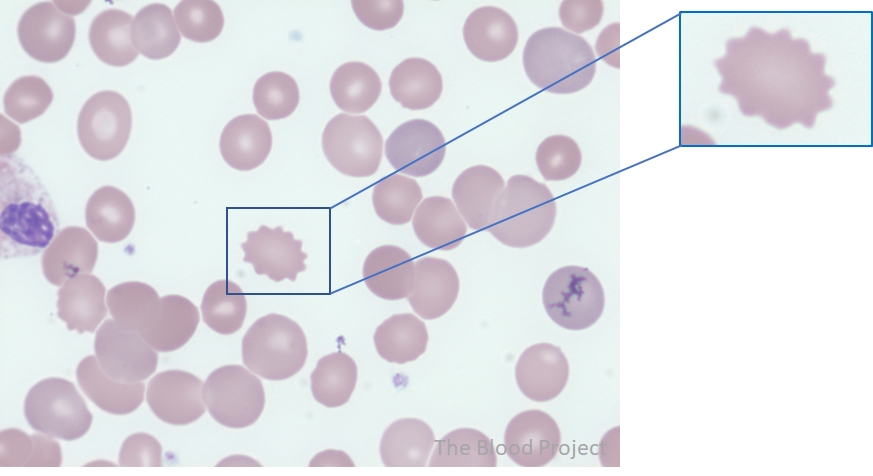
A burr cell, or echinocyte, has many short projections of similar length and width, spaced regularly around its surface. Their tips are generally rounded, and central pallor is usually preserved.
Burr cells may occur in advanced kidney disease, particularly uremia. They can also develop after blood collection because of storage or smear preparation, a process called crenation. Before attributing burr cells to disease, consider whether they persist in a freshly prepared smear.
Schematic, not to scale.
2 / 3
Irregular spikes: the spur cell
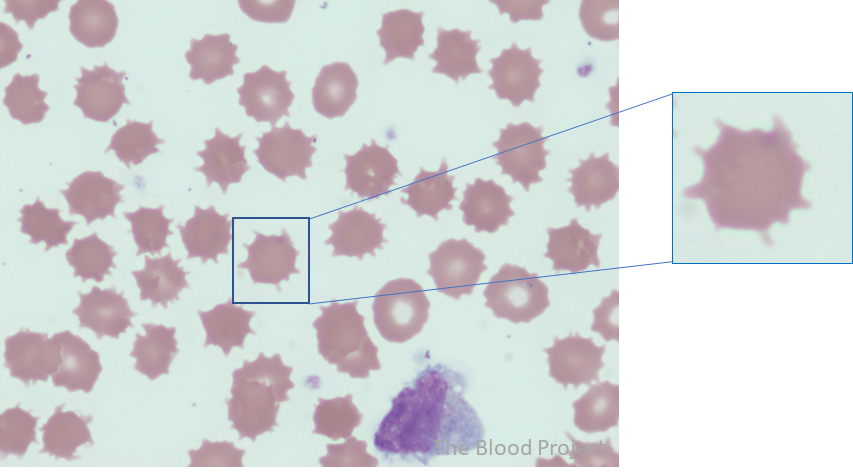
A spur cell, or acanthocyte, has fewer projections that vary in length and width and are irregularly distributed. Their tips may be pointed or rounded, sometimes forming knobs. Central pallor is often reduced or absent.
Acanthocytes occur in inherited disorders, including abetalipoproteinemia and neuroacanthocytosis syndromes, and may appear after splenectomy.
In advanced cirrhosis, classically alcohol-related, they are often called spur cells. When numerous and accompanied by hemolysis, they raise concern for spur cell anemia. Compare the two cells one detail at a time.
Compare the details
The burr cell’s spikes are short and similar in length, so their tips line up on one circle. The spur cell’s spikes vary in length and width, with pointed or knobbed tips.
The burr cell’s spikes are short and similar in length, so their tips line up on one circle. The spur cell’s spikes vary in length and width, with pointed or knobbed tips.The burr cell’s spikes are spread evenly around the edge. The spur cell has fewer, with irregular gaps between them.The burr cell usually keeps a pale center, like a normal red cell. In the spur cell, the pale center is often reduced or absent.
Schematic, not to scale.
From illustration to microscope
Here is what both cells look like on a real blood smear. Tap a picture to enlarge it.
A red cell’s shape depends on its membrane and the environment it encounters.
In uremia, changes in the circulating plasma can promote echinocyte formation, producing short, evenly spaced projections. The precise mechanism remains uncertain, and these changes may be reversible.
In advanced liver disease, excess cholesterol accumulates in red-cell membranes, increasing the cholesterol-to-phospholipid ratio. This alters membrane properties and reduces deformability. Further remodeling during splenic passage contributes to spur-cell formation and premature red-cell destruction.
A way to remember
B-U-R = Burr, Uremia, Regular.
Simplified. Mechanisms are summarized.
Quiz
Test your curiosity
Pick the answer you think is right. Every choice explains itself, and you can try again.
Question
A patient with alcohol-related cirrhosis has worsening anemia. The smear shows small, dense red cells with a few spikes of different lengths and no pale center. What are they?
Burr cells have many short spikes of similar length, spread evenly, and they usually keep their pale center. Their classic setting is kidney disease, or a sample that sat too long before the smear was made.
A few irregular spikes on a small, dense cell with no pale center is the spur cell. In advanced liver disease, extra cholesterol stiffens the membrane and the spleen trims and destroys these cells, which explains the anemia.
Target cells are common in liver disease too, but they have no spikes. They look like a bullseye: a dark spot in the middle of a pale ring.
The takeaway
Read the spikes: many short, regular projections suggest a burr cell; fewer, uneven projections suggest a spur cell.
Why it matters in the clinic
Burr cells may reflect kidney disease but are frequently artifacts of specimen preparation.
Spur cell anemia in advanced cirrhosis is a serious hemolytic complication associated with poor prognosis. Its significance goes well beyond the presence of an occasional acanthocyte.
Both findings must be interpreted in the context of the complete blood smear and the patient’s clinical condition.
Go further
In pyruvate kinase deficiency, red cells may develop irregular projections resembling spur cells.
These are known as contracted cells. What causes them to form?