

ASH Curiosity Collection
Card 02 · Blue Veins
So why do your veins look blue?
The short answerVeins look blue because of how light interacts with skin and blood, not because blood is blue.
Blood in your veins is dark red. Below, explore why veins appear blue and test your reasoning.
Explore the scienceYour blood
is never
actually blue.
So why do
your veins look blue?


 Stay Curious
Dark red blood, blue-looking veins
Every drop of your blood is a shade of red. Veins appear blue because of how light interacts with skin and blood, and how your brain compares colors. Three ideas explain it.
- 1 / 3Blood is red, with or without oxygen
- 2 / 3Red light goes deeper than blue
- 3 / 3Your brain does the rest
Blood is red, with or without oxygen
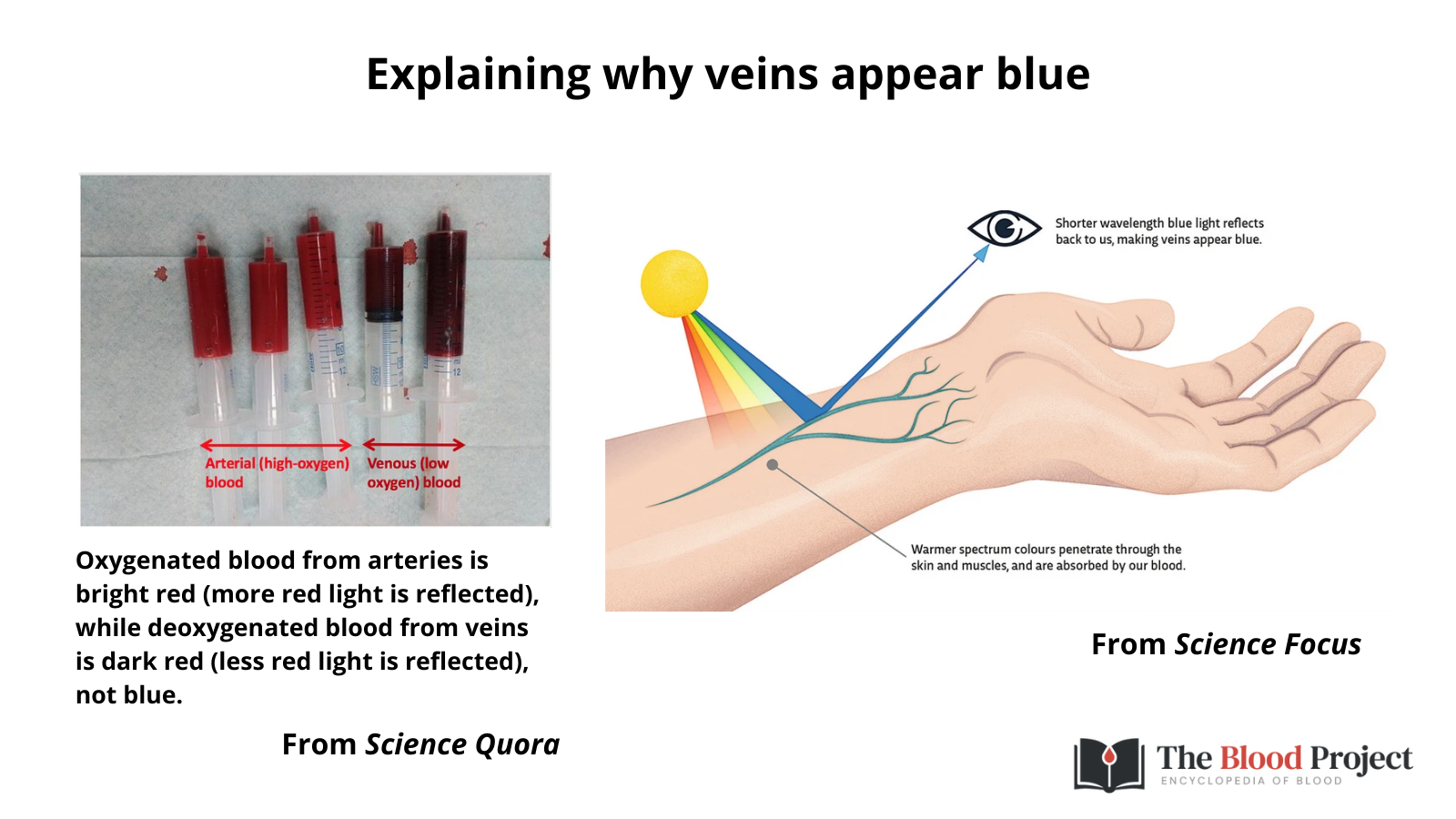
Hemoglobin gives blood its color. Oxygen-rich arterial blood is bright red. After releasing oxygen to tissues, blood becomes darker red.
That darker blood fills your veins. It is never blue.
Red light goes deeper than blue
Skin scatters and absorbs light. Much of the blue light returning to your eyes comes from shallow layers. Red light penetrates deeper, where it can reach a vein.
Blood absorbs much of that red light. Consequently, less red light returns from skin over a vein than from the surrounding skin, while the returning blue light changes much less. Switch between red and blue light below to compare.
Red light reaches the vein. Hemoglobin absorbs it, so far less red comes back from over the vein than from the skin beside it.
Red light reaches the vein. Hemoglobin absorbs it, so far less red comes back from over the vein than from the skin beside it.Blue light scatters back before it gets deep enough to reach the vein, so about the same amount returns from both spots.Simplified cross-section, not to scale. Depths are illustrative.
Your brain does the rest
Your visual system judges colors by comparing neighboring areas. Skin over a vein returns proportionally less red light than surrounding skin, making the vein appear blue or blue-green.
Remarkably, a vein can look blue even when more red than blue light returns to your eyes. What matters is the difference between neighboring patches of skin, not an abundance of blue light.
Test your curiosity
Pick the answer you think is right. Every choice explains itself, and you can try again.
What change in the light coming back from your skin makes a vein look blue?
It is actually the reverse. The skin over a vein sends back slightly less blue light too. What changes most is red: blood absorbs the red light that reaches it, so much less red returns.
Red light travels deep enough to reach the vein, and hemoglobin absorbs much of it. Blue light mostly scatters back before it gets that far, so it barely changes. The vein returns a smaller share of red than the skin around it, and your visual system reads that shift as blue.
Oxygen-poor blood is dark red, never blue. You can see it whenever blood is drawn into a tube. The blue comes from how light travels through skin, not from the blood itself.
Veins look blue because less red light returns from the skin above them, not because they add blue.
Pulse oximeters use a related principle. Oxygen-rich and oxygen-poor hemoglobin absorb red and infrared light differently. By comparing pulsating signals at these wavelengths, the device estimates arterial oxygen saturation. Skin pigmentation can affect this measurement. Some devices overestimate oxygen saturation in people with darker skin, potentially concealing dangerously low oxygen levels.
But some animals really do have blue blood.
What gives their blood its color, and what role does it play?
Stay Updated
Get the latest case studies, tutorials, and hematology insights delivered monthly to your inbox