
How expert consultants define terrain, assign weight, and make judgment visible when hemorrhage and thrombosis compete and stakes are real
Note: The video and audio linked above were generated with the assistance of AI. Clinical accuracy has been reviewed, but no AI-generated content can be guaranteed to be fully error-free.
More Than Bleeding: How Expert Consultants Manage Competing Harms
Active bleeding in an anticoagulated patient is not just a hemorrhage problem.
It is a competing-harms problem.
The same hemoglobin value, the same anticoagulant, and the same bleeding site can live in very different clinical worlds:
- a stable patient with limited bleeding and remote thrombosis
- a patient with active hemorrhage and recent high-risk VTE
- a patient whose bleeding is slowing but whose thrombotic risk is rising
- a patient with multi-system illness where both dangers evolve unpredictably
In each case, the facts may look similar.
The danger is not.
This is why anticoagulation with active bleeding is not primarily a diagnostic problem.
It is a judgment problem.
Expert consultation is not about choosing bleeding or thrombosis.
It is about managing both safely as the biology declares itself.
Consult Practice makes that expert judgment visible.
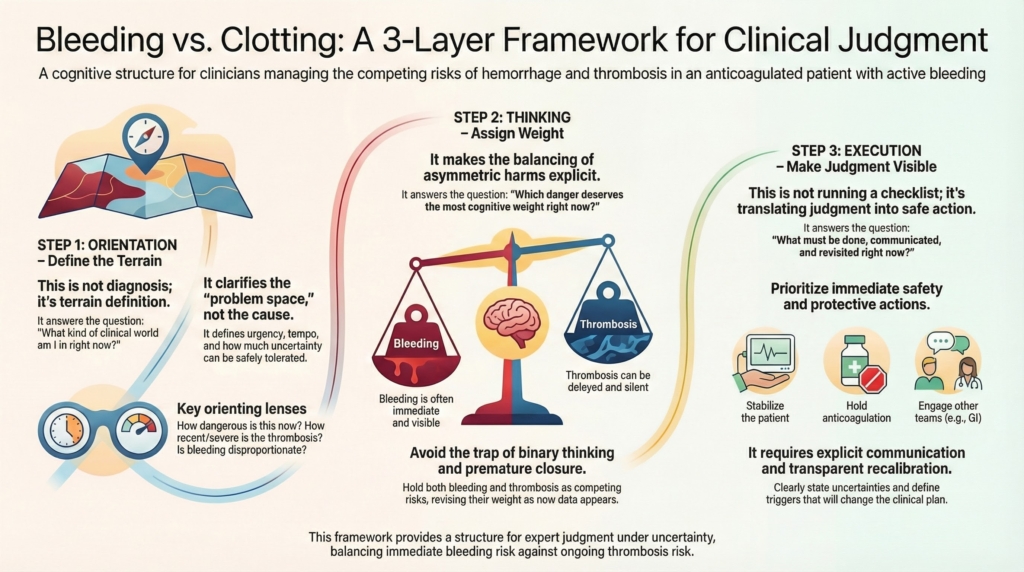
The Three-Layer Framework: Orientation, Thinking, Execution
This series approaches anticoagulation with active bleeding through three distinct cognitive layers:
- Orientation — defining the terrain
- Thinking — assigning weight within that terrain
- Execution — making judgment visible through action and communication
Each layer has a different job.
Confusing them is one of the most common sources of clinical error.
Orientation Defines the Map
Orientation answers a simple but powerful question:
What kind of clinical world am I in right now?
Orientation is not diagnosis.
It is terrain definition.
In anticoagulated patients with bleeding, Orientation clarifies:
- how dangerous this situation could be right now
- how fast it may evolve
- how much uncertainty can be safely tolerated
- whether bleeding, thrombosis, or both plausibly define the terrain
Orientation helps distinguish between worlds such as:
- immediate hemorrhagic danger terrain
- evolving blood-loss terrain
- competing-harms terrain (bleeding and thrombosis both relevant)
- contained or stable physiology terrain
- broader hematologic-system terrain
These are not causes.
They are problem spaces.
Orientation often begins at the time of the page.
But it is not a one-time act.
Whenever trajectory, stability, or thrombotic context changes, Orientation must be re-invoked.
Orientation answers:
What kind of situation is this?
Thinking Assigns Weight Within the Defined World
Once the terrain is defined, Thinking takes over.
Thinking answers a different question:
Within this world, which dangers deserve the most cognitive weight right now?
This is not about naming a cause.
It is about managing trade-offs under uncertainty.
In anticoagulation with bleeding, Thinking focuses on:
- relative urgency of hemorrhage versus thrombosis
- tempo and trajectory of bleeding
- recency and severity of thrombosis
- asymmetry of harms
- how costly it would be to be wrong in either direction
Thinking is where expert consultants:
- resist binary framing
- hold bleeding and thrombosis as competing risks
- assign provisional weight to each
- revise that weight deliberately as new information appears
- avoid forced elegance and premature closure
Thinking answers:
Which danger deserves priority right now, and what would change that?
Execution Makes Judgment Visible
Execution is where judgment becomes real to others.
Execution answers:
What must be clarified, protected, communicated, deferred, and revisited — right now?
This is where:
- stabilization is prioritized
- anticoagulation is held or resumed visibly and deliberately
- uncertainty is communicated clearly
- reassessment triggers are defined
- revision is made explicit over time
Execution is not running a checklist.
It is translating judgment into safe clinical behavior as biology evolves.
Execution includes:
- first safety passes
- protective escalation
- visible restraint
- explicit communication of competing risks
- transparent recalibration
This is why Execution is best described as:
Judgment made visible.
Execution answers:
How does expert judgment look in real clinical time?
Why This Framework Matters
Many errors in anticoagulation with bleeding do not arise from lack of knowledge.
They arise from:
- treating competing harms like a single-cause problem
- anchoring on bleeding or thrombosis prematurely
- allowing early labels to drive momentum
- failing to revise posture as trajectory changes
- confusing diagnosis with danger management
This framework protects against category failure:
- treating trade-offs like diagnostic puzzles
- treating evolving physiology like static abnormalities
- treating uncertainty as something to eliminate rather than manage
By separating Orientation, Thinking, and Execution, the consultant:
- defines the correct terrain
- assigns weight deliberately
- and makes judgment visible and revisable
This is how expert consultants manage risk when facts are incomplete and stakes are real.
How to Use This Series
This overview is the conceptual front door.
The three companion essays go deeper:
- Orientation — for defining the problem space
- Thinking — for managing competing harms and trade-offs
- Execution — for visible action and communication over time
They are designed to be used together.
Not as algorithms.
Not as diagnostic manuals.
But as a guide to how expert consultants think, act, and recalibrate when bleeding and thrombosis compete.
Bottom Line
Anticoagulation with active bleeding is not a diagnosis.
It is a competing-harms signal.
Expert care depends on:
- defining what kind of world the patient is in
- assigning cognitive weight to bleeding and thrombosis deliberately
- and making judgment visible through safe, adaptive execution
Orientation defines the map.
Thinking assigns weight.
Execution makes judgment visible.
That is how hematologists reason when hemorrhage and thrombosis compete and the stakes are real.