
How expert consultants define terrain, assign weight, and make judgment visible when immune reserve is falling and danger is often hidden
Note: The video and audio linked above were generated with the assistance of AI. Clinical accuracy has been reviewed, but no AI-generated content can be guaranteed to be fully error-free.
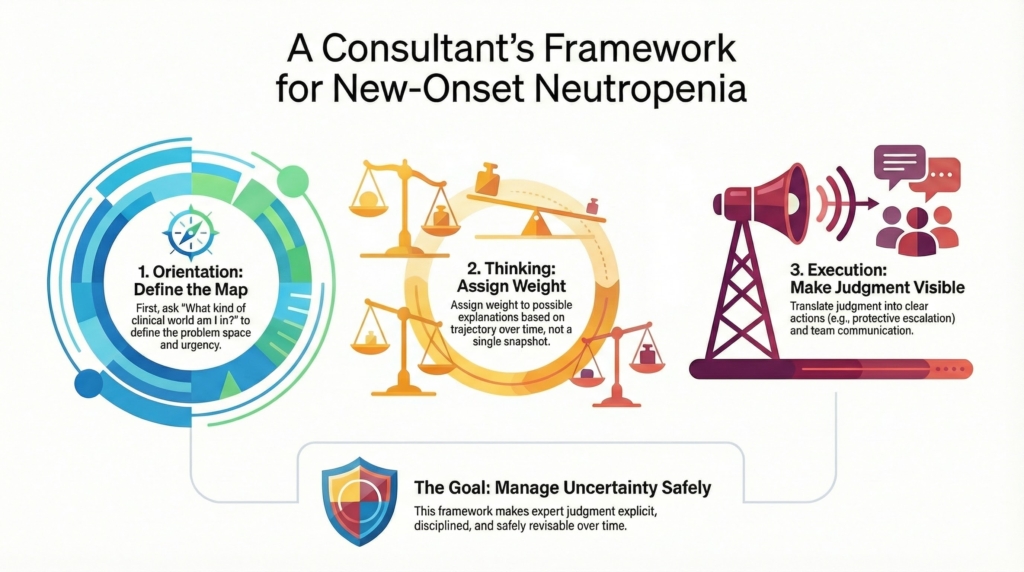
Why neutropenia is an Orientation–Thinking–Execution problem
New-onset neutropenia in the hospital is not primarily a diagnostic exercise.
It is a reserve-threat judgment problem.
A falling neutrophil count signals potential loss of host defense. The danger often lies not in the absolute number, but in what it implies about vulnerability, trajectory, and consequence.
Two patients with the same absolute neutrophil count may inhabit entirely different clinical terrains:
- one with expected, stable treatment-related neutropenia
- one with evolving marrow suppression
- one with immune-mediated destruction
- one with early, hidden infection risk
- one in whom tempo alone makes delay unsafe
The consult challenge is not naming the cause early.
It is deciding how to behave safely while the biology is still declaring itself.
That is why neutropenia belongs in Consult Practice.
The judgment problem neutropenia creates
Neutropenia creates a distinctive consult terrain:
- danger may precede visible infection
- severity can reshape urgency independent of mechanism
- trajectory often matters more than snapshot
- premature reassurance is a common cognitive trap
- protective escalation may be appropriate even without diagnostic clarity
The consultant’s task is not to eliminate uncertainty quickly.
It is to manage uncertainty safely.
How to use the three lenses
This series approaches neutropenia through three distinct cognitive lenses.
Each has a different job.
Orientation — defining the terrain
Orientation answers:
What kind of clinical world am I in right now?
In neutropenia, Orientation defines:
- whether immune reserve loss is plausible
- how narrow or broad the danger terrain is
- how much uncertainty is tolerable
- how fast the situation may evolve
Orientation does not diagnose.
It defines the problem space.
Thinking — assigning weight within that terrain
Thinking answers:
Within this world, which explanations deserve the most attention right now?
In neutropenia, Thinking manages:
- provisional weighting of marrow, drug, immune, and infection frames
- resistance to premature reassurance or forced coherence
- trajectory-based strengthening or release of hypotheses
- disciplined uncertainty tolerance
Thinking assigns weight.
It does not declare truth.
Execution — making judgment visible
Execution answers:
How does expert judgment become safe clinical behavior?
In neutropenia, Execution includes:
- protective escalation when reserve-threat is plausible
- visible restraint when trajectory supports safety
- explicit communication of uncertainty and vigilance
- defined reassessment triggers
- transparent recalibration over time
Execution is where judgment becomes real to others.
How to read this trilogy
These three pieces are designed to be used together.
Orientation defines the map.
Thinking determines stance within that map.
Execution translates that stance into visible action and communication.
Errors in neutropenia rarely arise from lack of knowledge.
They arise from:
- misclassifying the terrain
- assigning weight too early or too late
- allowing early labels to drive momentum
- failing to recalibrate when trajectory changes
This trilogy exists to make expert judgment:
- explicit
- disciplined
- and safely revisable over time
Bottom line
New-onset neutropenia is not just a low count.
It is a signal about immune reserve, vulnerability, and tempo.
Expert care depends on:
- defining what kind of world the patient is in
- assigning cognitive weight deliberately
- and making judgment visible through adaptive execution
Orientation defines the map.
Thinking assigns weight.
Execution makes judgment visible.
That is how hematologists reason when immune reserve is falling and the stakes are real.