
How expert consultants define terrain, assign weight, and make judgment visible when the white count is high and meaning depends on context, tempo, and signal rather than magnitude
Note: The video and audio linked above were generated with the assistance of AI. Clinical accuracy has been reviewed, but no AI-generated content can be guaranteed to be fully error-free.
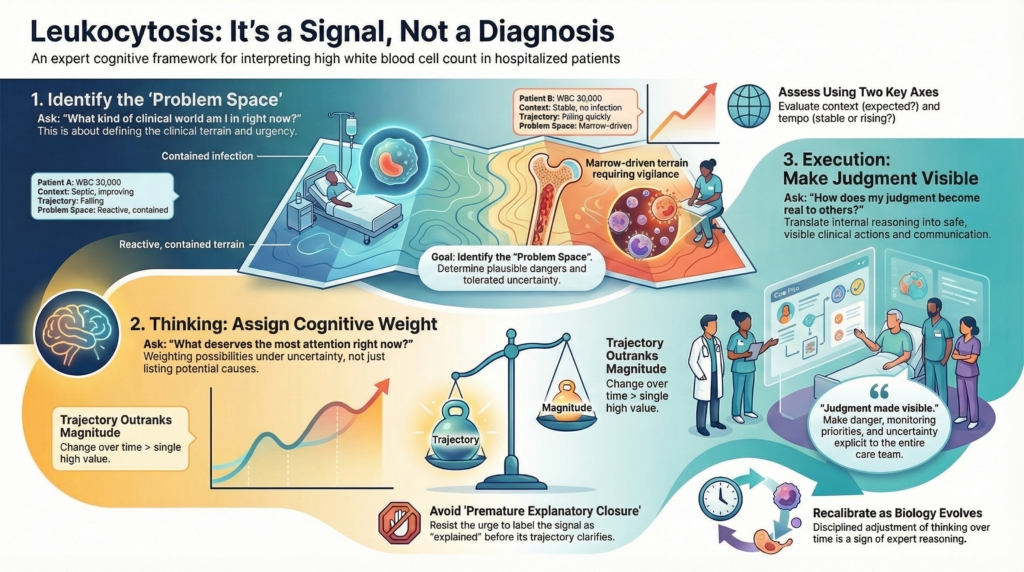
More Than a Number: When Leukocytosis Is a Signal, Not a Diagnosis
Leukocytosis is not simply a high white blood cell count.
It is a signal — of physiologic stress, inflammation, immune activation, marrow activity, or evolving disease.
The same white count can live in very different clinical worlds:
- a patient with severe sepsis and reactive demargination
- a patient receiving steroids or growth factors
- a stable patient with unexplained leukocytosis
- a patient with marrow-driven or clonal proliferation
- a patient with rapidly rising counts and emerging physiologic risk
In each case, the number may be identical.
The danger is not.
This is why leukocytosis is not primarily a diagnostic problem.
It is a signal-interpretation and tempo judgment problem.
Expert consultation is not about naming a cause as quickly as possible.
It is about interpreting what the signal means in this patient, at this moment, and adapting posture as biology declares itself.
Consult Practice makes that expert judgment visible.
The three-layer framework: Orientation, Thinking, Execution
This series approaches leukocytosis through three distinct cognitive layers:
- Orientation — defining the clinical terrain
- Thinking — assigning cognitive weight within that terrain
- Execution — making judgment visible through action and communication
Each layer has a different job.
Confusing them is a common source of clinical error.
Orientation defines the map
Orientation answers a simple but powerful question:
What kind of clinical world am I in right now?
Orientation is not diagnosis.
It is terrain definition.
In leukocytosis, Orientation clarifies:
- how dangerous this elevation might be in this context
- how fast the situation may evolve
- how much uncertainty can be safely tolerated
- whether this appears reactive, unexplained, or marrow-driven
Orientation helps distinguish between terrains such as:
- acute physiologic stress
- reactive or infection-related response
- medication-associated demargination
- marrow-driven or clonal proliferation
- multi-lineage hematologic involvement
- evolving pictures requiring surveillance
These are not causes.
They are problem spaces.
Orientation often begins at the time of the page, but it is not a one-time act.
Whenever new information changes the nature of the situation, Orientation is re-invoked.
Orientation answers:
What kind of situation is this?
Thinking Assigns Weight Within the Defined World
Once the terrain is defined, Thinking takes over.
Thinking answers a different question:
Within this world, which dangers and explanations deserve the most cognitive weight right now?
This is not about listing every cause of anemia.
It is about plausibility-weighting under uncertainty.
Thinking in severe anemia focuses on:
- tempo
- physiologic reserve
- threshold risk
- and consequence
Expert consultants use Thinking to:
- recognize when hemoglobin has become a reserve-threat
- distinguish acute loss from chronic underproduction
- hold multiple explanations provisionally
- avoid premature explanation
- recalibrate weight as trajectory evolves
Thinking answers:
What deserves the most attention right now, and what would change that?
Execution makes judgment visible
Execution is where judgment becomes real to others.
Execution answers:
What must be clarified, protected, communicated, deferred, and revisited — right now?
This is where:
- danger is made explicit
- monitoring is prioritized
- uncertainty is communicated safely
- and recalibration is visible over time
Execution is not running a checklist.
It is translating judgment into safe clinical behavior.
Execution includes:
- first safety passes
- alignment around vigilance
- visible restraint when appropriate
- protective escalation when necessary
- transparent revision as biology evolves
Execution is best described as:
Judgment made visible.
Execution answers:
How does expert judgment look in real clinical time?
Why this framework matters in leukocytosis
Many clinical errors in leukocytosis do not arise from lack of knowledge.
They arise from:
- treating the number as the diagnosis
- equating higher counts with greater danger
- assuming leukocytosis is always infection
- assuming leukocytosis is always malignancy
- failing to use trajectory and proportionality
- or reassuring prematurely based on a single snapshot
This framework protects against category failure:
- treating signal problems like diagnostic puzzles
- treating evolving physiology like static abnormalities
- treating uncertainty as something to eliminate rather than manage
By separating Orientation, Thinking, and Execution, the consultant:
- defines the correct terrain
- assigns weight deliberately
- and makes judgment visible and adaptable
This is how expert consultants manage risk when meaning is incomplete and stakes are real.
How to use this series
This overview is the conceptual front door.
The three companion essays go deeper:
- Orientation — for defining the leukocytosis terrain
- Thinking — for signal-discrimination and plausibility-weighting
- Execution — for visible vigilance, communication, and recalibration
They are designed to be used together.
Not as algorithms.
Not as diagnostic manuals.
But as a guide to how expert consultants think, act, and revise posture in real clinical environments.
Bottom line
Leukocytosis in hospitalized patients is not a diagnosis.
It is a signal.
Expert care depends on:
- defining what kind of clinical world the patient is in
- assigning cognitive weight based on context and tempo
- and making judgment visible through safe, adaptive execution
Orientation defines the map.
Thinking assigns weight.
Execution makes judgment visible.
That is how hematologists reason when the white count is high and the stakes are real.