
Making Judgment Visible: Executing the Consult on Anemia and Thrombocytopenia
Note: The video and audio linked above were generated with the assistance of AI. Clinical accuracy has been reviewed, but no AI-generated content can be guaranteed to be fully error-free.
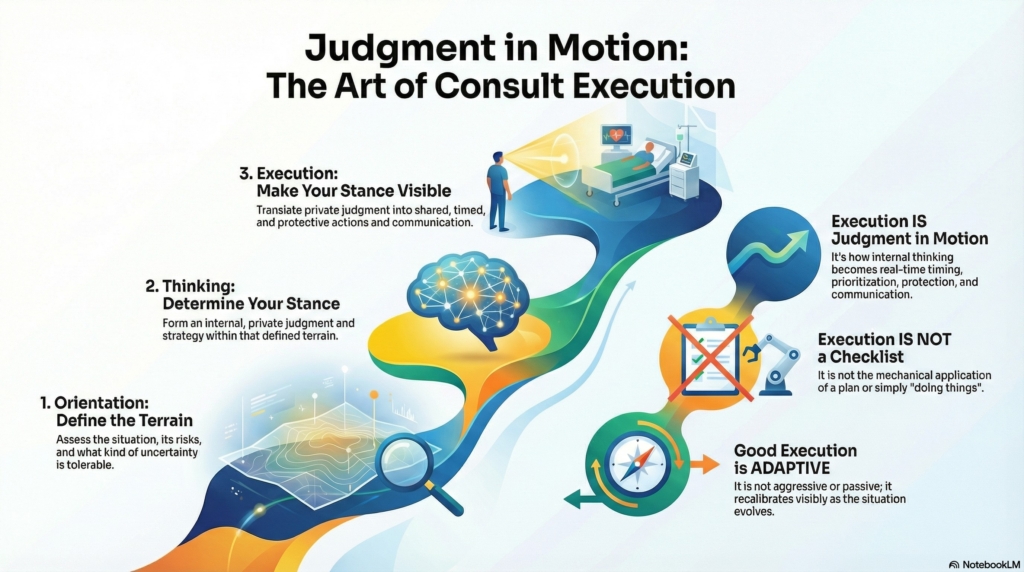
Doctrinal Framework: How Orientation, Thinking, and Execution Fit Together
Orientation, Thinking, and Execution are not steps in a sequence. They are distinct cognitive functions that operate continuously during real clinical care.
They are conceptually ordered — Orientation defines the terrain, Thinking assigns weight within that terrain, and Execution makes judgment operative — but they are temporally interwoven at the bedside. Consultants often execute while still thinking, and re-orient as new information emerges.
This architecture exists to prevent category error: applying the wrong kind of reasoning to the wrong kind of problem. Orientation determines what kinds of danger are plausible and how much uncertainty can be tolerated. Thinking determines which possibilities deserve cognitive weight. Execution translates that stance into shared, timed, and protective action.
Private judgment does not protect patients. Judgment must become visible, communicated, and adaptive to be safe.
Execution is where consultant judgment becomes visible, actionable, and shared in the real world.
It is not simply what you do.
It is how your internal judgment becomes operative at the bedside.
Execution is where judgment leaves your head and enters the care environment.
It is the practical, real-time expression of consultant responsibility.
What Execution Is (in Consult Practice)
Execution is not the checklist.
Execution is not the order set.
Execution is not simply “doing things.”
Execution is how consultant judgment becomes visible, shared, and protective in real time.
It is the translation of internal stance into:
- timing
- prioritization
- protection
- communication
- and revision
Execution is where uncertainty is made safe for patients and teams.
Without Execution, judgment remains private.
Private judgment does not protect patients.
What Execution Is Not
Execution is not about having the right diagnosis.
It is not the mechanical application of a plan.
It is not speed.
Execution is the discipline of translating judgment into protection, timing, and shared understanding while uncertainty remains.
Good execution is not aggressive.
Good execution is not passive.
Good execution is adaptive.
Early urgency may later soften.
Initial restraint may later escalate.
Credibility is built through visible reassessment and clear communication, not through early certainty.
Where Execution Lives Relative to Orientation and Thinking
Think of Consult Practice as three nested layers of expert work:
Orientation = Defining the map
Thinking = Choosing a stance within that map
Execution = Making that stance visible and operative
They are not steps.
They are different kinds of cognitive and behavioral work.
But they are temporally interwoven.
Does Execution Come After Thinking?
Conceptually: yes.
In real life: no, not cleanly.
Conceptually, the flow is:
Orientation → Thinking → Execution
But in real clinical time:
- You execute while you are still thinking
- You think while you are already executing
- You re-orient based on what your execution reveals
Execution is downstream of Thinking in logic,
but simultaneous with Thinking in time.
This is why consultants say things like:
“Let’s do this for now, but I’m not convinced yet.”
That is Execution and Thinking running in parallel.
Does Execution Involve Thinking?
Absolutely — but not analytical thinking.
Execution involves a different kind of cognition.
Not:
- hypothesis generation
- probability ranking
- mechanism analysis
But:
- timing judgment
- safety judgment
- communication judgment
- priority judgment
- revision judgment
Execution is judgment-in-motion.
It is thinking about:
- what must be protected right now
- what can safely wait
- what must be said out loud
- what signals require immediate re-evaluation
- how to prevent downstream misinterpretation
This is why Execution is cognitively demanding, even when it looks simple.
Does Thinking Involve Execution?
No — and this asymmetry matters.
Thinking is internal stance formation.
Thinking can happen:
- silently
- privately
- on paper
- in your head
Execution cannot.
Execution only exists when:
- someone hears it
- someone acts on it
- something changes
- a plan becomes shared
- uncertainty is made explicit
So:
- Thinking can exist without Execution (unsafe in real life)
- Execution cannot exist without Thinking (it becomes protocol or reflex)
Does Orientation Involve Execution?
Orientation may prompt early protective actions,
but Orientation itself is not Execution.
Orientation defines:
- what kind of situation this is
- what kind of danger structure exists
- what kind of uncertainty is tolerable
Execution is what you do because of that definition.
So:
Orientation = “This is a high-risk, fast-moving terrain.”
Execution = “Then I need to clarify X, protect Y, and tell the team Z.”
The Clean Doctrine
This is the version you can teach:
Orientation defines the terrain.
Thinking determines stance within that terrain.
Execution makes that stance visible through action and communication.
Execution is where judgment becomes shared, timed, and protective.
It is not a checklist.
It is judgment in motion.
Why Execution Matters Educationally
Most trainees see only Execution.
They see:
- orders
- recommendations
- notes
- checklists
They do not see:
- the Orientation that defined the terrain
- the Thinking that assigned weight and consequence
Your framework makes visible that:
Execution is the tip of an iceberg.
When you teach Execution well, you are teaching:
- how to protect patients while uncertain
- how to avoid false reassurance
- how to avoid reflex escalation
- how to recalibrate visibly and safely
That is a major educational contribution.
Execution Across Consult Terrains
In most consults, Execution is rarely about a single decisive act.
It is about managing evolving risk in real time.
Across clinical domains, Execution typically includes:
- prioritizing trajectory over single values
- protecting physiologic reserve while meaning is unclear
- preventing premature diagnostic momentum
- exporting uncertainty to the team
- defining reassessment triggers
- revising posture as the biology clarifies
Execution answers:
- What must be watched closely?
- What would change concern?
- What would justify escalation?
- What allows safe restraint?
Execution moves the vehicle.
It is the practical, real-time expression of consultant responsibility at the bedside.