When the Blood Type Suddenly Changes

When the Blood Type Suddenly Changes
Cold agglutinins interfering with blood bank testing

By William C. Aird, MD

Case Presentation

A 68-year-old man with:

  • end-stage renal disease on hemodialysis
  • diabetes mellitus
  • hepatitis C
  • recent MRSA bacteremia

was admitted with severe anemia.

His hemoglobin had fallen to the 5–7 g/dL range, and transfusion was planned.

During compatibility testing, the blood bank reported a striking finding:

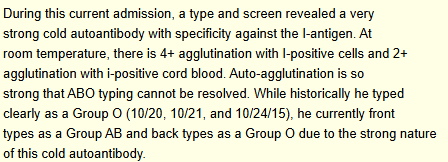
“A very strong cold autoantibody with specificity against the I antigen.
Auto-agglutination is so strong that ABO typing cannot be resolved.”

Historically, the patient had consistently typed as blood group O.

During this admission, however:

TestResult
Forward typingAB
Reverse typingO

Blood bank report:

ABO typing discrepancies are not merely a laboratory curiosity. In patients who require urgent transfusion, failure to recognize cold agglutinin interference can delay the safe selection of compatible blood products.

This patient’s recent MRSA bacteremia reflects severe systemic illness, which can exacerbate hemolysis through complement activation and physiologic stress. However, the identification of a strong anti-I cold autoantibody in a 68-year-old patient without evidence of Mycoplasma infection raises the possibility of underlying cold agglutinin disease (CAD) rather than transient infection-associated cold agglutinin syndrome. In this setting, the MRSA infection may represent either a trigger that brought the hemolysis to clinical attention or simply an incidental comorbidity.

Which mechanism best explains the discrepancy in the patient’s ABO typing?

a
Transfusion reaction
b
Cold-induced red cell agglutination
c
Mixed-field transfusion reaction
d
Bone marrow failure

Explanation

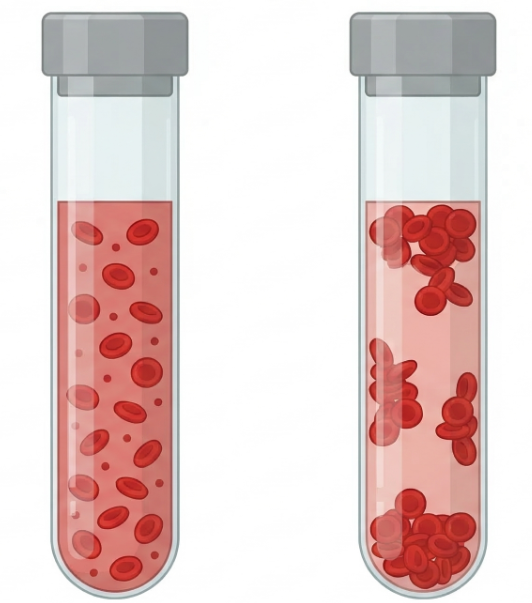
Strong cold agglutinins can cause extensive red cell agglutination at room temperature.

This interferes with ABO blood typing, which relies on two complementary tests:

Forward typing
detects A and B antigens on the patient’s red cells

Reverse typing
detects anti-A and anti-B antibodies in the patient’s plasma

When red cells are strongly agglutinated by cold autoantibodies:

  • the clumps may nonspecifically react with typing reagents
  • this can produce spurious agglutination in forward typing

In contrast, reverse typing often remains correct because the patient’s plasma antibodies are unaffected.

The result can be an apparent change in blood type, as seen in this patient.

Warming the specimen usually disperses the red cell clumps and allows accurate typing.

Why is cold agglutinin interference in ABO typing more clinically consequential than cold agglutinin interference in CBC indices?

a
CBC indices are always clinically unimportant
b
CBC indices are easier to correct mathematically
c
ABO typing is unrelated to red cell agglutination
d
ABO discrepancies can delay or complicate urgent transfusion support

Explanation

Cold agglutinins can distort both CBC analysis and blood bank testing, but the consequences are different.

When CBC indices are inaccurate, the result is usually diagnostic confusion.

When ABO typing is unreliable, the result may be a transfusion safety problem.

In a severely anemic patient who needs blood urgently, unresolved typing may delay compatible transfusion or require the blood bank to use emergency protocols, often involving pre-warmed methods and, when necessary, empiric release of compatible blood products under blood bank guidance.

That is why ABO interference is not just a laboratory puzzle, it is a patient safety issue.

Antibody Specificity

Blood bank testing showed that the patient’s cold autoantibody targeted the I antigen.

Which infection is classically associated with anti-I cold agglutinins?

a
Mycoplasma pneumoniae
b
Epstein–Barr virus
c
Cytomegalovirus
d
Influenza

Explanation

Cold agglutinins directed against the I antigen are classically associated with Mycoplasma pneumoniae infection.

However, anti-I antibodies are also commonly seen in primary cold agglutinin disease, particularly in older adults with clonal IgM antibodies produced by an underlying B-cell lymphoproliferative disorder.

In infection-associated cold agglutinin syndrome:

  • antibodies are typically polyclonal
  • hemolysis is transient

In contrast, in primary CAD:

  • antibodies are often monoclonal anti-I
  • hemolysis may be chronic or recurrent

In this patient, no evidence of Mycoplasma infection was identified, making primary cold agglutinin disease a more likely explanation for the antibody.

The patient’s hemoglobin is 5.8 g/dL and transfusion is required urgently.
ABO typing cannot be resolved because of strong cold autoagglutination.

What is the most appropriate next step?

a
Delay transfusion until the blood type can be definitively determined
b
Transfuse group AB red cells empirically
c
Transfuse group O red cells in consultation with the blood bank
d
Perform bone marrow biopsy before transfusion

Explanation

When severe cold agglutination prevents reliable ABO typing, transfusion decisions must prioritize patient safety while the laboratory discrepancy is being resolved.

In urgent situations, the blood bank may release group O red blood cells, which are compatible with all ABO blood types.

Additional steps may include:

  • pre-warmed compatibility testing
  • warming patient samples before typing
  • close collaboration between the clinical team and the transfusion service

Once the cold agglutinin interference is resolved, standard ABO typing can usually be performed.

The key principle is that transfusion should not be dangerously delayed in a severely anemic patient, even when laboratory testing is temporarily unreliable.

Management

Management of cold agglutinin–mediated hemolysis focuses on minimizing cold-induced antibody activity, including:

  • warming blood products during transfusion
  • maintaining warm ambient temperature
  • avoiding cold exposure

In secondary cold agglutinin syndrome, treatment is directed at the underlying trigger such as infection or malignancy.

In primary cold agglutinin disease, disease-directed therapy may be required for patients with severe or persistent hemolysis. Treatments may include B-cell–directed therapy such as rituximab or complement-targeted therapies.

In urgent situations where cold agglutinins interfere with blood bank testing, collaboration with the transfusion service and use of pre-warmed compatibility techniques are essential to ensure safe transfusion support.

Teaching Points

  • Cold agglutinins can interfere with ABO typing as well as CBC analysis.
    Severe red cell agglutination may produce an apparent change in blood group and make compatibility testing difficult.
  • Forward and reverse typing are affected differently by cold agglutinin interference.
    Agglutinated red cells may react nonspecifically in forward typing, while reverse typing may remain correct.
  • Not all laboratory interference has the same clinical consequence.
    CBC distortion creates diagnostic confusion, whereas ABO interference can create a transfusion safety problem.
  • Anti-I cold agglutinins are classically associated with Mycoplasma pneumoniae but may also occur in primary cold agglutinin disease.
    In older adults without evidence of infection, anti-I antibodies may reflect an underlying clonal B-cell disorder rather than infection-related cold agglutinin syndrome.

Why This Case Matters

Cold agglutinin disease does not always present with dramatic symptoms.

Sometimes the first clue is a laboratory mystery:

  • the CBC cannot be calculated
  • the blood type appears to change
  • the smear shows striking red cell clumping

Recognizing these patterns allows clinicians to identify cold agglutinin–mediated interference, work effectively with the blood bank, and ensure safe transfusion support when blood is urgently needed.

Prev
 1 / 14 
Next