
When Bleeding Reveals an Acquired Hemostatic Disorder
When Bleeding Reveals an Acquired Hemostatic Disorder
Acquired von Willebrand syndrome in Waldenström macroglobulinemia
By William C. Aird, MD
Case Presentation
A 79-year-old man with a four-year history of Waldenström macroglobulinemia is referred for evaluation of recurrent gastrointestinal bleeding and worsening iron deficiency anemia.
Over the previous year, he has required multiple red blood cell transfusions and several courses of intravenous iron. Upper endoscopy has demonstrated recurrent duodenal angioectasias treated with argon plasma coagulation, yet his anemia continues to recur. He also reports easy bruising but has no personal or family history of a congenital bleeding disorder. His bleeding symptoms began only after the diagnosis of Waldenström macroglobulinemia.
Initial laboratory studies show:
| Test | Result |
|---|---|
| Hemoglobin | 8.9 g/dL |
| Platelet count | 220 × 10⁹/L |
| PT | Normal |
| aPTT | Mildly prolonged |
| Factor VIII activity | 29% |
Which feature of this patient’s history most strongly suggests an acquired, rather than inherited, bleeding disorder?
Explanation
Inherited von Willebrand disease typically presents earlier in life, often with a history of mucocutaneous bleeding or an affected family member.
In contrast, new-onset bleeding in an older adult, particularly in association with a lymphoproliferative disorder such as Waldenström macroglobulinemia, should raise suspicion for acquired von Willebrand syndrome (AvWS).
Further Evaluation
Because of the combination of recurrent bleeding, low factor VIII activity, and an underlying lymphoplasmacytic disorder, additional VWF studies are obtained.
| Test | Result |
|---|---|
| VWF antigen | Low |
| Platelet-dependent VWF activity | Low |
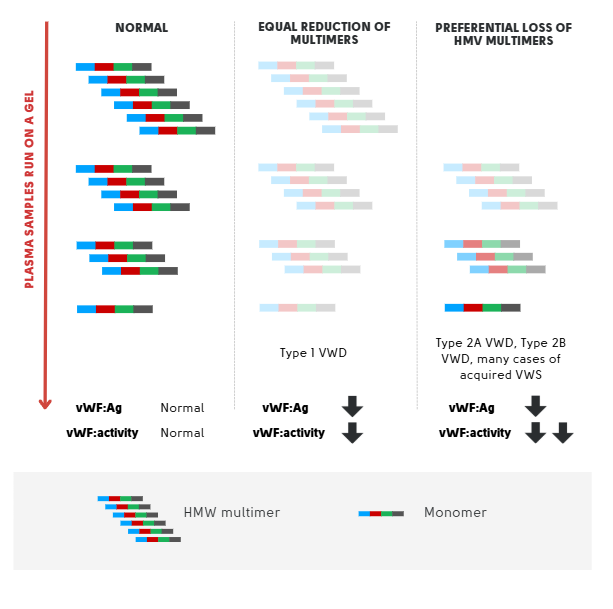
| Multimer analysis | Loss of high-molecular-weight multimers |
These findings establish the diagnosis of acquired von Willebrand syndrome.
More on VWF Multimers
Why does acquired von Willebrand syndrome cause a reduction in factor VIII activity?
Explanation
Von Willebrand factor serves as the carrier protein for factor VIII in the circulation.
When functional VWF is reduced, factor VIII loses this protective effect and is cleared more rapidly from plasma.
As a result, patients with acquired VWS often have:
- reduced VWF antigen
- reduced VWF activity
- secondary reduction in factor VIII
- a mildly prolonged aPTT
Underlying Biology
Acquired von Willebrand syndrome has been reported in association with several lymphoproliferative disorders, including Waldenström macroglobulinemia.
Several mechanisms have been proposed, including:
- antibody-mediated clearance of VWF
- adsorption of VWF onto malignant lymphoplasmacytic cells
- interactions between monoclonal IgM paraproteins and VWF, resulting in accelerated removal from the circulation
Regardless of the precise mechanism, the result is a deficiency of functional VWF despite previously normal hemostasis.
Which feature most strongly distinguishes acquired von Willebrand syndrome from inherited von Willebrand disease?
Explanation
Laboratory abnormalities may resemble inherited VWD.
The distinguishing feature is context.
Acquired VWS develops secondary to another disorder, including:
- lymphoproliferative diseases
- myeloproliferative neoplasms
- cardiovascular disorders (such as severe aortic stenosis or left ventricular assist devices)
- autoimmune diseases
- hypothyroidism
Recognition of the underlying disorder is essential because treatment often depends on addressing the primary disease.
Management
The patient receives intravenous iron and endoscopic treatment of bleeding angioectasias.
Because his bleeding is thought to result from acquired VWS related to Waldenström macroglobulinemia, treatment is directed toward the underlying lymphoplasmacytic disorder.
He receives rituximab-based therapy.
Over the following months:
- IgM concentration decreases.
- Bleeding episodes become less frequent.
- Hemoglobin gradually improves.
- VWF levels increase.
What is the primary rationale for treating the underlying Waldenström macroglobulinemia?
Explanation
Supportive therapies such as VWF-containing concentrates, desmopressin, antifibrinolytics, or intravenous immunoglobulin may temporarily improve hemostasis in selected patients.
However, durable control of acquired VWS often requires treatment of the underlying disorder responsible for the abnormal VWF metabolism.
In lymphoplasmacytic disorders, successful treatment of the clone may restore normal VWF levels and reduce bleeding.
Teaching Points
- Acquired von Willebrand syndrome should be suspected in older adults with new-onset bleeding and no personal or family history of an inherited bleeding disorder.
- Waldenström macroglobulinemia is a recognized cause of acquired VWS.
- Loss of functional VWF leads to secondary reduction in factor VIII activity and may mildly prolong the aPTT.
- Loss of high-molecular-weight multimers supports the diagnosis of acquired VWS and helps explain impaired platelet adhesion.
- Long-term management requires treatment of the underlying disorder in addition to supportive hemostatic therapy.
Why This Case Matters
Acquired von Willebrand syndrome is uncommon but likely underrecognized. Unlike inherited von Willebrand disease, it develops later in life and often signals an underlying systemic disorder. Recognizing the pattern of new-onset mucocutaneous or gastrointestinal bleeding, reduced VWF function, and an associated condition such as Waldenström macroglobulinemia shifts the diagnostic focus from replacing missing clotting proteins to identifying and treating the disease responsible for the VWF abnormality.