
How VWD makes future injury present before it happens
Note: The video and audio linked above were generated with the assistance of AI. Clinical accuracy has been reviewed, but no AI-generated content can be guaranteed to be fully error-free.
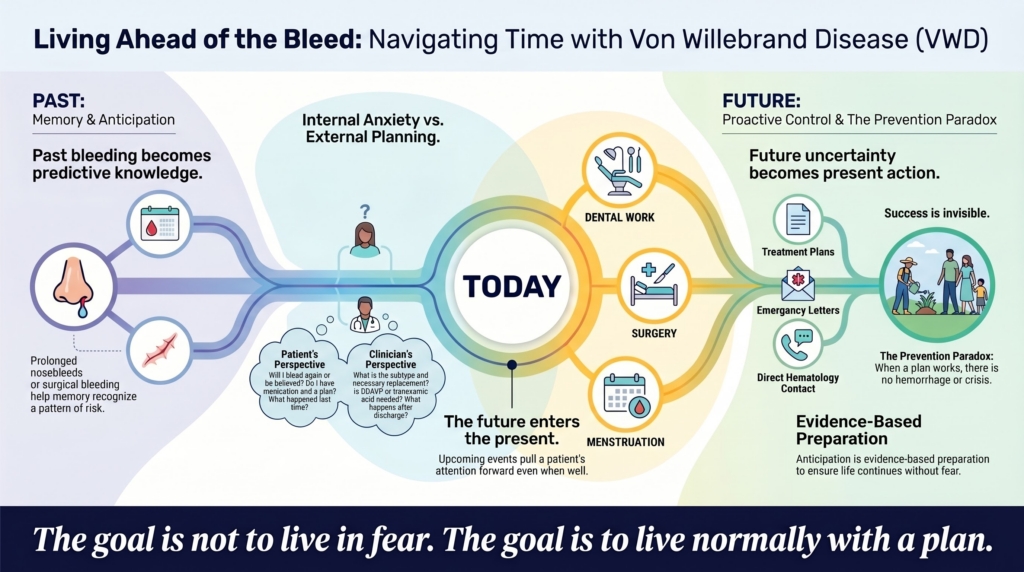
Why this spoke matters
Bleeding is an event.
VWD is often lived before the event occurs.
Before the tooth is pulled. Before the period begins. Before the baby is delivered. Before the colonoscopy. Before the surgery. Before the fall. Before the emergency department.
Before the bleeding starts, the patient may already be planning, calling, explaining, worrying, packing medication, checking whether the hospital has VWF concentrate, wondering whether the dentist understands, or wondering whether postpartum bleeding will happen again.
This is one of the distinctive temporal burdens of VWD.
Past bleeding can make future bleeding feel present long before it occurs.
The bleed that has not happened yet
In many conditions, symptoms drive care. Something hurts, swells, fails, or is measured.
In VWD, the most important clinical event may not have happened yet. The patient is well today, but they are scheduled for surgery, planning pregnancy, entering adolescence, starting anticoagulation, approaching delivery, or about to have a dental extraction.
The disease becomes relevant because of what is about to happen. This is a different kind of illness experience. It is not only symptom-based. It is forecast-based.
The patient and clinician must imagine a future hemostatic challenge and prepare for it. VWD management guidance repeatedly emphasizes planning around the specific challenge, including surgery, minor procedures, heavy menstrual bleeding, pregnancy, postpartum care, neuraxial anesthesia, and antithrombotic therapy.1
Anticipation functions as a clinical signal, not just an emotional response.
Anticipation as clinical reasoning
Anticipation is not anxiety alone.
It is clinical reasoning applied to time.
A good VWD plan asks:
- What challenge is coming?
- What has happened before?
- What is the subtype or working diagnosis?
- What are the baseline VWF and FVIII levels?
- Does desmopressin work?
- How long does it work?
- Is tranexamic acid needed?
- Is VWF replacement needed?
- What local measures matter?
- What happens after discharge?
- Who will respond if bleeding occurs?
These questions turn future uncertainty into present action.
The patient anticipates risk from the inside. The clinician plans for risk from the outside. Good VWD care brings those two forms of knowledge together.
The patient’s calendar
For many patients, VWD lives in the calendar.
- dental appointment
- period expected next week
- iron infusion next month
- hematology visit before surgery
- third-trimester VWF testing
- delivery plan
- tranexamic acid refill
- postpartum follow-up
- colonoscopy date
- anticoagulation decision
The calendar becomes a map of possible bleeding. Time becomes structured around potential hemostatic stress.
This can be empowering. It can also be exhausting.
A person without VWD may see a dental appointment.
A person with VWD may see a hemostatic event.
Same date. Different future.
Waiting for the period
Heavy menstrual bleeding creates a recurring temporal burden. The patient may begin anticipating the period before bleeding starts:
- Do I have enough pads?
- Will it start during school?
- Will I bleed through clothes?
- Will I miss work?
- Will I become more iron deficient?
- Should I start tranexamic acid?
- Will this cycle be worse?
The period becomes not only a physiologic event, but a forecast. It is a monthly negotiation with the future.
Recurrence amplifies anticipation.
In VWD, menstruation may impose not just blood loss but anticipatory structure on life. Patient-experience literature emphasizes that heavy menstrual bleeding may shape school, work, sport, social life, anxiety, and quality of life long before it is fully recognized as a bleeding-disorder manifestation. Cohort data also show that heavy menstrual bleeding, iron deficiency, and treatment needs remain common in women with VWD.2
The patient lives around what the blood might do.
The postpartum future
Delivery is often treated as the central event. But for some patients with VWD, the postpartum period is the period of greatest concern.
A patient may plan for birth and still fear the days after discharge:
- Will bleeding increase?
- Will the hospital remember the plan?
- Will tranexamic acid be prescribed?
- Will VWF levels fall?
- Will anyone believe me if I call?
VWF and FVIII levels often rise during pregnancy, especially in type 1 VWD and low VWF, but they fall after delivery. This is why postpartum planning matters even when late-pregnancy values are reassuring.3
The highest-risk period may follow the most monitored moment.
A delivery plan is incomplete unless it includes delayed postpartum bleeding instructions: what bleeding is abnormal, whether tranexamic acid should be used, how long treatment should continue, who should be called, when to seek urgent care, and how postpartum follow-up will occur.
A prior postpartum hemorrhage can make future pregnancy feel haunted. The event that has already happened becomes a future possibility.
This is how VWD alters time: past bleeding becomes future anticipation.
Past events as rehearsal
Every bleeding event teaches.
A nosebleed that would not stop. A dental extraction that bled overnight. A postpartum hemorrhage. A surgery with unexpected oozing. A transfusion. A period that caused anemia.
These events become stored as bodily memory. They shape the next plan. They also shape fear.
Prior bleeding becomes predictive knowledge.
The patient may not be afraid in general.
They may be remembering accurately.
Anticipation in VWD is often evidence-based. The patient is not imagining a possibility. They are remembering what happened the last time the hemostatic system was tested.
The difference between fear and memory
Clinicians may interpret worry as anxiety. Sometimes it is. But sometimes worry is memory.
The patient who fears dental work may be remembering prolonged bleeding after wisdom-tooth extraction. The patient who fears childbirth may be remembering postpartum hemorrhage. The patient who fears surgery may be remembering being told “everything should be fine” and then bleeding. The patient who fears a period may be remembering flooding through clothes in public.
This distinction matters.
Anxiety imagines danger.
Memory recognizes a pattern.
In VWD, fear is often evidence-based. Anxiety and memory may both be present, but the clinician should not dismiss one as the other.
The moral labor of preparedness
Preparedness can look like vigilance.
The patient asks questions, calls ahead, requests letters, carries medication, repeats the diagnosis, checks the plan, and asks what will happen after discharge.
This can be seen as excessive. But for a patient with VWD, preparedness may be the only way to make ordinary life safe.
Preparedness becomes a form of responsibility.
The burden is moral as well as practical. The patient may feel responsible for preventing failure in systems that should already know what to do. They may feel they must be calm, informed, persuasive, and grateful.
This is a hidden labor of inherited bleeding disease.
The plan as antidote to fear
A plan does not eliminate risk. But it changes the shape of risk.
Without a plan, the future is vague threat.
With a plan, the future becomes sequenced:
- before surgery, give this
- after delivery, continue this
- if bleeding increases, call this number
- if the emergency department is needed, bring this letter
- if dental bleeding occurs, use this medication and contact this clinician
A plan gives the patient a way to inhabit the future without being overwhelmed by it.
Structure reduces existential uncertainty.
Good hemostatic planning is therefore not only medical. It is psychological. It makes anticipation bearable.
When planning fails
Planning can fail in many ways.
The plan is not written. The note is buried. The dentist does not receive it. The emergency department does not understand it. The product is not available. The clinician assumes “mild” means no risk. The patient is discharged before delayed bleeding occurs. The postpartum plan ends at delivery.
When planning fails, patients may learn not only that they can bleed. They learn that systems can forget.
Failure teaches patients to plan for systems, not just bleeding.
That memory changes future anticipation. The next time, the patient worries not only about biology. They worry about logistics.
The future as social negotiation
A future procedure becomes a social negotiation.
The patient may need to coordinate:
- hematology
- surgery
- anesthesia
- dentistry
- obstetrics
- gynecology
- emergency care
- pharmacy
- insurance
- family
- school
- work
The bleeding has not happened. But the social machinery has already begun.
Anticipation extends beyond biology into coordination.
This is why VWD can feel larger than its bleed count. The disease generates coordination work. A person with VWD may spend hours preventing a complication that, if successfully prevented, never appears in the record.
Prevented bleeding is invisible
When planning works, nothing happens.
No hemorrhage. No transfusion. No emergency visit. No return to the operating room. No delayed dental bleeding. No postpartum crisis.
This success can be misread.
If nothing happened, perhaps the plan was unnecessary.
But prevented bleeding is not evidence of low risk. It may be evidence of good care.
Prevention erases its own evidence.
VWD repeatedly creates invisible successes.
The best outcome may leave no visible trace.
The clinician’s time horizon
Clinicians often work in short intervals: today’s visit, this procedure, this pregnancy, this lab result.
Patients live longer arcs. They remember the last bleed. They anticipate the next one. They think about future children, future surgeries, future aging, future anticoagulation.
Clinicians see episodes.
Patients experience trajectories.
Good VWD care requires aligning these time horizons. The clinician must see not only today’s level, but tomorrow’s challenge. The patient must be helped to plan without being asked to live permanently in fear.
The diagnosis as future tense
VWD diagnosis often speaks in future tense.
- You may bleed with surgery.
- You may need treatment before dental extraction.
- You may need postpartum tranexamic acid.
- Your child may need testing.
- Your levels may rise in pregnancy.
- Your levels may change with age.
- You may need prophylaxis if bleeding becomes recurrent.
Unlike a diagnosis that explains current symptoms alone, VWD diagnosis often predicts situations. It is a diagnosis of conditional futures.
VWD is a predictive diagnosis as much as a descriptive one.
This can be useful.
It can also be unsettling.
Living normally with a plan
The goal is not for patients to live as if bleeding is always imminent. That would be its own harm.
The goal is to live normally with plans that activate when needed.
A person with VWD should be able to go to school, work, travel, play sports, become pregnant, have procedures, and age with appropriate support. Planning should enlarge life, not shrink it.
The right plan says:
you can do this safely.
Not:
you should avoid life.
Children and anticipatory parenting
For parents of a child with VWD, anticipation can be intense.
- playground injuries
- sports
- vaccinations
- dental work
- tonsillectomy
- menarche
- school trips
- sleepovers
- emergency care
Parents anticipate before the child can understand risk. They may see future bleeding before the child has language for it.
Caregiver studies in pediatric VWD show that family burden can include worry, psychosocial strain, and effects on daily life, particularly when disease is moderate or severe.4
Parents may struggle to balance protection and freedom. Too little caution can be dangerous. Too much caution can make the child feel fragile.
The art is to help the child grow into competence, not fear.
Adolescence and taking over time
Adolescence adds another transition.
The young person must gradually take over anticipatory work:
- remembering medication
- describing the diagnosis
- knowing when a period is too heavy
- telling a coach
- telling a partner
- calling the clinic
- preparing for dental work
Responsibility for future risk gradually transfers.
This transfer of responsibility is not just education.
It is time training.
The adolescent learns how to carry the future without being dominated by it.
Pregnancy as intensified anticipation
Pregnancy intensifies anticipation because it combines biology, family, risk, and hope.
A patient may think about:
- their own bleeding
- the baby’s risk
- labor
- neuraxial anesthesia
- cesarean delivery
- postpartum hemorrhage
- breastfeeding
- tranexamic acid
- family inheritance
- prior miscarriage
- prior hemorrhage
Pregnancy compresses multiple future risks into one time frame. It is already future-oriented. VWD adds hemostatic forecasting to the emotional forecasting of parenthood.
Good care acknowledges both.
Aging and new futures
As patients age, the future changes.
Earlier concerns may fade. New ones emerge:
- gastrointestinal bleeding
- angiodysplasia
- aortic stenosis
- cardiac procedures
- cancer screening
- antiplatelet therapy
- anticoagulation
- falls
- orthopedic surgery
A patient who learned to plan around periods and childbirth may later need to plan around colonoscopy, atrial fibrillation, valve disease, or falls. VWF levels may rise with age, but aging also brings new hemostatic challenges and competing risks.5
These risks require individualized balancing of bleeding and thrombotic risk rather than automatic avoidance of antithrombotic therapy.6
The content of anticipation changes, but the structure remains.
VWD is a life-course disorder because the future keeps changing.
The burden of explaining future risk
It is often easier to explain a problem that has already happened. It is harder to explain one that might happen.
The patient may say:
- I need a plan before surgery because I might bleed.
- I need medication after delivery because bleeding may increase later.
- I need tranexamic acid for a dental extraction because bleeding may recur.
This can sound hypothetical. But prevention always sounds hypothetical before it works.
Prevention requires arguing for events that will not occur.
The patient with VWD often has to advocate for care that is intended to prevent an event rather than respond to one.
When the future is overestimated
Anticipation can also overgrow.
A patient may avoid procedures unnecessarily. Avoid sports. Avoid pregnancy. Avoid dental work. Avoid travel. Avoid anticoagulation when needed. Avoid life.
This is not good care.
The clinician must distinguish meaningful risk from disabling fear. The answer is not dismissal. It is calibrated planning.
- What is actually risky?
- What is safe?
- What needs medication?
- What needs no special intervention?
- What should trigger urgent care?
The goal is calibrated anticipation, not elimination of uncertainty.
Accurate anticipation is protective.
Unbounded anticipation is burdensome.
Time, control, and trust
VWD threatens control because bleeding can feel sudden. Planning restores some control. Trust restores more.
The patient trusts the clinician. The clinician trusts the patient’s history. The proceduralist trusts the plan. The emergency team trusts the letter. The family trusts the preparation.
Trust distributes responsibility across the system.
When trust is present, the future is less frightening. When trust is absent, patients may feel they must control everything themselves.
That is exhausting.
Trust is part of the temporal care of VWD.
What a good anticipatory plan includes
A good plan should answer:
- What is the diagnosis or working diagnosis?
- What are baseline VWF and FVIII levels?
- What has happened before?
- Does desmopressin work?
- Is tranexamic acid useful?
- When is VWF concentrate needed?
- What procedures need hematology input?
- What should be done for heavy menstrual bleeding?
- What is the pregnancy and postpartum plan?
- What should happen in the emergency department?
- Who should be called?
- What should the patient carry?
- What should change as the patient ages?
This plan should not be written only for clinicians.
It should be usable by the patient.
Clinical synthesis
VWD changes the patient’s relationship to time.
Bleeding may be episodic, but anticipation can be continuous. Future procedures, periods, deliveries, injuries, medications, and aging-related decisions can shape present life long before bleeding occurs.
This anticipation is not merely anxiety. It is often memory, planning, and clinical reasoning. Good care turns vague future danger into practical preparation.
The goal is not to make patients live in fear. It is to make future challenges safe enough that patients can live freely.
In VWD, the best plan is one that allows the future to arrive without surprise.
In VWD, time is not neutral.
It is part of the disease.
Evidence anchor: why anticipation is part of VWD care
Summary derived from management guidelines, patient-experience literature, quality-of-life studies, pregnancy/postpartum guidance, pediatric caregiver data, and low-VWF life-course literature. The evidence consistently shows that VWD care is prospective: risk often becomes clinically relevant before bleeding occurs.
| Evidence stream | What it shows | Why it matters | Main limitation |
|---|---|---|---|
| Management as planning around future challenges | VWD management guidance emphasizes individualized planning for surgery, minor procedures, heavy menstrual bleeding, pregnancy, postpartum care, neuraxial anesthesia, prophylaxis, and antithrombotic therapy.7 | VWD becomes clinically important not only when bleeding is present, but when a hemostatic challenge is approaching. | Evidence certainty varies by scenario, subtype, and treatment strategy. |
| Heavy menstrual bleeding as recurring anticipation | Women and girls with VWD report that HMB affects school, work, sports, social life, anxiety, and quality of life; cohort data show HMB, iron deficiency, and treatment needs remain common.8 | Menstruation is not only episodic blood loss; it can structure time through monthly anticipation and preparation. | HMB is multifactorial and varies with therapy, life stage, and gynecologic conditions. |
| Pregnancy and postpartum risk | VWF and FVIII often rise during pregnancy in type 1 VWD and low VWF but fall after delivery. Management guidance emphasizes peripartum and postpartum planning, including consideration of postpartum tranexamic acid.9 | A reassuring delivery plan may be incomplete if it does not address delayed postpartum bleeding. | Pregnancy-related correction is less reliable in type 3 VWD and some type 2 variants. |
| Prior bleeding as predictive knowledge | Prior dental, surgical, obstetric, menstrual, gastrointestinal, or traumatic bleeding informs future planning and treatment choice.10 | Patient concern may reflect memory of prior hemostatic failure rather than generalized anxiety. | Past bleeding does not predict every future scenario with certainty. |
| Pediatric caregiver burden | Caregiver studies in pediatric VWD show psychosocial burden and effects on daily life, especially in moderate or severe disease.11 | Parents may anticipate bleeding before children can understand risk, making guidance and competence-building essential. | Data are strongest for moderate/severe pediatric VWD and may not generalize fully to low VWF. |
| Aging and changing future risks | VWF levels may rise with age, but older patients may face new risks such as procedures, gastrointestinal bleeding, falls, antiplatelet therapy, and anticoagulation.12 | The content of anticipation changes across the life course, even when the structure of planning remains. | The relationship between age-related VWF normalization and bleeding risk remains incompletely defined. |
| Quality of life and invisible work | VWD burden includes emotional, social, physical, and practical effects beyond measured bleeding events.13 | Anticipation, coordination, and prevention are part of disease burden even when no bleed occurs. | QoL instruments may not fully capture the specific temporal burden of anticipating future bleeding. |
Interpretive note: These evidence streams support the essay’s central claim: VWD is often lived prospectively. The patient may be well today, but a future challenge can make bleeding risk clinically present. Anticipation is not merely anxiety. It is often memory, planning, and clinical reasoning applied to time.
Anticipatory guidance: making the future safer without making the patient fearful
Based on management guidelines, patient-experience literature, pediatric caregiver data, and life-course VWD reviews.
Start with the upcoming challenge
Ask:
- What is coming next: dental work, surgery, menstruation, pregnancy, delivery, colonoscopy, anticoagulation, travel, sports, or aging-related care?
- What happened the last time the patient faced a similar challenge?
- What has worked before?
- What failed?
- What does the patient fear, and is that fear based on prior bleeding?
- What would make the situation feel safe enough?
Build a plan that is specific enough to use
A practical anticipatory plan should include:
- diagnosis or working diagnosis
- subtype, if known
- baseline VWF antigen, VWF activity, and FVIII levels
- prior lowest levels and testing context
- prior bleeding events relevant to the upcoming challenge
- desmopressin response, if known
- tranexamic acid plan, if appropriate
- VWF replacement plan, if appropriate
- local measures for dental or mucosal bleeding
- postpartum instructions when relevant
- emergency department instructions
- thresholds for calling or seeking urgent care
- hematology contact information
- what medication or letter the patient should carry
- follow-up after the challenge, especially when delayed bleeding is possible
Do not stop planning at the visible event
Remember:
- dental bleeding may recur after the patient leaves the office
- surgical bleeding may be delayed
- postpartum bleeding may occur after discharge
- menstrual bleeding is recurrent, not isolated
- anticoagulation decisions require balancing thrombosis and bleeding
- aging introduces new procedures, medications, and bleeding sites
- a reassuring current VWF level may not answer every future-risk question
Use language that distinguishes memory from anxiety
Instead of:
“Try not to worry.”
Try:
“Your concern makes sense because you bled before. Let’s use that history to plan.”
Instead of:
“The delivery should be fine.”
Try:
“The delivery plan looks reassuring, and we also need a postpartum plan because your prior bleeding happened after discharge.”
Instead of:
“Nothing happened last time, so you probably did not need treatment.”
Try:
“Nothing happened may mean the plan worked.”
Instead of:
“You are being very cautious.”
Try:
“You are doing the right thing by checking the plan before the challenge.”
Practical takeaway: Anticipatory care should reduce fear, not enlarge it. The best VWD plan turns future danger into concrete steps, helps the patient live freely, and makes sure the bleed that never happens is recognized as a success of preparation.
Reflect & Apply Case
A 32-year-old woman with type 1 VWD is pregnant with her second child.
Her first delivery was uncomplicated, but she developed heavy delayed postpartum bleeding 8 days later and required emergency care.
Her third-trimester VWF levels are currently reassuring.
She says:
“Everyone keeps telling me the delivery should be fine. But I’m not afraid of delivery. I’m afraid of the week after.”
Questions for reflection:
- Why is her fear clinically meaningful rather than simply anxious?
- How does prior postpartum bleeding change the future?
- Why can reassuring third-trimester levels fail to address postpartum risk?
- What should an anticipatory postpartum plan include?
- How can the clinician reassure her without dismissing her memory?
- What does this case teach about time in VWD?
This case illustrates the central lesson:
in VWD, the bleed that matters most may be the one the patient is already planning to prevent
Test your thinking
A short quiz on anticipation, planning, and future risk in VWD.