
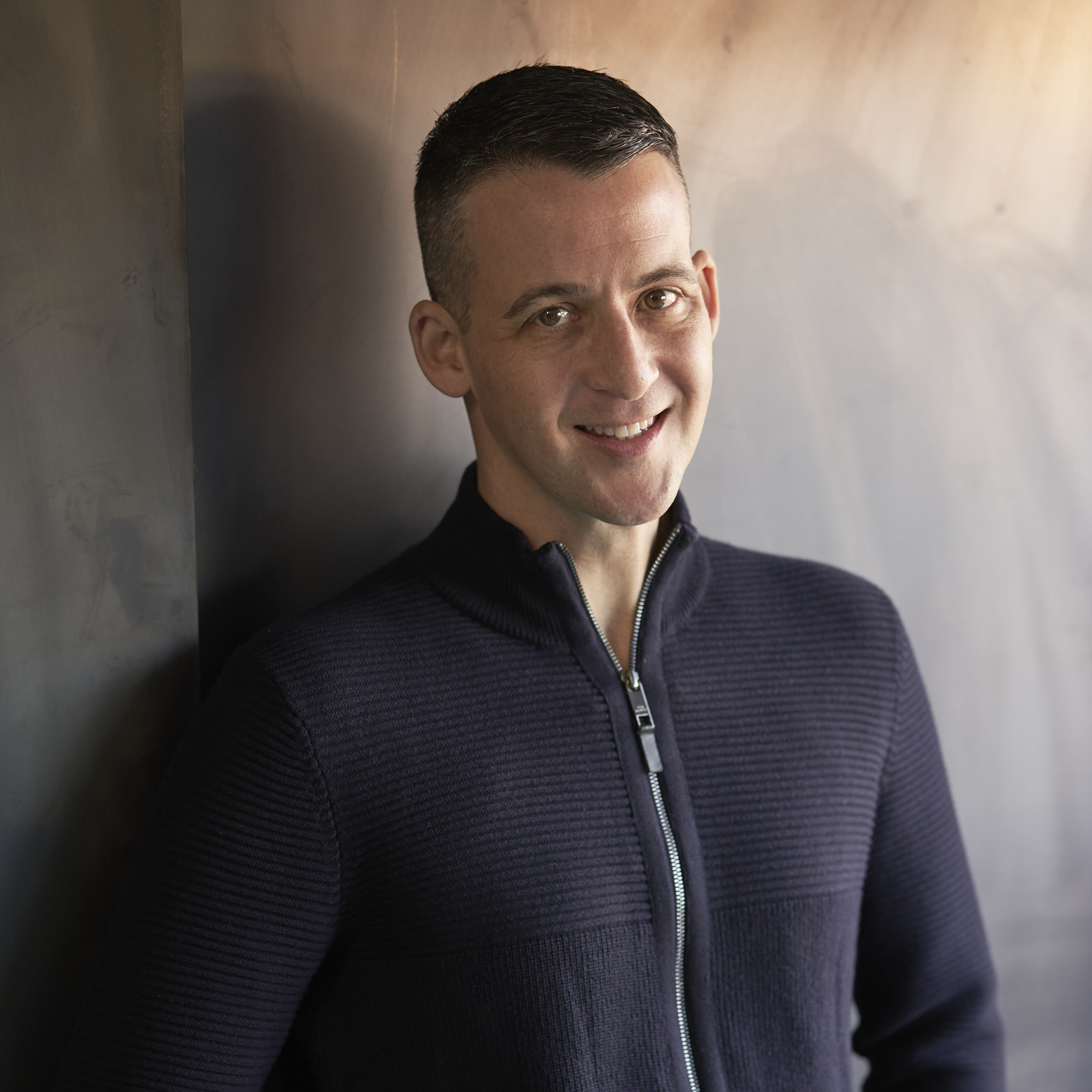
Michael Zirulnik, PhD, is Associate Professor of Medical Humanities and Assistant Vice President for Phoenix Development at Creighton University. An artist, educator, researcher, and communication scholar, his career has spanned higher education, emergency medical services, aviation, science communication, design, and the arts. His creative practice focuses on “public art for public health,” using art and storytelling to engage audiences with health topics and lived experiences, including his traveling exhibition Strips & Needles: A Day in the Life, which explores life with type 1 diabetes. He has taught and published across the fields of human communication and medical humanities and previously directed the ThinkWritePublish program at Arizona State University. Dr. Zirulnik earned his undergraduate and master’s degrees from Rutgers University and his PhD in organizational and intercultural communication from Arizona State University.
Explore Michael Zirulnik’s Work
- Think Write Publish: Science & Religion — A multi-year project exploring the intersections of science, religion, and storytelling.
- Transformation Is a Long Game — Michael Zirulnik’s TEDx Talk on social transformation and creating lasting change.
- Strips & Needles: A Day in the Life — A look at Zirulnik’s traveling exhibition exploring the lived experience of type 1 diabetes through art.
In this podcast, Michael Zirulnik talks with Helen Osborne about:
- How a lifelong “North Star” and an unconventional career path shaped Michael’s approach to service, education, and the medical humanities.
- How art and storytelling can make complex or difficult health topics more accessible while creating opportunities for empathy, compassion, and connection.
- Why people in medicine and science can benefit from looking beyond traditional professional boundaries, drawing on their broader experiences, and giving themselves permission to think bigger.
Producer and audio editor: Adam Weiss, Relativistic Media
Transcript:
HELEN: Welcome to Talking About Blood. I’m Helen Osborne, host of this podcast series and a member of the advisory board for the Blood Project. I also produce and host my own podcast series about health communication, and that’s called Health Literacy Out Loud. Today’s guest is Dr. Michael Zirulnik, who is Associate Professor of Medical Humanities and Assistant Vice President for Phoenix Development at Creighton University. I was introduced to Michael by Randy Rodriguez and Kristin LaFollette, both affiliated with The Blood Project. They met Michael at the 2026 Health Humanities Consortium held at Indiana University. When Randy emailed to introduce me to Michael, he wrote that Michael is an artist, an educator, and wonderful advocate for bringing the humanities into health care in ways that create space for reflection, connection, and more compassionate care. Wow, sounds like a great podcast guest to me. Michael, welcome to Talking About Blood.
MICHAEL: Helen, it’s good to be here with you.
HELEN: I’m delighted to have this conversation. Now, you and I had a preliminary call. Before we did this, that’s the way I do that with all guests. It’s kind of like we’re all ready to do this. And I asked you to just informally introduce yourself, not your regular old bio stuff, but just informally introduce yourself. And the first thing you talked about was something you referred to as your North Star. And then you told me a little bit more about that. And that’s a dream and a vision you’ve had for yourself since you were a little guy. So we might get to what your North Star is, but I want to look at the great big picture because you have a great big vision. Why is your North Star a good place to start getting to know somebody?
MICHAEL: Sure, Helen. Thanks for asking that question. My North Star has existed, as you said, since I was a little guy, maybe 10 or earlier, and it has been a vision, whether I achieve it or not. It has been a North Star that has guided many of the decisions in my personal and professional life that I have made. And it’s created a beautiful journey and taken me on a, what some might call a circuitous path, but it’s one of discovery.
HELEN: Okay. I guess because now I know it, but listeners might be super curious. Give us the fast version of what your North Star is, and we can use that as that big vision of your journey, whether it’s circuitous or straight.
MICHAEL: Sure, I really don’t know where it came from, and perhaps I need to go visit our colleagues in psychiatry or psychology to uncover and unpack where it came from. But my North Star has been U.S. Ambassador to wherever it is I may be appointed in the world. Beautiful, nice post, some wonderful embassy or a hardship post. But it’s about service.
HELEN: Hmm. Okay. That’s really interesting because the work you’re doing now, you’re a professor at a university, you have many talents and maybe you can share a little bit more, but your focus is on medical humanities. So being an international ambassador, for me, that would be a real circuitous connection. Take us on that little bit of a journey to get to the point you’re at now.
MICHAEL: Certainly. The journey began volunteering at Brighton Gardens, nursing and assisted living space when I was in high school.
HELEN: Okay.
MICHAEL: Prior to that, when I was 12, I was diagnosed with type 1 diabetes. And I thought it was really cool.
HELEN: Really? Having a serious diagnosis when you’re 12 with a lot of medical intervention is really cool?
MICHAEL: My mother told me, probably in my 20s, She thought that was a good outcome that I had psychologically thinking it was cool, but maybe not the most normal. But I thought it was cool, Helen, because all of a sudden, overnight, I was given syringes and vials of insulin and lancets to squish blood out of my finger and put on a machine.
HELEN: Okay.
MICHAEL: And that was my interlude into the world of health and health care.
HELEN: Well, you already had another interlude because you were volunteering at an assisted living. So you’ve had two entry points. I don’t know which came first, but they both came before you were choosing careers, probably.
MICHAEL: They did. First diabetes, and then maybe a year or two later volunteering at Brighton Gardens. Then my mother would take me at night to night school where I became an EMT. Then volunteering at the local rescue squad, which parlayed into, we grew up pretty poor, and so how was I going to go to college and not necessarily have a ton of debt? So I wound up working and doing EMS in New Brunswick, New Jersey, and I went to Rutgers. That was my first parlay into higher education. And I did EMS for about seven years full time.
HELEN: So for our listeners who could be international, and I’m a plain language person, so I like making clear what all these acronyms are. EMS?
MICHAEL: Emergency medical service, emergency medical technician, so it meant that I got to work on the back of an ambulance and I had the privilege of showing up when people were often at their worst or in a moment of crisis and serving them in a way that I could.
HELEN: That’s really interesting. So I hear lots of forays into medicine and healthcare, whether it’s emergency medicine or healthcare, continuing care in there and your own experiences of being a patient, someone who has to deal with your inner functionings and your outer paraphernalia like syringes and that. And now you’re a professor of medical humanities, is that correct? There’s a few more steps in there.
MICHAEL: That is right. There’s a lot of steps in there, Helen.
HELEN: Well, okay. I did ask you to do the short one, and this podcast is about you, for sure. You are our guest, but it’s also about the lessons learned that you want to share with our listeners. And let me tell you a little bit about the listeners of Talking About Blood. So this series was started by Dr. Bill Aird, a hematologist, and his vision was broad and certainly very respectful of the humanities in tandem with medicine, that they each don’t stand alone. So that’s what we’ve been doing. And I think from the start, he saw this as a way that seasoned professionals, those experienced in medicine, can be paying new regard, perhaps, to the person side of this. So that’s one of the audiences: experienced, well-accomplished scientists and doctors. The other part of our audience are people newer to the health field or sciences. Maybe they’re residents in medicine. Maybe they’re working on their PhD in science. Maybe they’re just thinking about what they want to do with their lives, but they have an inkling, like I think you did as a little guy, somehow it’s going to have to do with health and science. And our audience also includes people who are just curious, curious about the world, curious about our bodies, and in this case, curious about blood. Can you share with all of us, why does talking about your journey, focusing on your North Star, matter to each of those audiences?
MICHAEL: When I think about the bigger picture, I think about not only where we are, but where we’ve been and where we’re going.
HELEN: Okay.
MICHAEL: My journey is, whether it’s a straight path or circuitous, going from an experience of diabetes to then volunteering at a nursing home where I got to learn and experience from other individuals that were much older than I at the time. And then volunteering and serving people in their sometimes darkest days, having the opportunity to go back to the station house and reflect with my comrades, and then moving into teaching at a university, then moving into being an internationally based flight attendant and seeing the world and serving people in a different way, then back into working at a science policy think tank, we were translating complex information for a more general audience. Again, it was another type of service. And then working for some time in museums and understanding that world. It’s about being more open and interested in others, and learning and understanding so that we can better serve. For the limited time that we have here, however long or short that may be, how we can be good humans and serve. But when I think about some of your listeners, Helen, I think about blood and innovation and medicine and health care and allied health fields, and some of them that are likely researchers, scientists, physicians, nurses, nurse practitioners, they all went into this for some reason, some guided reason. Whatever that reason is, I would invite listeners to reflect on that often and come home to their mission. I’m often reminded of the teaching of Father Greg Boyle, a Jesuit based out of Los Angeles. And Father Boyle started what is considered the largest gang rehabilitation project in the world.
HELEN: Gang? Describe that for us, because when I think of gang, I think of street gangs, but there’s also ganglia, and, you know, do you mean street gangs?
MICHAEL: I do mean street gangs, and it is a voluntary rehabilitation program.
HELEN: Okay.
MICHAEL: No one can be ordered to go there. And Father Boyle accepts and embraces all. And he often will say, and has written, when we see someone, we might think, why are they like that? But rather, let’s ask ourselves not “Why are they like that?” but “What happened to them?”
HELEN: Okay.
MICHAEL: And that creates a different mindset for how we access space, the world, and people around us. And that’s the beauty of the humanities: moving from pity to sympathy to empathy to compassion. And compassion is that moment and that opportunity to act and respond when we have greater understanding. And that’s the space that I try to work in.
HELEN: You don’t do clinical work, though, right? Your day-to-day work is what? Teaching and writing papers, and, you know?
MICHAEL: I don’t. Teaching, writing, researching, producing artwork. And to be clear with the listeners, I have a PhD, not an MD or a DO.
HELEN: Okay. I appreciate and I can feel the calmness. We’ve never met in person, but it’s somehow connecting through these virtual waves here. You know, I feel the calmness and I wish I was as calm every day in my life as you seem to exude. But I also think about listeners or other people in my world who are more counters. Show me the evidence. You know, this sounds great, great for him, great for people who do this kind of work. But me, I want to know, does this work? Does it not? You also describe yourself as a researcher. For those who want to know more, evidence-based, about this way of viewing the world and participating in the world, what can you tell all of us about that?
MICHAEL: Sure. When I think about the work that we’re doing in medical humanities and the work I do, which is public art for public health, that is not new. Not at all. I just gave it a name so that my colleagues and others might have an access point that might arouse or pique their curiosity in what it is that I’m doing. And when I think about it, I think about one of the Codex Bibles from like 1030, 1040 in Germany, where it’s the parable of the cleansing of the lepers, right? Jesus and the cleansing of the lepers. That’s essentially public art for public health. And it’s a beautiful illustration.
HELEN: Can you be more specific? I don’t know my history too well from the thousands and about lepers you know and you have not described for the whole audience as public art for public health make it a little more concrete I’m a health literacy person clearly what this is all about.
MICHAEL: When I’m doing work that I consider public art for public health, it is work that is taking what’s often either taboo, maybe ideas or topics around depression, mental health, and mental wellness, mental illness, or hidden or visible disability. So maybe that’s diabetes, HIV, AIDS, colon health. And I use art and artwork as a platform in which to bring ideas and practices of public health into the purview of larger audiences.
HELEN: Okay.
MICHAEL: So what does that look like? Historically, it looks like this beautiful illustration in a 1030, 1040 illustration and a parable of cleansing of the lepers. And I won’t get into necessarily, and I’m not an expert in this space either, but the parable of touching others who are in need, the underserved, the marginalized, the under-resourced. And then I think of more contemporary matters, the work of Eric Avery, who’s a printmaker and was making prints about safe sex and bringing awareness around HIV and AIDS. He was doing this in the late 80s and the 90s, and he’s in his 80s now, and he continues to do this work in other areas. I think of Keith Haring and the work that he did, public art to bring awareness to HIV and AIDS. Or in the 90s, Jonathan Larson, who wrote Rent, and that was a musical. So using the theatrical arts to bring awareness and create opportunities for people to access a space they may not have been in. And that was informed by La Bohème from the 1800s. That surrounded the ideas of tuberculosis. And humanity, right? So these are all works of public art that address in some way, even if that was their direct or indirect intention, address public health in some way, form or fashion.
HELEN: Okay. Thank you. And I see you. Other people won’t be seeing you, but you’ve got a lot of your artwork behind you. Get back to my question. For those of us who, you know, listeners who want to know, well, sounds good for him. What’s the evidence? Tell us quickly what the evidence is for the effectiveness of this.
MICHAEL: Sure, what’s the evidence? On one point I’ll say, do we need empirical evidence? In some ways, no. There’s some work that I do, Helen, that has zero research around it. We just know it’s helping people, one person at a time. So can we scale it? Can we capture it? No. Does it mean it’s not worth doing? Absolutely not. It means it’s worth doing because one life is one life. In the second point, to your question around evidence, we’re evidence-based, data-driven. There’s a lot of work happening. If I take one example, I’ll take an example of these cards that I created that our listeners can’t see, but you see behind me. Okay. These are cards that use story, imagery, and positive affirmations to create neural connections through dopamine hits. Cards that are in the size of a tarot card. The cards all have bright, vivid colors. There’s a dopamine hit. They have positive affirmations on them, like, I see you, you are loved, together we rise. And they’re all done in the style of Keith Haring’s artwork, right? Again, to create dopamine hits. We know this from addiction medicine and neuroscience.
HELEN: Okay.
MICHAEL: And the idea there is the common card that is on the back of each one of these art pieces. And that common card has suicide and crisis helplines available to those that live within the continental United States. So 9-8-8 for the Suicide & Crisis Lifeline. There’s a number for veterans crisis. There’s a number for LGBTQIA+ youth and there’s a crisis line for youth in general. So these are the most at-risk groups. So the idea there is telling a story through visual imagery, using neuroscience, creating dopamine hits and linking a resource to the artwork so that when we or someone else needs that resource, whether we’ve kept the card or thrown it away, there’s a higher likelihood that we will remember that those resources exist and where and how to access them. And when I think about research that was done and published in the annals of the National Academy of Medicine. We know now that story is remembered better and for far longer than if we just spoke about numbers. It’s how we’re wired. It’s the humanity of us.
HELEN: Thank you. I love how you weave in story and illustrations and affirmations and, you know, the serious work that you’re doing in a way that is understandable by the audience. As we close out our podcast conversation right now. What would be your look ahead, your wish, your North Star for people who already are in the medicine and science fields or thinking about getting there?
MICHAEL: A couple of things. One, health science education and medical education in general is scripted. It is standardized. It has milestones. It has benchmarks. It has exams. It has steps. It is a guided path with very rigid boundaries around it. And that’s okay. But when I think about many of your listeners, and I know some of them who are clinicians, they’re also humans outside of being a doctor or being a scientist, and they do really cool things outside of that world. And so what I think is wonderful is to take the arts writ large as a tool to step outside of healthcare, to step outside of medicine, to look beyond the borders that we’ve created and give ourselves permission to do something different, to do something bigger, to be creative so that we can then step back into medicine and question, why are we doing it this way? Is it the best way? Is there another way that’s possible? Let me give myself permission to try. And often our innovation is limited by the boundaries that we set upon ourselves. When we can lift them, that’s where I often see colleagues and friends innovating really beautiful and remarkable ways. And if I could leave your beautiful listeners with this quote, Helen. It is a poem by the late Mary Oliver titled, The Summer Day.
HELEN: Okay.
MICHAEL: The last two lines read, “Tell me, what is it you plan to do with your one wild and precious life?”
HELEN: That’s beautiful. Thank you so much for, of course, being a guest on this podcast for teaching me, and I hope our listeners, so much about dreaming big, knowing eventually where we want to go and appreciating all the ways we took to get there, whether they were organized steps like, you know, the classes you take in an academic program, whether they’re the more circuitous ones that you bring in different pieces of our lives and experience to appreciate where we want to go in our lives. Thank you, Michael, so much for being a guest on Talking About Blood.
MICHAEL: Thank you, Helen, and thanks for doing the good work you do.
HELEN: As we just heard from Michael Zirulnik, it’s important to dream big and keep somewhere in our mind that North Star of where we want to go in this world and in our lifetimes, and then take steps and appreciate all that we did along the way to help get there. This is part of the humanity in medicine, and that’s what The Blood Project so wonderfully brings out. To learn more about The Blood Project and explore its many resources for professionals and trainees and patients, please go to thebloodproject.com. I invite you to also listen to my podcast series about health communication, and that’s at healthliteracyoutloud.com. Please help spread the word about this podcast series and The Blood Project. Thank you for listening. Until next time, I’m Helen Osborne.