
Oct

9

2026

A Challenging Case of Factor XIII Deficiency

By Cilomar Martins, MD and Paula H.B. Bolton-Maggs FRCP, FRCPath, DM Oxon

Curbside Consult Rare Bleeding Disorders
Cilomar Martins, MD
Case & Questions Cilomar Martins, MD Hematology Fellow, Beth Israel Deaconess Medical Center
Paula H.B. Bolton-Maggs
Expert Commentary Paula H.B. Bolton-Maggs, FRCP, FRCPath, DM Oxon Consultant Haematologist (retired); former Medical Director, SHOT
Case at a Glance

Intracranial Hemorrhage, a Lupus Anticoagulant, and Recurrent Thrombosis

39-year-old woman with a reported history of FXIII deficiency, scleroderma, and Raynaud phenomenon.

Presentation: Repeated blows to the head during a domestic dispute, followed by headache and lightheadedness. Head CT showed a 28-mm left parafalcine frontal intraparenchymal hemorrhage. Initially treated with 10 units of FFP and cryoprecipitate.
aPTT~45–50 s
PT / INRNormal
FibrinogenNormal
Mixing studyPositive at 1–2 h
Lupus anticoagulantPositive
aCL · Anti-β2GPINegative
  1. Since childhood Cryoprecipitate every 2 weeks

    FXIII deficiency reported without an inhibitor. Port placed for difficult venous access.

    Replacement-dependent
  2. 2019 FXIII concentrate

    Transitioned to plasma-derived FXIII concentrate every 30 days.

    Monthly prophylaxis
  3. 2022 VTE, then major bleeding

    DVT and PE after bowel surgery despite prophylaxis. Bleeding on therapeutic heparin; IVC filter, then apixaban.

    Hemorrhagic shock
  4. Current Monthly FXIII concentrate

    Stable from a bleeding standpoint; recurrent admissions for abdominal pain.

    Stable
Read the full case presentation

A 39-year-old woman with a reported history of factor XIII (FXIII) deficiency, scleroderma, and Raynaud phenomenon was admitted following a domestic dispute during which she sustained repeated blows to the head. She subsequently developed headache and lightheadedness, and head CT demonstrated a 28-mm left parafalcine frontal intraparenchymal hemorrhage.

Initial laboratory evaluation was notable for an isolated prolonged activated partial thromboplastin time (aPTT) of approximately 45–50 seconds, with a normal PT/INR and fibrinogen level. A mixing study was initially negative but became positive after 1- and 2-hour incubation. Lupus anticoagulant testing was positive, while anticardiolipin and anti–β2-glycoprotein I antibodies were negative. She was initially treated with 10 units of fresh frozen plasma and cryoprecipitate.

After discharge, further review of her history revealed that she had reportedly received cryoprecipitate every 2 weeks since childhood for FXIII deficiency, although her prior bleeding phenotype and the circumstances surrounding the original diagnosis were not well documented. Previous testing reportedly demonstrated FXIII deficiency without evidence of an FXIII inhibitor. Because of difficult venous access, she had required placement of a port for regular cryoprecipitate infusions. In 2019, she was transitioned to plasma-derived FXIII concentrate administered every 30 days.

Her subsequent clinical course was complicated by venous thromboembolism. In 2022, following surgery for small bowel obstruction, she developed a proximal DVT and segmental pulmonary embolism despite prophylactic anticoagulation. While receiving therapeutic heparin, she subsequently developed massive hematemesis and bleeding from an interventional radiology drain, resulting in hemorrhagic shock. Anticoagulation was discontinued and an IVC filter was placed. She was ultimately transitioned to apixaban, with subsequent removal of the filter.

She currently remains clinically stable from a bleeding standpoint on monthly FXIII concentrate despite recurrent hospitalizations for abdominal pain.

Clinical Questions & Expert Commentary

Four Questions from the Fellow

Each question was posed by Dr. Martins. Form your own answer first, then reveal Dr. Bolton-Maggs’s commentary.

1 2 3 4
1Fellow’s Question

How would you interpret the coexistence of a prolonged aPTT and a positive lupus anticoagulant in a patient with FXIII deficiency?
Expert CommentaryPaula H.B. Bolton-Maggs

Factor XIII deficiency is not associated with any prolongation of the routine coagulation tests such as prothrombin time or activated partial thromboplastin time (aPTT). (Since the aPTT varies considerably depending on reagents and conditions the normal range for the test used should always be given.)

The finding of a prolonged aPTT in this case is due to the presence of the Lupus Anticoagulant (LA). Classically the prolongation is not corrected by a mix with normal plasma, usually evident immediately but some, as here, are only evident after incubation. LA are heterogeneous antibodies which interfere with phospholipid complexes in the coagulation reactions. The test can be affected by pre-test variables such as sample collection and handling: frozen samples are not recommended (unless they have been double centrifuged) as they may contain platelet fragments.

The LA is one of a trio of tests for antiphospholipid syndrome and in this patient the other two tests were negative. However, because of the incidence of false positive LA tests (e.g. during viral infections) confirmation is required usually after a minimum interval of 12 weeks.

The recommendation for testing from recent guidelines is that two LA assays of different principles must be used, and individuals are regarded as having an LA if either test is positive. In patients who are not on anticoagulation, these should be a dilute Russell viper venom time (DRVVT) and an aPTT using a reagent with proven LA responsiveness (Arachchillage, Platton et al. 2024).

Persistent LA are associated with an increased risk of thromboembolic events as in this case. She also has an underlying autoimmune disease (scleroderma with Raynaud phenomenon).
2Fellow’s Question

What bleeding history and clinical features are most useful in distinguishing patients who require lifelong prophylaxis from those who may be managed with replacement primarily around bleeding episodes or invasive procedures?

Expert CommentaryPaula H.B. Bolton-Maggs

Factor XIII deficiency and its treatment

Factor XIII deficiency is very rare (1 in 2 million individuals) and is inherited as autosomal recessive (and is therefore mostly found in areas where consanguinity is common and where access to diagnostic laboratories may be difficult). Classical presentation is with umbilical cord bleeding at birth (which can occur with any of the severe factor deficiencies) or other serious bleeding early in life. FXIII is a transglutaminase circulating as a tetramer (2 A units and 2 B units). FXIII cross links fibrin and strengthens the clot. The routine coagulation tests are normal and specific assay of FXIII is required. FXIII plays a crucial role in haemostasis. It stabilizes the fibrin clot by α- and γ-chain cross-linking, regulates fibrinolysis by incorporating antifibrinolytic proteins, and contributes to clot size and stability by retaining red blood cells in the fibrin clot (Bounaix, Schroeder et al. 2024).

Although in the past this was detected by clot solubility tests, immunoassays are more reliable and recommended for diagnosis. Once the diagnosis of severe deficiency is made, lifelong treatment is necessary particularly because of the risk of intracranial haemorrhage and other severe bleeding. The half-life of FXIII is 11-14 days therefore replacement material need only be given at 20-30 day intervals.

Where concentrates are not available, replacement therapy can be administered as fresh frozen plasma (preferably virus-inactivated) in doses of 10 mL kg−1 at 4–6 weeks interval or cryoprecipitate administered in doses of 1 bag per 10–20 kg every 3–4 weeks. It is preferable to use FXIII concentrates either pasteurized (about 240 units/vial) or recombinant FXIII (Novo Nordisk, Bagsvaerd, Denmark)(Naderi, Dorgalaleh et al. 2013).

3Fellow’s Question

How would you approach anticoagulation in a patient with severe or clinically significant FXIII deficiency who develops venous thromboembolism?

Expert CommentaryPaula H.B. Bolton-Maggs

The paradox in this case is the presence of a bleeding disorder and thrombosis associated with the LA. However, FXIII deficiency is also associated with thrombosis. The history suggests severe FXIII deficiency since she was dependent on replacement therapy from childhood, initially with cryoprecipitate and later FXIII concentrate. She has suffered from recurrent severe thrombosis so lifelong anticoagulation is warranted. This can be maintained provided that the FXIII replacement therapy is sufficient. In the absence of thrombosis a trough level of >15% is suggested, but in view of the anticoagulant therapy, a higher trough is recommended of >20-30%. There is a single case report in the literature (Bounaix, Schroeder et al. 2024) where the anticoagulant was also given at reduced dose.

4Fellow’s Question

How should FXIII replacement be managed during major surgery, trauma, or intracranial hemorrhage, and what laboratory monitoring is useful in these settings?

Expert CommentaryPaula H.B. Bolton-Maggs

In the event of major surgery, trauma or ICH the FXIII level should be maintained at a higher trough level of >50%, and this should be monitored using an immunoassay (Schroeder 2020). Guidelines are somewhat vague but it has been suggested that the level is kept in the normal range for 5 days or until wound healing is complete (Bolton-Maggs, Perry et al. 2004).

From the Fellow

Key Takeaways

By Cilomar Martins, MD
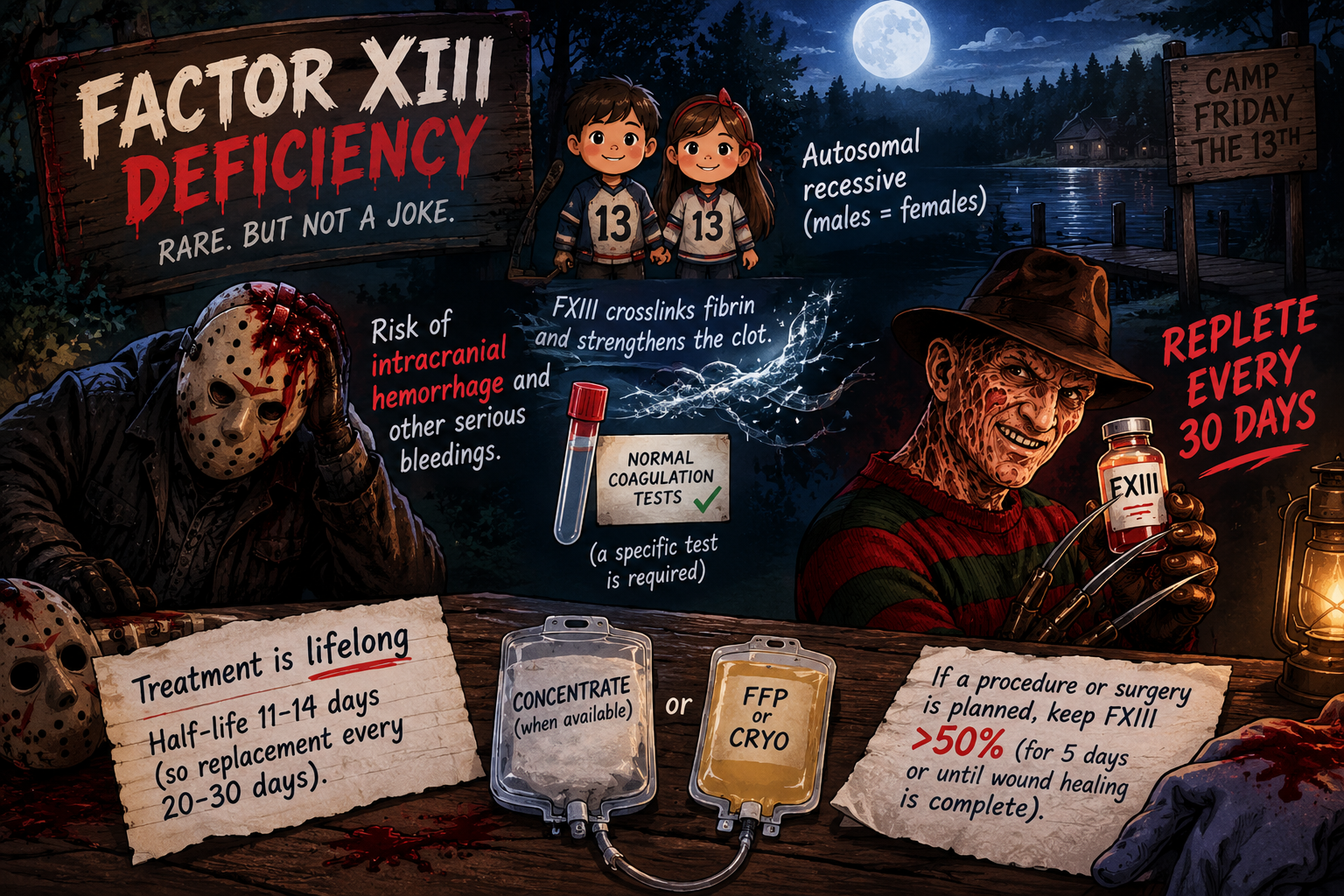
Clinical Pearl “Routine coagulation tests are NORMAL, and a specific test is required for diagnosis.”

Factor XIII deficiency is extremely rare (1:2,000,000) and it is autosomal recessive (males = females). The classical presentation is with umbilical cord bleeding at birth, but sometimes with other serious bleedings early in life.

Interestingly, FXIII is “downstream” in the coagulation cascade; it crosslinks fibrin and strengthens the clot. Routine coagulation tests are NORMAL, and a specific test is required for diagnosis.

Treatment of this bleeding disorder is lifelong because of the risk of intracranial hemorrhage and other severe bleedings. Half-life of factor XIII is 11-14 days, so patients get replacement every 20 to 30 days. If concentrates are not available, fresh frozen plasma or cryoprecipitate are good alternatives.

If a procedure or surgery is planned, FXIII level should be maintained at a higher trough level of >50%. It has been suggested that the level is kept in the normal range for 5 days or until wound healing is complete.

Factor XIII deficiency infographic
Visual MemoryImage created by the fellow with ChatGPT
References (5)
  • Arachchillage, D. J., S. Platton, K. Hickey, J. Chu, M. Pickering, P. Sommerville, P. MacCallum, K. Breen and B. S. H. Committee (2024). “Guidelines on the investigation and management of antiphospholipid syndrome.” Br J Haematol 205(3): 855-880.
  • Bolton-Maggs, P. H., D. J. Perry, E. A. Chalmers, L. A. Parapia, J. T. Wilde, M. D. Williams, P. W. Collins, S. Kitchen, G. Dolan and A. D. Mumford (2004). “The rare coagulation disorders–review with guidelines for management from the United Kingdom Haemophilia Centre Doctors’ Organisation.” Haemophilia 10(5): 593-628.
  • Bounaix, L., V. Schroeder, P. Fontana and A. Casini (2024). “Management of anticoagulation and factor XIII replacement in a patient with severe factor XIII deficiency and recurrent venous thromboembolic disease: case report and review of literature.” Res Pract Thromb Haemost 8(2): 102371.
  • Naderi, M., A. Dorgalaleh, S. Tabibian, S. Alizadeh, P. Eshghi and G. Solaimani (2013). “Current understanding in diagnosis and management of factor XIII deficiency.” Iran J Ped Hematol Oncol 3(4): 164-172.
  • Schroeder, V. (2020). “Laboratory Assessment of Coagulation Factor XIII.” Hamostaseologie 40(4): 467-471.
About the Contributors

Meet the Authors

Cilomar Martins, MD
Case & Questions

Cilomar Martins MD is a hematology-focused fellow at Beth Israel Deaconess Medical Center. He completed medical school in Brazil, where he also completed Internal Medicine residency and Palliative Care fellowship before moving to the United States. He then completed residency at Mass General Brigham, Salem Hospital. His clinical focus is both classical and malignant hematology.

Paula H.B. Bolton-Maggs
Expert Commentary

Paula H.B. Bolton-Maggs FRCP, FRCPath, DM Oxon is a Consultant haematologist (retired), former Medical Director of the Serious Hazards of Transfusion (SHOT) haemovigilance scheme (2011-2018), and current data analyst for incidents of avoidable, delayed and under/overtransfusion. She served as Honorary Senior Lecturer in the Faculty of Biology, Medicine and Health at University of Manchester UK from 2003 to 2025.