

Exercise #21 – Answers

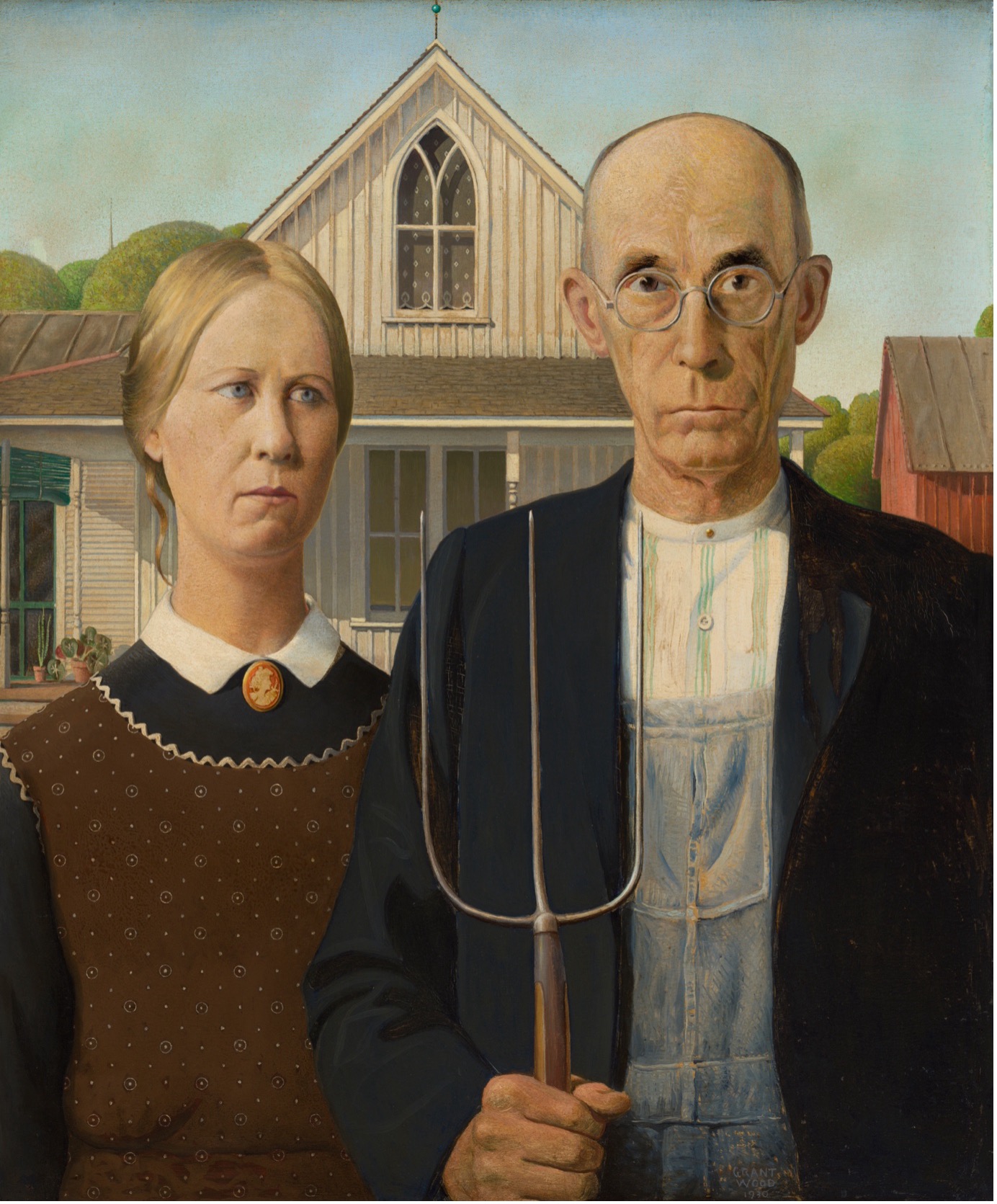
American Gothic, Grant Wood, 1930, Oil on board, Art Institute of Chicago
Public Domain
Q.1. Describe what you see in this picture.
A.1. I see two people, a man on the right with a pitchfork and a woman on the left. The painting is full of vertical and horizontal lines relieved by the rounded trees in the background. They stand in front of a cream-coloured wooden house with a pitched roof above and a darker horizontal one below. The full extent of the house is not shown. There are three closed windows, one cream-coloured with a floral patterned curtain in a pointed arch window above and two rectangular grey ones below with closed blinds. It is not clear if the window on the left of the picture above steps is another window or a door. It has a folded green awning above it and some green plants on the top step on the right. There is a smaller barn-like building on the right of the picture behind the couple. It has a dark pitched roof, no windows and red exterior walls. In the far background, several rounded trees can be seen right and left against a blue sky with faintly visible clouds. Gentle sunshine coming from the left lights up parts of the house and the couple’s faces. This is a rural scene with a farmer and either his daughter or wife.
Q.2. Describe the couple in the foreground: ages, style of dress, and expressions.
A.2. The man is much older than the woman: he is around sixty, wears rounded glasses, is almost bald with black hair and eyebrows flecked with some grey. Wrinkles of aging are visible on his face, forehead and neck. The single tanned hand with thickened knuckles seen gripping a pitchfork is that of a man who works outdoors. The woman is probably in her thirties with firmly tied blond hair, parted in the middle. They both are dressed in old-fashioned clothes: she wears an brown patterned apron over a neckline dark white-collared dress with a cameo brooch; he wears mud-soiled blue denim overalls over a white striped collarless shirt and a dark jacket. The pattern on her apron echoes that of the curtains in the gothic window. Both stand centrally, silent, with strikingly severe, stern expressions. He stares out at us, while she seems wrapped in her own thought and looks away to the right.
Q.3. What do you think might be the relationship and occupations of the couple?
A.3. Their relationship is unclear but as they are pictured together it is close. She could be a younger wife or his daughter.
Note
Grant Wood (1891-1942) was an American painter from Iowa. This was his most famous painting. Using a figurative, realistic style, he was known as one of the American Regionalists who wanted to move away from European art towards an art inspired by local American rural landscape and its people. The painting was seen by some as part of the steadfast American spirit in the face of the Depression, while some thought that it painted rural people as dour and backward. The models for the two figures were his sister, intended to be the farmer’s daughter, and his dentist who posed as the farmer. The prominent pitchfork was seen as a traditional symbol of labour. The Gothic style of the upper window was inspired by a form of Gothic revival in wood seen in Iowa. Grant had studied Gothic and early Renaissance art in Europe which can be seen in the precise clarity and attention to detail in American Gothic.