
Low von Willebrand Disease: A Bleeding Disorder of Unknown Cause?
O’Donnell JS, Baker RI. Low von Willebrand disease: a bleeding disorder of unknown cause? Hämostaseologie. 2023;43:44–51.
Why read this review?
Read this review if you want to understand why low VWF remains one of the most disputed concepts in contemporary hemostasis.
Its defining idea is not merely that patients with VWF levels of 30–50 IU/dL are heterogeneous. The authors propose something more challenging:
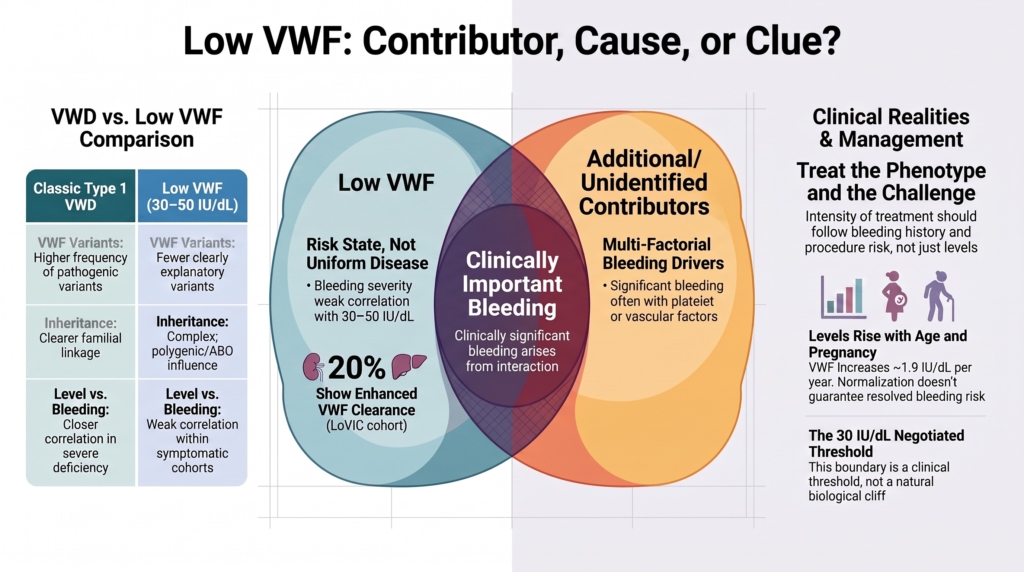
In some patients with real bleeding and mildly reduced VWF, the low VWF may be a contributor rather than a complete explanation.
The paper places low VWF and bleeding disorder of unknown cause—often abbreviated BDUC—in partially overlapping conceptual spaces. Clinically important bleeding may arise where mild VWF reduction interacts with one or more unidentified hemostatic, vascular, structural, or gynecologic modifiers.
This is a proposed model, not a validated classification system. But it is the idea that makes the paper distinctive and establishes it as a keystone of the low-VWF literature.
What scholarly job does it perform?
Focused controversy review
This is not a neutral review of all positions.
It is a sustained argument for a particular interpretation of patients with VWF levels of 30–50 IU/dL.
The authors synthesize evidence from:
- genotype–phenotype studies;
- family and linkage analyses;
- endothelial-cell experiments;
- VWF clearance studies;
- symptomatic bleeding cohorts;
- women’s-health studies;
- procedural series;
- and observations during aging and pregnancy.
They use that evidence to argue that:
- low VWF should not automatically be treated as the mild end of classic type 1 VWD;
- the degree of mild VWF reduction often does not fully explain bleeding severity;
- clinically significant bleeding may require additional, incompletely defined modifiers.
The biological boundary between low VWF and type 1 VWD remains incomplete and overlapping. The review’s contribution is to make the case for preserving the distinction rather than assuming that the debate has been settled.
Review at a glance
| Feature | Assessment |
|---|---|
| Publication year | 2023 |
| Review type | Focused narrative controversy review |
| Best audience | Hematologists evaluating symptomatic patients with VWF levels of 30–50 IU/dL |
| Best use | Understanding the biological and clinical case for treating low VWF as a distinct phenotype or risk state |
| Distinctive contribution | Proposes overlap between low VWF and bleeding disorder of unknown cause |
| Evidence-selection method | Narrative expert review; no reproducible search strategy or formal evidence grading is reported |
| Scope | Classification, genetics, endothelial biology, clearance, bleeding phenotype, women’s health, procedures, aging, pregnancy, and overlap with BDUC |
| Read with caution | The paper is explicitly argument-driven and combines cohort evidence, small mechanistic studies, expert interpretation, and proposed disease models |
Best consulted for
- the case for distinguishing low VWF from classic type 1 VWD;
- the 30–50 IU/dL diagnostic boundary;
- poor concordance between mild VWF reduction and bleeding severity;
- incomplete linkage to the VWF gene;
- proposed endothelial synthesis and secretion defects;
- accelerated clearance in selected patients;
- heavy menstrual bleeding and postpartum hemorrhage;
- observational treatment data for tranexamic acid and desmopressin;
- the proposed relationship between low VWF and BDUC.
Not sufficient alone for
- a neutral account of all classification positions;
- individualized diagnosis;
- formal guideline recommendations;
- comprehensive perioperative planning;
- validated identification of a low-VWF/BDUC overlap subgroup;
- management of secure type 2 or type 3 VWD;
- proof of the additional mechanisms responsible for bleeding.
Central thesis
The review’s central thesis is:
Low VWF is a heterogeneous laboratory and clinical phenotype in which mildly reduced VWF may contribute to bleeding without being causally sufficient to explain it.
The authors support this argument with several group-level observations:
- many people with VWF levels of 30–50 IU/dL do not have clinically important bleeding;
- within studied symptomatic cohorts in this range, bleeding severity did not correlate clearly with the residual VWF level;
- identifiable pathogenic VWF variants are less common than in patients with more marked quantitative deficiency;
- inheritance is often unclear;
- VWF levels frequently rise with age or pregnancy;
- laboratory normalization is not consistently accompanied by resolution of the historical bleeding phenotype;
- and selected patients may overlap mechanistically with BDUC.
The review therefore proposes a model in which:
clinically significant bleeding in some patients reflects low VWF acting together with one or more unidentified modifiers
That model is influential and clinically useful. It has not yet been converted into agreed diagnostic criteria.
The conceptual model
1. Low VWF and type 1 VWD overlap—but may not be interchangeable
The review revisits the historical distinction between:
- type 1 VWD: usually associated with VWF levels below 30 IU/dL;
- low VWF: VWF levels of 30–50 IU/dL in a patient with a bleeding phenotype.
That distinction was based on group-level differences in:
- frequency of identifiable pathogenic VWF variants;
- inheritance;
- relationship between VWF level and bleeding;
- endothelial biosynthesis and secretion;
- clearance;
- and age-related behavior.
The authors argue that low VWF should not automatically be treated as the mild end of classic type 1 VWD.
They do not establish a natural biological cliff at 30 IU/dL. Both categories are heterogeneous, and their distributions overlap.
The threshold is therefore best understood as a clinical and conceptual boundary, not a clean biological dividing line.
2. The 30–50 IU/dL range contains different clinical phenotypes
Some patients in this range have substantial bleeding.
Others do not.
Among referred symptomatic patients, common manifestations include:
- heavy menstrual bleeding;
- postpartum hemorrhage;
- epistaxis;
- oral bleeding;
- bruising;
- procedural bleeding;
- and iron deficiency caused by chronic blood loss.
But those cohorts are selected precisely because patients were referred for bleeding, low VWF, or both. Their rates of heavy menstrual bleeding, iron deficiency, and procedural complications should not be interpreted as population prevalence among everyone with VWF levels of 30–50 IU/dL.
The important observation is narrower:
Within studied symptomatic low-VWF cohorts, similar laboratory values may accompany very different bleeding burdens.
That weak relationship challenges the assumption that the plasma VWF level alone provides a complete explanation of the phenotype.
3. Genetics supports a complex-trait model
Patients with more marked quantitative VWF deficiency are more likely to have an identifiable pathogenic VWF variant.
In low VWF, such variants are identified less consistently.
Family and linkage studies also show that reduced VWF levels do not always track cleanly with the VWF locus.
These observations support a complex-trait model involving some combination of:
- variants within VWF;
- ABO blood group;
- polygenic influences;
- modifiers of endothelial synthesis or secretion;
- modifiers of glycosylation and clearance;
- likely non-VWF genetic factors;
- and environmental or physiological influences.
The responsible non-VWF genes remain largely undefined.
The evidence therefore supports complexity and incomplete genetic explanation—not proof that a particular set of other genes accounts for most cases.
4. Small mechanistic studies implicate endothelial synthesis and secretion in a subset
The review gives substantial attention to endothelial-cell biology.
The cited studies describe findings such as:
- elevated FVIII-to-VWF ratios;
- reduced platelet VWF in some patients;
- attenuated stimulated release from endothelial colony-forming cells;
- fewer or smaller Weibel–Palade bodies;
- reduced VWF transcription;
- mosaic endothelial VWF expression;
- and broader transcriptional abnormalities.
These observations suggest that impaired endothelial synthesis, intracellular processing, or stimulated secretion contributes in a subset of patients.
They do not establish one dominant mechanism for all low VWF.
The studies are generally small and biologically intensive. Their value is mechanistic plausibility rather than reliable population-frequency estimation.
5. Accelerated clearance contributes in a subset
The review also discusses increased VWF clearance.
In the Low VWF Ireland Cohort, approximately 20% of studied patients met the investigators’ criterion for enhanced clearance—a reduction in VWF antigen of more than 30% between 1 and 4 hours after desmopressin.
That estimate is specific to the cohort and the study definition. It should not be assumed to represent all low-VWF populations.
The clearance phenotype also appeared less pronounced than in classic enhanced-clearance type 1C VWD.
The practical implication is important:
- a steady-state VWF propeptide-to-antigen ratio may fail to identify mild clearance abnormalities;
- direct assessment of VWF survival after desmopressin may be more informative;
- and the early peak alone does not describe the durability of the response.
Reduced production and accelerated clearance are explanations for why VWF is low. Neither necessarily explains the entirety of why the patient bleeds
6. Low VWF and bleeding may have overlapping but nonidentical causes
This is the conceptual center of the paper.
The authors distinguish two questions:
- Why is the VWF level mildly reduced?
- Why does this patient have clinically important bleeding?
The first may involve:
- ABO blood group;
- reduced endothelial synthesis;
- altered secretion;
- glycosylation;
- accelerated clearance;
- or complex genetic influences.
The second may also depend on:
- platelet function;
- fibrinolysis;
- vascular integrity;
- local anatomy;
- gynecologic pathology;
- obstetric factors;
- structural lesions;
- procedural exposure;
- and unidentified hemostatic abnormalities.
The authors therefore hypothesize that some symptomatic low-VWF patients occupy an overlap with BDUC.
Validated criteria for identifying that subgroup do not yet exist.
What this review uniquely offers
1. The low-VWF/BDUC overlap model
This is the paper’s signature contribution.
The authors treat low VWF as biologically real and potentially contributory, while questioning whether it constitutes a complete causal diagnosis in every symptomatic patient.
Their proposed model is:
mild VWF reduction may interact with additional unidentified factors to produce clinically significant bleeding
This avoids two simplistic conclusions:
- “The VWF is low, so it explains everything.”
- “The reduction is mild, so it is irrelevant.”
Low VWF may matter without being the whole answer.
That distinction is the conceptual keystone of the low-VWF review cluster.
2. A distinction between a clinical phenotype, a risk state, and a disease
The authors continue to use low VWF as a clinically useful entity.
They identify patients, describe outcomes, and discuss treatment.
At the same time, they question whether the isolated laboratory reduction constitutes a causally complete disease.
Low VWF may therefore be understood as:
- a laboratory phenotype;
- a bleeding risk state;
- a clinically useful category;
- and, in some patients, part of a broader disorder.
The category’s usefulness does not prove biological uniformity.
3. A strong women’s-health lens
Heavy menstrual bleeding and postpartum hemorrhage are central to the paper’s argument.
In selected symptomatic cohorts, patients experienced:
- major menstrual blood loss;
- iron deficiency;
- missed work or school;
- failure of hormonal treatment;
- gynecologic interventions;
- primary postpartum hemorrhage;
- and secondary postpartum hemorrhage.
These data demonstrate that the clinical burden is real even when the causal model is uncertain.
They do not establish population-level risk among all individuals with mildly reduced VWF.
The pregnancy observations also require careful interpretation. Third-trimester VWF may rise substantially, yet postpartum hemorrhage can still occur because of:
- rapid postpartum decline in VWF;
- uterine atony;
- retained placenta;
- trauma;
- obstetric management;
- treatment differences;
- or other hemostatic contributors.
Persistent risk after pregnancy-associated normalization does not, by itself, prove an unidentified coagulation defect.
4. Concrete observational treatment data
The paper is conceptual, but it also points readers toward practical evidence.
Tranexamic acid
A retrospective series included 160 procedures in 60 adults.
Tranexamic acid alone was used for selected dental and minor procedures. Three bleeding events occurred, all after dental procedures; no bleeding occurred among the selected non-dental minor procedures treated with tranexamic acid alone.
The appropriate conclusion is:
In a retrospective adult cohort, tranexamic acid alone was effective for many selected minor procedures, particularly non-dental procedures.
This should not be generalized to every patient or procedure.
Desmopressin
The review describes strong laboratory responses among selected adults and favorable outcomes when desmopressin was used with tranexamic acid for procedures.
The appropriate conclusion is:
In studied adults, desmopressin usually produced a strong and sustained response, but treatment still requires patient- and procedure-specific assessment.
A response trial may remain useful, and suitability depends on:
- age;
- cardiovascular risk;
- hyponatremia risk;
- fluid restriction;
- contraindications;
- response durability;
- and the nature of the procedure.
Pediatric evidence was more limited.
Where interpretation begins
1. The paper represents the strongest distinct-low-VWF position
The authors explicitly challenge the assumption that symptomatic VWF levels of 30–50 IU/dL should automatically be absorbed into classic type 1 VWD.
They acknowledge the reasons behind the broader 2021 guideline definition, including:
- diagnostic sensitivity;
- recognition of symptomatic patients;
- concern about barriers created by the term “low VWF”;
- access to care and treatment;
- and uncertainty in the available evidence.
But they weight the evidence differently.
Their framework prioritizes:
- biological specificity;
- recognition of heterogeneous mechanisms;
- separation of association from causation;
- and avoidance of treating a negotiated threshold as a natural disease boundary.
The disagreement therefore reflects both:
- different interpretations of the evidence;
- and different weighting of diagnostic sensitivity, biological specificity, access to care, and the harms of over- and underdiagnosis.
Like the Nature Primer from the opposing direction, this review’s authority and its partisanship arise from the same expertise.
2. The BDUC overlap is an influential hypothesis
The overlap model is conceptually powerful.
It explains why:
- mildly reduced VWF may be common;
- bleeding severity may vary substantially;
- genotype may be unrevealing;
- and bleeding may remain disproportionate to the measured abnormality.
But the model is not yet an established diagnostic framework.
The review itself calls for direct comparison of low-VWF and BDUC cohorts.
Readers should therefore treat the overlap as:
- a research hypothesis;
- a useful reasoning model;
- and a prompt to search for other contributors;
not as a validated category that can currently be assigned at the bedside.
3. The paper uses group differences to argue for categorical distinction
The paper’s table contrasting low VWF with type 1 VWD is clear and educational.
But it sharpens overlapping distributions into binary columns.
At the individual level:
- some low-VWF patients have pathogenic VWF variants;
- some type 1 patients do not;
- clearance abnormalities occur in both;
- age-related increases occur in both;
- bleeding varies within both;
- and mechanisms overlap.
The table should therefore be read as a summary of group tendencies, not as an individual diagnostic rule.
The comparison also risks making “classic type 1 VWD” appear more uniform than it is. Type 1 itself includes:
- reduced synthesis;
- secretion defects;
- enhanced clearance;
- variable genotype;
- and variable penetrance.
The authors’ contrast is illuminating, but necessarily simplified.
4. Persistent bleeding after laboratory normalization is interpreted as evidence of additional contributors
The review emphasizes that VWF may rise with age or pregnancy without consistent disappearance of the historical bleeding phenotype.
The authors interpret this as support for additional pathology.
That is plausible, but not proven.
Other explanations include:
- cumulative rather than current bleeding measurement;
- gynecologic or structural disease;
- obstetric causes;
- platelet or vascular factors;
- iron deficiency as a consequence of prior bleeding;
- and uncertainty about how current laboratory normalization changes future risk.
A normalized VWF value does not prove that the bleeding problem has resolved.
It also does not prove that a second unidentified hemostatic defect exists.
5. Much of the evidence comes from selected referral cohorts
The review draws heavily on:
- the Low VWF Ireland Cohort;
- the Zimmerman Program;
- adolescent heavy-menstrual-bleeding cohorts;
- and retrospective procedural series.
These studies are valuable because they characterize symptomatic patients in detail.
But referral cohorts are enriched for bleeding and diagnostic uncertainty.
The review is therefore strongest when addressing:
symptomatic patients referred for evaluation
It is less definitive about the meaning of VWF levels of 30–50 IU/dL in the general population.
What it decides for the reader
The review supports a coherent working position:
- low VWF is biologically and clinically heterogeneous;
- it should not automatically be treated as the mild end of classic type 1 VWD;
- within symptomatic cohorts in the 30–50 IU/dL range, bleeding severity is not clearly predicted by the residual VWF level;
- low VWF often behaves as a complex trait rather than a simple monogenic disorder;
- impaired endothelial synthesis or secretion may contribute in selected patients;
- accelerated clearance contributes in a subset;
- heavy menstrual bleeding and postpartum hemorrhage are important burdens in symptomatic cohorts;
- treatment should reflect personal bleeding history, procedure, and therapeutic response rather than the VWF number alone;
- disproportionate bleeding should prompt consideration of additional hemostatic, gynecologic, structural, or vascular contributors.
What it leaves open
The paper does not identify the additional abnormalities responsible for bleeding.
It leaves unanswered:
- Which non-VWF genes are important?
- How often does low VWF coexist with platelet dysfunction?
- What role does abnormal fibrinolysis play?
- Are there endothelial abnormalities affecting both VWF and vascular integrity?
- How should a low-VWF/BDUC overlap subgroup be identified?
- Which patients are at increased procedural risk after laboratory normalization?
- When is mildly reduced VWF a population variant?
- When is it a clinically meaningful risk factor?
- When does it become part of a broader bleeding disorder?
- Should diagnostic terminology prioritize biology, clinical sensitivity, access to care, or some balance among them?
These questions are not peripheral.
They define the unresolved category.
The paper is most useful as a map of active transition—not a declaration that these problems have been solved.
What has changed since publication?
The review was published in 2023.
Subsequent work has broadened and complicated its framework rather than resolving it.
Later studies have examined:
- combined low-VWF and type 1 cohorts;
- qualitative low-VWF phenotypes;
- activity-to-antigen ratios within mild VWF abnormalities;
- age-dependent BAT behavior;
- longitudinal diagnostic reassessment;
- polygenic and non-VWF influences;
- and the relationship between changing levels and changing bleeding opportunity.
These studies do not simply confirm the review.
They reinforce several of its concerns while challenging simple categories:
- threshold-based groups overlap;
- mild qualitative abnormalities may not justify further subdivision;
- both VWF levels and bleeding scores change with age;
- and neither laboratory values nor recorded phenotype are fixed.
A useful library line would be:
Last checked for major updates: [month year]
Strengths
- Introduces a memorable and clinically useful overlap model.
- Takes a clear position while acknowledging competing terminology.
- Separates why VWF is low from why a patient bleeds.
- Integrates genetics, endothelial biology, clearance, and clinical phenotype.
- Treats heavy menstrual bleeding and postpartum hemorrhage as major clinical burdens.
- Includes concrete observational treatment data.
- Recognizes the access-to-care rationale behind broader diagnostic definitions.
- Makes mechanistic and classificatory uncertainty explicit.
Limitations
- It is a narrative expert review without a reproducible search strategy or formal evidence grading.
- It represents one influential school of interpretation rather than a neutral consensus.
- Much of the clinical evidence derives from selected referral cohorts.
- Several mechanistic conclusions rely on small endothelial and laboratory substudies.
- The low-VWF/BDUC overlap remains a proposed model without validated diagnostic criteria.
- The review does not identify the additional defects proposed to account for bleeding.
- Genetics supports a complex-trait model but does not yet identify the responsible non-VWF modifiers in most patients.
- Treatment evidence is retrospective and observational.
- The LoVIC clearance estimate is cohort-specific.
- The comparison with type 1 VWD may make type 1 appear more homogeneous than it is.
- Table-based contrasts describe group tendencies, not rules for individual patients.
- Pregnancy and age-related observations do not establish that laboratory normalization leaves procedural risk unchanged.
- The article predates several 2024–2025 studies that further complicate mild VWF classification.
How to read this review
Read it as an argument in four moves.
First: Identify the proposed overlap
The paper is not simply comparing low VWF with type 1 VWD.
It is proposing that some symptomatic low-VWF patients may occupy an overlap with BDUC.
Ask what evidence supports that idea—and what evidence would be required to validate it.
Second: Separate level from phenotype
Whenever the review discusses a VWF result, ask:
Does this value adequately explain the bleeding?
The authors’ answer is often no.
Third: Separate the mechanism of low VWF from the mechanism of bleeding
Reduced synthesis, impaired secretion, and accelerated clearance may explain the laboratory phenotype.
They do not necessarily explain the entire clinical phenotype.
Clinical pearls
- A mildly reduced VWF level may be contributory without being causally sufficient.
- Within studied symptomatic patients in the 30–50 IU/dL range, bleeding severity did not correlate clearly with residual VWF level.
- Pathogenic VWF variants are identified less often than in patients with more marked quantitative deficiency, but the groups overlap.
- Low VWF is best approached as a complex trait rather than assumed to be a uniform monogenic disorder.
- Small mechanistic studies suggest impaired endothelial synthesis or stimulated secretion in a subset.
- In the LoVIC cohort, approximately 20% met the study criterion for enhanced clearance.
- Laboratory normalization with age or pregnancy does not by itself establish that the historical bleeding phenotype has resolved.
- Heavy menstrual bleeding and postpartum hemorrhage are important burdens in selected symptomatic cohorts.
- Treatment should follow phenotype, procedure, contraindications, and demonstrated response—not the VWF number alone.
- In a retrospective adult cohort, tranexamic acid alone was effective for many selected minor non-dental procedures.
- In studied adults, desmopressin generally produced a strong and sustained response, but it is not universally appropriate.
- Persistent bleeding disproportionate to a mild VWF reduction should prompt consideration of additional hemostatic, structural, gynecologic, or vascular contributors.
- A high BAT score may support more cautious procedural planning, but it is not a stand-alone treatment rule.
Where it fits in the VWD module
This review is the conceptual keystone of the low-VWF conversation.
It connects directly to:
- What VWD Names
- Classification as a Tool
- Where Diagnostic Thresholds Break Down
- Lab–Phenotype Mismatch
- Normal VWF Variation versus Disease
- Bleeding Assessment Tools
- Heavy Menstrual Bleeding and Iron Deficiency
- Pregnancy and Delivery
- Desmopressin Trial
- Surgery and Procedures
- Long-Term Follow-up and Reassessment
It also bridges:
- the Nature Primer’s broader type 1 framework;
- the qualitative low-VWF Journal Club;
- the age-and-BAT study;
- the practical How I Treat article;
- and the Brenner review on diagnostic removal.
Read next
For the opposing integrated framework
Seidizadeh O, Eikenboom JCJ, Denis CV, et al. von Willebrand disease. Nature Reviews Disease Primers. 2024.
Read this for the framework that incorporates symptomatic VWF levels of 30–50 IU/dL within type 1 VWD.
For longitudinal reassessment
Brenner MK, Christopherson PA, Flood VH. (Un) Diagnosing von Willebrand disease. 2025.
Read this for the question of whether a mild historical diagnosis still fits after years of new clinical and laboratory evidence.
For bedside management
Lavin M, O’Donnell JS. How I treat low von Willebrand factor levels. Blood.
Read this for the practical reasoning behind tranexamic acid, desmopressin testing, procedure planning, and treatment intensity.
For original evidence challenging laboratory subdivision
Atiq F, et al. Qualitative low VWF. Blood. 2025.
Read this for evidence that activity-to-antigen ratios may not divide mild low-VWF phenotypes into clinically meaningful groups.
For the guideline decision
ASH/ISTH/NHF/WFH 2021 diagnostic guideline
Read this to understand why the panel adopted a broader type 1 definition while acknowledging low-certainty evidence and the potential harms of diagnostic exclusion.
Bottom line
This review presents one of the clearest arguments that VWF levels of 30–50 IU/dL should not automatically be interpreted as classic type 1 VWD.
In selected symptomatic cohorts, the laboratory phenotype is biologically heterogeneous, correlates poorly with bleeding severity, and may reflect reduced synthesis, altered secretion, enhanced clearance, or complex genetic influences.
The authors propose that low VWF often acts as a contributory bleeding risk factor interacting with additional, incompletely defined mechanisms. That is a persuasive and clarifying model—but not yet a validated classification system.
Its deepest question is not:
Is the VWF low?
It is:
Is the VWF reduction sufficient to explain the bleeding in front of us?
Reflect and discuss
- When does a biological risk factor become a disease?
- Should diagnostic terminology prioritize biological specificity, diagnostic sensitivity, access to care, or some balance among them?
- What evidence would be needed to validate a low-VWF/BDUC overlap subgroup?
- If two patients have the same VWF level but different bleeding phenotypes, what additional mechanisms should be considered?
- Does persistent bleeding after VWF normalization prove that another hemostatic defect exists?
- How should Table 1’s group-level contrasts influence—but not determine—the diagnosis of an individual patient?
- Which statements in this review are direct observations, which are mechanistic inferences, and which represent the authors’ preferred model of disease?