
For Your Healthcare Provider
Have your patient scan this QR code with their smartphone camera to instantly access this educational guide on their device.

A guide for patients with Type 1 von Willebrand disease
Access the Resources
Note: The video and audio linked above were generated with the assistance of AI. Clinical accuracy has been reviewed, but no AI-generated content can be guaranteed to be fully error-free.
Von Willebrand disease type 1 is the most common form of von Willebrand disease and is usually mild.↵
Most people with type 1 von Willebrand disease live normal lives and need little or no ongoing treatment.
This information is for general education and does not replace medical care. It applies to people who are medically stable. If you are experiencing new or worsening symptoms, contact your doctor or seek emergency care.
First things first
Type 1 von Willebrand disease is the most common and mildest form of von Willebrand disease. It is often discovered after routine blood testing, evaluation for heavy menstrual bleeding, or before surgery or dental work.
Many people with type 1 von Willebrand disease do not know they have it until later in life. Others may never develop symptoms significant enough to require treatment.
This page focuses on what type 1 means, why it behaves the way it does, and how it is usually managed..
What is type 1 VWD?
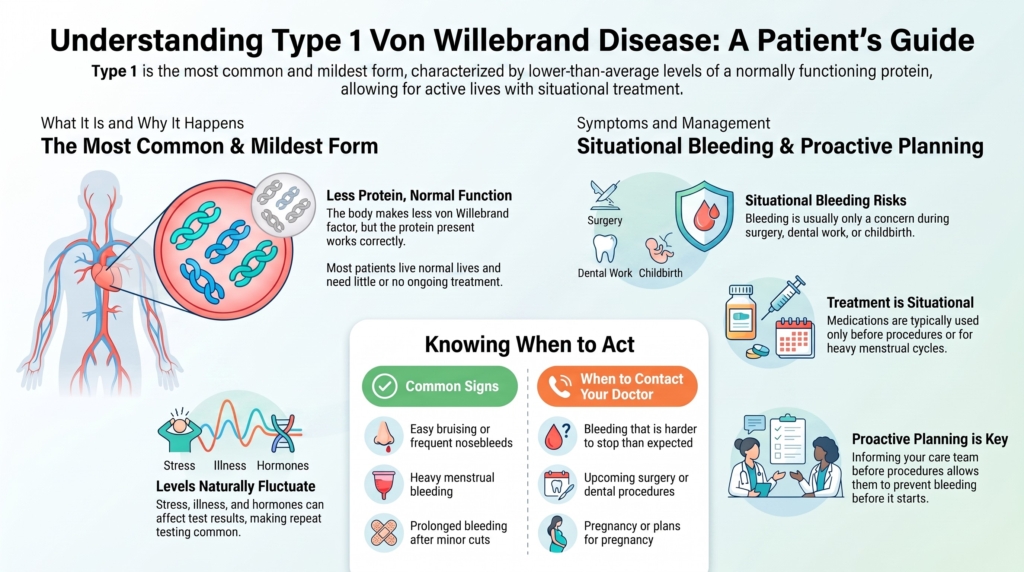
In type 1 von Willebrand disease, the body makes less von Willebrand factor than usual, but the von Willebrand factor that is present works normally.
Because the protein functions correctly, clotting usually occurs, but bleeding may take longer than average to stop.
Type 1 von Willebrand disease is best thought of as having less of a working protein, not a complete absence of the protein and not a protein that does not work.
Why it happens (causes)
Type 1 von Willebrand disease is inherited, meaning it runs in families. The gene involved leads to lower production of von Willebrand factor.
Importantly, von Willebrand factor levels are naturally variable. Levels can rise or fall with stress, illness, hormones, pregnancy, and inflammation. This does not mean that stress or minor illnesses are dangerous. It means that test results need context and are sometimes repeated.
This variability explains why diagnosis can feel uncertain and why repeat testing is common. In some people, levels fluctuate around common diagnostic cutoff values, which can make the diagnosis feel less clear-cut than other medical conditions.
Does it cause symptoms?
Symptoms in type 1 von Willebrand disease are often mild and may be absent altogether.
When symptoms occur, they may include easy bruising, frequent nosebleeds, bleeding that takes longer than usual to stop after cuts, heavy menstrual bleeding, or prolonged bleeding after dental work or surgery.
Many people with type 1 von Willebrand disease have normal daily bleeding and only notice differences during situations that challenge the clotting system, such as surgery, dental procedures, childbirth, or significant injury.
Is it dangerous?
For most people, type 1 von Willebrand disease is not dangerous and does not shorten life expectancy.
Serious or spontaneous bleeding is uncommon. Bleeding risk is usually predictable and related to specific situations such as surgery, dental procedures, childbirth, or significant injury.
Knowing that you have type 1 von Willebrand disease allows your care team to plan ahead rather than respond to bleeding after it happens.
How your doctor evaluates it
Evaluation typically includes blood tests that measure the amount of von Willebrand factor and how well it functions. Because levels fluctuate, testing may be repeated, especially if initial results are borderline.
Doctors interpret results alongside your bleeding history rather than relying on a single number. A mildly low value in someone with no bleeding symptoms may be managed very differently from the same value in someone with significant bleeding.
How is it treated
Many people with type 1 von Willebrand disease do not need regular treatment.
When treatment is needed, it is often situational. Options include medications that temporarily increase von Willebrand factor levels or clot-stabilizing medications. These are typically used before and after procedures or to manage heavy menstrual bleeding.
Treatment decisions are individualized and based on symptoms, planned procedures, and past bleeding history rather than lab values alone.
Daily life and self-care
Most people with type 1 von Willebrand disease live normal, active lives without daily restrictions.
Awareness and planning are usually more important than ongoing therapy. Many people participate in sports, exercise, and routine activities without problems.
Knowing your diagnosis helps you communicate effectively with healthcare providers and plan ahead when needed. For example, telling your dentist or surgeon ahead of time can allow simple precautions that reduce bleeding risk.
When should I contact my doctor?
Most bleeding symptoms are not emergencies, but it is helpful to know when to check in.
You should contact your doctor if you notice:
- new or unusual bleeding
- bleeding that takes longer to stop than usual
- bleeding that is harder to stop than expected
- heavy menstrual bleeding that interferes with daily life
- upcoming surgery, dental work, or medical procedures
- pregnancy or plans for pregnancy
- questions about medications that affect bleeding
Your care team can help decide whether any additional testing or treatment is needed.
What is the usual plan going forward?
Many people with type 1 von Willebrand disease are followed periodically, often by a primary care clinician with input from a hematologist as needed.
Follow-up is usually focused on planning for major life events such as surgery or pregnancy, rather than frequent testing or treatment. For people with mild disease and minimal symptoms, this may mean long intervals between visits.
Making sense of it
Type 1 von Willebrand disease reflects lower-than-average levels of a normally functioning protein, not a fragile or unstable clotting system.
This explains why symptoms are often mild, why lab values fluctuate, and why treatment is usually situational rather than continuous.
Understanding this framework helps prevent unnecessary worry and over-treatment.
Key takeaways
- most common form — type 1 is the most frequent and usually the mildest type
- partial deficiency — von Willebrand factor is lower than usual but works normally
- levels fluctuate — stress, illness, and hormones affect test results
- often mild — many people have few or no symptoms
- planning matters — awareness helps prevent bleeding during procedures
For clinicians: Read our detailed guide on how to communicate about Type 1 VWD to patients.