
For Your Healthcare Provider
Have your patient scan this QR code with their smartphone camera to instantly access this educational guide on their device.

A guide for patients with von Willebrand disease
Access the Resources
Note: The video and audio linked above were generated with the assistance of AI. Clinical accuracy has been reviewed, but no AI-generated content can be guaranteed to be fully error-free.
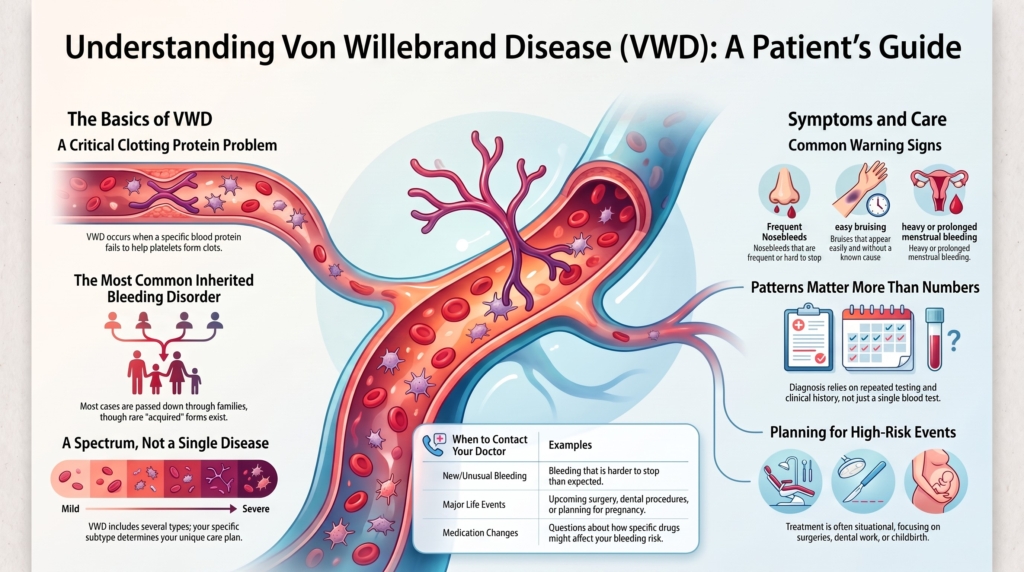
Von Willebrand disease is a bleeding condition caused by a problem with a blood protein that allows platelets to stick and helps clots form properly.
Most people with von Willebrand disease have mild or manageable symptoms and live full, normal lives.
This information is for general education and does not replace medical care. It applies to people who are medically stable. If you are experiencing new or worsening symptoms, contact your doctor or seek emergency care.
First things first
Von Willebrand disease (often shortened to VWD) is the most common inherited bleeding disorder, and it is also one of the most variable. Some people have very mild symptoms that never interfere with daily life. Others need closer follow-up or treatment during surgeries, dental work, childbirth, or major injuries.
The term “von Willebrand disease” refers to a group of related conditions rather than a single uniform illness. Understanding which type of von Willebrand disease you have matters more than the name alone, because each type affects the clotting system in a different way.
This overview page explains the big picture and then points you to more focused pages when additional detail is helpful.
What is VWD?
Von Willebrand disease is caused by a problem with von Willebrand factor, a protein in the blood that helps clotting work normally. It helps platelets stick to injured blood vessels, and it protects another important clotting protein from breaking down too quickly.
When von Willebrand factor is low or does not work properly, bleeding can last longer than usual.
Why it happens (causes)
Most forms of von Willebrand disease are inherited, meaning they are passed down in families. The underlying gene affects how much von Willebrand factor is produced or how well it functions.
There is also a separate condition called acquired von Willebrand disease, which can develop later in life in people with certain medical conditions and is not inherited. Most von Willebrand disease diagnosed in childhood or young adulthood is the inherited form.
Von Willebrand factor levels can fluctuate with stress, illness, hormones, pregnancy, and inflammation, which is why diagnosis often requires careful interpretation rather than a single blood test.
Does it cause symptoms?
Symptoms vary widely. Some people bruise easily or have frequent nosebleeds. Others notice heavy menstrual bleeding or prolonged bleeding after dental work or surgery. Some people notice that bleeding takes longer to stop after minor cuts. Many people have no noticeable symptoms at all.
Symptoms do not always match laboratory numbers exactly, which is why doctors focus on both bleeding history and test patterns.
Is it dangerous?
For most people, von Willebrand disease is not dangerous and does not shorten life expectancy.
More serious bleeding is uncommon and usually occurs in people with more severe forms or during specific situations such as surgery, childbirth, or major injury. Knowing the type of von Willebrand disease helps doctors anticipate risk and prevent problems rather than reacting after bleeding occurs. If you are planning surgery or have a more severe type, your doctor may consult with or refer you to a hematologist who specializes in bleeding disorders.
How your doctor evaluates it
Evaluation usually involves a combination of blood tests that measure the amount of von Willebrand factor, how well it functions, and related clotting proteins. Because levels can change over time, testing is often repeated.
Doctors interpret results by looking at overall patterns rather than relying on a single value.
How is it treated
Treatment is individualized and depends on the type of von Willebrand disease, the severity of symptoms, and the situation.
Many people do not need daily treatment. Others may receive treatments that temporarily raise von Willebrand factor levels, medications that stabilize clots, or infusions of clotting proteins during higher-risk situations such as surgery or childbirth.
Each type-specific page explains treatment options in more detail.
Daily life and self-care
Most people with von Willebrand disease live normal, active lives. Awareness and planning are usually more important than ongoing medical therapy.
Knowing your specific type helps guide everyday decisions without unnecessary restrictions, and most people do not need to avoid routine activities.
When should I contact my doctor?
Most bleeding symptoms are not emergencies, but it is important to know when to check in.
You should contact your doctor if you notice:
- new or unusual bleeding
- bleeding that takes longer to stop than usual
- bleeding that is harder to stop than expected
- menstrual bleeding heavy enough to interfere with daily life
- upcoming surgery, dental work, or medical procedures
- pregnancy or plans for pregnancy
- questions about medications that affect bleeding
Your care team can help plan ahead and reduce risk.
What is the usual plan going forward?
Many people with von Willebrand disease are followed periodically by a primary care clinician or hematologist, with more attention during life events that affect bleeding risk.
The goal is anticipation and preparation rather than frequent testing or treatment.
Making sense of it
Von Willebrand disease is best understood as a spectrum rather than a single diagnosis. The key questions are how much von Willebrand factor is present, how well it works, and how the body behaves during real-world situations such as injury or surgery.
This is why type-specific information matters and why management is personalized.
Key takeaways
- not one disease — von Willebrand disease includes several distinct patterns
- which type matters — management depends more on subtype than the name alone
- testing needs context — results are interpreted as patterns, not single numbers
- most people do well — many live full lives with little or no treatment
- planning prevents problems — knowing your type helps guide safe care
For clinicians: Read our detailed guide on how to communicate about VWD to patients.