
Structured listening in a disorder defined by history
Note: The video and audio linked above were generated with the assistance of AI. Clinical accuracy has been reviewed, but no AI-generated content can be guaranteed to be fully error-free.
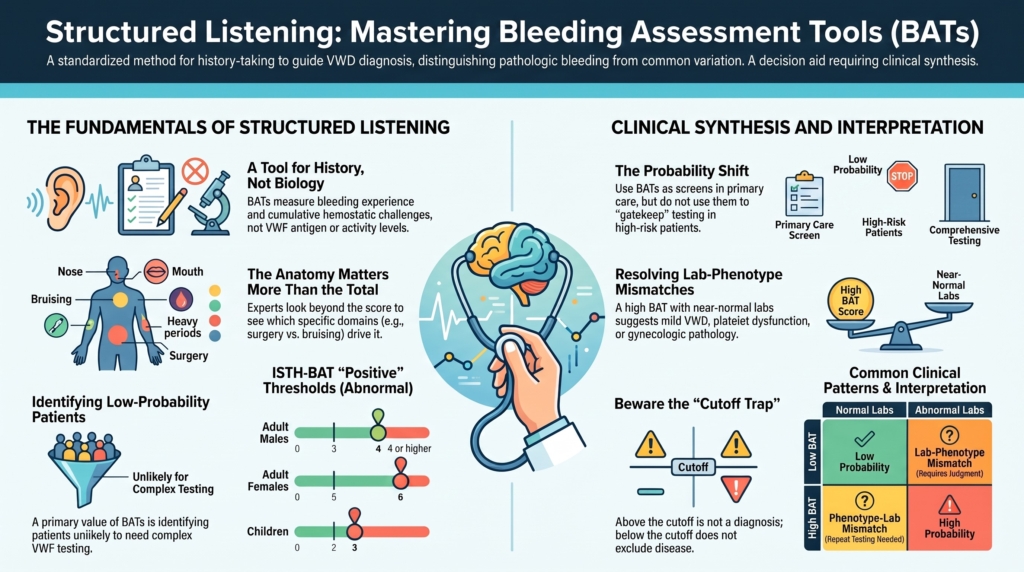
Why this spoke matters
Bleeding history is essential.
Bleeding history is also unreliable.
In von Willebrand disease, diagnosis depends on narrative. But narrative is shaped by memory, exposure, normalization, anxiety, family culture, and access to medical care.
Bleeding assessment tools were designed to impose structure on that instability.
They standardize how clinicians ask, and how patients answer.
They do not convert history into laboratory data.
They make history more interpretable.
A BAT is not a VWF assay. It is not a subtype classifier. It is not a verdict.
It is a tool for structured listening.1
Why bleeding history is hard
Bleeding is common.
Epistaxis, bruising, heavy menstrual bleeding, dental bleeding, and postoperative oozing all occur in people without an inherited bleeding disorder.
The clinical challenge is distinguishing:
common variation
from
pathologic bleeding tendency
Unstructured history-taking magnifies noise.
One patient may describe mild bruising as alarming. Another may normalize years of heavy menstrual bleeding because every woman in her family bleeds the same way. A third may report no bleeding because they have never had surgery, dental extraction, childbirth, major trauma, or antithrombotic exposure.
Children illustrate both sides of the problem.
The pediatric abnormal threshold is lower, but a child may still have a low bleeding score simply because life has not yet tested hemostasis.
Absence of bleeding is sometimes absence of exposure
Family history has the same problem in reverse. A family may appear negative because relatives were never challenged, were never asked, or normalized bleeding across generations.
Conversely, when a first-degree relative has VWD, the pretest probability is not low even if the patient’s own BAT score is negative. In that setting, guidelines recommend against using a BAT alone to decide whether specific VWD testing is needed.2
What BATs measure
Bleeding assessment tools:
- catalog bleeding domains
- assign weighted scores
- standardize questioning
- capture interventions required for bleeding
- improve reproducibility across clinicians and centers
They do not measure VWF antigen.
They do not measure VWF activity.
They do not measure platelet binding, collagen binding, FVIII binding, multimer distribution, or clearance.
They measure bleeding experience.
That distinction matters.
A history of transfusion-requiring postpartum hemorrhage does not carry the same diagnostic weight as occasional childhood bruising. Recurrent surgical re-bleeding does not mean the same thing as self-limited nosebleeds. Iron deficiency from years of heavy menstrual bleeding is different from a single heavy period.
The score matters.
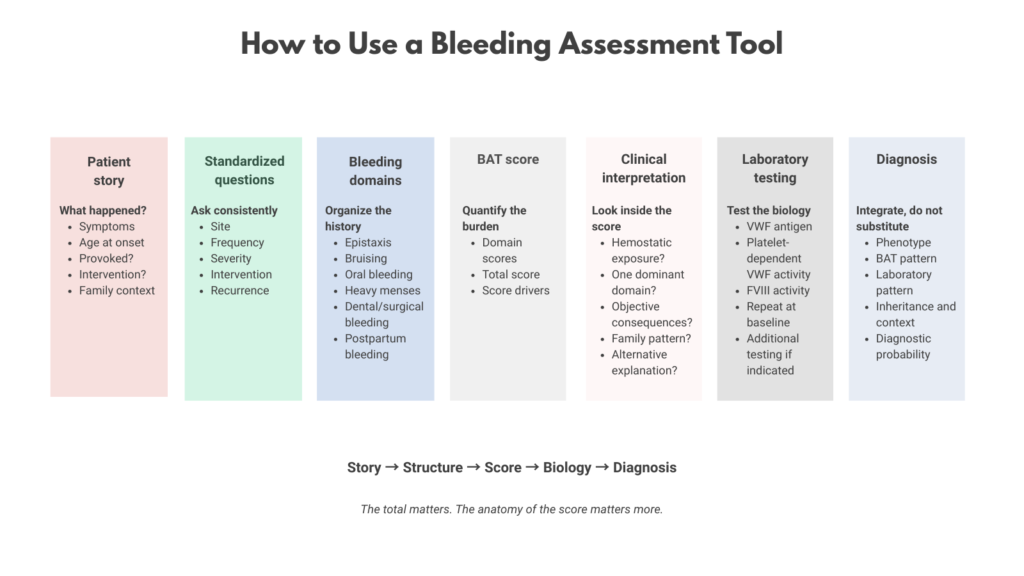
The anatomy of the score matters more.
Why BATs were needed
The first major BAT studies were designed to solve a practical problem: clinicians needed a reproducible way to decide whether a bleeding history was significant enough to justify laboratory investigation for VWD.
In the original multicenter work on type 1 VWD, a standardized questionnaire and bleeding score helped distinguish obligate carriers of type 1 VWD from healthy controls. Very specific criteria, such as three or more bleeding symptoms or sex-adjusted bleeding-score thresholds, were useful, but not perfectly sensitive. Bleeding history could strongly shift probability, but it could still miss some affected individuals.3
The MCMDM-1 VWD study extended this work by showing that bleeding score correlated inversely with VWF activity, VWF antigen, and FVIII. It also showed that mucocutaneous bleeding score helped predict bleeding after surgery or tooth extraction.4
That was an important advance.
It meant history could be quantified without becoming objective.
What BATs do well
BATs are most useful when they help decide whether a bleeding history deserves further evaluation.
They can:
- standardize history-taking
- identify patients who warrant laboratory evaluation
- reduce unnecessary testing in low-pretest-probability settings
- compare patients across studies and clinics
- make research cohorts more reproducible
In one prospective primary-care evaluation, the condensed MCMDM-1 VWD questionnaire showed 100% sensitivity and a negative predictive value of 1.0 for type 1 VWD. Its greatest value was identifying patients in whom VWF testing was unlikely to be necessary. That performance should not be generalized uncritically to hematology referral populations or to every bleeding disorder.5
A very low bleeding score lowers the probability of clinically significant VWD, especially in low-pretest-probability settings.
It does not exclude disease.
This is particularly important in children, men, and anyone with limited hemostatic challenges.
A high bleeding score increases concern for VWD or another bleeding disorder.
It does not identify the mechanism.
A positive BAT is evidence of abnormal bleeding burden.
It is not evidence of VWF-specific pathophysiology.
The ISTH-BAT cutoffs
The ISTH-BAT was developed to create a single standardized tool for reporting bleeding symptoms across adult and pediatric populations.
Normal ranges were later established using merged adult and pediatric data:
- adult males: 0 to 3
- adult females: 0 to 5
- children: 0 to 2
Commonly used positive thresholds are therefore:
- adult males: 4 or higher
- adult females: 6 or higher
- children: 3 or higher
These thresholds give clinicians a shared language. They remind us that abnormal is not synonymous with diagnostic.6
A positive BAT should open a diagnostic pathway.
It should not close one.
What guidelines actually say
Guidelines formalize what experienced clinicians already do intuitively.
The ASH/ISTH/NHF/WFH 2021 diagnostic guideline recommends a validated BAT as an initial screening test in patients with low pretest probability, such as those seen in primary care.
But in patients with intermediate probability, such as those already referred to hematology, the guideline suggests against relying on a BAT to decide whether to order specific VWD testing.
In patients with high probability, such as those with an affected first-degree relative, the guideline recommends against relying on a BAT to decide whether testing is needed.7
That is the Bayesian lesson.
The same score means different things in different pretest-probability settings.
A BAT shifts prior probability up or down.
It never replaces it.
Where BATs mislead
BATs fail in predictable ways.
Patient factors include:
- age
- recall bias
- cultural norms
- family normalization
- anxiety or under-reporting
Exposure factors include:
- lack of surgery
- lack of dental extraction
- lack of childbirth
- lack of major trauma
- avoidance of procedures
- hormonal suppression of bleeding
Interpretive errors include:
- treating a cutoff as diagnostic truth
- assuming a low score excludes disease
- assuming a high score identifies VWD
- ignoring what is driving the score
Heavy menstrual bleeding deserves special caution.
It is common, clinically important, and frequently under-recognized. It may be the first or only manifestation of VWD, especially in adolescents and young patients. But it may also reflect gynecologic, endocrine, anatomic, or iatrogenic factors.8
A high BAT score driven almost entirely by heavy menstrual bleeding should not be dismissed.
But it should be unpacked.
The question is not simply whether the menses are heavy.
The question is whether the pattern fits a bleeding disorder:
- onset at menarche
- flooding or large clots
- documented iron deficiency
- need for hormonal therapy or antifibrinolytics
- postpartum hemorrhage
- other mucocutaneous bleeding
- family pattern
- absence of a sufficient gynecologic explanation
The number is the beginning of interpretation, not the end.
The cutoff trap
BATs were designed to reduce subjectivity.
They were not designed to abolish judgment.
A cutoff score can help decide who needs further evaluation. But treating the cutoff as diagnostic truth recreates the same mistake made with laboratory thresholds.
Above the cutoff does not mean disease.
Below the cutoff does not mean no disease.
The cutoff is a decision aid, not a biologic border.
BATs can also saturate. Recurrent similar events may not fully capture increasing clinical burden. Conversely, one dramatic event may dominate the score without proving an inherited disorder.
A one-time transfusion-requiring postpartum hemorrhage and years of moderate heavy menstrual bleeding might yield similar scores.
They do not necessarily imply the same mechanism.
This is why experts do not only ask:
What is the score?
They ask:
What is driving the score?
The crowded territory of mucocutaneous bleeding
Mucocutaneous bleeding does not belong only to VWD.
It may reflect VWD, platelet dysfunction, mild coagulation factor deficiency, acquired bleeding tendency, gynecologic pathology, medication effect, anatomic disease, or bleeding of unknown cause.
The BSH guideline emphasizes that bleeding histories are subjective, symptoms overlap with those reported in the normal population, and mildly reduced VWF levels may be insufficient by themselves to explain significant bleeding. It also warns that assigning VWD too readily in borderline cases may obscure the need to evaluate other causes.9
That is humbling.
A bleeding phenotype may be real even when the laboratory label is unclear.
A laboratory abnormality may be real even when the bleeding phenotype is mild.
A BAT can organize the ambiguity.
It cannot eliminate it.
The lab–BAT interaction
BATs are most powerful when interpreted relationally with laboratory data.
Four patterns are common:
- low BAT + normal labs → low probability
- high BAT + abnormal labs → high probability
- high BAT + near-normal labs → phenotype-lab mismatch
- low BAT + low labs → laboratory-phenotype mismatch
The first two patterns are usually straightforward.
The third and fourth patterns require judgment.
A high BAT with near-normal VWF studies raises several possibilities: mild VWD, another bleeding disorder, platelet dysfunction, gynecologic bleeding, acquired contributors, or misclassification of bleeding severity.
A low BAT with low VWF levels raises a different question: clinically meaningful VWD, low VWF without bleeding expression, absence of hemostatic challenge, or a transient biologic state.
In the low BAT + low labs quadrant, repeat testing and family evaluation often become particularly important.
Neither mismatch should be closed by algorithm.
Both require synthesis.
Why normal screening tests do not settle the question
Routine screening tests can be normal in VWD.
The platelet count is often normal, except in some patients with type 2B VWD. The prothrombin time is expected to be normal. The activated partial thromboplastin time may also be normal unless FVIII is sufficiently reduced. Bleeding time and platelet function analyzer closure time lack sensitivity in mild bleeding phenotypes.10
This is why bleeding history matters.
A patient with normal PT, aPTT, and platelet count may still have VWD.
Conversely, abnormal screening results may point away from VWD and toward a different or additional hemostatic disorder.
A BAT does not replace laboratory testing.
But it can rescue the clinician from false reassurance.
The low VWF problem
BATs become especially influential when VWF levels are mildly reduced.
In the 30 to 50 IU/dL range, bleeding phenotype varies widely. Some individuals bleed substantially. Others do not.
This is also where guideline language differs. Some frameworks use “low VWF” to describe patients with VWF activity between 30 and 50 IU/dL and bleeding, emphasizing that mildly reduced VWF may be a risk factor rather than the sole cause of bleeding. The ASH/ISTH/NHF/WFH 2021 guideline instead recommends diagnosing type 1 VWD when VWF is below 50 IU/dL in a patient with abnormal bleeding, partly to preserve access to care.11
This is where BATs exert their greatest influence.
And their greatest risk of misinterpretation.
A convincing mucocutaneous bleeding phenotype makes mildly reduced VWF more clinically meaningful.
A low bleeding score lowers concern, but does not erase the biologic signal, especially in children or patients without hemostatic challenge.
In this range, the BAT does not answer the question.
It changes how seriously the question must be pursued.
Timing matters
VWF is not static.
Stress, acute bleeding, anemia, illness, pregnancy, exercise, and inflammation can increase VWF levels. Blood group O, hypothyroidism, and some medications can lower them. VWF also tends to rise with age.12
This creates a diagnostic paradox.
The moment bleeding brings the patient to attention may be the moment VWF is least representative of baseline.
A BAT can preserve the signal of the bleeding phenotype when the laboratory signal is temporarily blurred.
But it cannot fix mistimed testing.
When suspicion persists, repeat testing at baseline health remains essential.
What BATs cannot tell you
BATs do not define mechanism.
They do not distinguish VWD subtypes, localize the molecular defect, or separate VWD from platelet dysfunction, mild coagulation factor deficiency, gynecologic bleeding, or bleeding of unknown cause.
BATs do not predict with precision.
They do not quantify exact surgical bleeding risk, future bleeding risk, or treatment-related thrombotic risk.
BATs do not replace judgment.
They do not override laboratory biology, family history, repeat testing, or clinical context.
They tell us that bleeding deserves attention.
They do not tell us the full cause.
How experts use BATs
Experts use BATs interpretively, not numerically.
They ask:
- Which bleeding domains are positive?
- How old was the patient when bleeding began?
- Were bleeding episodes spontaneous or provoked?
- Was medical intervention required?
- Was iron deficiency documented?
- Did bleeding occur after surgery, dental extraction, childbirth, or trauma?
- Is there a family pattern?
- Do the labs fit the bleeding story?
- Does the bleeding story fit the labs?
This approach preserves the value of the BAT while avoiding score worship.
The total matters.
But the anatomy of the score matters more.
When to trust the score
BATs are most reliable when they are:
- administered systematically
- used prospectively
- interpreted in clinical context
- combined with repeat laboratory testing
- connected to family and exposure history
They are least reliable when they are:
- used retrospectively
- interpreted in isolation
- treated as diagnostic cutoffs
- applied to patients without hemostatic challenges
- reduced to a single number without examining the bleeding domains
Self-administered or electronic BATs can be helpful for large practices and research cohorts, because they preserve structure and improve reproducibility.
But structured data still require clinical interpretation.
A questionnaire can collect information.
It cannot perform judgment.
Clinical synthesis
Bleeding assessment tools are instruments of structured listening.
They discipline how we collect history.
They improve reproducibility.
They sharpen probabilistic reasoning.
But they do not decide.
Used well, they enrich interpretation.
Used uncritically, they recreate the same errors as laboratory thresholds: substituting a score for judgment.
The question is not:
What is the BAT score?
It is:
What does this pattern of bleeding mean?
And how does it fit with the patient’s biology?
Evidence anchor: what BAT studies show, and what they do not
Summary derived from the major BAT development and validation studies used in VWD diagnosis. These studies show that structured bleeding histories improve reproducibility, help distinguish affected from unaffected populations, and can reduce unnecessary testing in low-pretest-probability settings. They do not show that BATs independently diagnose VWD, determine subtype, or exclude disease in patients with limited hemostatic exposure.
| Evidence stream | What it shows | Practical meaning | Main limitation |
|---|---|---|---|
| Early type 1 VWD bleeding-history studies | Standardized questionnaires and bleeding scores helped distinguish obligate carriers of type 1 VWD from healthy controls. Highly specific criteria were useful, but sensitivity was incomplete.13 | Bleeding history can shift probability when collected systematically. | Some affected individuals may have low or nondiagnostic scores. Limited prior hemostatic exposure may further reduce the apparent bleeding burden, particularly in children and younger patients. |
| MCMDM-1 VWD quantitative bleeding score | Bleeding score correlated inversely with VWF:RCo, VWF antigen, and FVIII, and mucocutaneous bleeding score was strongly associated with bleeding after surgery or tooth extraction.14 | BATs make bleeding phenotype more measurable and clinically comparable. | Correlation is not diagnosis; bleeding severity varies even among patients with similar VWF values. |
| Condensed MCMDM-1 VWD questionnaire | In one prospective primary-care evaluation, the condensed questionnaire showed high sensitivity and very high negative predictive value for type 1 VWD.15 | BATs can help identify low-probability patients in whom VWF testing is less likely to be useful. | Performance depends on setting and pretest probability; results should not be generalized to hematology referrals or high-risk relatives. |
| ISTH-BAT standardization and normal ranges | The ISTH-BAT created a standardized framework for adult and pediatric bleeding history. Normal ranges were established as 0–3 for adult males, 0–5 for adult females, and 0–2 for children.16 | Common positive thresholds provide a shared language: adult males ≥4, adult females ≥6, children ≥3. | These are abnormal bleeding-score thresholds, not VWD-defining thresholds. |
| Guideline interpretation | ASH/ISTH/NHF/WFH recommends BATs as initial screening tools in low-pretest-probability settings, but not as gatekeepers in intermediate- or high-probability settings.17 | BATs are most useful when they structure the decision to test, not when they are used to avoid testing in patients already at meaningful risk. | A BAT cannot replace family history, repeat VWF testing, clinical judgment, or assessment of other bleeding mechanisms. |
Interpretive note: The evidence supports BATs as tools for structured history-taking and probability shifting. Their greatest value is not in producing a final score, but in revealing the bleeding pattern behind the score. Used well, they sharpen diagnostic reasoning. Used uncritically, they become another threshold to worship.
Guideline perspective: How BATs fit into VWD diagnosis
Guideline organizations and expert sources referenced
ASH/ISTH/NHF/WFH 2021 diagnostic guideline
British Society for Haematology / UKHCDO guidance
BSH 2024 laboratory diagnosis and monitoring guideline
ISTH/SSC BAT communication and normal-range studies
Expert reviews on VWD diagnosis, heavy menstrual bleeding, and low VWF
Shared guidance themes
Bleeding assessment tools are recommended as structured history instruments, not diagnostic tests.
BATs are most useful in patients with low pretest probability, especially in primary care or initial evaluation settings, where they can help decide whether VWD-specific testing is warranted.
BATs should not be used alone to avoid testing in patients with intermediate or high pretest probability, including hematology referrals, patients with a convincing bleeding history, abnormal initial laboratory findings, or an affected first-degree relative.
A positive BAT indicates abnormal bleeding burden. It does not establish VWF-specific pathophysiology.
A negative BAT lowers probability, but does not exclude VWD, especially in children, men, patients with limited hemostatic challenges, or individuals with a strong family history.
Clinical situations where BATs are especially useful
Guidelines and expert reviews support BAT use when the goal is to:
- standardize bleeding history
- reduce variability in clinical assessment
- identify patients who may need VWF antigen, platelet-dependent VWF activity, and FVIII testing
- document bleeding severity in a reproducible way
- place mildly reduced VWF levels in the context of the patient’s bleeding phenotype
- distinguish low-probability presentations from those needing VWD-specific laboratory testing or further evaluation
Situations where BATs should not be used as gatekeepers
Consistent with the guideline principle that BATs should not serve as testing gatekeepers in patients with meaningful pretest probability, testing should not be withheld solely because of a low BAT score when there is:
- an affected first-degree relative with VWD
- recurrent procedure-related bleeding
- transfusion-requiring bleeding
- heavy menstrual bleeding with iron deficiency or treatment requirement
- postpartum hemorrhage
- abnormal VWF or FVIII results
- limited hemostatic exposure despite clinical concern
What guidelines emphasize
Use BATs to structure history, not to replace judgment.
Interpret BATs according to pretest probability.
Examine what drives the score, not only the total.
Pair the bleeding phenotype with repeat VWF testing performed at baseline health.
Recognize that abnormal BAT thresholds are not VWD-defining thresholds.
Consider other causes of mucocutaneous bleeding when BAT and VWF results do not align.
What guidelines do not mandate
Diagnosis of VWD based on BAT score alone
Exclusion of VWD based on a low BAT score alone
Use of BATs to distinguish VWD subtypes
Use of BATs to predict exact procedural bleeding risk
Use of BATs as a substitute for VWF antigen, VWF activity, FVIII, repeat testing, or family assessment
Sources
Rodeghiero F, Tosetto A, Abshire T, et al. ISTH/SSC bleeding assessment tool: a standardized questionnaire and a proposal for a new bleeding score for inherited bleeding disorders. J Thromb Haemost. 2010;8:2063-2065.
Elbatarny M, Mollah S, Grabell J, et al. Normal range of bleeding scores for the ISTH-BAT: adult and pediatric data from the merging project. Haemophilia. 2014;20:831-835.
Bowman M, Mundell G, Grabell J, et al. Generation and validation of the Condensed MCMDM-1VWD Bleeding Questionnaire for von Willebrand disease. J Thromb Haemost. 2008;6:2062-2066.
Rodeghiero F, Castaman G, Tosetto A, et al. The discriminant power of bleeding history for the diagnosis of type 1 von Willebrand disease: an international, multicenter study. J Thromb Haemost. 2005;3:2619-2626.
Tosetto A, Rodeghiero F, Castaman G, et al. A quantitative analysis of bleeding symptoms in type 1 von Willebrand disease: results from a multicenter European study. J Thromb Haemost. 2006;4:766-773.
James PD, Connell NT, Ameer B, et al. ASH ISTH NHF WFH 2021 guidelines on the diagnosis of von Willebrand disease. Blood Adv. 2021;5:280-300.
Laffan MA, Lester W, O’Donnell JS, et al. The diagnosis and management of von Willebrand disease: a UKHCDO guideline approved by the British Committee for Standards in Haematology. Br J Haematol. 2014;167:453-465.
Platton S, Baker P, Bowyer A, et al. Guideline for laboratory diagnosis and monitoring of von Willebrand disease: a joint guideline from the United Kingdom Haemophilia Centre Doctors’ Organisation and the British Society for Haematology. Br J Haematol. 2024;204:1714-1731.
Perez Botero J. von Willebrand disease and heavy menstrual bleeding: when and how to test. Hematology Am Soc Hematol Educ Program. 2024;2024:376-381.
Reflect & Apply Case
A 24-year-old woman is evaluated for heavy menstrual bleeding since menarche.
- VWF antigen: 44 IU/dL
- Platelet-dependent VWF activity: 41 IU/dL
- Factor VIII activity (FVIII:C): 63 IU/dL
- BAT score 7, driven primarily by heavy menstrual bleeding
Question
Does the BAT score meaningfully increase the probability of clinically significant VWD?
Yes, but not conclusively.
A BAT score of 7 is above the usual positive threshold for an adult female. It increases concern because the VWF values are mildly reduced and the bleeding phenotype is not trivial.
But the score is HMB-driven, so the central question is whether the heavy menstrual bleeding has the pattern of a bleeding disorder or is better explained by another cause.
Concern would increase if bleeding began at menarche, caused iron deficiency, required hormonal therapy or antifibrinolytics, coexisted with epistaxis or easy bruising, appeared in relatives, or was accompanied by postpartum or procedural bleeding.
Concern would decrease if the heavy menstrual bleeding was isolated, late-onset, explained by gynecologic pathology, not associated with iron deficiency or treatment requirement, and accompanied by no other mucocutaneous bleeding, no family history, and repeatedly borderline or normal VWF studies at baseline health.
The most uncertainty-reducing next step is not to worship the BAT score.
It is to determine what is inside it.
In this range, the BAT does not make the diagnosis.
It changes the prior probability that mildly reduced VWF is clinically important.
Test your thinking
A short quiz on the use of BATs in VWD.