
The hemophilia mimic
Note: The video and audio linked above were generated with the assistance of AI. Clinical accuracy has been reviewed, but no AI-generated content can be guaranteed to be fully error-free.
Why this spoke matters
Type 2N VWD is easy to miss. That is exactly why it deserves a standalone essay.
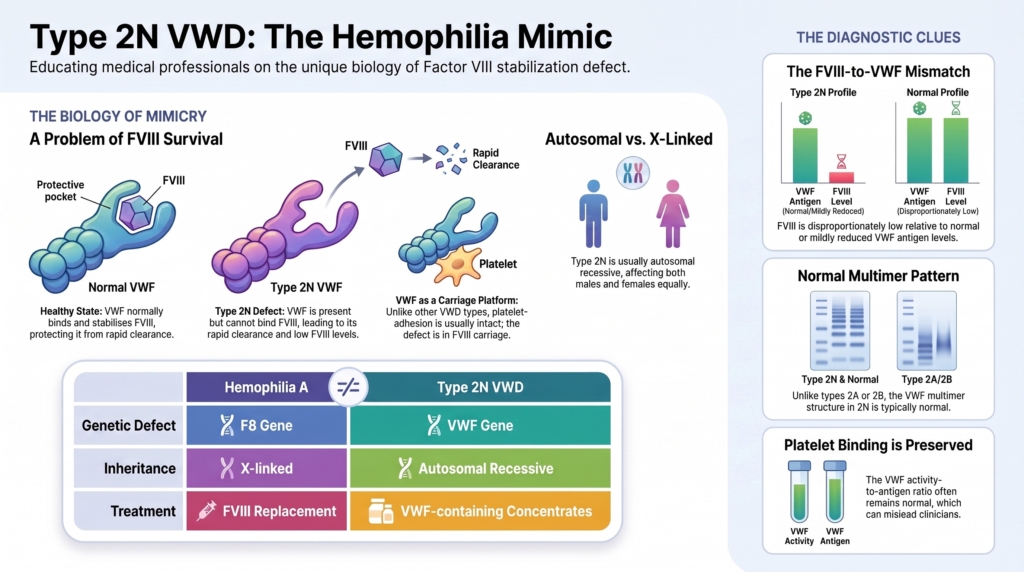
Most learners are taught that VWF helps platelets stick to injured vessels. That is true, but incomplete. VWF also carries factor VIII. FVIII circulates in plasma in a noncovalent complex with VWF, which protects FVIII from premature degradation and clearance.1
In type 2N VWD, the platelet-adhesion side of VWF may look relatively intact. The problem is that VWF cannot bind FVIII normally. FVIII therefore clears too quickly, and the patient may look as if they have mild hemophilia A.
But the inheritance pattern, family counseling, confirmatory testing, and treatment logic are different. Type 2N teaches one of the most important lessons in the VWD module: VWF is not one function. It is a platform.
What the “N” means
The “N” stands for Normandy. The subtype was recognized in patients with low FVIII who appeared to have hemophilia A, but whose abnormality was impaired binding of FVIII to VWF.
Type 2N is therefore a qualitative VWD subtype. The VWF protein is present, the multimer pattern is usually normal, and platelet-dependent VWF activity may be normal or reduced in proportion to antigen. The key abnormality is FVIII that is disproportionately low because VWF cannot bind and stabilize it normally.2
This is why type 2N can escape the usual mental model of VWD. It may not begin with mucosal bleeding. It may begin with a low FVIII level.
The normal role of VWF in FVIII survival
FVIII does not circulate well alone. In plasma, most FVIII is bound to VWF, and this binding protects FVIII from premature proteolysis and clearance. The FVIII-binding site is located in the D′-D3 region of VWF.3
When that binding site is abnormal, FVIII is not adequately protected. FVIII falls, and the patient may develop bleeding that resembles FVIII deficiency.
Type 2N is not a problem of absent FVIII production. It is a problem of FVIII survival.
Why type 2N mimics hemophilia A
Hemophilia A is caused by deficiency or dysfunction of FVIII itself. Type 2N VWD causes low FVIII because the carrier protein cannot bind FVIII properly. Both conditions can produce reduced FVIII activity, procedure-related bleeding, soft-tissue bleeding when FVIII is sufficiently low, and a prolonged aPTT if FVIII is low enough.
But the diseases are not the same:
- in hemophilia A, the defect is in F8
- in type 2N VWD, the defect is in VWF
- hemophilia A is X-linked
- type 2N VWD is usually autosomal recessive
- hemophilia A primarily asks who carries an F8 variant
- type 2N asks what VWF alleles are segregating
- FVIII replacement corrects the missing factor in hemophilia A
- in type 2N, durable correction often requires VWF capable of stabilizing FVIII
The mimicry is real. So is the distinction.
A different inheritance pattern
Type 2N VWD is typically inherited in an autosomal recessive pattern. Affected patients are often homozygous or compound heterozygous for variants affecting FVIII binding. Sometimes a type 2N allele is inherited with another VWF allele that reduces VWF quantity, making the phenotype more complex.4
This matters clinically. A woman with low FVIII may be assumed to be a hemophilia A carrier. A man with low FVIII may be assumed to have mild hemophilia A. But if the true diagnosis is type 2N, family counseling changes.
A low FVIII result should not automatically be interpreted through an X-linked lens.
The laboratory pattern
The classic type 2N pattern is:
- low FVIII
- VWF antigen normal or mildly reduced
- platelet-dependent VWF activity normal or mildly reduced in proportion to antigen
- normal or near-normal VWF activity-to-antigen ratio
- usually normal multimer pattern
- low FVIII-to-VWF antigen ratio
The key is disproportion. FVIII is lower than expected for the VWF antigen level. In type 1 VWD, FVIII may be low because VWF is low, but FVIII often tracks with the degree of VWF reduction. In type 2N, FVIII is too low for the amount of VWF present.
That mismatch localizes the problem to FVIII binding.
The ratio that matters
In many type 2 subtypes, the platelet-dependent activity-to-antigen ratio is central. In type 2N, that ratio may be normal. The more important relationship is between FVIII and VWF.
A low FVIII:C-to-VWF:Ag ratio should raise suspicion for type 2N, especially when the family pattern does not fit X-linked hemophilia A. But the ratio is a screening clue, not a definitive exclusion test. Some genetically confirmed patients, especially compound heterozygotes with additional quantitative VWF defects, may not follow the classic ratio pattern. When suspicion remains, VWF testing or genetic testing is needed.5
A learner who only remembers “type 2 equals low activity-to-antigen ratio” will miss type 2N.
Confirmatory testing
Type 2N is confirmed by showing impaired binding of FVIII to VWF or by identifying pathogenic VWF variants associated with reduced FVIII binding.
The VWF:FVIII assay directly tests the ability of the patient’s VWF to bind FVIII. It is diagnostically discriminating but is mainly available in specialized laboratories. Genetic testing can identify variants in the VWF regions encoding the FVIII-binding domain, especially the D′-D3 region.6
This is one of the settings where genetic testing can be particularly useful. It can distinguish type 2N VWD from nonsevere hemophilia A, clarify inheritance, guide family counseling, and prevent the wrong diagnostic label from persisting.
When to suspect type 2N
Think of type 2N when:
- FVIII is low but VWF antigen is not proportionally low
- a patient is labeled as mild hemophilia A but the family history does not fit
- both males and females in a family appear affected
- a woman has low FVIII and is assumed to be a hemophilia carrier, but F8 testing is unrevealing
- a man has low FVIII with no F8 variant identified
- the VWF activity-to-antigen ratio is normal, but FVIII is unexpectedly low
- the multimer pattern is normal or near-normal
- bleeding is procedure-related or soft-tissue predominant, with only modest mucosal symptoms
Type 2N is not common, but it matters because missing it changes the explanation.
How type 2N differs from other VWD types
Type 1 VWD is mainly quantitative. VWF antigen and activity are reduced together, and FVIII may be low because less VWF is available to carry it. Type 2N is mainly a binding defect: the amount of VWF may be adequate, but the FVIII-binding site is impaired.
Type 2A, type 2B, and many type 2M variants are primarily disorders of VWF-mediated platelet adhesion or collagen binding. They often show abnormal platelet-dependent activity relative to antigen. Type 2A and many type 2B cases show loss of high-molecular-weight multimers. Type 2B may show thrombocytopenia and enhanced low-dose RIPA. Type 2M generally has preserved multimers with impaired binding.
Type 2N is different. It is a defect in FVIII carriage. The multimer pattern is usually normal, the platelet side may be relatively preserved, and the FVIII side is the clue.
This is why type 2N sits awkwardly inside type 2. It is qualitative VWD, but not mainly platelet-adhesion VWD.
Bleeding phenotype
The bleeding phenotype of type 2N depends largely on the FVIII level. Patients may have:
- easy bruising
- procedure-related bleeding
- postoperative bleeding
- soft-tissue bleeding
- trauma-related bleeding
- mucosal bleeding in some cases
- postpartum bleeding
When FVIII is more substantially reduced, bleeding can resemble mild or moderate hemophilia A. Hemarthrosis is less typical than in severe hemophilia, but low FVIII can shift the phenotype toward deeper tissue bleeding.7
The phenotype may be less classically mucocutaneous than other VWD subtypes. That contributes to diagnostic confusion.
The aPTT clue
The aPTT may be prolonged if FVIII is sufficiently low. But a normal aPTT does not exclude type 2N, because mild FVIII reductions may not prolong the aPTT reliably.
A normal PT and a normal or mildly prolonged aPTT do not settle the diagnosis. If FVIII is unexpectedly low relative to VWF, the clinician should keep asking why.
Treatment logic
Treatment depends on the clinical situation. For minor bleeding or selected procedures, desmopressin may be useful in some patients if it produces adequate and sustained FVIII and VWF responses. But response is mutation-dependent and kinetic. A peak FVIII rise is not enough if FVIII falls too quickly.
For major surgery, significant bleeding, inadequate desmopressin response, or situations requiring sustained correction, VWF-containing replacement is often needed. The goal is not only to raise FVIII. It is to supply VWF capable of binding and stabilizing FVIII.8
Type 2N turns treatment into a kinetic question: what FVIII level is needed, and when?
Why FVIII alone may not be enough
If type 2N is treated as hemophilia A, FVIII replacement may raise the FVIII level transiently. But without normal VWF binding, FVIII survival may be shortened. That may matter for sustained hemostasis.
When replacement is required, VWF-containing concentrate is preferred over FVIII-only products for durable correction because it supplies VWF capable of stabilizing FVIII. In some acute situations, FVIII may still be needed for immediate correction, especially if the chosen VWF product does not provide immediate FVIII rise. But durable planning must address the VWF-mediated stabilization defect.9
The underlying defect is not absent FVIII production. It is failure of VWF to protect FVIII.
Desmopressin: useful only if the response answers the question
Desmopressin releases endogenous VWF and FVIII. In type 2N, the released VWF may still bind FVIII poorly. Some patients may show an adequate FVIII rise. Others may not. Some may peak but fail to sustain levels long enough.
A desmopressin trial should therefore measure both VWF and FVIII over time. The key question is not simply: did VWF rise? It is: did FVIII rise enough, and did it stay high enough for the intended challenge?
Pregnancy and type 2N
Pregnancy raises VWF and FVIII in many individuals, but type 2N requires careful interpretation. A pregnant patient may show improved FVIII levels late in gestation. That does not erase the binding defect.
Delivery planning should consider current FVIII and VWF levels, bleeding history, prior delivery outcomes, neuraxial anesthesia goals, and postpartum decline. After delivery, VWF and FVIII fall toward baseline. If the baseline defect is impaired FVIII binding, postpartum bleeding risk may re-emerge as pregnancy physiology recedes.10
As with other VWD subtypes, pregnancy can improve the numbers without removing the diagnosis.
Genetic counseling
Type 2N is important for counseling because it is usually recessive. An affected patient may have two VWF variants affecting FVIII binding, or one type 2N variant plus another VWF variant affecting quantity.
Family testing may clarify carrier status. Partner testing may matter in selected circumstances, especially if there is consanguinity, family history, or concern for severe VWF genotypes. This differs from hemophilia A counseling. The family question is not only: who carries F8? It is: what VWF alleles are segregating?
Common pitfalls and a practical diagnostic sequence
Type 2N is associated with several recurrent pitfalls:
- mistaking it for mild hemophilia A
- assuming a woman with low FVIII is a hemophilia carrier
- failing to order VWF testing when FVIII is low
- failing to compare FVIII with VWF antigen
- assuming a normal VWF activity-to-antigen ratio excludes type 2 VWD
- not ordering FVIII-binding or genetic testing when the pattern points to type 2N
- using FVIII replacement without recognizing shortened FVIII survival
- ignoring autosomal inheritance because the phenotype looks hemophilia-like
When FVIII is low, ask:
- is there an F8 variant?
- does the inheritance pattern look X-linked?
- what are VWF antigen and platelet-dependent activity?
- is FVIII disproportionately low relative to VWF antigen?
- is the VWF activity-to-antigen ratio preserved?
- is the multimer pattern normal?
- has VWF been tested?
- would VWF genetic testing clarify the diagnosis?
The goal is not to test everyone for type 2N. It is to recognize when the pattern is asking for it.
The bottom line
Type 2N VWD is a qualitative VWF defect in which VWF cannot bind FVIII normally. Because FVIII is not adequately stabilized, FVIII levels are disproportionately low. The resulting phenotype can mimic mild hemophilia A.
The key diagnostic clue is not a low VWF activity-to-antigen ratio. It is a low FVIII level out of proportion to VWF antigen and platelet-dependent activity.
Type 2N is not “VWD that looks like hemophilia” by accident. It is VWD revealing why hemophilia biology depends on VWF.
When FVIII is low, do not ask only whether FVIII is abnormal. Ask whether VWF is failing to protect it.
Clinical synthesis
Type 2N VWD is a qualitative VWF defect in which VWF cannot bind and stabilize FVIII normally. As a result, FVIII is cleared prematurely, producing disproportionately low FVIII levels despite relatively preserved VWF antigen, platelet-dependent activity, and usually normal multimers.
The disorder often mimics mild or moderate hemophilia A, but the biology is fundamentally different. The defect lies in VWF, not F8, inheritance is usually autosomal recessive rather than X-linked, and diagnosis depends on recognizing that FVIII is too low for the amount of VWF present.
The key diagnostic clue is not the VWF activity-to-antigen ratio. A normal ratio does not exclude type 2N because the primary defect is not platelet binding. The important relationship is between FVIII and VWF: is FVIII disproportionately low for the amount of VWF present?
Treatment also follows the biology. Desmopressin may help selected patients only if a trial demonstrates adequate and sustained FVIII responses. When sustained correction is required, VWF-containing replacement is generally preferred because restoring VWF restores the carrier needed for FVIII survival.
Type 2N VWD is uncommon, but it reveals one of the central principles of hemostasis: VWF is not only an adhesive protein. It is also the essential carrier that allows FVIII to survive in the circulation.
When FVIII is unexpectedly low, do not ask only whether FVIII is abnormal. Ask whether VWF is failing to protect it.
Evidence anchor: why type 2N VWD mimics hemophilia A
| Evidence stream | What it shows | Why it matters | Main limitation |
|---|---|---|---|
| FVIII-binding biology | VWF binds and stabilizes FVIII through the D′D3 region; impaired binding shortens FVIII survival despite preserved platelet-binding function.11 | Explains why FVIII can be markedly reduced even when VWF antigen is relatively preserved. | FVIII level alone cannot distinguish type 2N from hemophilia A. |
| Laboratory phenotype | Type 2N typically shows low FVIII with relatively preserved VWF antigen, platelet-dependent activity, and normal multimers.12 | The critical clue is the mismatch between FVIII and VWF, not the activity-to-antigen ratio. | Compound genotypes may produce atypical laboratory patterns. |
| Diagnostic testing | VWF:FVIII-binding assays and targeted VWF genetic testing distinguish type 2N from hemophilia A and clarify inheritance.13 | Correct diagnosis changes counseling and treatment planning. | VWF:FVIIIB assays are available mainly in specialized laboratories. |
| Treatment studies | FVIII responses to desmopressin are mutation-dependent and may not be sustained; VWF-containing concentrates provide more durable FVIII support when replacement is required.14 | Treatment should be guided by FVIII kinetics rather than peak response alone. | Evidence is limited because type 2N VWD is uncommon. |
| Inheritance studies | Type 2N is usually autosomal recessive and may affect both males and females, unlike classic hemophilia A.15 | Family history and inheritance pattern are important diagnostic clues. | Family pedigrees may be incomplete or modified by compound VWF variants. |
Interpretive note: Type 2N VWD is not simply “VWD with low FVIII.” It is a disorder of FVIII carriage. The defining clue is that FVIII is disproportionately low for the amount of VWF present, making type 2N a biologic mimic of mild hemophilia A rather than a disorder of platelet adhesion.
Guideline perspective: how to use the type 2N label
Guidelines help place type 2N into a rational diagnostic sequence. In patients with suspected VWD, initial testing should include VWF antigen, platelet-dependent VWF activity, and FVIII activity. When FVIII is disproportionately low relative to VWF antigen, type 2N should enter the differential, especially if the inheritance pattern does not fit hemophilia A.16
The label is useful because it names the failed function: FVIII carriage. A good type 2N diagnosis should therefore say more than “VWD subtype.” It should specify that the patient has a VWF-mediated FVIII-binding defect, and that management should be based on bleeding history, FVIII level, procedural risk, desmopressin response over time, and need for VWF-containing therapy.
A practical diagnostic statement might read:
“This patient has suspected type 2N VWD: FVIII is disproportionately low relative to VWF antigen, VWF platelet-dependent activity is relatively preserved, multimers are normal, and the family pattern does not fit X-linked hemophilia A. Confirmation should include a VWF:FVIIIB assay and/or targeted VWF genetic testing.”
That sentence does more than name the disorder. It preserves the reasoning that matters.
Reflect & Apply Case
A 22-year-old man is referred with a diagnosis of mild hemophilia A. He has had prolonged bleeding after dental extraction and a postoperative hematoma after appendectomy.
His laboratory results show:
- FVIII activity: 18 IU/dL
- VWF antigen: 78 IU/dL
- platelet-dependent VWF activity: 74 IU/dL
- activity-to-antigen ratio: normal
- multimer analysis: normal
- F8 testing: no pathogenic variant identified
His sister has also had postoperative bleeding and low FVIII.
Questions for reflection:
- Why does this not behave like typical X-linked hemophilia A?
- What is the key laboratory mismatch?
- Why does the normal VWF activity-to-antigen ratio not exclude type 2N VWD?
- What confirmatory testing should be considered?
- How would treatment planning differ if this is type 2N rather than hemophilia A?
- Why might FVIII replacement alone be less durable than expected?
- What counseling issue changes once the diagnosis shifts from hemophilia A to VWD?
Expert synthesis: This patient’s low FVIII with normal VWF antigen and activity reflects a failure of FVIII stabilization rather than FVIII production. The normal VWF activity-to-antigen ratio and normal multimer pattern argue against type 2A, type 2B, and many type 2M variants. The similarly affected sister and absence of an F8 variant support autosomal inheritance. The leading diagnosis is type 2N VWD. Confirmation should include a VWF:FVIIIB assay and/or targeted VWF genetic testing. Management should prioritize VWF-containing therapy when sustained FVIII support is needed, with desmopressin considered only if a trial demonstrates adequate and durable FVIII response.
This case illustrates the central lesson: when FVIII is low, do not ask only whether FVIII is abnormal. Ask whether VWF is failing to protect it.
Test your thinking
A short quiz on type 2N VWD.