
Why naming bleeding matters
Note: The video and audio linked above were generated with the assistance of AI. Clinical accuracy has been reviewed, but no AI-generated content can be guaranteed to be fully error-free.
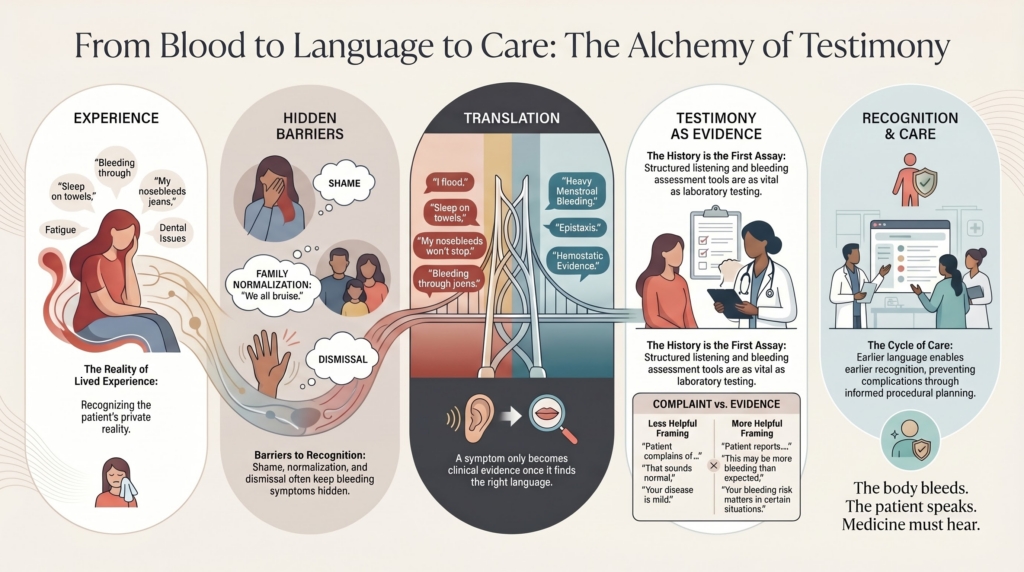
Why this spoke matters
Bleeding is not silent.
But people often are.
A nosebleed can be described. A bruise can be shown. A surgical bleed can be documented. But menstrual blood, postpartum blood, oral bleeding, clots, staining, flooding, and iron-deficiency fatigue may be harder to speak.
Patients may be embarrassed. Parents may normalize. Clinicians may not ask. Families may avoid the topic. Medical forms may compress experience into checkboxes. The result is that bleeding can occur without becoming medical evidence.
In VWD, naming bleeding matters because the history is often the first diagnostic test. In many patients, language comes before laboratory evidence. Bleeding assessment tools formalize this principle by turning concrete bleeding descriptions into structured diagnostic information, though they do not replace clinical judgment.1
The history is often the first diagnostic assay.
If bleeding cannot be spoken, it may not be recognized.
Blood is not just a fluid
Blood carries meaning. It can signal danger, identity, shame, injury, womanhood, childbirth, violence, disease, family history, and loss of control.
In hematology, blood is measured:
- hemoglobin
- ferritin
- VWF activity
- FVIII
- platelets
But patients encounter blood first as experience: on clothes, in sheets, in the sink, in the toilet, on a toothbrush, on dental gauze, after delivery, after surgery.
The laboratory comes later.
Speech comes in between.
Blood becomes clinically useful only after experience becomes language.
Why bleeding can be hard to name
Bleeding may be difficult to name for many reasons. It may be private, messy, repetitive, apparently normal, shameful, associated with sexuality, menstruation, childbirth, or trauma, minimized by family, dismissed by clinicians, or difficult to quantify.
The patient may not know what counts as abnormal. They may not know what words medicine expects. They may say “bad periods” when medicine needs “heavy menstrual bleeding.” They may say “I bruise easily” when medicine needs pattern, size, frequency, and provocation. They may say “I bled a lot” when medicine asks how many pads, how many days, how many clots, whether there was flooding, and whether iron was needed.
A symptom becomes evidence only after it finds language.
The challenge is not only bleeding.
It is translation.
The shame of excess
VWD often produces bleeding that exceeds what the patient thinks should happen: too many nosebleeds, too many bruises, too much menstrual blood, too much bleeding after dental work, too much bleeding after childbirth.
Excess can produce shame. The patient may feel messy, uncontrolled, dramatic, fragile, or different. Shame may suppress disclosure, distort recall, or make the patient describe serious bleeding in minimizing language.
A teenager who bleeds through clothing may remember the humiliation more vividly than the blood volume. A postpartum patient may remember the fear in the room. A child with recurrent epistaxis may remember classmates staring. A patient with bruises may remember explaining that no one hurt them.
The clinical record may say “bleeding episode.” The lived experience may be embarrassment, exposure, and loss of control.
Patient-experience literature in VWD emphasizes stigma, normalization, delayed recognition, and the social and emotional burden of bleeding, especially around heavy menstrual bleeding.2
When silence protects
Silence is not always failure. Sometimes silence protects dignity.
A patient may not want to discuss menstrual blood with a stranger. A teenager may not want a parent in the room. A family may avoid painful birth stories. A patient may not want to be identified by illness. A person may be tired of explaining.
Clinicians should not assume that silence means absence. Silence may mean discomfort, fear, lack of vocabulary, prior dismissal, cultural caution, trauma, or the belief that bleeding is normal.
Good history-taking creates permission. It uses privacy, developmentally appropriate language, and concrete questions without forcing disclosure.
The clinician’s responsibility to ask
In VWD, the clinician must ask concretely.
Not only:
Do you bleed easily?
But:
- Do you have nosebleeds that last more than 10 minutes?
- Do you bruise without clear injury?
- Do your gums bleed with brushing or dental cleaning?
- Have you bled after dental extraction?
- Have you had bleeding after surgery?
- Have you ever needed packing, cautery, transfusion, or return to care?
- How long do your periods last?
- Do you pass clots?
- Do you flood through clothes or sheets?
- Do you need double protection?
- Have you needed iron?
- Did you bleed after delivery?
- Did anyone in your family have heavy periods, postpartum hemorrhage, early hysterectomy, or unusual bleeding?
Specific questions reduce shame. They tell the patient that these forms of bleeding are legitimate topics. Bleeding assessment tools help structure this conversation, but they work best when paired with clinical context, trust, and interpretation.3
The difference between complaint and evidence
Patients often learn that some forms of bleeding are treated as complaints rather than evidence.
Heavy periods may be treated as nuisance. Nosebleeds as annoyance. Bruises as clumsiness. Fatigue as stress. Dental bleeding as local technique. Postpartum hemorrhage as obstetric bad luck.
But in VWD, these events may be diagnostic.
Medicine often rewards measurable findings. VWD frequently begins with testimony. A bleeding history is necessary but not sufficient; its meaning depends on context, reproducibility, laboratory pattern, testing conditions, and prior hemostatic challenges.
A bleeding history is not a collection of complaints. It is a map of hemostasis under stress.
When clinicians treat bleeding as evidence, the patient’s story changes status. It becomes medically useful, actionable, and part of the diagnostic architecture.
The body speaks before the patient can
Many patients with VWD bleed before they have language for bleeding. A child has nosebleeds. A toddler bruises. A girl reaches menarche and floods. A teenager becomes iron deficient. A patient bleeds after wisdom-tooth extraction.
The body speaks first.
The patient learns words later.
Diagnosis often supplies language retrospectively. It lets the patient say:
- that was bleeding
- that was abnormal
- that was connected
- that was not just me
This delay matters. A patient may live for years inside symptoms they cannot yet name. A diagnosis gives language retrospectively.
Menstrual euphemism
Menstrual bleeding often comes wrapped in euphemism: bad periods, heavy flow, accidents, leaks, clots, a rough cycle, problems, being irregular. Euphemism may be personal, familial, cultural, or protective.
Medicine translates these descriptions into “heavy menstrual bleeding.” That phrase is clinically useful. But clinicians must not let the technical phrase erase the lived one.
“Flooding” may carry diagnostic force. “Bleeding through jeans at school” may convey severity better than “menorrhagia.” “Sleeping on towels” may matter more than cycle length alone.
Heavy menstrual bleeding is one of the most important manifestations of VWD and often requires specific, concrete questioning because it may be normalized, private, and recognized late.4
The patient’s language should be preserved, not merely converted.
Family speech and family silence
Families transmit both genes and language. They teach what bleeding is called, what is normal, what should be mentioned, and what should be endured.
A family may say:
- we all have bad periods
- we all bruise
- nosebleeds are normal for us
- childbirth is always rough in our family
No one may say:
this could be a bleeding disorder.
Families transmit both genes and interpretive frameworks. Sometimes family silence protects dignity or avoids painful stories. Sometimes it hides disease. When VWD is diagnosed, speech can change. Family stories become medical history. Silence becomes pattern. Words become prevention.
Naming can create responsibility
Naming bleeding can also create responsibility.
Once VWD is named, the patient may feel responsible for telling dentists, surgeons, obstetricians, relatives, partners, schools, and emergency clinicians.
This can be empowering. It can also be burdensome. A diagnosis gives the patient words, but it also asks the patient to use them repeatedly. The patient may become the messenger of a condition others do not understand.
Responsibility should be shared.
Written plans, procedure letters, emergency instructions, and clinician-to-clinician communication help distribute the burden of making bleeding legible.
When words are not believed
Speech does not always produce recognition.
A patient may name bleeding and still be dismissed. That happens especially when bleeding is private, menstrual, intermittent, or not visible at the appointment.
They may say:
- I bleed through clothes.
- I pass large clots.
- I am exhausted.
- I bled after delivery.
- I always need iron.
- I bruise without injury.
And hear:
- That can be normal.
- Your labs are borderline.
- Your hemoglobin is fine.
- You look well.
- It probably is not serious.
Naming bleeding creates the possibility of recognition.
It does not guarantee it.
Medicine must be willing to receive the words as evidence.
The politics of credibility
Not all patients are believed equally.
Age, gender, race, culture, language, disability, neurodivergence, body size, psychiatric history, and prior medical experiences can shape how bleeding testimony is heard. Short appointments, limited menstrual-health training, fragmented records, and unfamiliarity with VWD can also make disbelief structural rather than purely interpersonal.
VWD sits inside these broader patterns. A teenager may be dismissed as dramatic. A menstruating patient may be told heavy bleeding is expected. A patient with anxiety may have bleeding concerns psychologized. A patient from a family where bleeding is normalized may understate symptoms. A patient who speaks indirectly may be missed by clinicians expecting direct medical language.
Listening is an active clinical skill.
It requires asking, receiving, interpreting, and documenting.
Medical words can help
Medical words can be liberating.
- VWD
- heavy menstrual bleeding
- iron deficiency
- postpartum hemorrhage
- delayed bleeding
- mucocutaneous bleeding
- hemarthrosis
- angiodysplasia
- type 1
- type 2
- type 3
These words organize experience. They allow documentation, treatment, family communication, and planning. They allow patients to say:
this is known.
this has a name.
there is a plan.
A diagnosis can turn shame into explanation.
Language does not merely describe disease.
It organizes it.
Medical words can also harm
But medical words can also narrow or wound.
- mild
- borderline
- low-risk
- normal
- functional
- anxious
- not significant
- unremarkable
These words may be clinically intended. They may also be heard as dismissal. Labels carry emotional as well as clinical meaning.
“Mild” may erase burden or lead to omission of needed procedure planning. “Borderline” may erase legitimacy. “Normal” may erase history. “Not significant” may erase the patient’s experience.
The issue is not that clinicians should avoid precision. It is that precision without context can become harm.
Naming without reducing
The challenge is to name bleeding without reducing the patient to bleeding.
The patient is not fragile. Not defective. Not a diagnosis. Not a laboratory value. Not a bleeding score.
But the bleeding should still be named.
This balance matters. Diagnosis can clarify identity, but it can also constrain it. Patients often want both recognition and freedom. They want clinicians to take the disease seriously without making life smaller.
Good language does both. It says:
your bleeding matters.
your life is larger than your bleeding.
The role of written language
Written language can protect patients.
- a clear note
- a procedure plan
- an emergency letter
- a postpartum plan
- a school letter
- a family communication letter
Written language makes bleeding history portable. It reduces the need for the patient to persuade every new clinician. It transforms speech into record. It also protects clinicians and teams by standardizing communication.
But written language must be clear.
“History of mild VWD” may not be enough.
Better:
Type 1 VWD with prior delayed dental bleeding and heavy menstrual bleeding; DDAVP responsive; use tranexamic acid for minor mucosal procedures; contact hematology before surgery.
Specificity protects.
The speech of children
Children may not have words for bleeding.
They may say:
- I get red stuff.
- My nose leaks.
- My legs are spotty.
- I do not like brushing my teeth.
- I am tired.
- My tummy hurts.
Parents may normalize symptoms. Children may lack vocabulary. Adolescents may have words but not want to use them. They may avoid discussing periods, clots, or blood loss.
Clinicians must create developmentally appropriate language.
The goal is not only diagnosis. It is helping the child become a person who can name risk without shame.
The speech of clinicians
Clinicians also need better language.
Instead of:
Your disease is mild.
Try:
Your bleeding risk is usually manageable, but it can matter with certain challenges.
Instead of:
Your labs are borderline.
Try:
Your levels are near the boundary, so your bleeding history becomes especially important.
Instead of:
That sounds normal.
Try:
Some bleeding is common, but what you are describing may be more than expected.
Instead of:
Your periods are heavy, but lots of people have heavy periods.
Try:
Heavy periods are common, but flooding, clots, iron deficiency, and bleeding through clothes deserve evaluation.
Instead of:
You are fine.
Try:
You are safe for ordinary life, but we should plan before procedures.
Language can change the emotional temperature of care.
When speech becomes advocacy
Patients with VWD often become advocates by necessity.
They teach others how to understand their bleeding. They correct misconceptions. They ask for medications. They remind teams about postpartum risk. They explain why “mild” still needs planning. They tell relatives to get tested.
This advocacy can be powerful. It can also be exhausting.
Advocacy fatigue is real. A good healthcare system should not require every patient to become an expert advocate to receive safe care.
But when patients do speak, clinicians should recognize the expertise in that speech.
Naming as prevention
Naming bleeding can prevent harm by prompting recognition, testing, procedure planning, iron treatment, family evaluation, and anticipatory guidance.
It allows recognition before surgery. It identifies heavy menstrual bleeding before severe iron deficiency. It alerts obstetric teams before delivery. It prompts family testing before a child’s procedure. It turns scattered events into a pattern.
Iron deficiency or anemia should trigger questions about menstrual blood loss, epistaxis, dental bleeding, bruising, and family history, especially in adolescents and menstruating patients.5
In VWD, naming is not merely descriptive. It is part of risk stratification and prevention.
The earlier bleeding becomes language, the earlier it can become care.
The unsaid in the chart
Charts often omit what matters.
They may include:
- menorrhagia
- epistaxis
- easy bruising
- postoperative bleeding
- iron deficiency
But they may omit:
- missed school
- sleeping on towels
- fear of standing up
- blood on clothes
- shame in the classroom
- the mother’s heavy periods
- the grandmother’s hysterectomy
- the dentist who dismissed bleeding
- the emergency physician who did not believe the patient
These omissions matter. They are not all needed in every note. Some details should not be documented verbatim if doing so would embarrass or expose the patient unnecessarily. But if medicine records only the biomedical event, it may miss the human burden.
Clinicians should know more than every note needs to say.
Clinical synthesis
Bleeding must be named before it can be recognized, diagnosed, treated, or prevented.
In VWD, this is especially important because bleeding is often intermittent, private, normalized, family-shaped, or invisible by the time of the appointment. Naming bleeding can transform shame into evidence.
But speech only helps if clinicians are prepared to listen.
The task is not simply to ask whether bleeding occurs. It is to create the conditions in which patients can describe blood honestly, specifically, and without humiliation.
VWD care depends on language. It depends on patient language, clinical language, and documentation language.
VWD is diagnosed partly through laboratory testing.
It is recognized first through language.
The body bleeds.
The patient speaks.
Medicine must hear.
Evidence anchor: why naming bleeding matters in VWD
Summary derived from diagnostic guidelines, bleeding-assessment literature, patient-experience studies, heavy-menstrual-bleeding reviews, quality-of-life data, and iron-deficiency studies. The evidence consistently shows that bleeding must be elicited, described, interpreted, and documented before it can become diagnosis, treatment, or prevention.
| Evidence stream | What it shows | Why it matters | Main limitation |
|---|---|---|---|
| Structured bleeding history | Diagnostic guidance emphasizes integrating bleeding phenotype, family history, laboratory results, and clinical context. Bleeding assessment tools help convert patient-reported bleeding into structured diagnostic information, but they do not replace judgment.6 | VWD often begins with testimony. The history may be the first diagnostic assay. | Bleeding symptoms are common, subjective, and influenced by prior hemostatic challenges and treatment. |
| Patient experience and stigma | Patient-experience literature describes stigma, normalization, delayed recognition, difficulty naming vaginal bleeding, and social and emotional burden, especially among women and girls with VWD.7 | Shame and normalization can prevent bleeding from becoming medical evidence. | Qualitative and QoL studies may not define diagnostic thresholds or treatment decisions by themselves. |
| Heavy menstrual bleeding language | HMB may be described as flooding, leaks, clots, bleeding through clothes, sleeping on towels, missed school, or “bad periods.” HMB is often private, normalized, and recognized late.8 | Patient language may carry diagnostic force and should be preserved, not merely converted into “menorrhagia.” | HMB is multifactorial and requires both gynecologic and hemostatic interpretation. |
| Iron deficiency as downstream evidence | Iron deficiency and fatigue are common in adolescents and women with bleeding disorders and VWD-associated HMB. Cohort data show HMB, iron deficiency, iron deficiency anemia, and treatment needs remain common in women with VWD.9 | Anemia or iron deficiency should trigger questions about menstrual blood loss, epistaxis, dental bleeding, bruising, and family history. | Iron deficiency is not specific to VWD and should be interpreted in clinical context. |
| Family language and normalization | Families may describe inherited bleeding as “bad periods,” “nosebleeds,” “bruising,” postpartum hemorrhage, hysterectomy, or “bad bleeders” before anyone names VWD.10 | Families transmit interpretive frameworks as well as genes. Shared symptoms can obscure shared pathology. | Family stories may be incomplete, inaccurate, normalized, or due to other causes. |
| Written plans and documentation | Management guidance emphasizes individualized planning for procedures, HMB, pregnancy/postpartum care, antithrombotic therapy, and emergency situations.11 | Clear written language makes bleeding history portable and reduces the burden on patients to persuade each new clinician. | Documentation must balance clinical specificity with privacy and dignity. |
Interpretive note: These evidence streams support the essay’s central claim: language is part of the diagnostic pathway in VWD. Bleeding becomes clinically useful when patients are given permission to describe it, clinicians know how to ask, and the record preserves enough specificity to guide care.
Communication guidance: turning bleeding into evidence without shame
Based on diagnostic guidance, patient-experience literature, HMB reviews, iron-deficiency studies, and management recommendations.
Ask concretely
Instead of asking only, “Do you bleed easily?”, ask:
- How long do nosebleeds last?
- Do you bruise without clear injury?
- Do your gums bleed with brushing or dental cleaning?
- Have you bled after dental extraction?
- Have you bled after surgery?
- Did you need packing, cautery, transfusion, iron, emergency care, or return to care?
- How many days do your periods last?
- How many heavy days?
- Do you pass clots?
- Do you flood or bleed through clothes or sheets?
- Do you need double protection?
- Have you needed iron?
- Did you bleed after delivery or miscarriage?
- Does anyone in your family have heavy periods, postpartum hemorrhage, hysterectomy for bleeding, recurrent nosebleeds, or unusual bleeding?
Listen for patient language
Preserve phrases that carry clinical meaning:
- “I flood.”
- “I sleep on towels.”
- “I bleed through jeans.”
- “I pass clots.”
- “I always need iron.”
- “My nosebleeds do not stop.”
- “We all have bad periods.”
- “The dentist said I bled more than expected.”
These are not merely colorful descriptions. They may be diagnostic clues.
Interpret carefully
- A bleeding history is necessary but not sufficient.
- HMB may be gynecologic, hemostatic, or both.
- Iron deficiency is a clue, not a diagnosis.
- Family history supports suspicion but does not prove VWD.
- A normal or borderline VWF panel does not automatically erase a consistent bleeding history.
- A bleeding assessment tool structures listening but does not replace clinical judgment.
- Patient testimony should be interpreted with laboratory pattern, testing conditions, prior hemostatic challenges, and treatment history.
Use language that legitimizes without reducing
Instead of:
“That sounds normal.”
Try:
“Some bleeding is common, but what you are describing may be more than expected.”
Instead of:
“Your hemoglobin is fine.”
Try:
“Your hemoglobin is reassuring, but ferritin and bleeding history still matter.”
Instead of:
“Your disease is mild.”
Try:
“Your bleeding risk is usually manageable, but it can matter with certain challenges.”
Instead of:
“Your labs are borderline.”
Try:
“Your levels are near the boundary, so your bleeding history becomes especially important.”
Instead of:
“You are being anxious.”
Try:
“Your concern may reflect what happened before. Let’s use that history to plan.”
Document with enough specificity
Avoid:
“Mild VWD.”
Better:
“Type 1 VWD with prior delayed dental bleeding and heavy menstrual bleeding; DDAVP responsive; tranexamic acid effective for mucosal bleeding; contact hematology before surgery.”
Avoid:
“Menorrhagia.”
Better:
“Menses 9 days, flooding, clots, bleeding through clothes, ferritin 8 ng/mL, missed school.”
Avoid:
“Family history positive.”
Better:
“Mother with heavy menstrual bleeding and iron deficiency; maternal grandmother hysterectomy at 38 for bleeding; aunt postpartum hemorrhage.”
Practical takeaway: Naming bleeding is clinical work. The goal is not to make patients perform their suffering convincingly. It is to ask well enough, listen carefully enough, and document clearly enough that private bleeding can become recognition, planning, and care.
Reflect & Apply Case
A 16-year-old girl is referred for “anemia.”
She answers “no” when asked if she has a bleeding disorder.
When asked more specifically, she reports periods lasting 9 days, clots, flooding through clothes at school, sleeping on towels, recurrent nosebleeds, and gum bleeding after dental cleaning.
She says:
“I thought this was just gross, not medical.”
Questions for reflection:
- Why did the first question fail?
- What changed when the clinician asked more specific questions?
- How did shame affect the patient’s ability to name bleeding?
- Why is “anemia” an incomplete description of the problem?
- What language should be preserved in the medical record?
- How can diagnosis transform embarrassment into evidence?
- What does this case teach about speech as part of clinical care?
This case illustrates the central lesson:
blood becomes medically meaningful when someone is given permission to name it.
Test your thinking
A short quiz on how bleeding becomes evidence in VWD.