
For Your Healthcare Providers
Have your patient scan this QR code with their smartphone camera to instantly access this educational guide on their device.

A brief guide for patients with anemia and smaller than normal red blood cells
Access the Resources
Note: The video and audio linked above were generated with the assistance of AI. Clinical accuracy has been reviewed, but no AI-generated content can be guaranteed to be fully error-free.
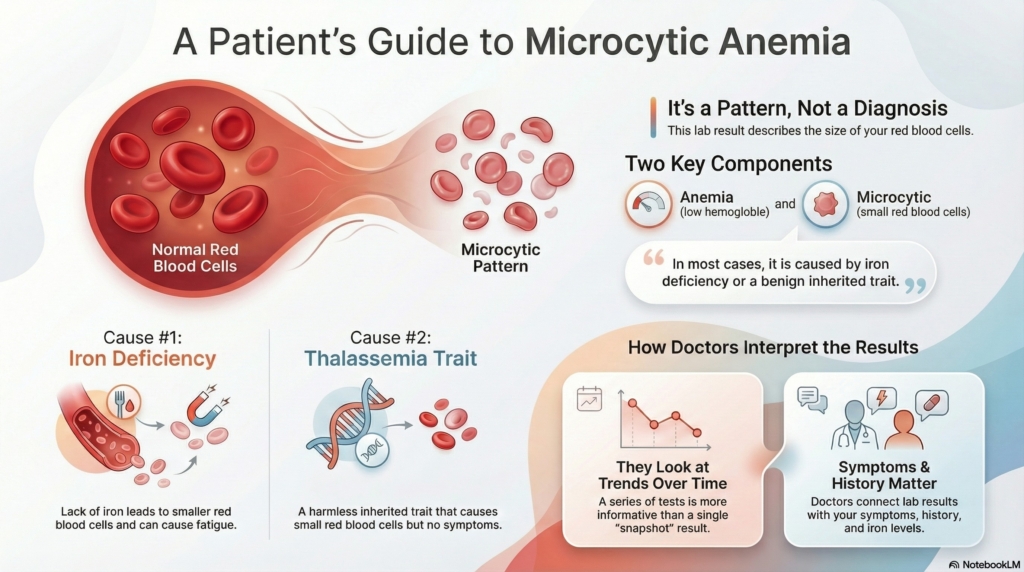
Microcytic anemia is a common pattern on blood tests.
In most cases, it is caused by iron deficiency or a benign inherited trait.
Having microcytic anemia does not automatically mean a serious blood disorder.
Doctors focus on patterns, symptoms, and changes over time to understand what this finding means for you.
This guide applies to outpatient evaluation and does not apply to emergency or rapidly worsening illness.
First things first
Not all anemia is the same.
Microcytic anemia describes the size of red blood cells, not the cause. In this pattern, red blood cells are smaller than usual, but the reason for that matters more than the label itself.
Understanding why red blood cells are small helps guide the next steps.
What is microcytic anemia?
Microcytic anemia means:
- hemoglobin or hematocrit is low, and
- red blood cells are smaller than usual
Red blood cell size is measured by the mean corpuscular volume (MCV). When the MCV is below the usual range, anemia is described as microcytic.
This pattern helps doctors narrow the most likely causes.
The most common causes
For most people, microcytic anemia is due to one of two reasons.
Iron deficiency (most common)
Iron is required to make hemoglobin. When iron levels are low, red blood cells become smaller and carry less oxygen.
Iron deficiency may be related to:
- menstrual blood loss
- gastrointestinal blood loss (which may be hidden)
- increased iron needs (such as during pregnancy or growth)
- reduced iron absorption or dietary insufficiency
Iron deficiency is treatable, and further evaluation helps identify the cause.
Thalassemia trait (a normal variant)
Thalassemia trait is an inherited pattern of red blood cell production. It is not a disease and usually causes no symptoms.
In thalassemia trait:
- red blood cells are small
- the body often makes more red blood cells to compensate
- hemoglobin levels are often near normal or only mildly low
This pattern has usually been present for most of a person’s life and does not require treatment. Family members may have similar blood test patterns if they are tested.
Less common causes
Less commonly, microcytic anemia can be related to chronic inflammation or other medical conditions.
Doctors consider these possibilities when iron deficiency and thalassemia trait do not explain the pattern.
How doctors tell the difference
Iron deficiency and thalassemia trait can look similar on a blood count, but doctors use patterns to distinguish them.
They may look at:
- iron studies, including ferritin (which reflects iron stores)
- the number of red blood cells relative to their size
- whether anemia is new or long-standing
- family history or ancestry patterns
- changes over time
In some cases, additional testing helps confirm the diagnosis.
Symptoms: present or absent
Some people with microcytic anemia feel well, especially when anemia is mild or develops slowly.
Iron deficiency may cause symptoms such as:
- fatigue
- shortness of breath with exertion
- reduced exercise tolerance
- symptoms related to low iron stores
Thalassemia trait typically causes no symptoms, even when red blood cells are quite small.
Snapshot vs movie
A blood test shows a snapshot at one point in time.
Doctors care more about:
- trends over time
- stability versus progression
- how lab results align with symptoms
This is why repeat testing is common and often reassuring.
How this page fits with the rest of your results
This page explains what microcytic anemia means as a pattern.
Your doctor may also point you to more focused information, such as:
- iron deficiency
- iron studies and ferritin
- inherited red blood cell traits
Each builds on the same idea: the pattern guides where to look next.
Key takeaways
- what it means: microcytic anemia is anemia with small red blood cells
- what it is not: it describes a pattern, not a diagnosis
- most common causes: iron deficiency and thalassemia trait
- important reassurance: thalassemia trait is a benign inherited variant
- how symptoms behave: symptoms depend on the cause and severity
For clinicians: Read our detailed guide on how to communicate about microcytic anemia to patients.